
AI payment reminder calls for collection agencies work when each debt gets few, well-timed calls. Regulation F presumes a collector is within limits at seven calls in seven days per debt, with a quiet week after a conversation. The agency's own list keeps that count across every campaign and redial.
Key Takeaways
- Count calls per debt in your own list, across every campaign.
- A conversation starts a seven-day quiet period for that debt.
- Split lists by time zone, since each campaign keeps one clock.
This post is part of our guide to AI debt collection software for agencies, where your own list enforces the call limits. Below, we cover the call count, calling hours, stop requests and tone. Along the way, we show how the campaign runs in Dograh, the open-source AI voice agent platform we build.
What makes a reminder feel like harassment
A reminder starts to feel like harassment when it comes too often or keeps coming after someone asked you to stop. The complaint record shows both, plus a smaller count about calling hours. In the first ten months of 2026, the CFPB's complaint database logged 3,571 debt collection complaints about frequent or repeated calls, 2,680 from people who told a collector to stop and kept getting contacted, and 325 about calls before 8 a.m. or after 9 p.m.
The law draws the same lines. The Fair Debt Collection Practices Act (FDCPA) bans calling someone again and again with intent to annoy or harass them, and Regulation F turns that into a number you can count against.
Many reminders never get picked up at all. Hiya's State of the Call survey of more than 12,000 consumers in six countries found that 86% of calls from unknown numbers go unanswered. A reminder that rings out is still an attempt, so an unanswered campaign can use up a week's limit without one conversation.
This post covers reminders after an account reaches an agency. Calls before a bill is overdue are a different job, covered in our post on payment and bill reminders.
Counting calls per debt
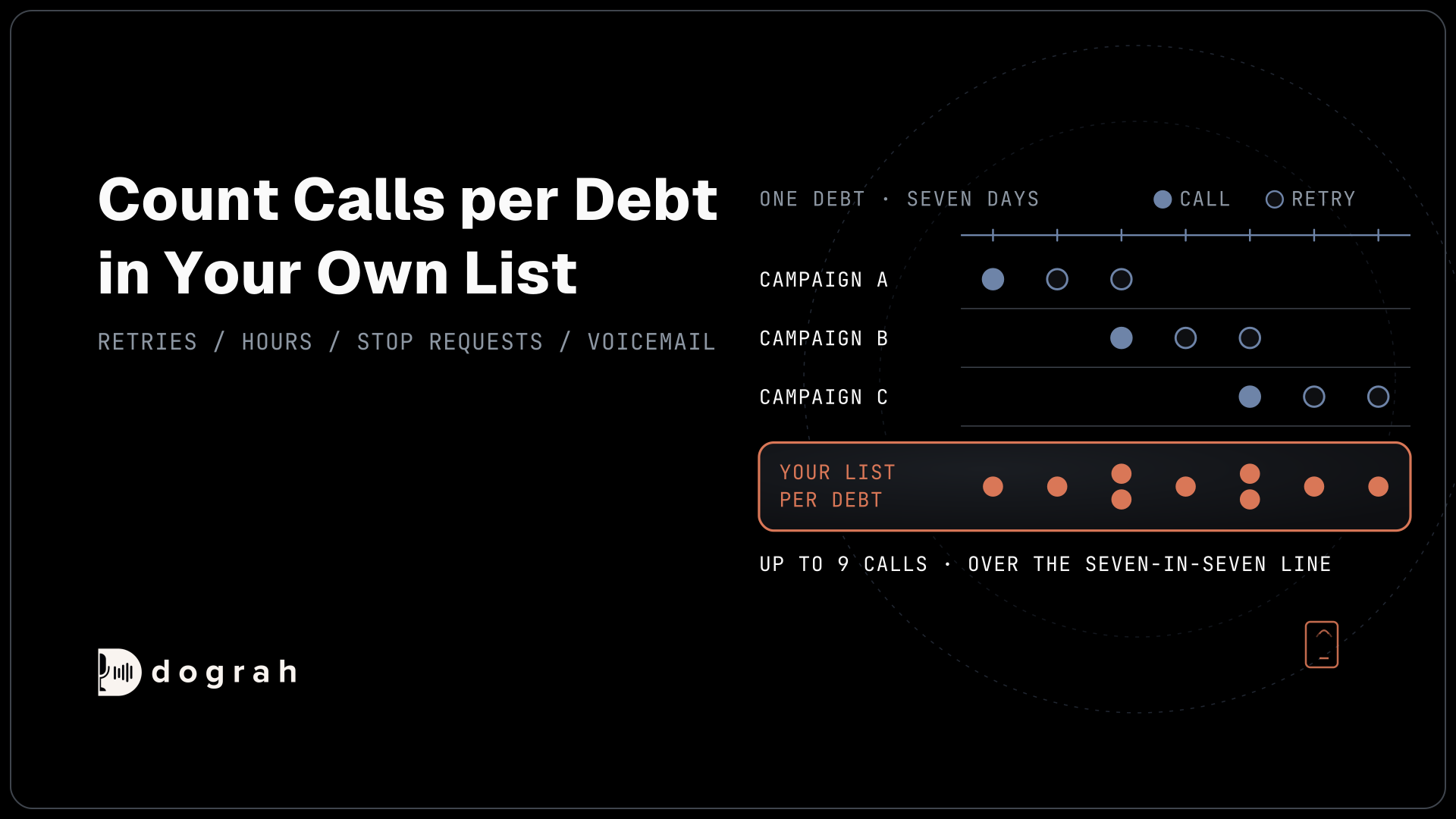
The limit runs per debt, across every campaign that touches it. Regulation F's call-frequency rule presumes a collector is within limits if it calls about a debt no more than seven times in seven days. A phone conversation about the debt starts a seven-day quiet period. Calls the person agreed to are left out of the count, and so are calls that never connect to the number. A call that rings and goes unanswered does count.
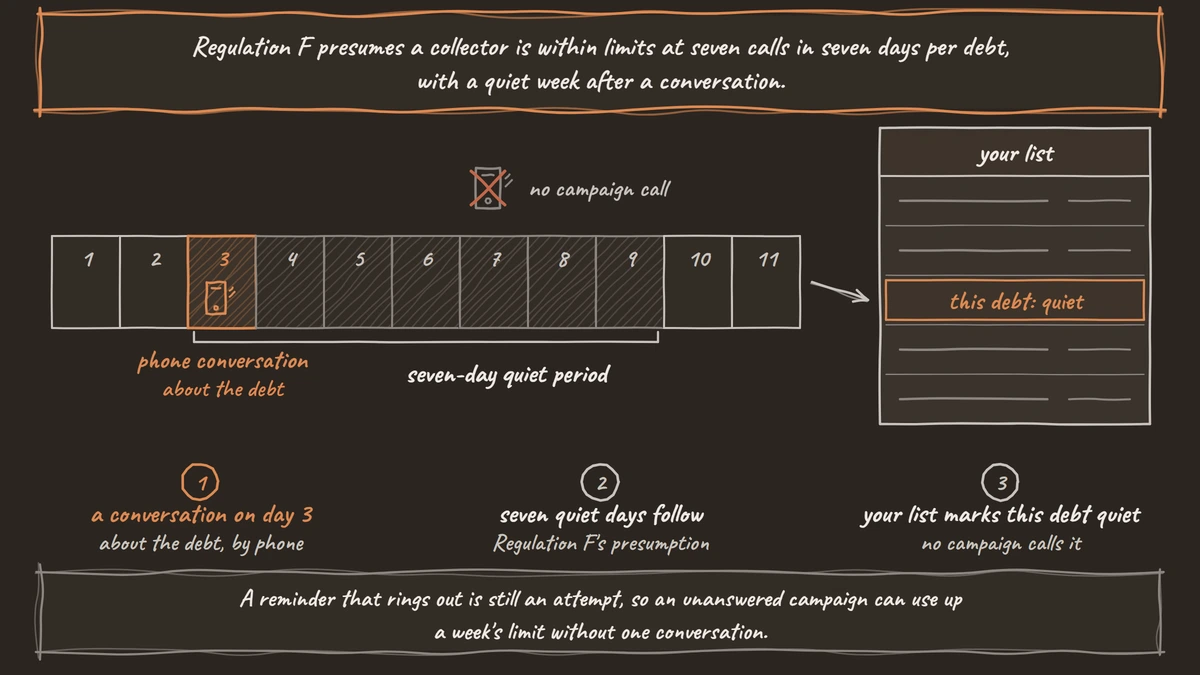
The numbers add up faster than they look. Three campaigns in one week, each with 2 retries, can place up to 9 calls about one debt, over the seven-in-seven line. Nothing inside any single campaign looks wrong.
A Dograh campaign stops calling a contact once a call is answered, but it does not count calls across campaigns. You set the retries (0 to 10), the delay between them and which results trigger a retry: Busy Signal, No Answer or Voicemail. A finished campaign can be redialed once for contacts that went to voicemail, got no answer or were busy, and those calls count too. Retries count inside one campaign only, so your own list keeps the per-debt total and leaves a consumer out of the next upload once they reach it, or you set retries to 0.
Some reminder playbooks use a fixed calendar, such as day 1, 7, 14 and 30. A calendar has no idea a conversation happened on day 3, so the count has to come from your list. Our post on compliance-safe collection disclosures covers the notice each of those calls still has to carry.
Campaigns also have a brake for failing calls. The Circuit Breaker is on by default for a new campaign. It pauses the campaign when half the calls in a 2-minute window fail, once at least 5 have ended, or at once if a model provider rejects your key or billing. Busy and no-answer results from the carrier do not count. You fix the cause and press Resume.

Open Source Alternative to Vapi / Retell
Self-hosted voice agent platform — no per-minute fees
dograh-hq/dograh
Star on GitHub
Calling hours and time zones
Calling hours follow the consumer's clock. Calls before 8 a.m. or after 9 p.m. at the consumer's location are presumed inconvenient under Regulation F.
A Dograh campaign's Call Schedule runs in one Timezone, UTC unless you change it, with calling windows by weekday. A national list in one campaign will reach someone at the wrong hour. Split the list by time zone and give each part its own campaign and window, and turn on Call Schedule before the campaign starts.
Work out each consumer's time zone from account data such as a billing address. An area code stays with the number when people move. Our post on AI voice agents for debt collection covers that case and the overlap rule when the two disagree.
Stop requests and voicemail
A request to stop is recorded on the call and remembered by your list. Under Regulation F, a person who asks not to be called by phone must not be called that way again. Under the FCC's rules for the Telephone Consumer Protection Act (TCPA), a person can withdraw consent in any reasonable way, and the caller has ten business days to honor it.
Inside one campaign, each contact gets one answered call, and retries happen only on busy, no answer or voicemail. So a person who says "stop calling me" is not called again by that campaign. The agent records the outcome as the built-in do_not_call Call Disposition, which goes out in the call data and webhooks, and your system removes the number from every later list.
Voicemail handling is off by default. Turn it on and set "When voicemail is detected" to Leave a message, and the agent plays one fixed message. Write it as a limited-content message, with a business name that does not reveal debt collection, a request to call back and a number. State rules can add to these, so confirm your own process with counsel before the first reminder campaign.
Join the Dograh Community
Dograh is an OSS alternative to Vapi. Join our Slack community for queries, releases, best practices & community interactions.
A reminder that sounds human
A reminder that sounds like a person gets heard out. Pre-recorded audio lets the fixed lines play in a real collector's voice, and text-to-speech fills in names, dates and amounts. The agent picks a recorded clip when one fits and falls back to text-to-speech when none does.
Running costs depend on where the agent runs. Self-hosted Dograh has no per-minute platform fee, but servers, model keys and phone minutes still cost money. Dograh Cloud charges a 1¢-a-minute platform fee.
Test the wording before you scale it. A campaign's traffic split sends set shares of contacts to up to 5 agent versions, with results for each, so two reminder scripts can run on one list. Then read the calls. QA scores each step of a call and can flag pressure or any mention of legal action, so set its sample rate to 100% for the first campaigns.
Glossary
- Seven-in-seven line
- Regulation F's test for call frequency: no more than seven calls about a debt in seven days, and none in the seven days after a phone conversation about it.
- Quiet week
- The seven days after a phone conversation about a debt, during which Regulation F's presumption expects no further calls about that debt.
- Limited-content message
- A voicemail that leaves only a business name that does not reveal debt collection, a request to call back and a number, so anyone who plays it learns nothing about the debt.
- Traffic split
- A campaign setting that sends set shares of contacts to up to 5 agent versions, so two reminder scripts can be compared on one list.