
AI voice agents for solicitors and law firms in the UK answer out-of-hours enquiries, take the names a solicitor needs for the conflict check, book consultations and put urgent calls through to the duty solicitor. They never say the firm can act. Dograh, the open-source voice agent platform, runs one self-hosted or on Dograh Cloud.
Key Takeaways
- An enquiry that rings out at 7pm can become another firm's client.
- The agent collects party names, and a solicitor runs the conflict check.
- Client data stays in the UK only with the platform and models there.
A caller who rings at 7pm about a dismissal or a divorce may not wait until morning. This post covers taking the enquiry, the conflict check, booking, out-of-hours calls, the SRA and PECR rules, and where the call runs, with each part shown working in Dograh.
The enquiry that rings out at 7pm
Someone who has just been dismissed, or just been served with papers, often looks for a solicitor that same evening. If your line goes to voicemail, they ring the next firm on the list.
Small firms feel this most. The SRA's firm statistics count 8,899 regulated firms, and 1,306 of them, 14.7%, are sole practitioners. A sole practitioner in a hearing all day has no one on reception at 7pm.
A voice agent answers that call, takes the enquiry and books the first consultation, and leaves every legal judgement to a solicitor. Everything it collects ends in the firm's own system, and none of it decides anything about the matter.
Taking the enquiry without giving advice
The agent collects facts, and the words that carry legal weight are fixed in advance. The call opens with the Greeting Text on the Start Call node, which is fixed text spoken word for word. It carries the firm's name and a recording notice. If you want to tell callers they're speaking with an automated assistant, write it in the Greeting Text along with the firm's name. Allow Greeting Interruption is on by default, so switch it off on that node and the whole opening plays.
The agent then asks for the caller's name and contact details, the area of law, a short account of what happened and any date that matters, such as when a dismissal took effect. It records each answer as the caller stated it. Each answer the agent writes down passes through the model, so the transcript and the recording are where the exact words live.
One sentence the agent never says, in any form: "you have a case." A prompt cannot guarantee that, because models avoid a banned phrase and still deliver its meaning. Exact wording holds only where Dograh plays fixed text, which means the greeting and a pathway's Transition Speech. So the agent closes every enquiry the same way: a solicitor will review it and call back.
An HTTP API tool writes the enquiry to the firm's case management system during the call, and a Webhook node sends the outcome and transcript link afterwards. Our guide to AI voice agents for law firms covers the US version of these calls and the practice system behind them.
Names for the conflict check
A conflict check needs names, and a solicitor makes the decision.
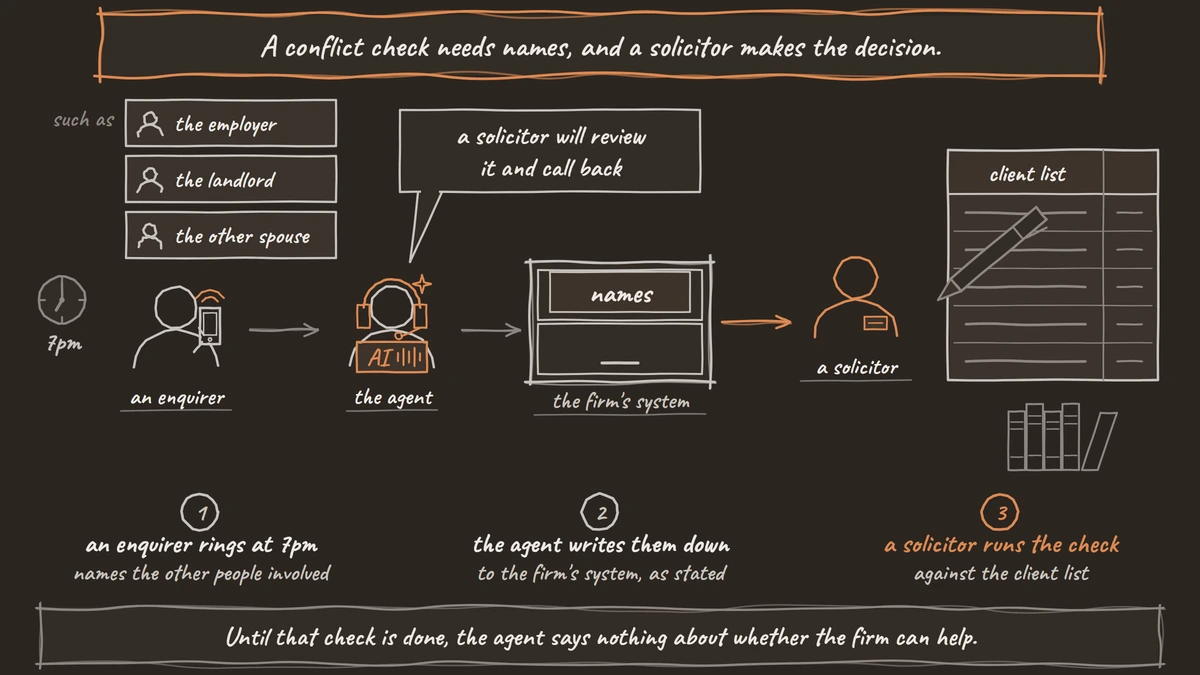
The SRA Code of Conduct for Solicitors says a solicitor does not act where there is a conflict of interest. It also requires the affairs of current and former clients to be kept confidential. So the agent asks for the names of the other people involved, such as the employer, the landlord or the other spouse, and writes them to the firm's system. A solicitor runs the check against the client list.
Until that check is done, the agent says nothing about whether the firm can help. It doesn't mention other clients, and it never confirms that someone is or was a client of the firm. An enquirer is not yet a client, but the same care with their details is generally what the Code expects of a firm.
Names come out of speech-to-text, which can mishear them. Add common surnames in your area and local business names to the Dictionary in the agent's Settings, and have the agent spell back any name it isn't sure of.

Open Source Alternative to Vapi / Retell
Self-hosted voice agent platform — no per-minute fees
dograh-hq/dograh
Star on GitHub
Booking and out-of-hours calls
Booking runs from the firm's own calendar, and urgent calls go to a person. For a first consultation, a tool reads open slots from the firm's calendar, the agent offers two, and a second tool writes the booking back once the caller agrees. The agent reads the date and time back before ending the call. When an existing client calls about a matter, the agent confirms identity first with a check the firm approves, such as date of birth plus a reference the firm gave them. A matching phone number pulls up a record, but it proves nothing about who is on the line.
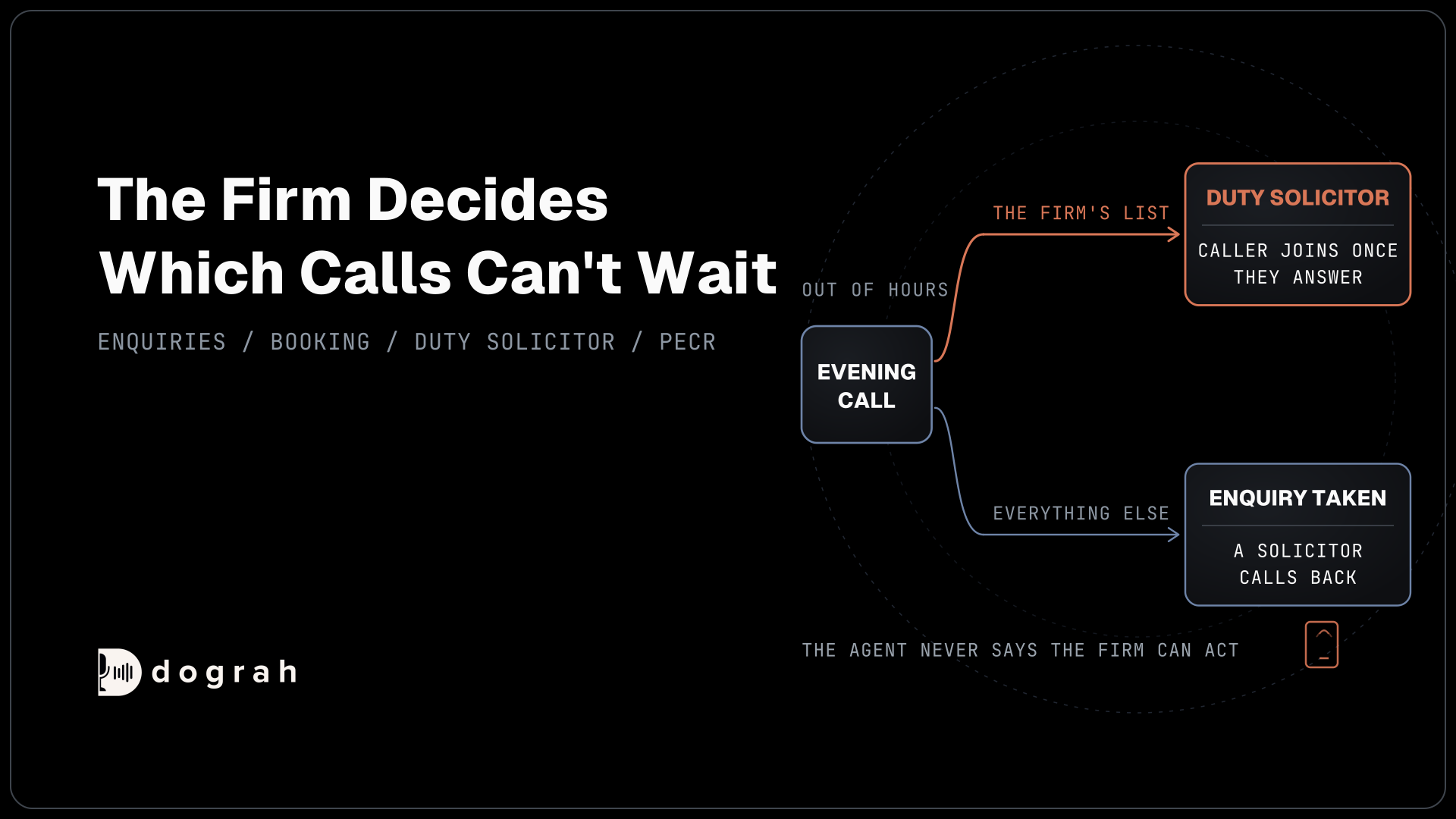
Out of hours, some calls can't wait for the morning, and the firm decides which ones. Transfer Call hands those callers to the duty solicitor, and it works on Twilio, Telnyx, Plivo, Cloudonix and Asterisk ARI. Dograh calls the duty solicitor first and connects the caller only when someone answers. The agent writes the details to the firm's system before the transfer, because no summary travels with the call by default.
If nobody answers within the timeout, 30 seconds by default, the caller stays with the agent, which writes a callback request to the firm's system. Some evening callers are in danger, such as someone leaving an abusive home. For them a fixed Transition Speech line plays: "If you are in danger, get to safety and call 999."
SRA and PECR rules for calls out
For a UK firm, the SRA settles most outbound calling before the marketing rules do. The same SRA Code says solicitors do not make unsolicited approaches to members of the public to advertise legal services, except to current or former clients. An outbound AI campaign to people who never contacted the firm is generally ruled out by that line alone. Calling back someone who rang the firm and asked to be called is a different matter, because they started the contact.
Calls that carry no promotion are simpler still. The ICO's guidance on live marketing calls says purely administrative service calls, such as confirming a booked consultation, are not direct marketing. Add an offer to that call and it becomes a marketing call under the Privacy and Electronic Communications Regulations (PECR).
The stakes are real. The ICO can now fine PECR breaches up to £17.5 million or 4% of global turnover. Keep reminders and callbacks free of offers, and confirm your position with your compliance officer (COLP), counsel or a data protection adviser.
Join the Dograh Community
Dograh is an OSS alternative to Vapi. Join our Slack community for queries, releases, best practices & community interactions.
Where the call runs and what the SRA expects
Hosted intake products say they are compliant, and the SRA asks a narrower question about where client information sits and who handles it. The SRA's guidance on confidentiality of client information treats storing data with a third party in the cloud as outsourcing. Firms need arrangements that protect client information, and they have to consider where it is held, including abroad. A hosted voice platform is one such arrangement, and so is each speech and language model provider that hears the caller.
For a firm, Dograh handles orchestration, meaning the call flow, the tools and the telephony, with the speech and language models as a separate layer the firm chooses. Dograh Cloud names no UK data region. Self-host the platform in a UK data centre with Docker, and recordings, transcripts and call records stay there. Client data stays in the UK only when the models run in that data centre too. Our post on on-prem voice AI for law firms sizes those servers.
If the firm self-hosts, call recording is turned on or off server-wide, and transcripts are kept in both cases. The firm deletes old recordings through its own retention process. Every call has a full trace of what the agent heard and said, and QA scores a sample of calls you choose, which is how a supervisor finds the call where the agent drifted towards advice. Self-hosted Dograh has no per-minute platform fee, but servers, model keys and phone minutes still cost money. Dograh Cloud charges a 1¢-a-minute platform fee.
Where to start
Start with the out-of-hours enquiry line, because those calls go unanswered today. Write the greeting and the closing line first, decide which calls go to the duty solicitor, and test the transfer on a real phone call before going live. Add consultation booking once the enquiries land cleanly in your system.
Glossary
- SRA Code of Conduct
- The Solicitors Regulation Authority's rules for solicitors in England and Wales, covering confidentiality, conflicts of interest and approaches to the public.
- Conflict check
- A solicitor's check that acting for a new client would not clash with a current or former client's interests. The agent collects the names, and the solicitor runs the check.
- Unsolicited approach
- Contacting a member of the public who did not ask to hear from the firm, to advertise its services. The SRA Code rules this out except for current or former clients.
- Outsourcing (SRA guidance)
- Any arrangement where a third party handles client information, including cloud storage and hosted services. The firm must make sure the arrangement protects that information.