
An AI receptionist for dental clinics in Canada answers while the team is chairside. It books from the practice system, answers Canadian Dental Care Plan (CDCP) questions from the clinic's own facts, runs reminder and recall calls, and takes after-hours messages in English or French. Dograh, the open-source voice agent platform, runs it self-hosted or on Dograh Cloud.
Key Takeaways
- New CDCP patients bring coverage questions the agent answers from clinic facts.
- Reminders and recall bookings for existing patients generally fall outside telemarketing.
- The clinic's province decides which health privacy law applies to calls.
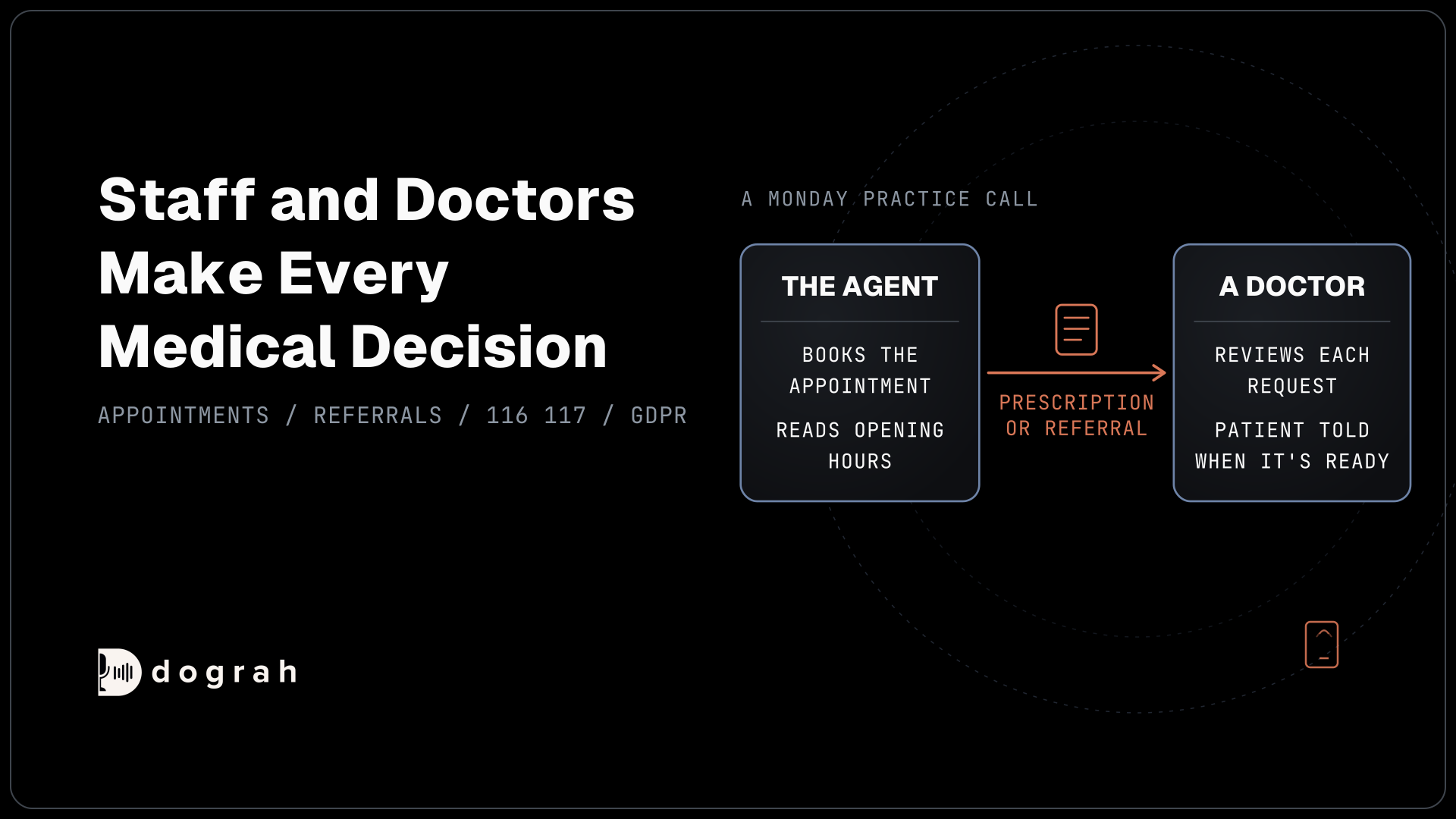
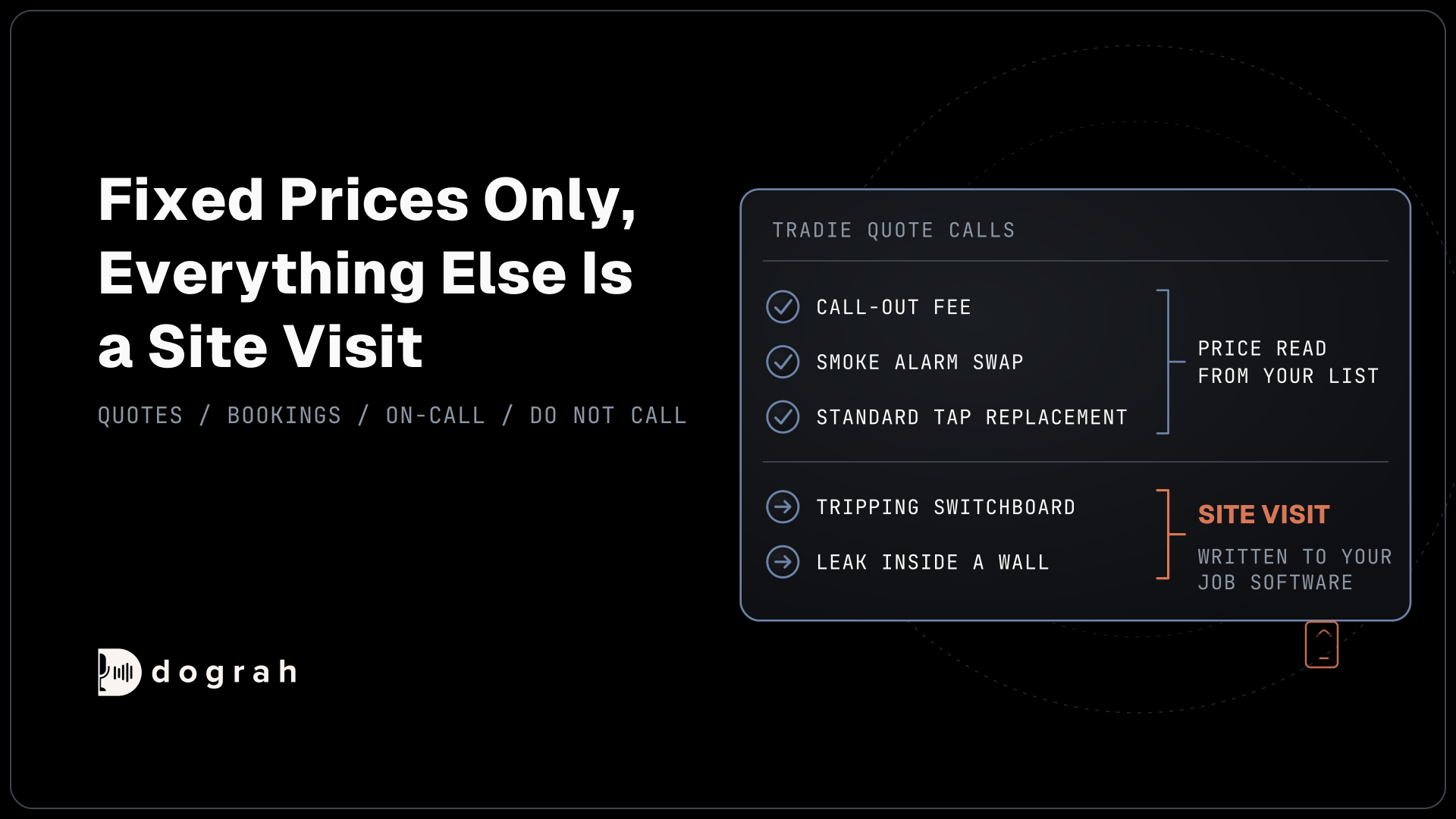
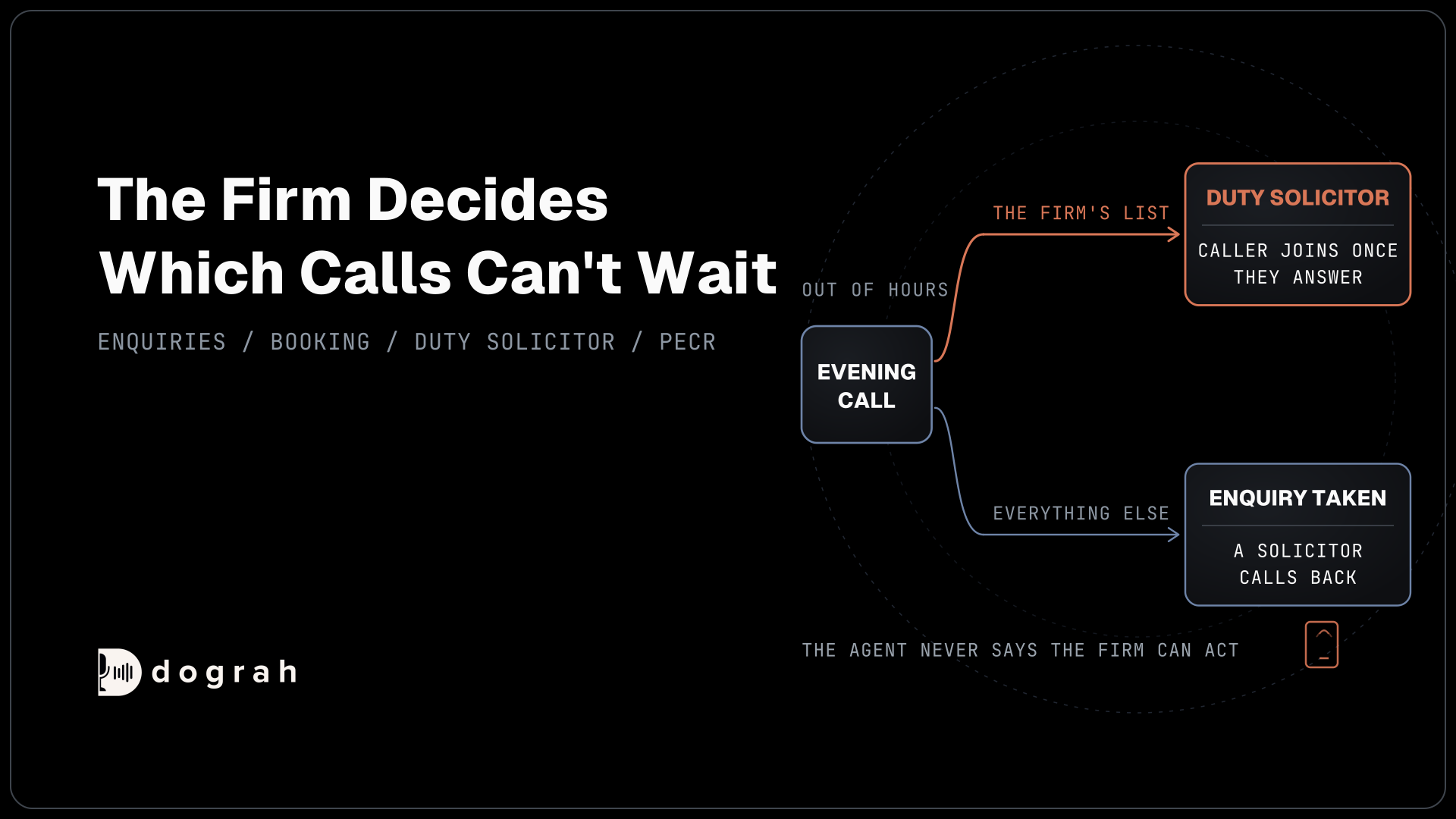
A front desk can't check a patient out and answer the phone at the same time. This post walks through which calls a Canadian clinic can hand to an AI receptionist, how French callers and after-hours pain are handled, and which privacy and do-not-call rules shape the setup.
The phone rings while the hygienist waits
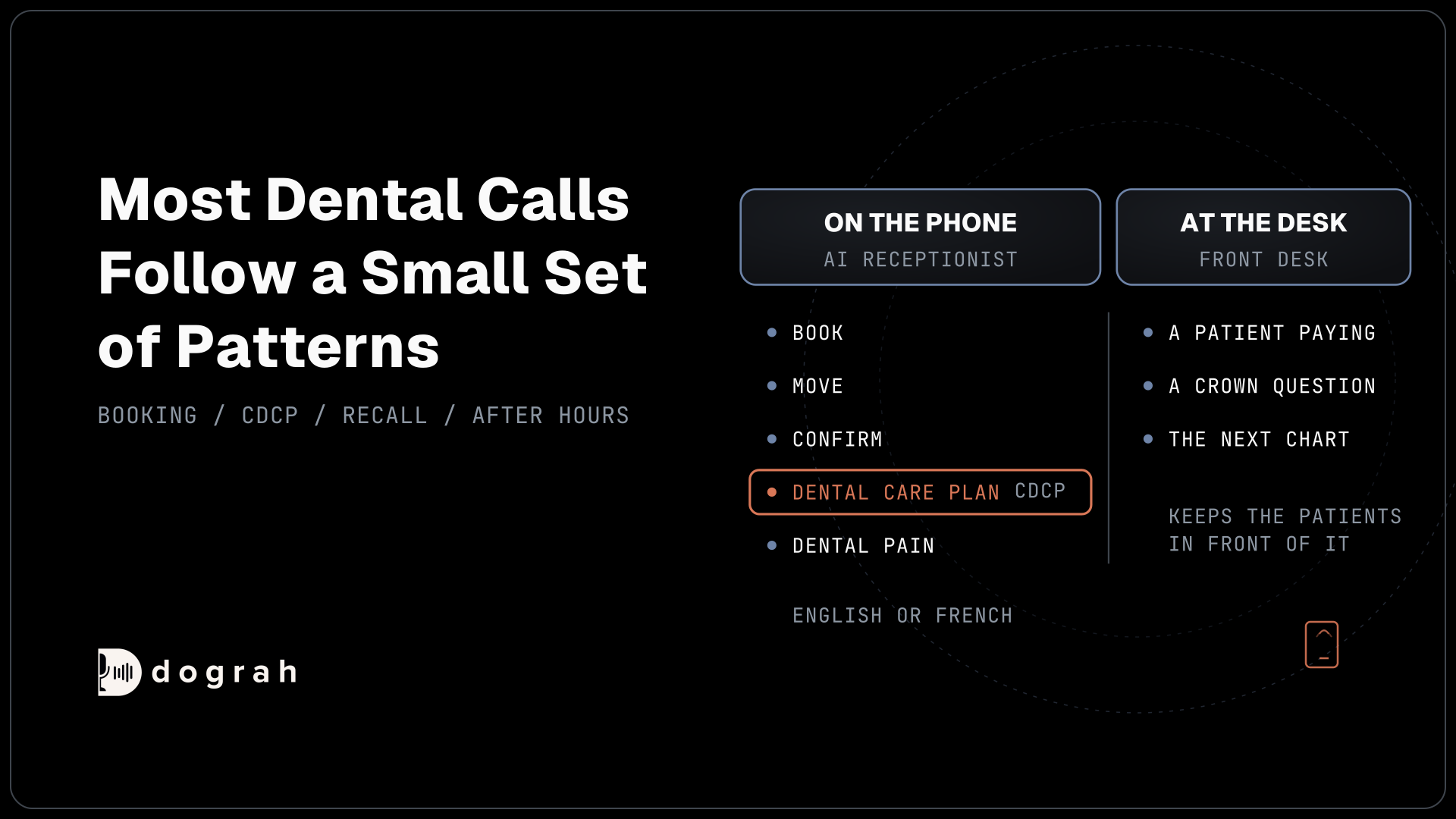
Picture the desk at 10am. One patient is paying, another is asking about a crown, and the hygienist is waiting for the next chart. The phone rings, and it's a new patient asking whether the clinic takes the Canadian Dental Care Plan.
That question has become routine. Government of Canada figures show 5,015,189 people enrolled in the plan for 2026-27, and 29,541 oral health providers taking part, including 25,611 dentists and specialists. Many of those patients are booking a dentist for the first time in years, and they call with questions before they book.
Most of these calls follow a small set of patterns: book, move, confirm, ask about coverage, report pain. An AI receptionist takes the patterns, and the front desk keeps the patients standing in front of it.
Booking and coverage questions
Booking runs through the clinic's own practice management system, and the agent checks who is calling before it names any appointment. An HTTP API tool reads open slots from that system during the call, and a second tool writes the booking back once the patient agrees. Dograh connects this way to any system with an API, whichever one the clinic uses. Before the agent mentions an existing appointment, it confirms the caller with details the clinic chooses, such as date of birth. A phone number finds a record, but it doesn't prove who is calling.
Coverage questions come from the clinic's own facts. Put the clinic's answers in Knowledge Base files: whether it accepts CDCP patients, what a new patient brings, how billing works with the plan. The agent answers from those files and doesn't estimate what the plan will pay for a treatment, because only the plan's own records can say that. When a patient asks something the files don't cover, the agent takes the question for the team.
Moves and cancellations follow the same path. The agent finds the visit after the identity check, offers two new times, and releases the old slot through the tool so the team can offer it to someone on the short-notice list. A same-day cancellation is the call most worth catching, because otherwise the hygienist's hour sits empty.
Our guide to AI voice agents for dental clinics covers which of these calls to hand over first.
Reminder and recall calls
Reminders confirm a booked visit, and recall calls book the cleaning or exam a patient is due for. Both run as Campaigns from a contact list the clinic uploads. Calling hours are set in one time zone per campaign, so a group with clinics in Halifax and Vancouver runs one campaign for each time zone. You set the retries (0 to 10) for busy or unanswered lines, and the clinic's own list should cap how often any patient is called.
Voicemail handling is off by default. Once it's switched on, the agent can leave one fixed message, so write it without health details, such as "This is the clinic calling about your appointment, please call us back."
When a patient says they don't want these calls, the agent writes the opt-out to the clinic's system through a tool, and the next campaign list leaves that number out. Patients answer by voice, so the agent asks plainly and records what they said.
Our post on dental recall and recare outreach covers the recall loop itself.

Open Source Alternative to Vapi / Retell
Self-hosted voice agent platform — no per-minute fees
dograh-hq/dograh
Star on GitHub
After-hours messages and dental pain
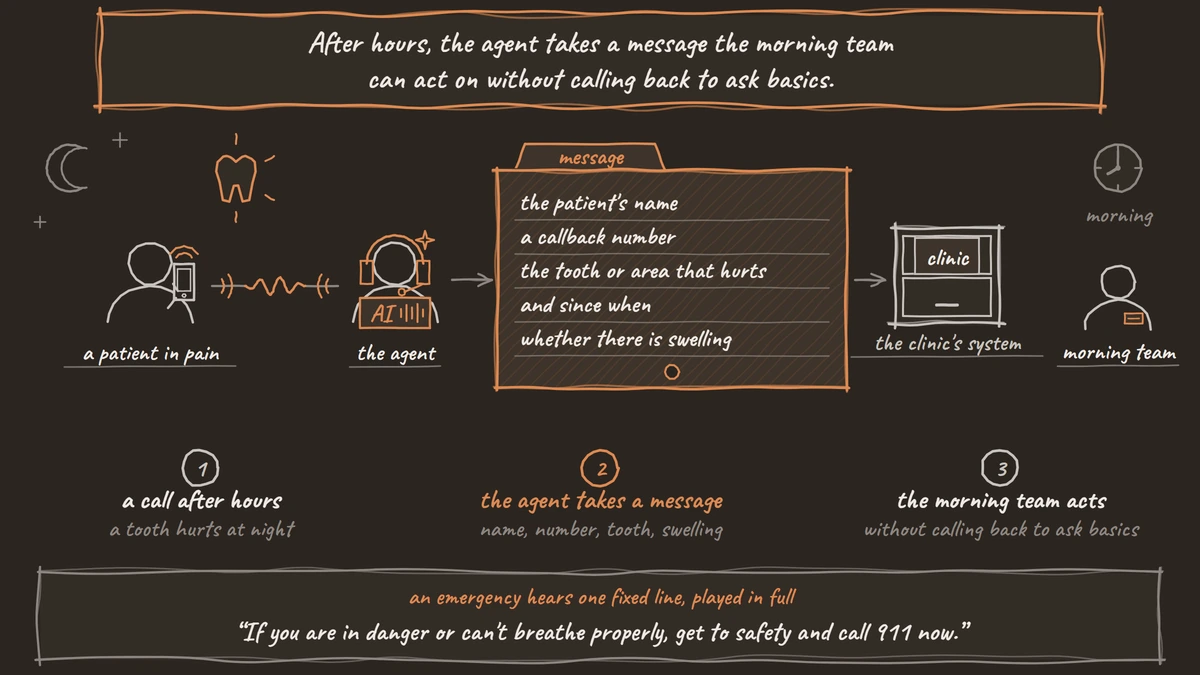
After hours, the agent takes a message the morning team can act on without calling back to ask basics. It collects the patient's name, a callback number, the tooth or area that hurts and since when, and whether there is swelling. A tool writes that message to the clinic's system during the call, or a Webhook node sends it after the call ends. A confirmation text goes out through the clinic's own messaging provider, which an HTTP API tool can call during the call.
Where the clinic has an on-call dentist, Transfer Call puts urgent cases through, and it works on Twilio, Telnyx, Plivo, Cloudonix and Asterisk ARI. Dograh rings the dentist first and connects the patient only when someone answers. If nobody picks up within 30 seconds, the default timeout, the patient stays with the agent, which takes the message and a callback request.
Some calls are emergencies, such as swelling that affects breathing or swallowing. For those, a pathway plays a fixed Transition Speech line with the caller muted, so it plays in full: "If you are in danger or can't breathe properly, get to safety and call 911 now."
English and French on one line
A clinic in Ottawa, Moncton or Montreal hears both languages on the same line. Set the agent's speech-to-text to Multilingual (Auto-detect) in the Model tab, and tick English and French under Language Hints, which work with Dograh models or Deepgram Flux. The Greeting Text plays before Dograh can hear which language the caller speaks, so write it in both, for example "Bonjour, hello, you've reached the clinic."
If the greeting carries a recording notice, switch off Allow Greeting Interruption on the Start Call node, since it's on by default and a caller who speaks early would cut the notice short. Add dental terms and local street names to the Dictionary in the agent's Settings, so names like "Moncton" or "parodontie" come through cleanly.
The front desk team can also record the lines patients hear most, such as the greeting and the closing, in both languages. The agent plays a recorded clip when one fits the moment and uses the text-to-speech voice for everything else, so the opening sounds like the clinic's own staff.
Provincial privacy law and the DNCL
Which privacy law covers a patient call depends on the clinic's province. The Office of the Privacy Commissioner of Canada explains that health information held by health care providers is mostly governed by provincial laws. Ontario's health law is one of four the commissioner lists as substantially similar to the federal Personal Information Protection and Electronic Documents Act (PIPEDA), so an Ontario clinic works out its duties under that provincial law. Where no substantially similar provincial law applies, PIPEDA covers a private clinic's commercial activity.
Outbound calls bring in the National Do Not Call List, which the CRTC enforces. A reminder or a recall booking for an existing patient sells nothing, so it generally falls outside telemarketing. A call promoting whitening to people who never visited is telemarketing. The DNCL rules bar telemarketing to listed numbers unless an exemption applies, such as the existing business relationship exemption for a purchase in the last 18 months or an inquiry in the last 6 months. Every telemarketer also keeps an internal do-not-call list and must check the National DNCL at least every 31 days. Confirm your clinic's duties with its privacy officer or counsel, including Quebec's own privacy and language rules for clinics there.
Join the Dograh Community
Dograh is an OSS alternative to Vapi. Join our Slack community for queries, releases, best practices & community interactions.
Where the call data lives
Hosted receptionists tend to show a PIPEDA badge. A clinic also needs to know where each call is processed and stored.
Dograh is the orchestration layer that runs the call flow, tools and telephony, and the speech and language models are a separate layer the clinic chooses. Dograh Cloud names no data region. Self-host the platform in a Canadian data centre, and recordings, transcripts and call records stay there. Patient audio stays in Canada only when the models run in that data centre too, which our post on AI voice agents for telehealth in Canada covers in more depth.
When the clinic self-hosts, recording is one on or off switch for the whole server, and transcripts are kept whether it is on or not. The clinic deletes old recordings on the schedule its privacy officer sets.
Every call has a full trace of what the agent heard and said, and QA scores a sample of calls you choose, so the office manager can check how coverage questions were answered. Self-hosted Dograh has no per-minute platform fee, but servers, model keys and phone minutes still cost money. Dograh Cloud charges a 1¢-a-minute platform fee.
Where to start
Start with after-hours messages, because those calls reach no one today. Then add booking through the practice system, and run reminder campaigns once bookings land cleanly. Write the bilingual greeting and the 911 line first, and test both with real calls in English and French.
Glossary
- Substantially similar provincial law
- A provincial privacy law the federal government treats as matching PIPEDA, so the provincial law applies instead within that province. Ontario's health information law is one.
- Existing business relationship exemption
- The DNCL exemption that allows telemarketing calls to listed numbers after a purchase in the last 18 months or an inquiry in the last 6 months.
- Internal do-not-call list
- The list every telemarketer must keep of people who asked that business not to call them.
- Canadian Dental Care Plan (CDCP)
- The federal dental coverage plan for eligible residents without dental insurance, whose members now call clinics to ask whether they take the plan.