
AI voice agents for dental recall and recare outreach call patients who are due for a cleaning or check-up and have nothing booked. The due list comes from the practice management system, the agent verifies the patient before naming the visit, and it books a live slot. The practice's own text goes first, and consent comes before any call.
Key Takeaways
- Text first from your own system. Call the patients who still have not booked.
- The healthcare exemption allows one call a day and three a week.
- Campaigns cannot cap calls per patient, so your list enforces the limit.
This post is part of our guide to AI voice agents for hospitals and health systems. The guide's specialty care section treats dental recall as outbound only, with consent settled before the first call. This post builds that recall call in Dograh, an open-source, self-hostable voice agent platform, from the due list in your practice management system to a booking written back into it.
The due list is longer than any front desk can call
Recall, which many practices call recare, is the biggest list most practices own, and it grows faster than staff can work it. CareQuest Institute's State of Oral Health survey, fielded with 9,450 adults in January and February 2025, found that 70% of US adults had a dental visit in the past year, against 84% who saw a physician. One adult in five saw a doctor but not a dentist.
The gap is widest where recall calls are hardest. Only 63% of adults aged 18 to 29 saw a dentist in the past year, against 77% of those aged 60 and older. Among adults earning $30,000 a year or less, dental visits fall to 52%, against 84% for those earning $100,000 or more. Cost is the objection a recall call will hear most often, and the agent's answer to it is a route to your team, never a quoted fee.
This post covers outbound recall only. Patients who phone the practice are handled in AI Voice Agents for Dental Reception and Call Answering, and reminders for visits already booked are in Healthcare No-Show Reduction: Why AI Voice Agents Beat Reminders.
Text first, then call the patients who have not booked
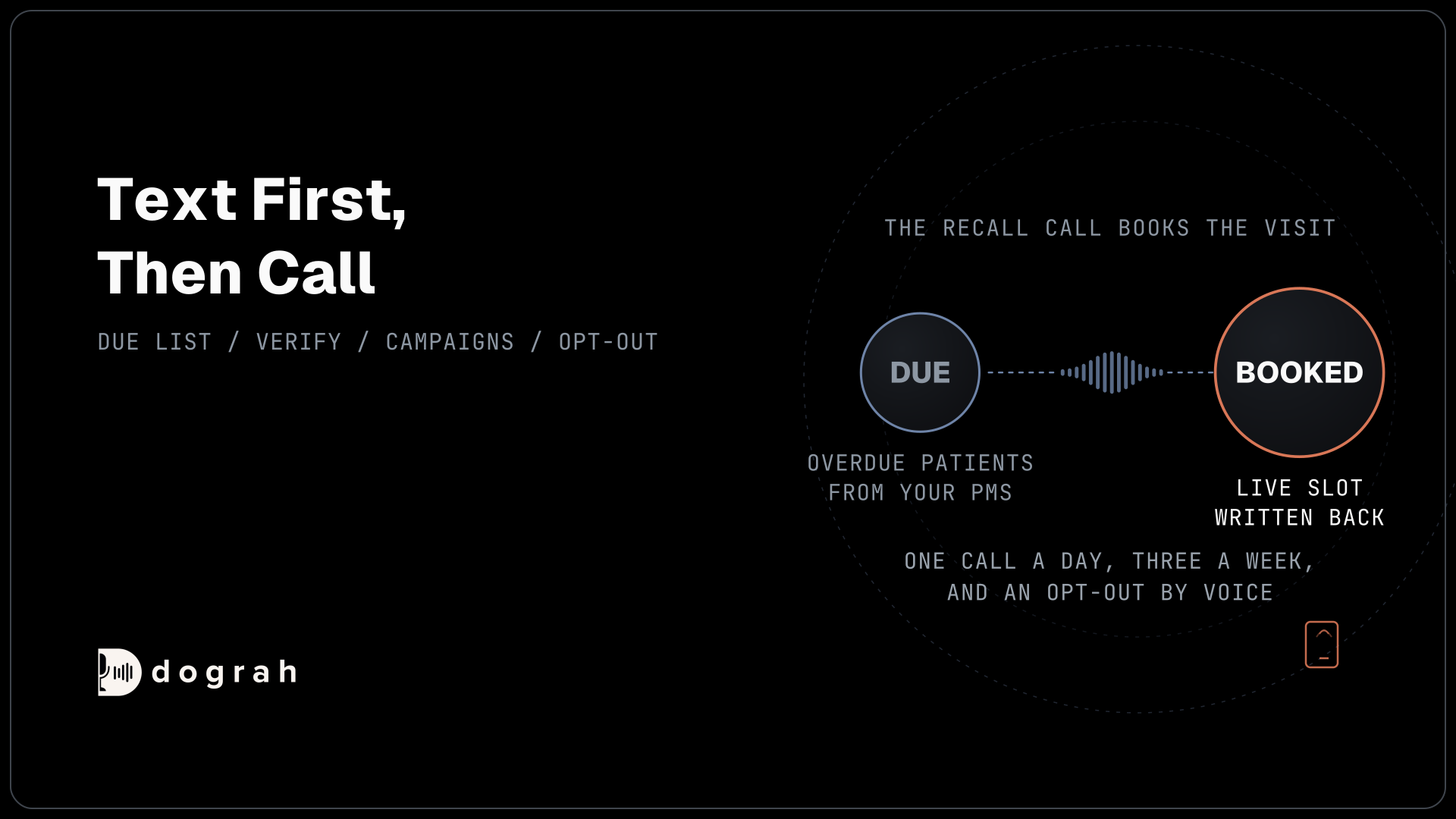
A recall campaign works best as a sequence, and the phone call belongs near the end of it. The practice's own system sends the first reminder by text or email, with a booking link. Dograh has no SMS tool, so that message comes from your practice management system (PMS) or patient messaging platform, with no voice agent involved.
The call goes to the patients who have not booked after those messages. That keeps the call list short and leaves the patient's limited daily call allowance for the call that can actually book a visit.
Build the due list in the practice system
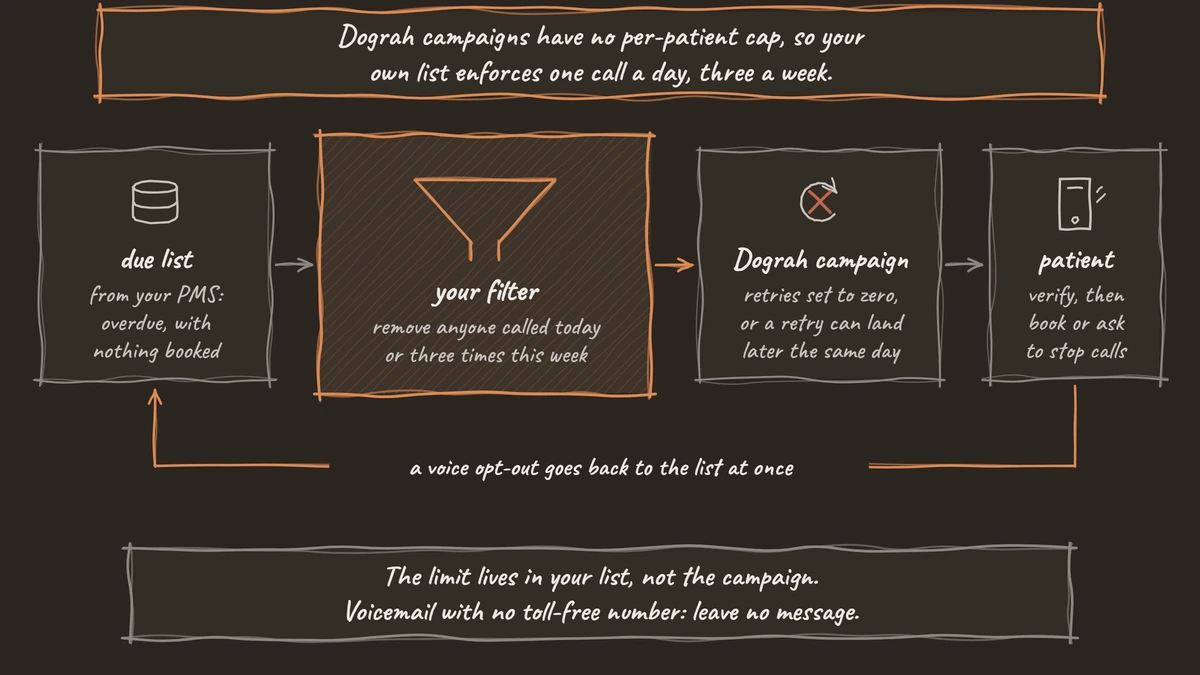
Your PMS decides who is due, and the voice agent only works the list it is given. Export the overdue patients with nothing booked as a CSV file and upload it to a Dograh campaign, or let the PMS or a scheduler start each call through the API Trigger, with the patient's due visit passed in as initial context.
Campaigns have no per-patient call cap. Their retry settings allow up to 10 retries, two by default, with a delay from 30 seconds to an hour, two minutes by default, and switches for retrying on busy, no answer and voicemail. A retry can land later the same day, which can break the exemption's limit of one call a day and three a week. So either your own list enforces the limit, removing anyone already called today or three times this week, or retries are set to zero. Calling hours can be set for each weekday.
The campaign runs the same way wherever Dograh is hosted. Self-hosted Dograh has no per-minute platform fee, though servers, any paid model keys and phone minutes still cost money. Dograh Cloud has a 1¢-a-minute platform fee. Self-hosting also means no business associate agreement (BAA) with Dograh is needed, since Dograh never receives the patient data, while the model providers you use by API key still need their own and the phone carrier may, depending on what it stores.

Open Source Alternative to Vapi / Retell
Self-hosted voice agent platform — no per-minute fees
dograh-hq/dograh
Star on GitHub
The call itself: greet, verify, book
The opening line is fixed and carries no health detail. Dograh's Greeting Text plays word for word, so put the practice's name and call-back number there, because the exemption wants both at the start of the call. Greeting Text plays before verification, so it never mentions the cleaning or anything else about the patient's care.
Next the agent says it is an automated assistant and asks for the patient's date of birth. Only after that check does it say a cleaning or check-up is due. A phone number finds the patient record. It does not prove who answered.
Then the agent books. An HTTP API tool reads open hygiene slots from the PMS during the call, the patient picks one, and a second request books it. A webhook writes the outcome back after the call: booked, declined, call back later, or opted out. Questions about cost or treatment go to your team through Transfer Call on Twilio, or as a callback request written to your system when nobody answers within the transfer timeout.
Run the first campaign on a small slice of the list. Dograh's quality assurance (QA) node scores each step of a sample of calls, so you can see where patients declined and which step of the call ran long. If calls routinely run past a minute, shorten the script before you widen the list.
Treatment-plan follow-up is a different call with stricter rules on money, covered in AI voice agents for dental clinics.
What the healthcare exemption allows
Recall calls to mobiles usually lean on one rule from the Federal Communications Commission (FCC), so read it in full. 47 CFR 64.1200(a)(9)(iv) exempts "Calls made by, or on behalf of, healthcare providers" when every condition is met. The calls must be "sent only to the wireless telephone number provided by the patient" and "must state the name and contact information of the healthcare provider". They are "strictly limited" to purposes that include "appointment and exam confirmations and reminders, wellness checkups". They "must not include any telemarketing, solicitation, or advertising" and "may not include accounting, billing, debt-collection, or other financial content". They "must be concise, generally one minute or less in length for voice calls", and "A healthcare provider may initiate only one message (whether by voice call or text message) per day to each patient, up to a maximum of three voice calls or text messages combined per week to each patient."
Several design rules follow, generally. The text from step one counts toward the same weekly limit as the call. A recall call that books a slot can run past one minute, so consent on file, collected at the patient's last visit, is generally the safer basis. A recall reminder about the patient's own care is generally a treatment communication rather than marketing under the definition in the Health Insurance Portability and Accountability Act (HIPAA) Privacy Rule, in 45 CFR 164.501, but adding an offer for a paid product or a whitening special changes that.
Join the Dograh Community
Dograh is an OSS alternative to Vapi. Join our Slack community for queries, releases, best practices & community interactions.
Opt-outs by voice and on voicemail
The rule asks for an opt-out on every call, and the form depends on who answers. A call a person could answer needs "an automated, interactive voice- and/or key press-activated opt-out mechanism". Dograh has no keypad tool, so the opt-out is by voice: the agent asks whether the patient wants to stop these calls, records the answer as an extracted variable, and the webhook writes it to your list. The provider "must honor opt-out requests immediately", so that list update has to reach the next campaign export.
A call that reaches voicemail is different. Any message the agent leaves must include "a toll-free number that the consumer can call to opt out of future healthcare calls". If you have no toll-free opt-out number, leave no message at all. In Dograh, turn on "Enable voicemail and screening handling" and keep "When voicemail is detected" set to "Disconnect the call", the default, which hangs up without a message.
This is informed commentary on the rule, not legal advice. Confirm your own position with counsel before the first recall campaign goes out.
Glossary
- Recare
- Outreach to patients who are due or overdue for a routine cleaning or check-up and have no visit booked. Many practices use recall and recare for the same list.
- Healthcare exemption
- The FCC rule at 47 CFR 64.1200(a)(9)(iv) that allows short, non-financial calls such as reminders and wellness checkups to a patient's mobile, at most one a day and three a week, with an easy opt-out.
- API Trigger
- A Dograh endpoint your own system calls to start one outbound call, passing details such as the patient's due visit as initial context.
- Toll-free opt-out number
- The number a voicemail left under the healthcare exemption must give, so a patient can stop future healthcare calls without waiting for the next live call.