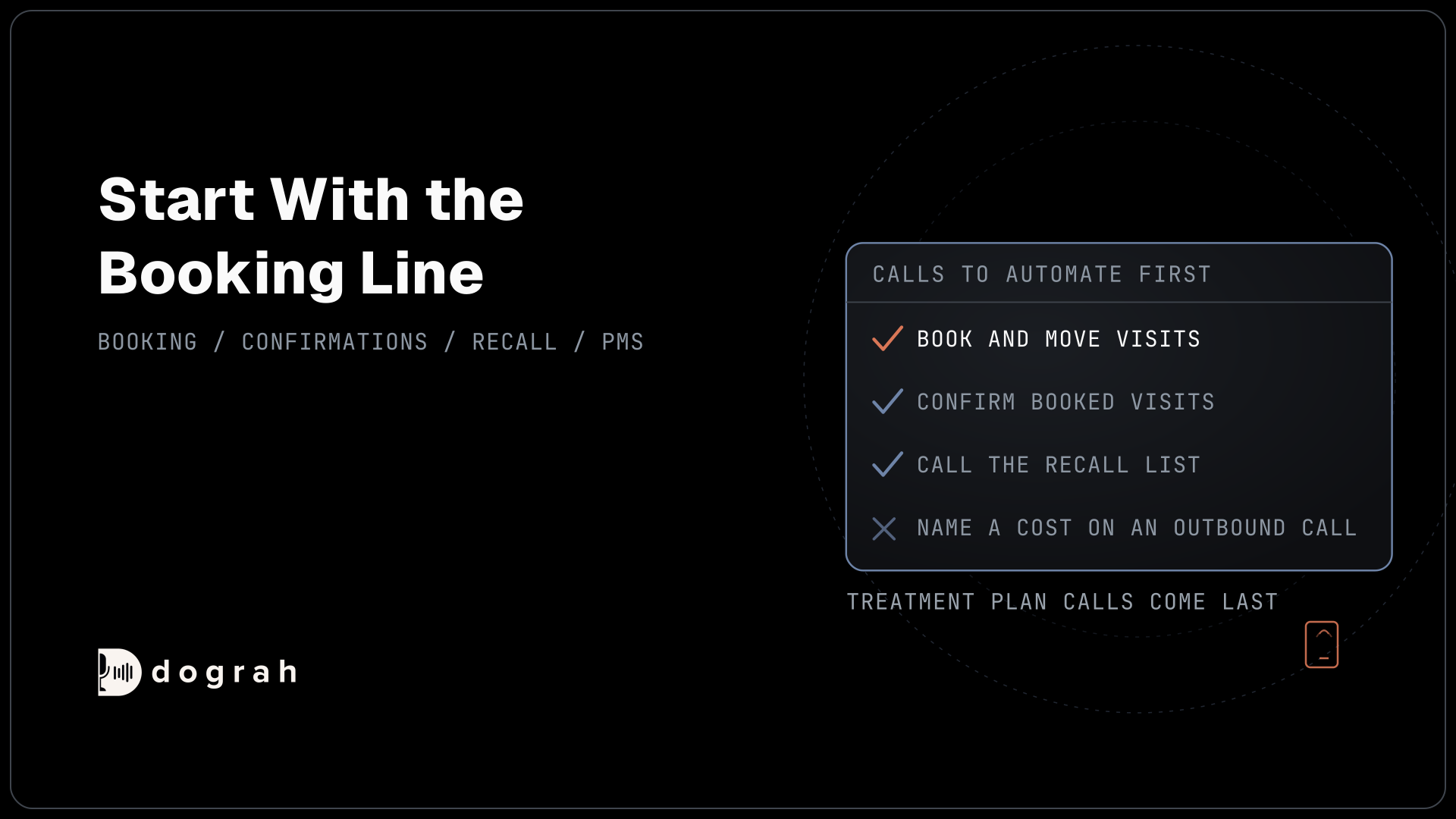

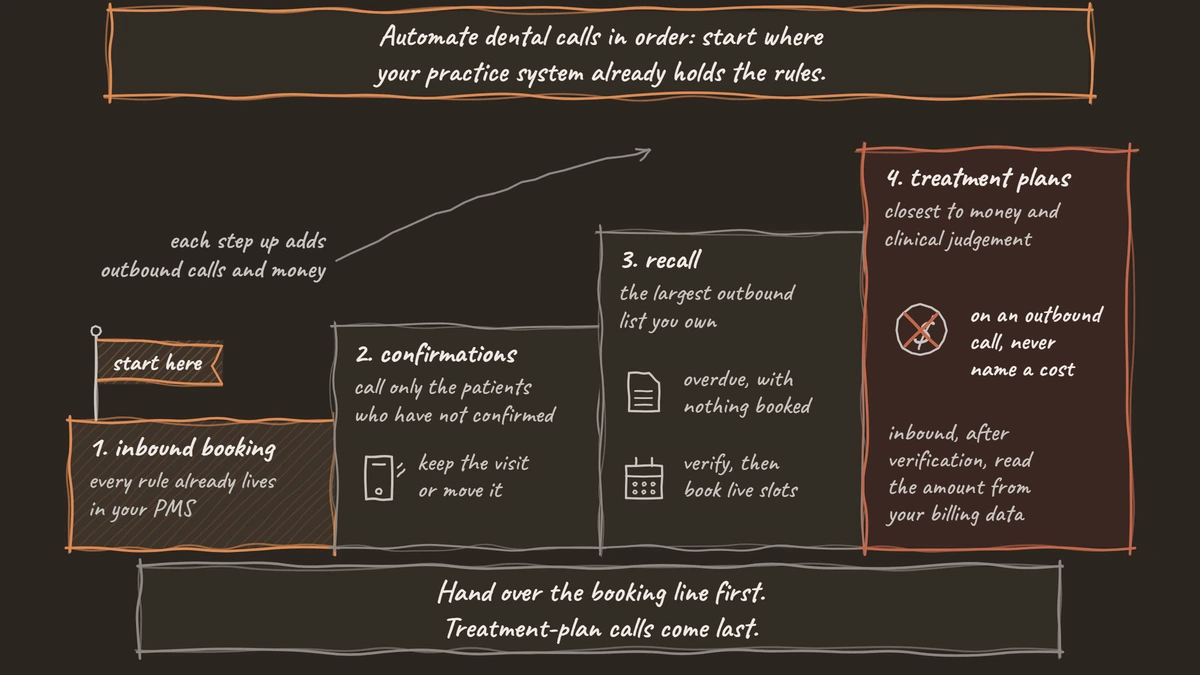
AI voice agents for dental clinics answer and place a practice's routine calls: booking and rescheduling, confirmations, recall and treatment-plan follow-up. Start with inbound booking, because the open slots already live in your practice management system. Leave treatment-plan calls for last, since they touch cost and clinical questions your team should own.
Key Takeaways
- Automate inbound booking first. Your practice system already holds the slots.
- Recall and treatment-plan calls are outbound, so consent comes before any dialing.
- Outbound treatment-plan calls never name a cost. Inbound calls can, after verification.
This post is part of our guide to AI voice agents for hospitals and health systems. The guide's section on care settings separates the dental call mix from a hospital's: bookings, reminders, recall and treatment-plan follow-up. Here those calls are put in the order a practice should automate them, with Dograh, an open-source, self-hostable voice agent platform, reading and writing your practice management system during each call.
Most dentists have not handed a call to AI yet
Dentists are cautious about AI on the phone, so the order you automate in matters more than the number of calls you automate. The American Dental Association's Health Policy Institute (HPI) asked 552 private-practice dentists in June 2026 which tasks they use AI for. For appointment scheduling, 9.2% use it today, 19.6% plan to, and 71.2% neither use it nor plan to, according to the HPI's Q2 2026 dental economy report. Asked how they feel about AI in dentistry, 17.7% answered that it is a tool and should not replace clinical judgement.
The pressure to try anyway comes from staffing. Among the dentists who were recruiting a hygienist in the second quarter of 2026, 87.7% called it very or extremely challenging, and hourly earnings of dental office staff have risen 23% since January 2021. Every routine call taken off the front desk gives time back to a team the practice cannot easily grow.
Answering the front-desk phone itself, including after-hours calls and patients in pain, is covered in AI Voice Agents for Dental Reception and Call Answering. This post covers the whole call mix and which part to hand over first.
First: inbound booking and rescheduling
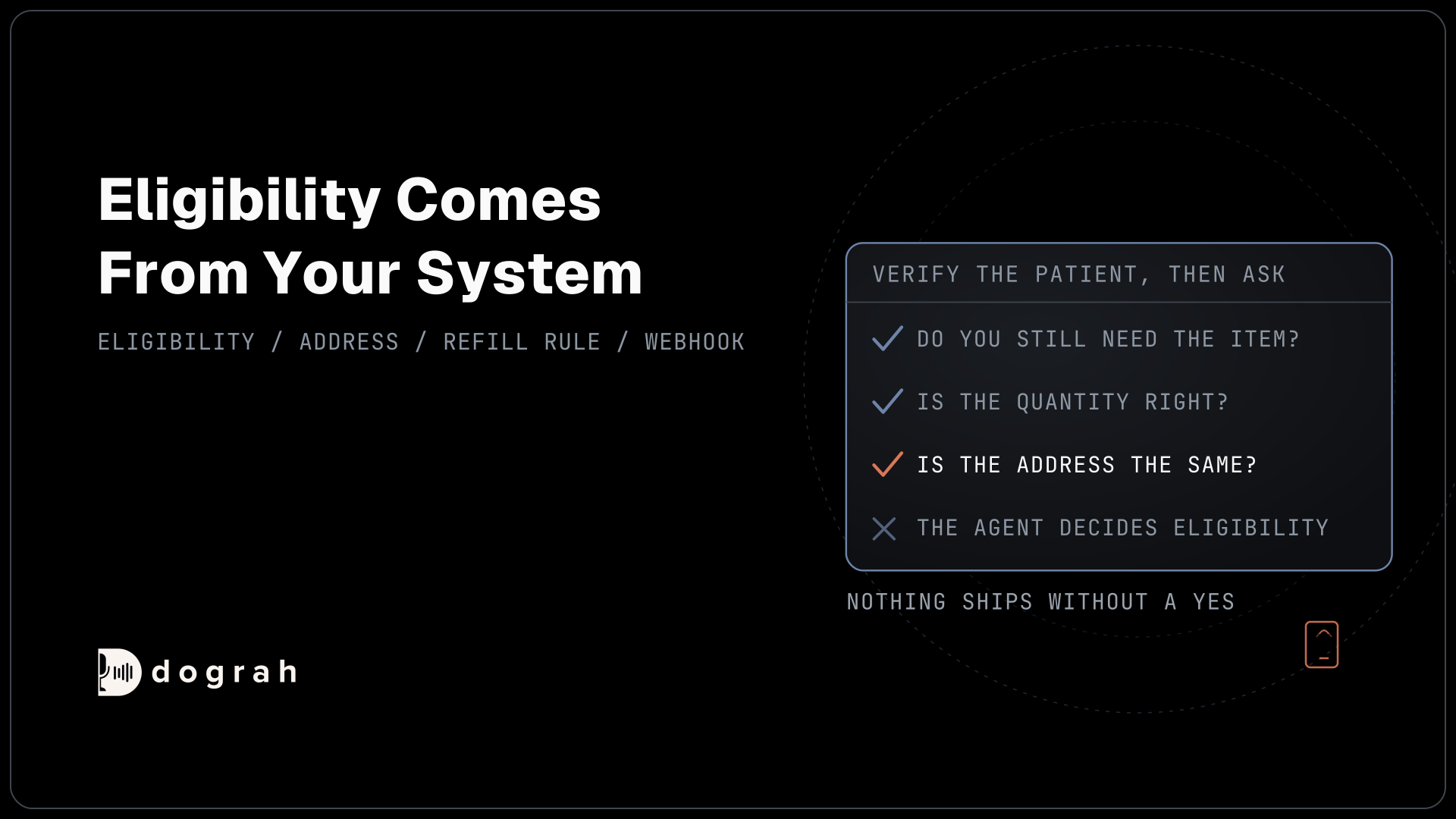
Booking is the safest call to automate because every rule it needs already lives in your practice management system (PMS). Systems such as Dentrix or Open Dental hold the schedule and the length of every visit type. The agent's job is to read that schedule and write to it. It never keeps its own copy.
The call runs greet, verify, disclose. The greeting names the practice and says the patient is talking to an automated assistant. Before the agent mentions any existing appointment, it confirms the patient's date of birth plus one more detail, such as the appointment date or the street address. A phone number finds the patient record. It does not prove who is calling.
In Dograh, Pre-Call Data Fetch can look up the caller's number in your PMS when the call connects, so the agent already knows which record to check. During the call, an HTTP API tool asks the PMS for open slots that match the visit type, and a second request books the one the patient picks. Slots fill up while the call is happening, so the agent reads them live rather than from a list loaded at the start. When the call ends, a webhook writes the outcome and the transcript link back to the patient record.
What the agent may change is your decision, written into its prompt and enforced by the PMS. A cleaning or a check-up can be booked directly. A new-patient visit or anything that needs the dentist's input goes to a person through Transfer Call, which works on Twilio. If nobody picks up within the transfer timeout, 30 seconds by default, the patient stays with the agent, which offers a callback and writes the request to your system.
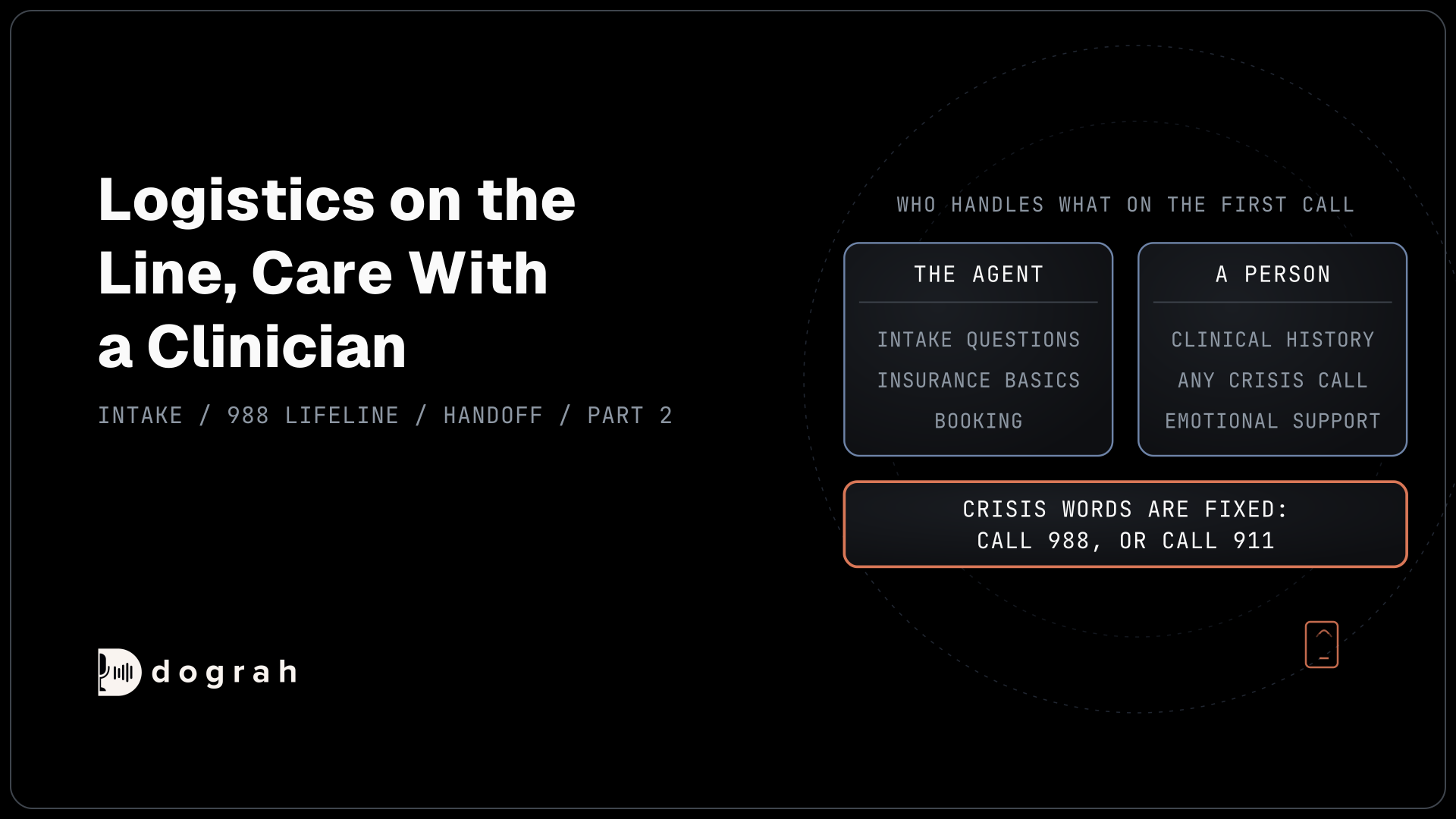
The agent never answers a clinical question. A patient who describes facial swelling that makes it hard to breathe or swallow hears a fixed instruction to call 911, played as a pathway's Transition Speech or a recorded clip once the emergency pathway is chosen, so the model never improvises that line. Every other question about pain goes to the dental team, and the reception post shows how a practice sorts those calls.
The design rules for the booking call itself are in AI voice agents for patient appointment scheduling.
Second: confirmations and reminders
A reminder that needs no answer should be a text, and a call earns its place only when the patient has to decide something. Dograh has no SMS tool, so the text comes from your PMS or patient messaging system. The voice agent calls the patients who have not confirmed, offers to keep or move the visit, and writes the answer back.
Reminder calls to mobile numbers fall under the Federal Communications Commission's (FCC) healthcare exemption only when they meet every one of its conditions, and the guide's consent section sets them out. Why a confirmation call beats a plain reminder for missed visits is argued in Healthcare No-Show Reduction: Why AI Voice Agents Beat Reminders.

Open Source Alternative to Vapi / Retell
Self-hosted voice agent platform — no per-minute fees
dograh-hq/dograh
Star on GitHub
Third: recall and recare outreach
Recall is the largest outbound list most practices own, and the hardest to work by hand. CareQuest Institute's State of Oral Health survey, fielded in early 2025 with 9,450 adults, found that 70% of US adults saw a dentist in the past year, against 84% who saw a physician. The other 30% make up a long due list, and part of it belongs to your practice.
The list comes from the PMS: patients whose cleaning or check-up is overdue and who have nothing booked. A Campaigns upload or the API Trigger starts each call. The agent verifies the patient before naming the visit that is due, then offers live slots and books one. The exemption's limits on how often a patient can be called, and how a patient opts out by voice, are worked through in AI voice agents for dental recall and recare outreach.
Last: treatment-plan follow-up
Treatment-plan calls come last because they sit closest to money and clinical judgement. The agent may tell the patient that a plan from their last visit is still open and offer to book a consult with the dentist. It never discusses the treatment itself, and on an outbound call it never names a cost or a balance.
Two rules drive that line. The FCC's healthcare exemption bars financial content from exempt calls. A call about an open treatment plan can also read as promoting a service, so it generally relies on the patient's prior consent to be called rather than on the exemption. Treat that as informed commentary and confirm your own position with counsel.
Cost questions will come up anyway. CareQuest found that 26% of US adults, about 69 million people, have no dental coverage, against 8% with no medical insurance. On an inbound call, after verification, the agent can read the patient's amount from your own billing or PMS data through an HTTP API tool. It never quotes a fee from memory, and insurance or clinical questions go to your team.
Join the Dograh Community
Dograh is an OSS alternative to Vapi. Join our Slack community for queries, releases, best practices & community interactions.
Where the patient data lives
A dental call carries a name, a date of birth, a treatment history and often a payment question. Self-hosting puts the call platform on your own servers. Dograh is the orchestration layer: it runs the call flow, tools and telephony, and the speech and language models are a separate layer you choose. Self-hosting Dograh means no business associate agreement (BAA) with Dograh is needed. The model providers you use by API key still hear the audio, so each needs its own BAA unless you also run open-weight models on your own servers. Your phone carrier may need one too, depending on what it stores. A BAA delegates obligations. It never transfers the practice's liability under the Health Insurance Portability and Accountability Act (HIPAA).
Dograh has no retention setting, so your own policy decides how long recordings and transcripts are kept. Self-hosted Dograh has no per-minute platform fee, though servers, any paid model keys and phone minutes still cost money. Dograh Cloud has a 1¢-a-minute platform fee.
Start with the booking line, read a week of transcripts, then add confirmation calls. Recall and treatment-plan calls wait until the inbound agent has earned the practice's trust.
Glossary
- Practice management system (PMS)
- The software that holds a dental practice's schedule, patient records, treatment plans and billing, such as Dentrix or Open Dental. The voice agent reads and writes it and never keeps its own copy.
- Pre-Call Data Fetch
- A Dograh setting at the bottom of the Start Call node that looks up fresh data, such as the patient record behind the caller's number, as soon as the call connects.
- Recall
- The list of patients due for a cleaning or check-up who have no visit booked. Recare is the same outreach under another name.
- Healthcare exemption
- The FCC rule at 47 CFR 64.1200(a)(9)(iv) that allows short, non-financial healthcare calls such as reminders to a patient's mobile number, within strict limits on purpose, length and frequency.