
An AI voice agent for dental reception books or moves appointments and answers hours and insurance questions. Pain calls are routed by two lists the dentist writes, to emergency care or the on-call dentist. Self-hosting is optional. Pair it with local open-weight models and patient call audio never reaches an AI vendor, though your phone carrier still carries the call.
Key Takeaways
- The agent owns booking and routine questions. Pain calls go to emergency care or the on-call dentist.
- Pain routing follows two lists the dentist writes, never the AI's judgement.
- A business associate agreement passes HIPAA duties on. The practice keeps its own.
This post is part of our guide to AI receptionists. The guide covers any business. This one walks a dental front desk call by call, for practices deciding whether an agent fits theirs. We build Dograh, an open-source, self-hostable voice agent platform.
The calls a dental front desk takes, and who should own each
Six kinds of call reach most dental front desks, and an agent should own only some of them.
| Call | What the agent does | Who owns it |
|---|---|---|
| New-patient booking | Collects name, date of birth, callback number and reason, then books an open slot and reads it back | Agent |
| Reschedule or cancel | Finds the patient by caller number and date of birth | Agent |
| "Do you take my plan?" | Answers from the practice's list of accepted plans | Agent, then a person for benefits |
| Pain or injury | Routes the call by the dentist's lists | Emergency care or the on-call dentist, at once |
| Hours and directions | Answers from the knowledge base | Agent |
| Recall and hygiene visits | Books the cleaning when a patient returns a reminder | Agent |
New patients already wait an average of about 14 business days for a first appointment, per the American Dental Association (ADA) Health Policy Institute's Q2 2026 report. A caller who hangs up without a slot may ring the next practice.
Platform data from Patient Prism, which sells call-coaching software to dental practices, covered 11.55 million dental calls in 2025. When a caller did not book, insurance was the reason more than 11 times as often as price. It also found that 31 of every 100 callers hung up before reaching anyone. So the agent answers "do you take my plan?" from your list of accepted plans, and a person checks the caller's actual benefits.
Start every call with a greeting that names the practice and says what the agent can help with, such as booking or moving appointments. Write it in the Start Call node, where the text plays word for word.
Some calls stay with people. The agent should not discuss a diagnosis, suggest treatment, argue a benefits dispute or work around a schedule template your team fixes by hand. Four out of five dentists told the ADA Health Policy Institute they have no interest in AI for treatment recommendations.
Pain calls follow two lists the dentist writes
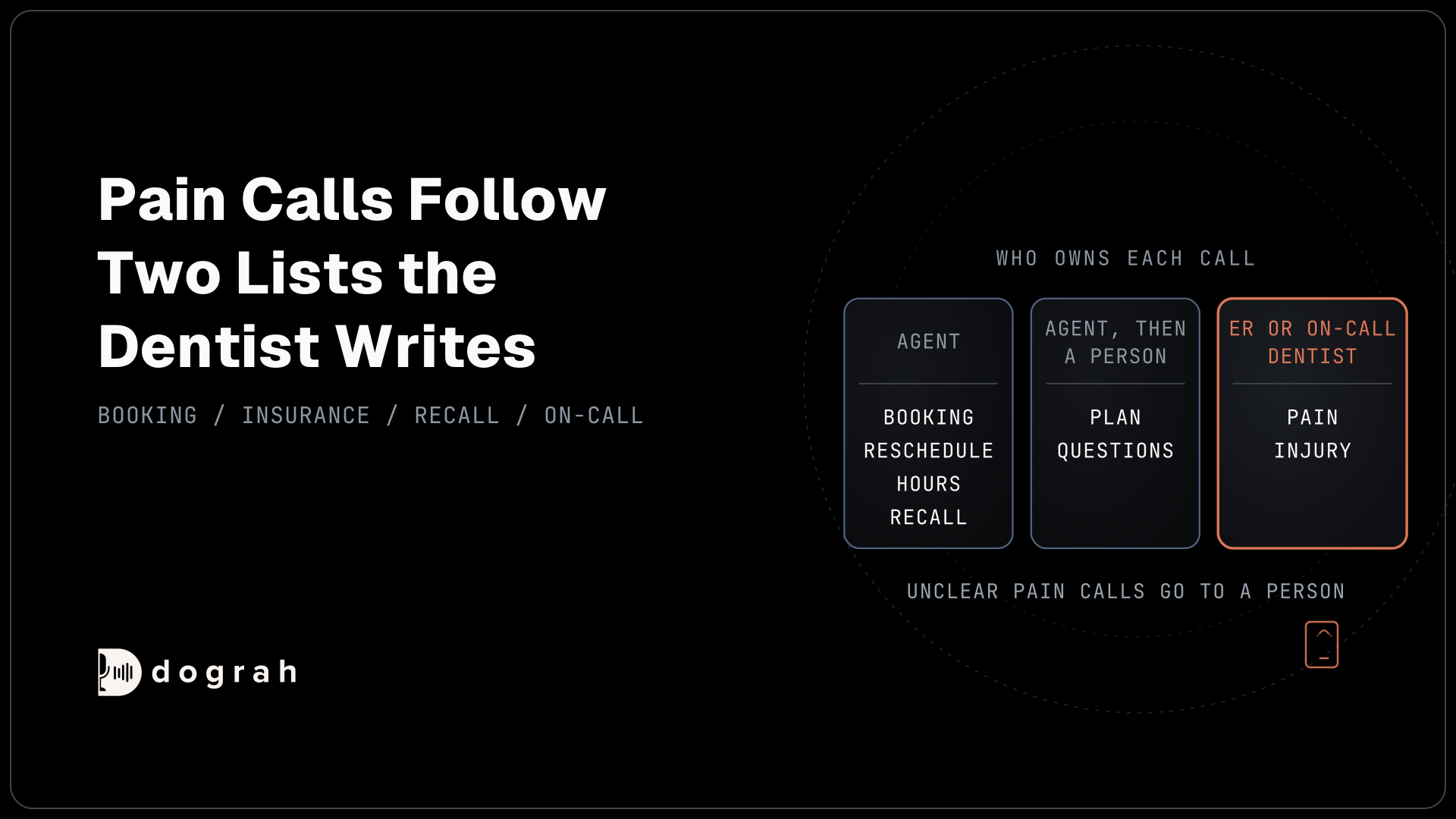
The agent never judges how serious a pain call is. It checks the caller's answers against two lists the dentist writes.
The American Academy of Pediatric Dentistry (AAPD) 2026 policy on emergency oral care says "Dental emergencies include, but are not limited to, facial swelling, infections, uncontrolled bleeding, pain, and orofacial trauma." The ADA definition it draws on separates potentially life-threatening cases, such as uncontrolled bleeding or swelling that could block the airway, from urgent ones such as severe tooth pain, a knocked-out tooth, a painful broken tooth or a dry socket.
The first list is for emergency care now. It leads to a pathway whose transition speech, fixed text that plays as written, tells the caller to hang up and call 911 or go to the nearest emergency room. Transition speech does not play on speech-to-speech models, so use a cascade of separate models for this agent.
The second list is for the on-call dentist now, and those calls transfer. Pain that matches neither list goes there too, as does any caller who asks for a person or any call the agent cannot make out.
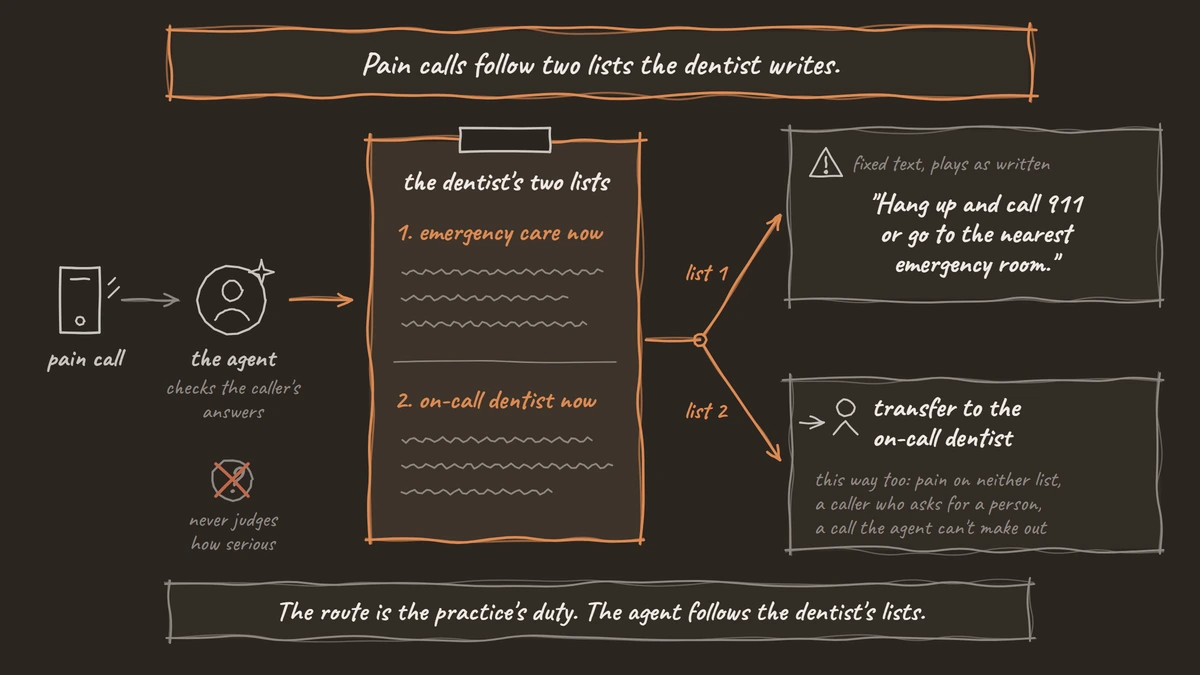
The route is the practice's duty: the ADA code, quoted by the AAPD, says dentists "shall be obliged to make reasonable arrangements for the emergency care of their patients of record."
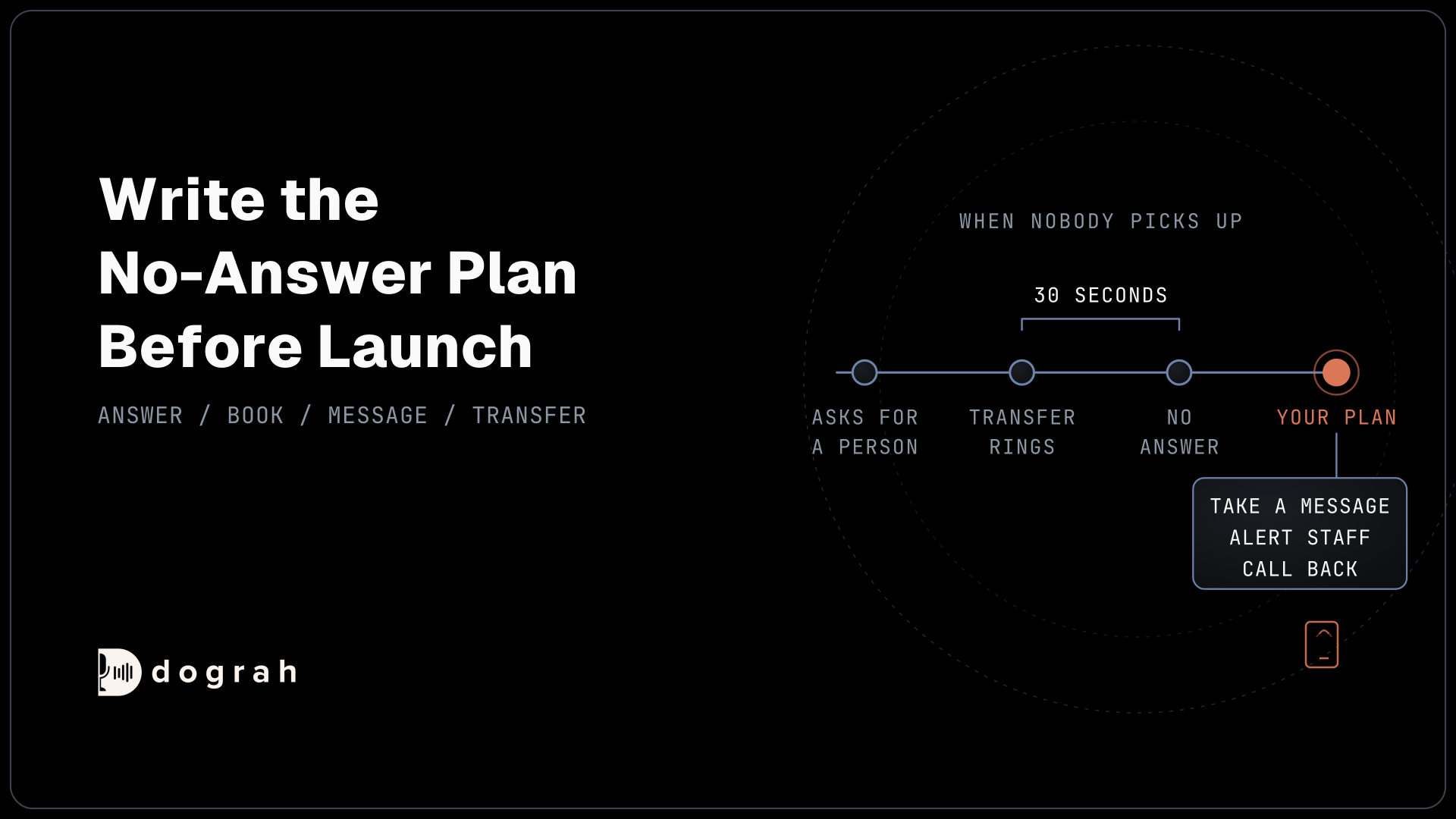
Dograh hands calls over with call transfer, on Twilio, Telnyx, Plivo, Cloudonix and Asterisk ARI. The transfer timeout is 30 seconds by default, adjustable from 5 to 120. If nobody answers, the transfer fails, the caller comes back to the agent, and you choose what happens next. For pain calls, have the agent resume and page the backup dentist. Browser web calls cannot transfer a caller to a phone number, so test this route over a real phone call.
AI Voice Agents for After-Hours Coverage covers the same lists at night. For where routing ends and clinical assessment begins, including California's Assembly Bill 3030, see our post on healthcare call centers.

Open Source Alternative to Vapi / Retell
Self-hosted voice agent platform — no per-minute fees
dograh-hq/dograh
Star on GitHub
Connecting the agent to your practice-management system
Dograh has no built-in connector for any dental practice-management system (PMS), so the agent reaches your schedule through the system's own API.
The agent needs open slots by appointment length, patient lookup by phone number and date of birth, the right to create or move appointments, and recall dates. Dograh covers that with pre-call fetch (caller lookup before the greeting), HTTP API tools (slots and booking during the call), a webhook (the call summary afterwards) and call transfer. Booking Meetings Mid-Call With Calendly Integration shows the same HTTP tool pattern.
Your practice software decides how easy this is. Open Dental has a public API. Its free tier can only read data, and slowly, which is enough to look up a caller before the greeting. Booking needs the paid tier, $30 a month per location. Open Dental also expects anyone building on its API to sign a business associate agreement (BAA) with the practices they serve.
Dentrix and Eaglesoft are closed. Only vendors their makers approve can connect, so the agent goes through an approved partner or middleware the practice already pays for. Self-hosting Dograh does not get around that rule.
Give the agent its own login with read access first. Once it can write, log every booking change and have it read the date and time back before saving.
Patient data, HIPAA and where self-hosting fits
A recorded call in which a patient describes a toothache is protected health information (PHI).
HIPAA (the Health Insurance Portability and Accountability Act) counts health information "whether oral or recorded in any form or medium", so recordings and transcripts generally fall in scope. Under the minimum necessary rule, a booking call should generally collect name, date of birth, callback number and a reason category, with no symptom history.
HIPAA lets a practice use a hosted voice vendor under a BAA, and the practice keeps its own duties. Under 45 CFR 164.504(e), a practice is not in compliance if it "knew of a pattern of activity or practice of the business associate that constituted a material breach or violation" and did not act. Signing a BAA doesn't end the practice's duties: if it learns the vendor is breaching the agreement, it must act.
Self-hosting is a choice that takes the voice vendor out of the data path. HIPAA does not require it. With Dograh and open-weight models on your own servers, recordings and transcripts never leave your infrastructure, and neither do the model requests. If those servers are rented from a cloud provider, you still need a BAA with that provider. Running Voice AI on Local, Self-Hosted Models covers that stack. Bringing your own API keys for hosted models changes who holds the contract, and the audio still reaches the model provider. The phone carrier carries the audio in every setup.
Confirm your own position with your compliance adviser or counsel before the agent takes patient calls.
Join the Dograh Community
Dograh is an OSS alternative to Vapi. Join our Slack community for queries, releases, best practices & community interactions.
What to ask before it answers your phones
Put any agent, ours included, through a short set of questions, because most dentists are not convinced yet.
In the ADA Health Policy Institute's Q2 2026 poll of 552 private-practice dentists, 70.3% neither use AI front-desk check-in tools nor plan to. Among dentists who do plan to adopt AI, those tools were the most common plan for 2026, at 32.4%.
| Ask | A good answer |
|---|---|
| Does the greeting name the practice? | Yes, in fixed text on every call |
| What happens on a pain call? | Your two lists, then a transfer with a set fallback when nobody answers |
| What does "integrates with Dentrix" mean? | A named approved-vendor route, with read and write access spelled out |
| Where do recordings and transcripts live? | A named location and a list of who can open them |
| What does the BAA cover? | A signed agreement, with your own monitoring duty unchanged |
| What does SOC 2 Type II prove? | An auditor checked the vendor's security controls. It is not a HIPAA approval |
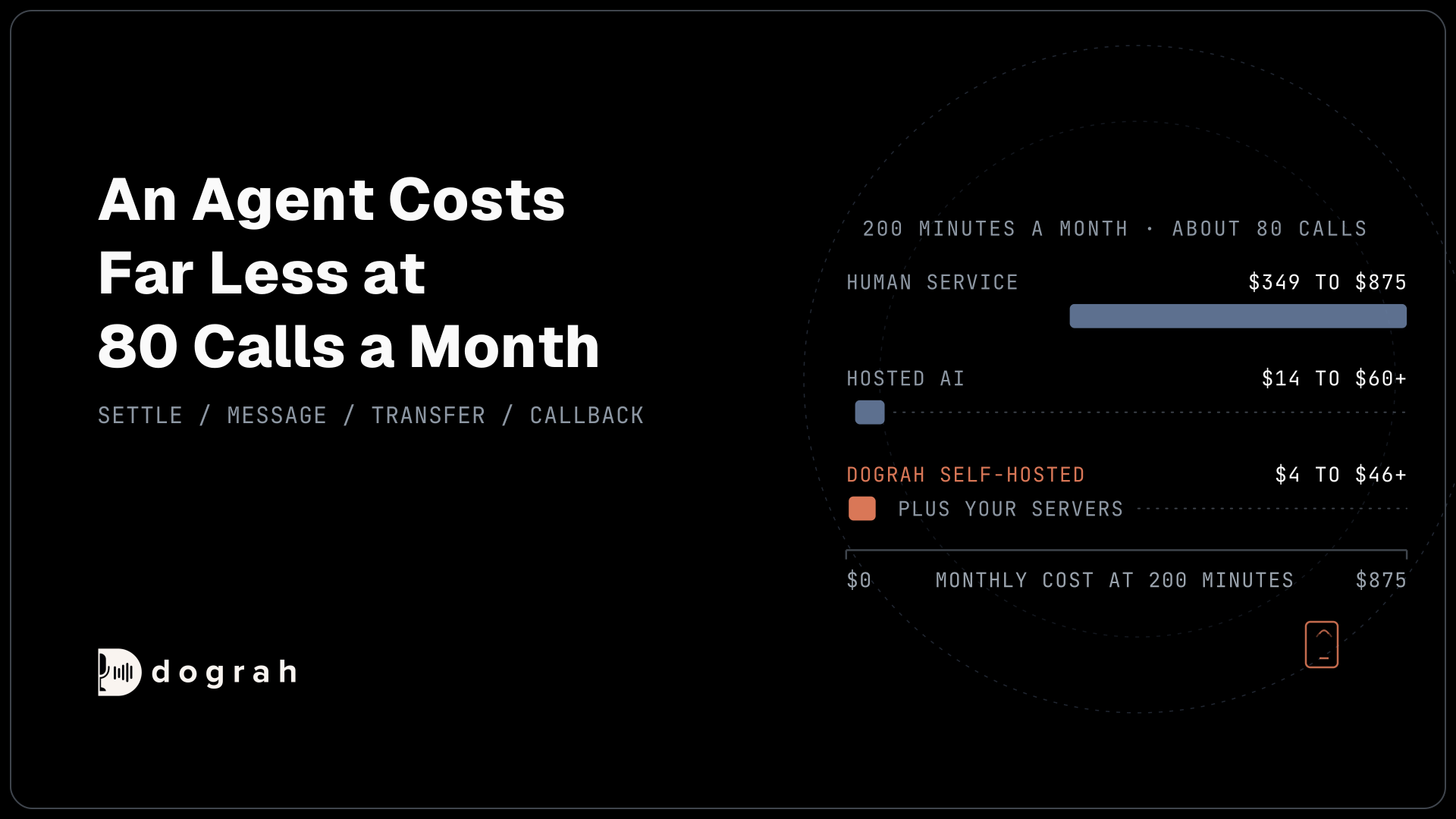
Price units differ, so compare them at your own call volume. Smith.ai's AI Receptionist Pro plan is $150 a month for 75 calls ($2.00 a call), list price. The open-source Dograh platform has no per-minute platform fee, and Dograh Cloud charges a 1¢/min platform fee. Model and phone costs apply either way.
If the answers hold up, start with hours questions and reschedules. Add new-patient booking once write access is tested on your PMS, and put pain routing through a real phone call before any patient reaches it.
Glossary
- Minimum necessary standard
- The HIPAA rule in 45 CFR 164.502(b) that asks practices and their vendors to limit protected health information to what a task needs. For a booking call, that means identity and contact details plus a reason category, with no symptom history.
- Patient of record
- A patient the practice has already seen and keeps a chart for. The ADA code obliges dentists to make reasonable arrangements for these patients' emergency care, which is why the on-call route belongs to the practice.
- Pre-call fetch
- A Dograh step that pulls data from your systems before the agent speaks. A dental agent can use it to look up the caller's number in the practice-management system, so it already knows whether the caller is an existing patient.
- Read-only API tier
- An access level that lets software look up records without changing them. Open Dental's free API tier works this way, so an agent on it can find a patient but cannot book an appointment.