
A self-storage voice agent answers unit availability and price calls from live facility data, then books the visit or reservation in your management software. Gate codes and lockouts always go to a person. For operators who want to own the setup, Dograh, the open-source AI voice agent platform, reads that data through your software's own API.
Key Takeaways
- Read units and rates as the call connects, then re-check before booking.
- Gate codes and lockouts go to a person, even after an identity check.
- Dograh reads your facility software through HTTP API tools and Pre-Call Data Fetch.
Most storage calls ask one thing first, whether a unit that size is free and what it costs. We cover where those answers come from, then we talk about how the agent books the visit, why gate codes go to a person, and how the call runs in Dograh.
What people ask when they call a storage facility
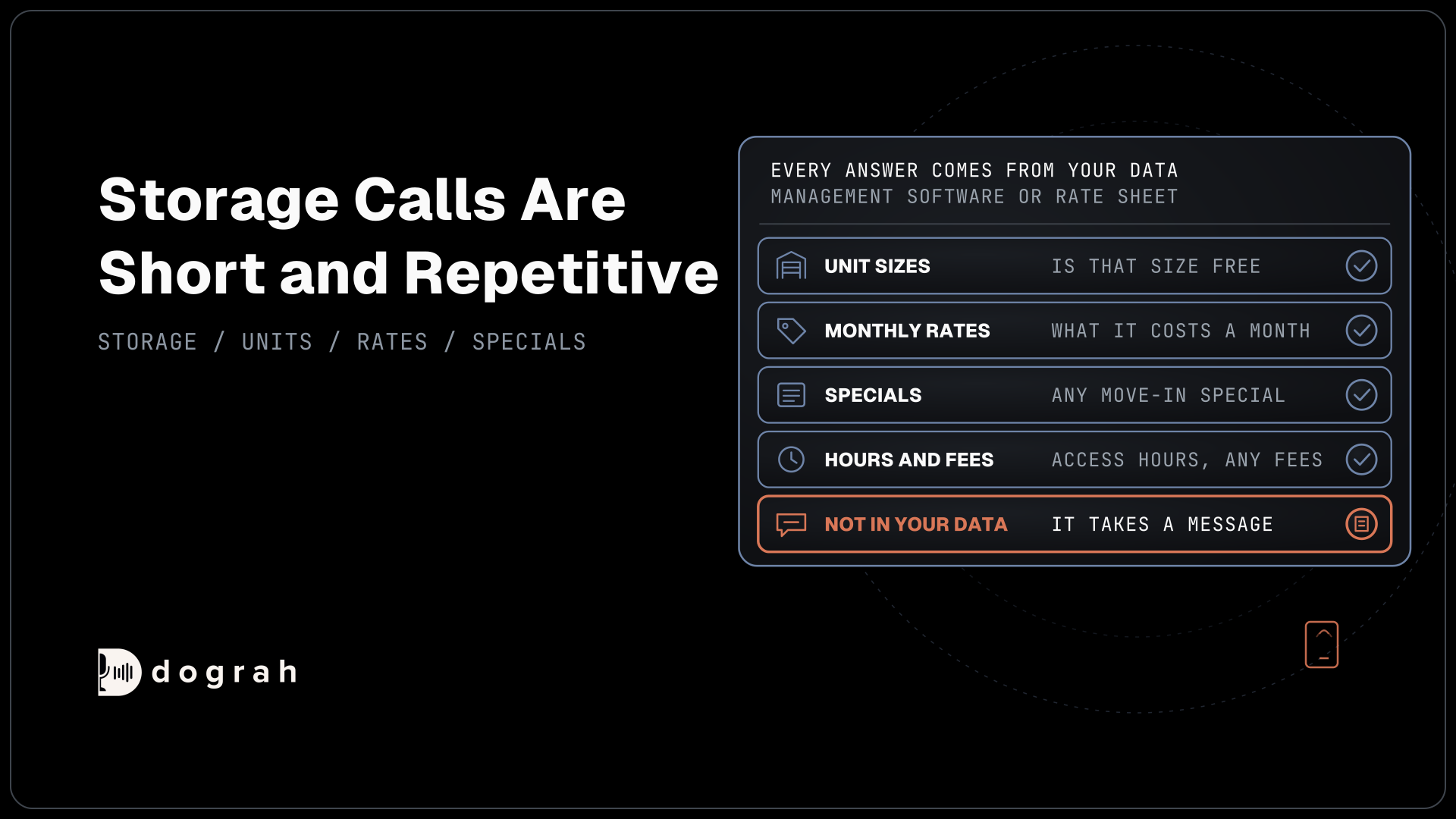
Storage calls are short and repetitive, which is why they suit an agent. Callers want to know if a 10x10 or a climate-controlled unit is free, what it costs a month, whether there is a move-in special, what the access hours are and whether they can reserve today. Existing tenants call about payments, access and moving out.
Volumes are real. swivl's first-quarter figures show its voice agents answered 128,716 self-storage calls in Q1 2026, about 90,000 of them with no staff involvement and 11,255 after hours, with 68% containment. Those are one vendor's numbers from its own customers, but they show how many of these calls arrive when the office is closed.
Every answer the agent gives comes from your data. Sizes, monthly rates, specials, fees and access hours come from your management software or your own rate sheet, never from the agent's guess. If a caller asks about something your data does not cover, such as a vehicle space you do not list, the agent says it will pass the question on and takes a message.
Calls from existing tenants need one more step. Before the agent says anything about a balance, a due date or a move-out, it checks one detail on file, such as the unit number with the tenant's last name and ZIP code. A phone number on the account helps find the record, but it is not proof of who is calling, so nothing personal is read out until that check matches. If it does not match, the agent offers to pass a message to the office.
Units and rates, read as the call connects
The fastest way to give the agent live numbers is to fetch them before it speaks. Pre-Call Data Fetch on the Start Call node sends a request to your endpoint as the call connects, with the caller's number and the number they dialed. The caller hears ringing while it runs, and if your endpoint fails to answer within 10 seconds, the call goes ahead without the data. Keep the endpoint quick and return only what the agent needs, since every second it takes is a second of ringing.
The dialed number tells your endpoint which facility the caller rang, so one agent can serve every site. Your endpoint returns that facility's open unit types, rates and current specials, and the agent can use them in its prompt and greeting as variables. That is a snapshot taken once at the start of the call, which is fine for answering "what do you have" and not enough for booking.
All of this assumes your management software has an API you can reach. Tenant Inc. describes Nectar as an open API platform with a developer portal, while Storable offers API access through its partner program. Ask your vendor which endpoints expose units and rates before you build. The pattern matches apartment leasing, which our post on AI voice agents for leasing inquiries covers for property management systems.
Re-check the unit before the agent books
A unit that was free when the call connected can be rented at the counter two minutes later. So before the agent books a visit or reserves a unit, an HTTP API tool asks your software again whether that exact unit is still open. If it has gone, the agent offers the next closest size or rate from the fresh answer.
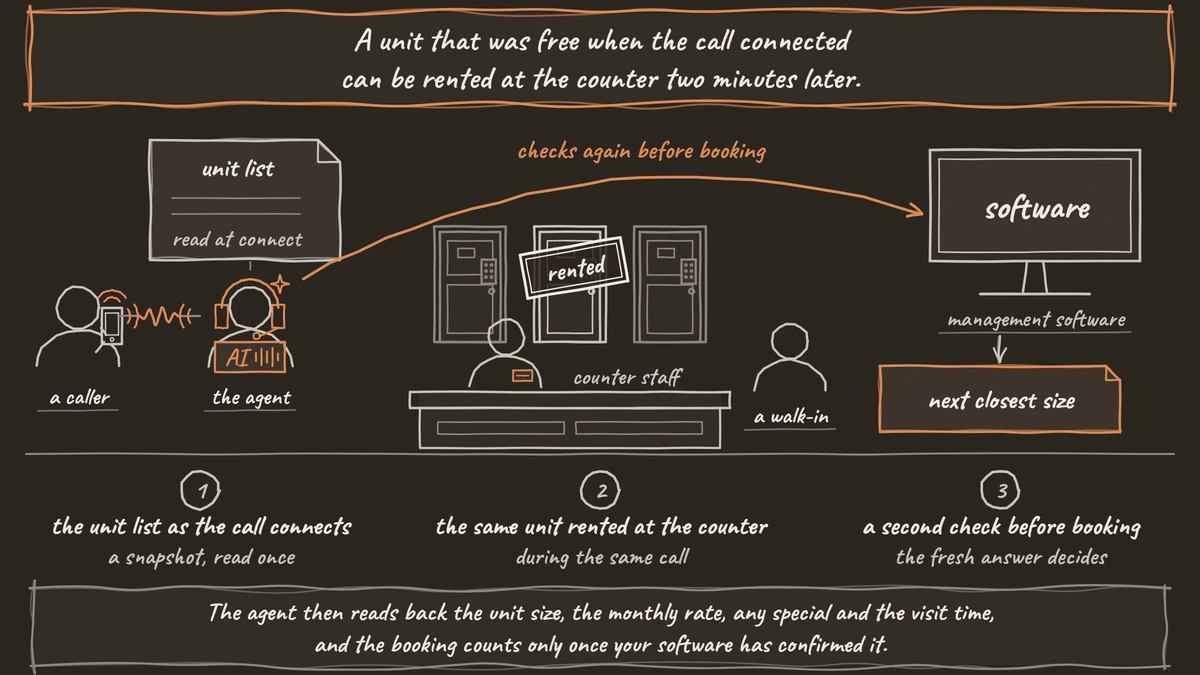
The same tool, or a second one, writes the reservation or the visit and gets a confirmation back. While the request runs, the tool's Messages setting can play a short line such as "Let me hold that for you", so the caller hears something. The agent then reads back the unit size, the monthly rate, any special and the visit time, and the booking counts only once your software has confirmed it.
Make writes safe to repeat, since a dropped call can send the same request twice. Add a Preset Parameter named workflow_run_id with the value {{initial_context.workflow_run_id}}, and your software can ignore a repeat. Money never changes hands on the call. If a reservation needs a deposit or the tenant wants to pay a move-in charge, an HTTP API tool asks your management software or payment provider to send its own secure link.

Open Source Alternative to Vapi / Retell
Self-hosted voice agent platform — no per-minute fees
dograh-hq/dograh
Star on GitHub
Gate codes and lockouts go to a person
A gate code opens a site full of other people's belongings, so the agent never reads one out, even to a tenant who has passed an identity check. The caller's number can find a tenant record, but it does not prove who is calling, and a code given to the wrong person cannot be taken back. Lockouts, overlocks for unpaid rent and anything about a lien sale go to the manager too.
Transfer Call works on Twilio, Telnyx, Plivo, Cloudonix and Asterisk ARI. Dograh calls the destination first and connects the caller only when someone answers, and a dynamic HTTP resolver can look up tonight's on-call manager, so the number is never hardcoded. If nobody answers within the timeout, the agent is told and stays on the call.
When nobody picks up, the agent takes the tenant's name, unit number and the problem, and an HTTP API tool writes a callback request to your management software or task list. Sites on Exotel, Vobiz or Vonage numbers use that callback request whenever a caller needs a person. Anyone who sounds in danger hears one fixed instruction, to get to safety and call 911. Our post on AI receptionist call transfers covers setting up these handoffs in more depth.
Join the Dograh Community
Dograh is an OSS alternative to Vapi. Join our Slack community for queries, releases, best practices & community interactions.
When the agent built into your software fits better
Some facility software now ships with a voice agent already connected. Tenant Inc.'s Lumio integration gives Lumio's agents access to tenant records, unit availability and payment data in Hummingbird, and Storable's integrations page lists Lumio and Patchwork Labs as AI call partners. swivl sells its own agents to operators too.
If you want an agent running this month with no build work, start there. An agent you build fits better when you want your own voice and models, want recordings and transcripts on servers you choose, or run sites on more than one management system and want one agent across them.
Running the storage agent in Dograh
You describe the agent in the Agent Builder, approve the "Your agent requirements" card and let it build the flow, then add the Pre-Call Data Fetch endpoint and the HTTP API tools for your software. Each facility number points at the same agent through its Inbound workflow setting, and your carrier, whether Twilio, Telnyx, Plivo or another, still provides the lines. Our guide to getting a phone number for an AI voice agent covers that step.
Dograh is the orchestration layer for the call flow, tools and telephony, while the speech-to-text, language model and voice are yours to pick. Unit words such as "climate-controlled" and "drive-up", and your facility names, go in the agent's Dictionary in Settings so speech-to-text hears them right.
After each call, a Webhook node can send the caller's details, the unit they asked about and links to the recording and transcript to your management software, so every inquiry becomes a lead. Callers answer by voice, and texts go out through your own provider via an HTTP API tool, for example a reservation confirmation.
Running Dograh yourself means no per-minute platform fee. It also keeps tenant calls on servers you control. You still pay for servers, model keys and phone minutes, and your team looks after the database and upgrades. Support comes from the open-source community, and Enterprise adds custom SLAs. If you would rather not host it, Dograh Cloud runs it for a 1 cent a minute platform fee, and its Pay as you go plan includes 10 calls at once, with more on request.
Where to start
Start with one facility and availability calls only. Point its number at the agent, check the snapshot against what your counter staff see, and listen to a week of calls. Add reservations once the re-check never misses, and keep gate codes and lockouts with your team from day one.
Glossary
- Pre-Call Data Fetch
- A request Dograh sends to your endpoint as the call connects, with the caller's and dialed numbers. Your endpoint returns facts such as that site's open units and rates.
- Snapshot
- The units, rates and specials loaded once at the start of a call. Good enough to answer questions, so a booking still needs a fresh check.
- Containment
- The share of calls an agent finishes without handing them to staff. swivl reported 68% for its self-storage agents in Q1 2026.
- Dynamic HTTP resolver
- A Transfer Call setting that asks your endpoint for the destination at transfer time, such as tonight's on-call manager, instead of a fixed number.