
An AI receptionist for a hair salon answers calls while you work, books, moves and cancels appointments, and sends complaints and price disputes to a person. It books only where your booking software lets an outside app write. For salons that want to own the setup, Dograh, the open-source AI voice agent platform, books through that software's API.
Key Takeaways
- Check that your booking plan lets an outside app write bookings before you buy.
- Moves and cancellations need an identity check and a read-back before anything changes.
- In Dograh, HTTP API tools book straight into the system your staff already use.
Most salon calls arrive while whoever would answer has scissors in hand. We start with whether your booking system lets an outside agent book at all, then we talk about how the agent books, moves and cancels, who takes complaints, and what 400 calls a month cost in Dograh.
Your booking system decides what the agent can do
Before you choose any receptionist, check what your booking software lets an outside app do. An agent that can read open slots but cannot write a booking can only take a message or send a link. That still helps, though a message is a weaker result than a booked chair, and each booking system draws this line in its own place.
Square is the clearest case. Square's Bookings API can search availability by service, team member and location, and it can create, update and cancel bookings. Writes for your own salon need a paid Appointments plan, Plus or Premium. On a plan without it, a write comes back with the error "Merchant subscription does not support write operations".
Other systems give an outside app less. Vagaro's public API describes reading appointment details such as status and start time, and its introduction lists no availability search or booking. Before you build anything, ask Vagaro what its API lets an outside app do on your account. Ask Fresha, Boulevard or any other system the same question, since access often depends on the plan you pay for.
Some booking systems sell their own receptionist. Reception by GlossGenius is a $50-a-month add-on that answers calls and texts around the clock and books into the GlossGenius calendar. If you already run GlossGenius and want nothing to build, that built-in route is worth a look. An outside agent makes sense when your system has a write API and you want to choose the voice, the models and where call records are kept.
Booking a new appointment while you work
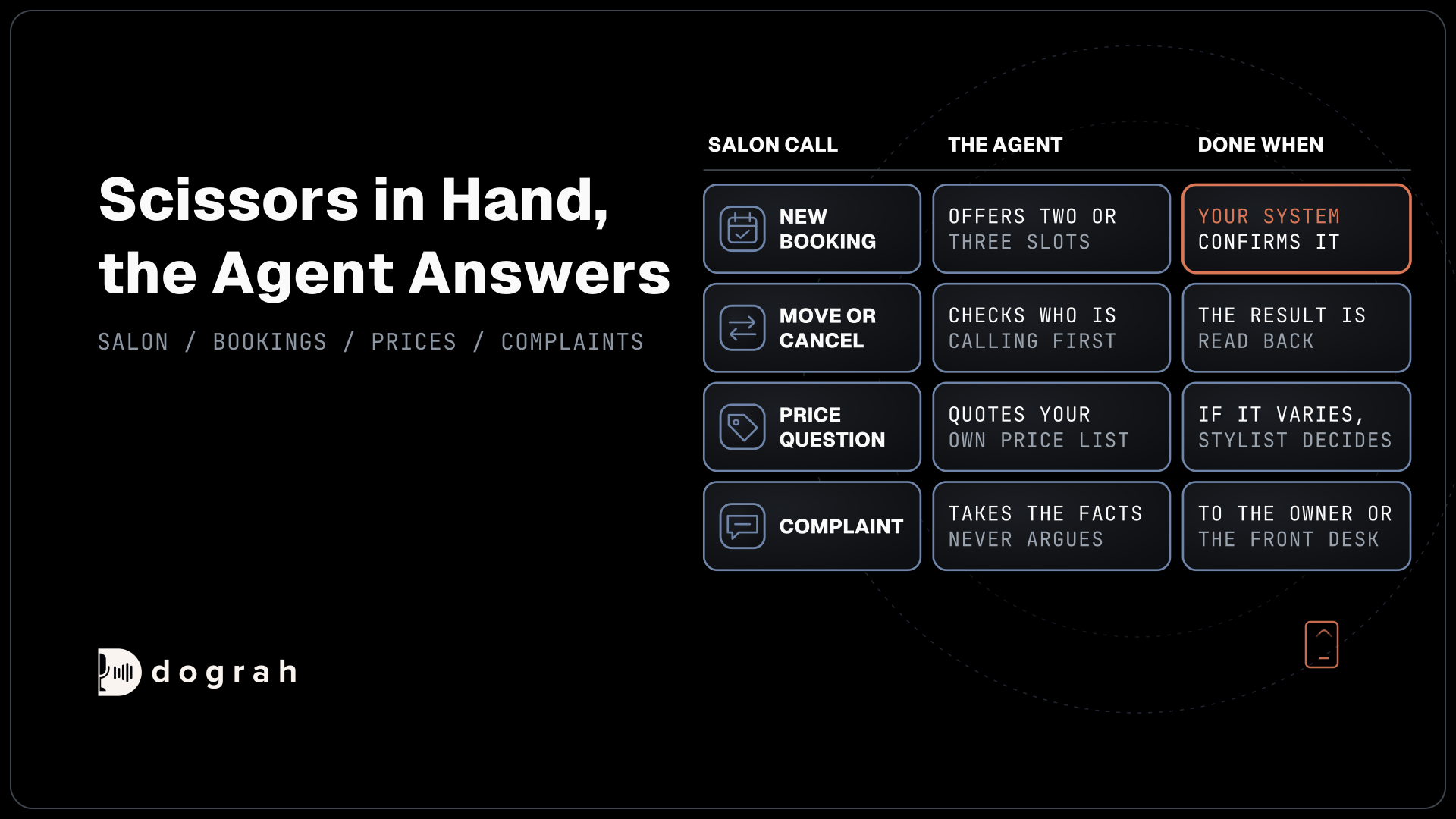
A new booking is a short loop, and the agent never guesses a slot. It asks for the service and the stylist, reads the open slots that fit from your booking system, offers two or three, writes the chosen one and reads it back. The booking counts only when your system confirms it.
In Dograh, an HTTP API tool does the read and the write during the call. While a request runs, the tool's Messages setting can play a short line such as "Let me check Ana's book", so the caller is never left in silence. Our post on AI voice agents for appointment scheduling covers this loop in full, including how to stop one request from booking twice.
Prices come from your own price list, written into the prompt or uploaded as a file to the Knowledge Base, so the agent quotes what you charge and never invents a figure. When a service is priced "from" a figure because length and hair type change it, the agent says so and leaves the final price to the stylist.

Open Source Alternative to Vapi / Retell
Self-hosted voice agent platform — no per-minute fees
dograh-hq/dograh
Star on GitHub
Moving and canceling, with a check first
A move or a cancellation changes someone's booking, so the agent confirms who is calling before it reads any booking back. The caller's number finds a booking, but it does not prove who is on the line. Partners and parents often book from their own phones for someone else, and anyone can call from any number.
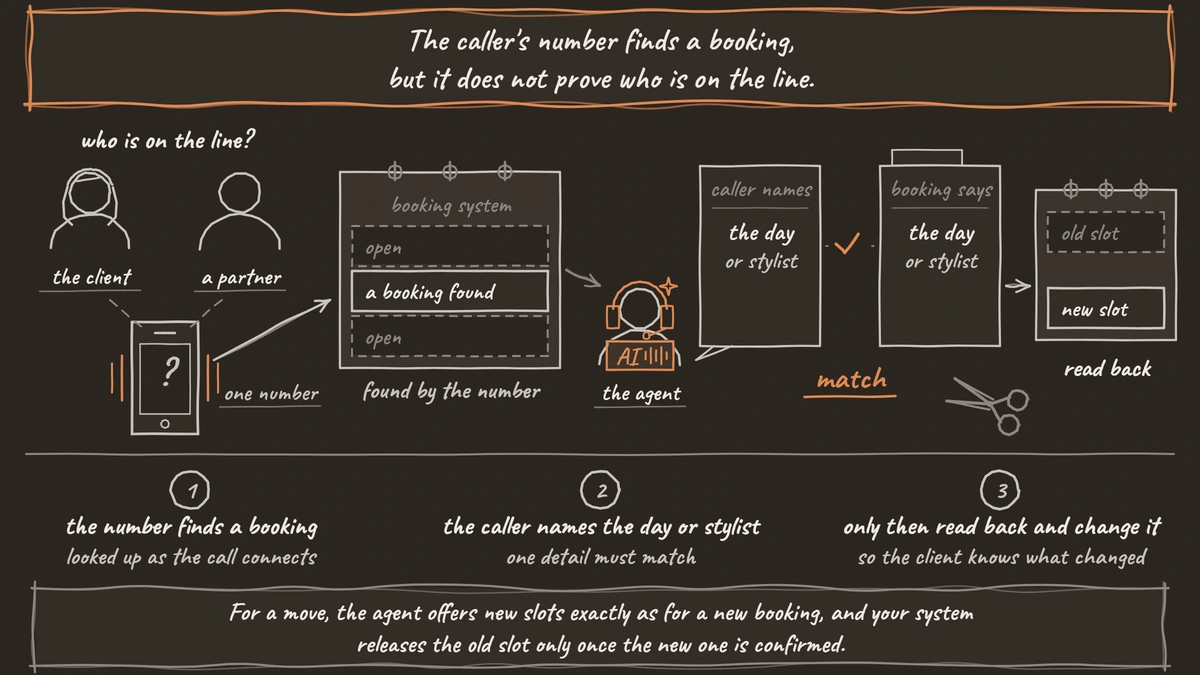
Pre-Call Data Fetch on the Start Call node can look up upcoming bookings by the caller's number as the call connects, and the caller hears ringing while it runs. The agent then asks the caller to name the appointment day or the stylist, or checks one detail on file such as the email address. Only when that matches does it read the booking back and talk about changing it.
The change itself goes through the same HTTP API tool. For a move, the agent offers new slots exactly as for a new booking, and your system releases the old slot only once the new one is confirmed. For a cancellation, it reads your cancellation policy from your own wording, states any fee as the policy says and never waives it. Then it reads the result back, so the client hangs up knowing what changed.
Phone lines drop and callers repeat themselves, so make every write safe to send twice. Add a Preset Parameter named workflow_run_id with the value {{initial_context.workflow_run_id}} to the tool, and your booking system can ignore a repeat instead of moving the booking twice. Refilling a canceled chair from a waitlist is a separate outbound call, covered in our post on AI voice agents for salons and barbershops.
Complaints and price disputes go to a person
Some calls should never stay with the agent. A client unhappy with a color, a dispute over what a service cost, a refund request and a reaction to a product all go to the owner or the front desk. On those calls the agent takes the facts and connects the caller, and it never argues a price or offers a discount.
Write that list into the prompt as plain rules. Transfer Call works on Twilio, Telnyx, Plivo, Cloudonix and Asterisk ARI. Dograh calls the destination first and connects the caller only when someone answers. If nobody picks up within the timeout, 30 seconds unless you change it, or the line is busy, the agent is told and the call carries on with it.
When nobody answers, the agent takes a message, and an HTTP API tool writes a callback request to your booking system or inbox with the client's name, the appointment and what went wrong. Salons on Exotel, Vobiz or Vonage numbers use this callback request every time a caller needs a person. A solo stylist can skip transfers altogether and return these calls between clients, as long as the message lands somewhere they check.
Join the Dograh Community
Dograh is an OSS alternative to Vapi. Join our Slack community for queries, releases, best practices & community interactions.
What 400 calls a month cost
The figures below are an example, so swap in your own call log. Take a salon with 400 calls a month at an average of 3 minutes each, which comes to 1,200 minutes.
Running Dograh yourself means no per-minute platform fee. You still pay for servers, model keys and phone minutes, and your team looks after the database and upgrades. Support comes from the open-source community, and Enterprise adds custom SLAs. If you would rather not host it, Dograh Cloud runs it for a 1 cent a minute platform fee, so 1,200 minutes come to $12 in platform fees for the month.
The phone line is a separate bill. On Twilio, receiving calls on a US local number costs $0.0085 a minute and the number itself $1.15 a month, so by our sum this salon's line comes to about $11.35. The speech-to-text, language model and voice you choose add their own per-minute rates on top, set by each provider.
Put the total beside what one lost booking is worth to you, and beside any receptionist you are pricing at the same volume. For a salon already on GlossGenius, Reception's flat $50 a month is the obvious number to set against it.
Setting up the salon agent in Dograh
You start in the Agent Builder by describing the receptionist in plain words, such as "Answer calls for a two-chair salon, book, move and cancel appointments in Square, and send complaints to the owner." The builder may ask a few questions, then shows "Your agent requirements" for you to approve before it builds the agent. You then add the HTTP API tools for your booking system and check each step on the canvas.
The agent answers on your existing salon number, through a carrier such as Twilio, Telnyx, Plivo or Vonage, and your carrier still provides the line. Our guide to getting a phone number for an AI voice agent covers pointing a number at an agent. As the orchestration layer, Dograh runs the call flow, tools and telephony, and you choose the speech-to-text, language model and voice for the agent from Dograh's models, your own keys or open models on your own servers.
Add stylist names and service words such as balayage, gloss or keratin to the agent's Dictionary in Settings, so speech-to-text hears them right. Callers answer by voice, and texts go out through your own provider via an HTTP API tool, so confirmations and reminders keep coming from your booking system. If you want to tell callers they're speaking with an automated assistant, or your location requires it by law, write it in the Greeting Text along with the salon's name.
Try each transfer on a real phone call before launch, since a test call in the browser cannot place one. Then let built-in QA score each step on a sample of live calls, so you can see where a move or a cancellation went wrong before a client tells you.
Where to start
Start with the booking-system check on your own plan. If writes are open, launch with new bookings and cancellations on one stylist's calendar, then add moves once the read-backs sound right. If you are still comparing receptionists for a small shop more broadly, our guide to AI receptionist for small business sets out what a small office needs and how far free plans go.
Glossary
- Bookings API
- Square's interface that lets an outside app search availability and create, update and cancel bookings. Writes for your own salon need Appointments Plus or Premium.
- Read-back
- The agent repeating the stylist, service, day and time after your booking system confirms a change, so the client hears exactly what was saved.
- Pre-Call Data Fetch
- A request Dograh sends to your endpoint as the call connects, carrying the caller's number. Your system answers with details such as upcoming bookings for the agent to use.
- Preset Parameter
- A fixed value an HTTP API tool sends with every request. Passing the call's workflow_run_id lets your booking system ignore a repeated write.