
A missed call in the trades costs the share of new jobs that never call back, times your close rate and average invoice. Count those inputs for two weeks. For trades businesses that want to own the fix, Dograh, the open-source AI voice agent platform, answers on your existing number and books into your job system where its API allows.
Key Takeaways
- Your own phone log beats any industry figure, so count two weeks first.
- Calling back later often fails, since most unknown-number calls go unanswered.
- Dograh answers, books or takes a message, and sends urgent jobs to a person.
A ringing phone on a job site is a choice between the customer in front of you and the one calling. We work out what the missed one costs, then we talk about how to count your own numbers, which fixes help, and how an agent in Dograh answers.
What a missed call costs, worked through
Not every missed call is a lost job, so the math needs filters. Some calls are suppliers or existing customers, and some new customers call back or answer when you ring them. What you lose is the new work that goes elsewhere, multiplied by how often you would have won it and what it would have paid.
Written as a formula, it is missed calls, times the share that were new work, times the share that never come back, times your close rate, times your average invoice. Every number below is an example, so replace each one with your own before you trust the answer.
Say you miss 15 calls a week. If 40% were new work, that is 6 calls. If half of those never call back or answer your callback, 3 jobs were in play. At a 50% close rate on quoted jobs, you would have won 1.5 of them, and at a $450 average invoice that is $675 a week. Over 50 working weeks it comes to $33,750.
Your figure could be far higher or lower. Emergency-heavy work, such as no-heat calls in January, has a high never-back share because the customer rings the next name on the list straight away. Planned work, such as a panel upgrade, gives you more time. That is why per-call dollar figures you see quoted online vary so much, and why your own inputs matter more than anyone's average.
Counting your own numbers in two weeks
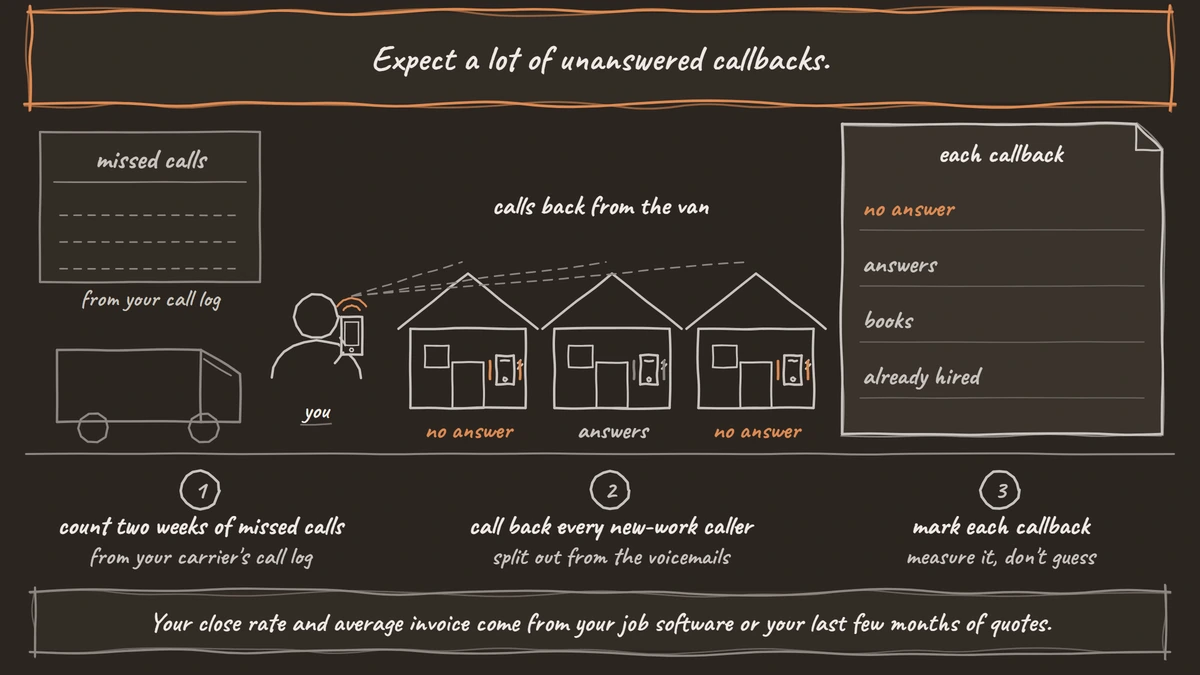
Two weeks of counting gives you a figure you can believe. Missed calls come from your carrier's call log or phone bill. To split new work from the rest, listen to the voicemails and note who each caller was. Your close rate and average invoice come from your job software or your last few months of quotes.
The never-back share is the one most people guess, so measure it. Call back every missed new-work caller and mark who answers, who books and who has already hired someone. Expect a lot of unanswered callbacks. Hiya's State of the Call 2026 reports that 86% of calls from unknown numbers go unanswered, and a callback from your personal mobile is an unknown number to most customers.
Speed counts on the customer's side too. In Jobber's home service trends report, a December 2025 survey of 1,050 US home service business owners, speed of first response was a key choice factor for 25% of customers, and 60% of the businesses reply to new leads the same day, with 20% inside an hour. For a second worked example with different inputs, see our guide to an AI receptionist for tradies in Australia.
Four ways to stop missing calls
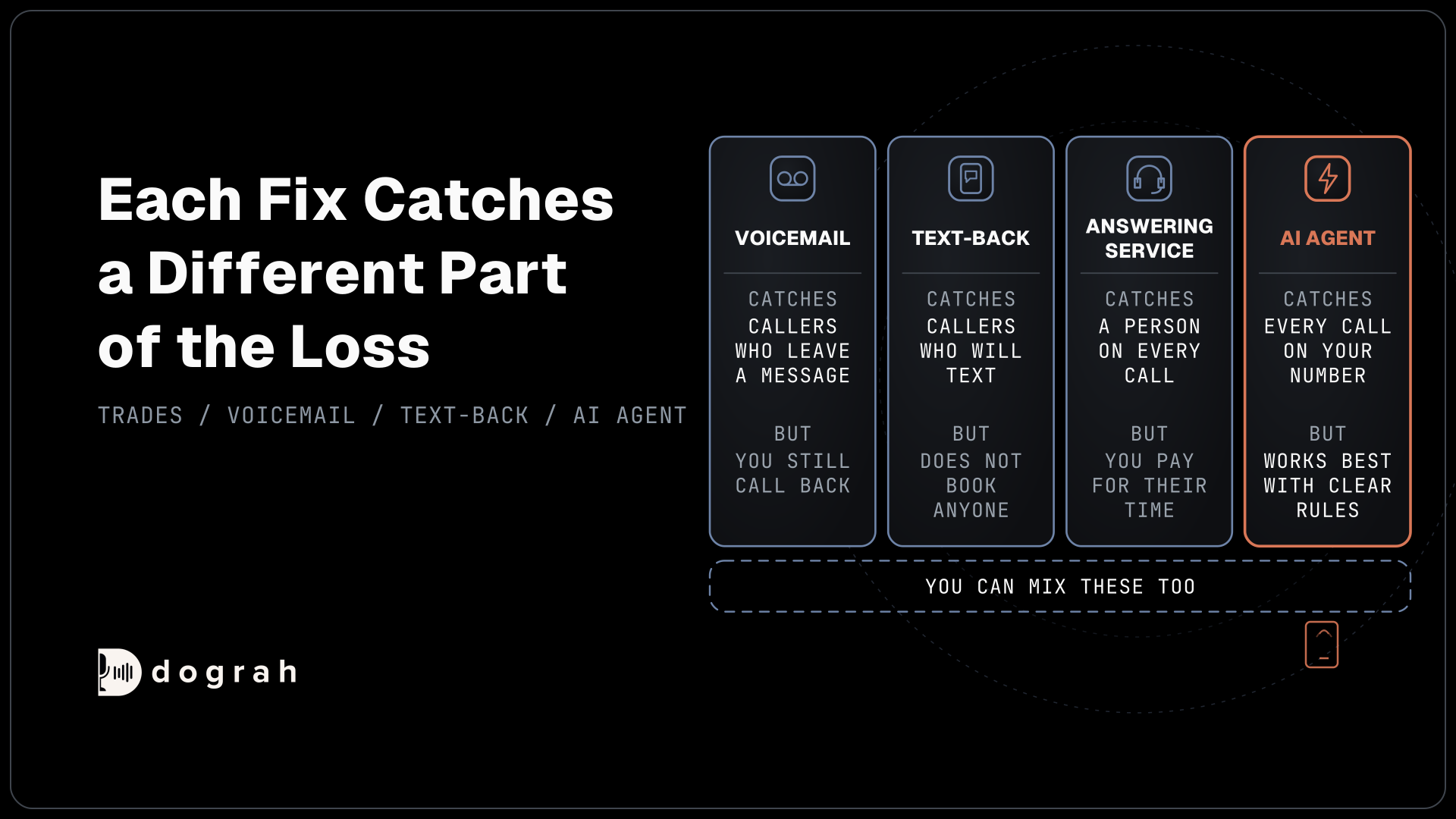
Each fix catches a different part of the loss. Voicemail costs nothing and catches only the callers willing to leave a message, and many new customers will not. You still have to call back, which brings the unanswered-callback problem with it.
A text sent from your own phone system or job software when a call goes unanswered tells the caller you saw it and asks what they need. It helps with callers who will text, but it does not book anyone or reach the person whose boiler has just failed.
A staffed answering service puts a person on every call. Most take messages, and some can book into your calendar if you give them access. A person handles unusual calls well, though you pay for their time and their notes still need writing into your job system.
An AI agent answers every call on your existing number, books into your job system where its API allows, takes a message for everything else and sends urgent jobs to a person. It works best when the rules are clear, such as which jobs you take, your service area and what counts as urgent. You can mix these too, with the agent taking every call and your text-back covering anyone who hangs up before it answers.

Open Source Alternative to Vapi / Retell
Self-hosted voice agent platform — no per-minute fees
dograh-hq/dograh
Star on GitHub
How an agent answers, books or takes a message
The agent answers on your existing number and asks what the job is, where it is and how urgent it feels. Our post on a contractor answering service with AI covers the five ways these calls can end, so here is the short version.
If the customer wants a visit, an HTTP API tool reads open slots from your job system, such as Jobber or Housecall Pro, and writes the booking where that system's API allows outside bookings. The agent reads the day and time back, and the booking counts once your system confirms it.
If the customer only wants a quote or a callback, the agent takes a message, records the name, address, job and best callback time, and a Webhook node sends it to your job system or inbox after the call. Temporary failures are retried automatically.
Urgent jobs go to a person. Transfer Call works on Twilio, Telnyx, Plivo, Cloudonix and Asterisk ARI, and Dograh calls the destination first and connects the caller only when someone answers. If the on-call person misses it, the agent stays with the caller and an HTTP API tool writes an urgent callback request. For electricians, the urgent list starts with sparks, burning smells and outages, as our post on electrical contractors explains.
Some calls need a fixed safety line before anything else, such as a gas smell, and each trade sets its own. Our guides for HVAC companies and plumbing companies give the wording for theirs and where to set it so it plays exactly as written.
Join the Dograh Community
Dograh is an OSS alternative to Vapi. Join our Slack community for queries, releases, best practices & community interactions.
What answering costs next to the missed jobs
Set the cost of answering beside the figure from your own count. Say the agent takes 200 calls a month at 3 minutes each, which is 600 minutes. These numbers are an example too.
Running Dograh yourself means no per-minute platform fee. You still pay for servers, model keys and phone minutes, and your team looks after the database and upgrades. Support comes from the open-source community, and Enterprise adds custom SLAs. If you would rather not host it, Dograh Cloud runs it for a 1 cent a minute platform fee, so 600 minutes come to $6 in platform fees for the month.
The phone line and models are separate bills. A Twilio number charges $0.0085 a minute for incoming calls on a US local line, plus $1.15 a month to keep it, which we work out at about $6.25 for those 600 minutes. The speech and language models you choose add their own per-minute rates. Against the example's $675 a week, the sums are easy to compare at your own volume.
Setting up the trades agent in Dograh
You describe the agent in the Agent Builder, such as "Answer calls for a two-van plumbing business, book jobs in our service area and send burst pipes to the on-call plumber." The builder may ask a few questions, shows "Your agent requirements" for you to approve, then builds the agent, and you add the tools for your job system.
Dograh handles the call flow, tools and telephony as the orchestration layer, and you pick the speech-to-text, language model and voice that suit your calls. Trade words and local street or suburb names go in the agent's Dictionary in Settings, so speech-to-text hears them right. Callers answer by voice, and texts go out through your own provider via an HTTP API tool, for example a booking confirmation.
Run your transfers on real phone calls first, as a browser test call cannot make one. Built-in QA then scores each step on a sample of live calls, and you can read the transcripts of any call that ended in a message rather than a booking.
Where to start
Count your two weeks first, then turn the agent on after hours only. Compare the bookings and messages it takes with what voicemail used to catch, and move it to daytime overflow once the urgent-job transfers work every time.
Glossary
- Close rate
- The share of quoted jobs you win. Take it from your job software or your last few months of quotes, not from a guess.
- Never-back share
- The share of missed new-work callers who neither call back nor answer your callback. Measure it by returning every missed call for two weeks.
- Callback request
- A note the agent writes to your job system when a transfer goes unanswered, with the caller's name, job and best time to call back.
- Webhook node
- A step that runs after the call and sends the details the agent gathered to your job system or inbox, retrying temporary failures automatically.