
AI voice agents for plumbing companies take the calls an answering service would, including leaks, clogs, water heater problems and new bookings. They quote only fixed prices from the company's own list and book live windows. Gas smells get fixed words to leave and call 911, and after-hours emergencies go to the on-call plumber with the details written first.
Key Takeaways
- The agent reads only fixed prices from your list, never repair estimates.
- A gas smell gets fixed words to leave and call 911 from outside.
- Night emergencies reach the on-call plumber with the address already written down.
Water through the ceiling at night and a running toilet need very different answers, yet both often reach voicemail. This guide shows how Dograh handles gas and flooding calls first, then bookings, fixed-price quotes, the on-call plumber, water heater calls and where call data sits. You can self-host Dograh or run it on Dograh Cloud.
The calls a plumbing company gets
A plumber's phone carries a few kinds of calls, and most of them are routine. Someone has a slow drain or a running toilet. Someone else has no hot water, or water coming through the ceiling. A landlord wants a quote for a new water heater, and a homeowner wants to know what a visit costs before booking.
Plumbers cover those calls at all hours. The Bureau of Labor Statistics outlook for plumbers counts about 510,600 plumber, pipefitter and steamfitter jobs in 2025 and projects 7% growth to 2035, with about 42,000 openings a year. It notes that plumbers are often on call for emergencies, so evening and weekend work is common.
Most leaks are slow and quiet. The EPA's WaterSense program estimates that an average household's leaks can waste more than 9,300 gallons a year, and that nine percent of homes have leaks wasting 50 gallons or more a day. A dripping faucet like that books a normal window. A burst pipe goes to the on-call plumber. The agent's first job is to tell the two apart using your own list.
An answering service writes down the message. A voice agent can read your schedule and your price list during the call, book the job and write it back to your field-service software, so the office starts the morning with jobs instead of messages. Commercial callers add their own pattern. A restaurant with a blocked grease line needs a plumber before the dinner rush, so the agent records the opening hours along with the address.
Gas, flooding and water near electrics
The calls that can hurt someone get designed first, before any booking prompt. Plumbers work on gas water heaters and gas lines, so a plumbing line hears gas calls too. Federal pipeline safety guidance says not to use a phone near a suspected leak and to call 911 from somewhere well away from it. The CDC also names water heaters among the household appliances to have serviced against carbon monoxide.
So a gas call gets one fixed line and no questions: "If you smell gas or your carbon monoxide alarm is going off, leave the building now and call 911 or your gas company from outside." The agent plays it and ends the call. A Webhook node then sends the caller's number and the outcome to your system, which alerts the on-call plumber.
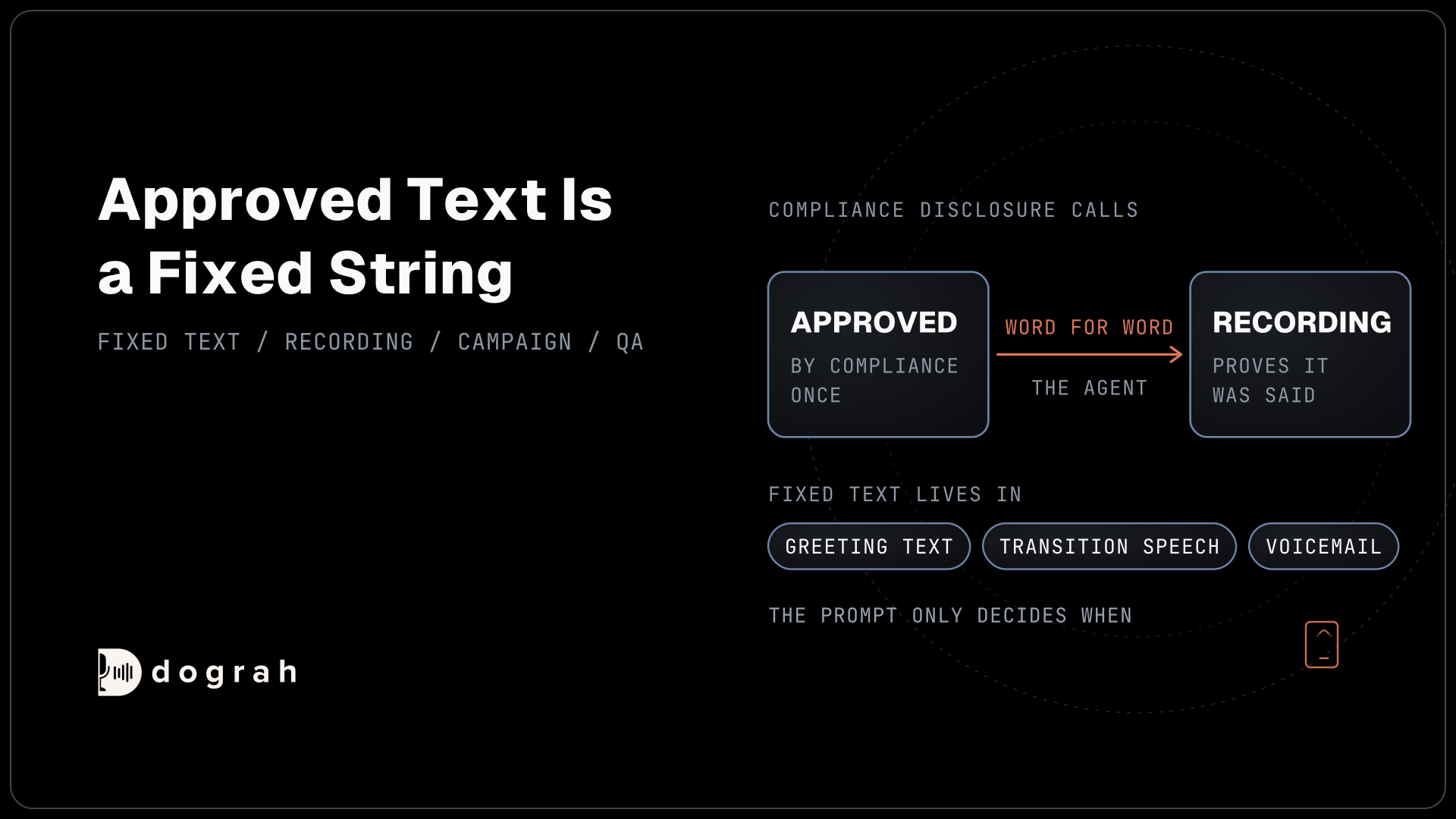
That line has to be fixed text, because inside a step the language model writes its own words. Put a short version in the Greeting Text, which every caller hears word for word, so it reaches someone who never says "gas". Allow Greeting Interruption is on by default, so switch it off on the Start Call node and the warning plays to the end. Repeat the line as Transition Speech on a "gas smell" pathway. The model decides when that pathway applies, so test it with phrases like "the basement smells like rotten eggs".
An active leak needs speed, and possibly a valve. Your company decides whether the agent tells callers where the main shut-off valve usually sits and how to close it. If you approve that wording, it plays as fixed text on the "active leak" pathway. If you don't, the agent skips it and goes straight to the on-call plumber.
Water near outlets or an electrical panel is a danger call first. The fixed line tells the caller to stay away from the water and the outlets, and "if anyone is in danger, get to safety and call 911." Then the call goes to the on-call plumber. A sewage backup is urgent too, and any advice beyond "a plumber is on the way" is your company's approved wording, never the model's.
Booking jobs into your schedule
Booking is the call that turns into revenue, and it should land straight in your field-service software. The agent sorts the job first, because a drain clearing and a water heater install take very different amounts of time. It checks the address against your service area through an HTTP API tool, then reads open arrival windows from your schedule during the call.
It offers only the windows your system returns, reads the job and the address back, and writes the job. The booking counts once your software returns a job number. AI voice agents for home-services appointment booking walks through that loop step by step, including duplicate protection and the failed-request path.
Repeat customers and landlords call often, and the lookup can start before hello. Pre-Call Data Fetch sends the caller's number to your system as the call connects and loads the matching customer record. A record found by phone number could belong to whoever picked up the handset, so every call runs greet, verify, then disclose. The prompt keeps past jobs and addresses unspoken until the caller passes a check your company approves, such as stating the service address on the account. A property manager calling about several buildings confirms each address the same way before the agent books against it.
Quotes from your price list
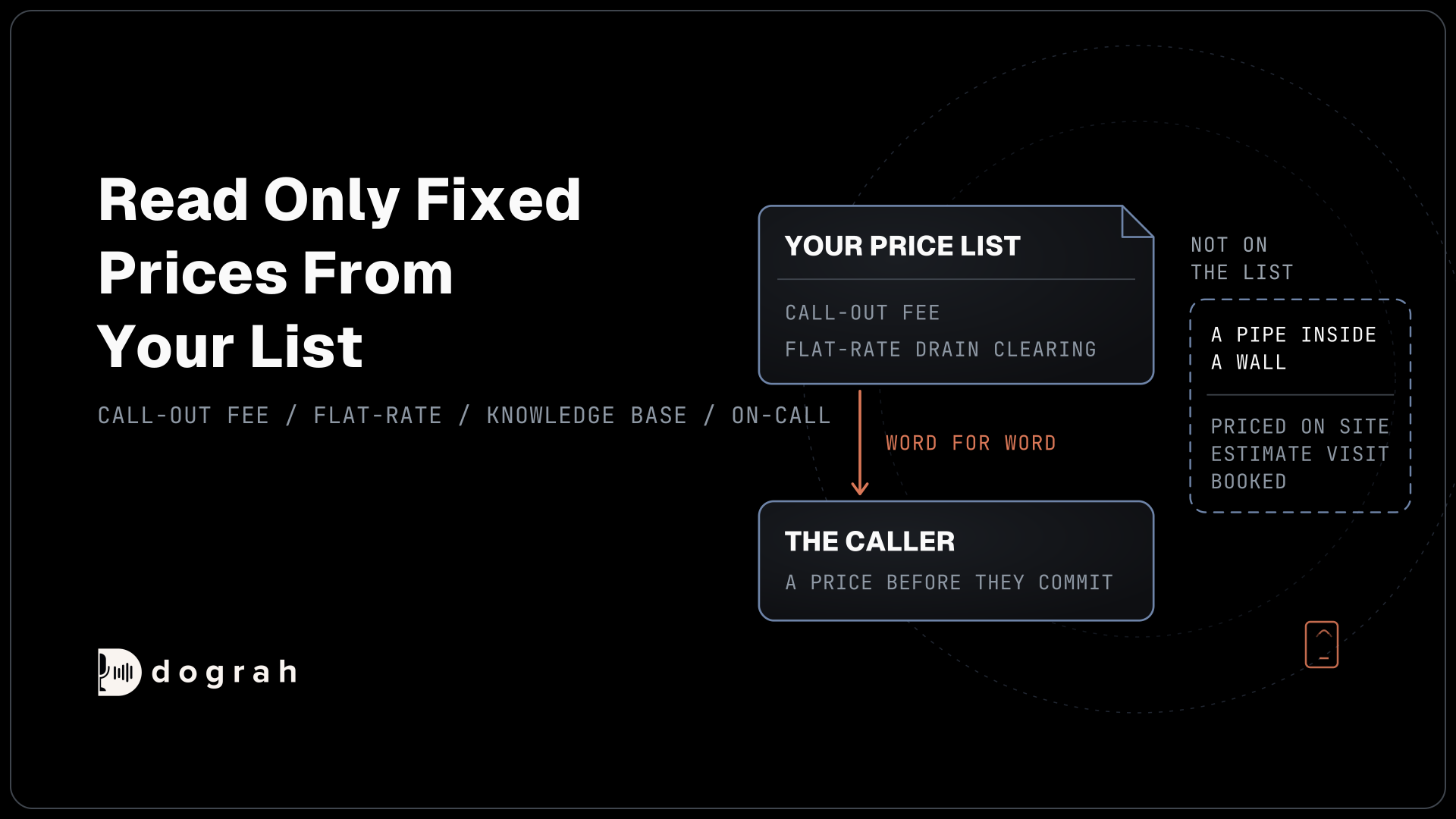
Callers want a price before they commit, and the agent can give a few of them. It reads only fixed prices your company publishes, and everything else is priced on site.
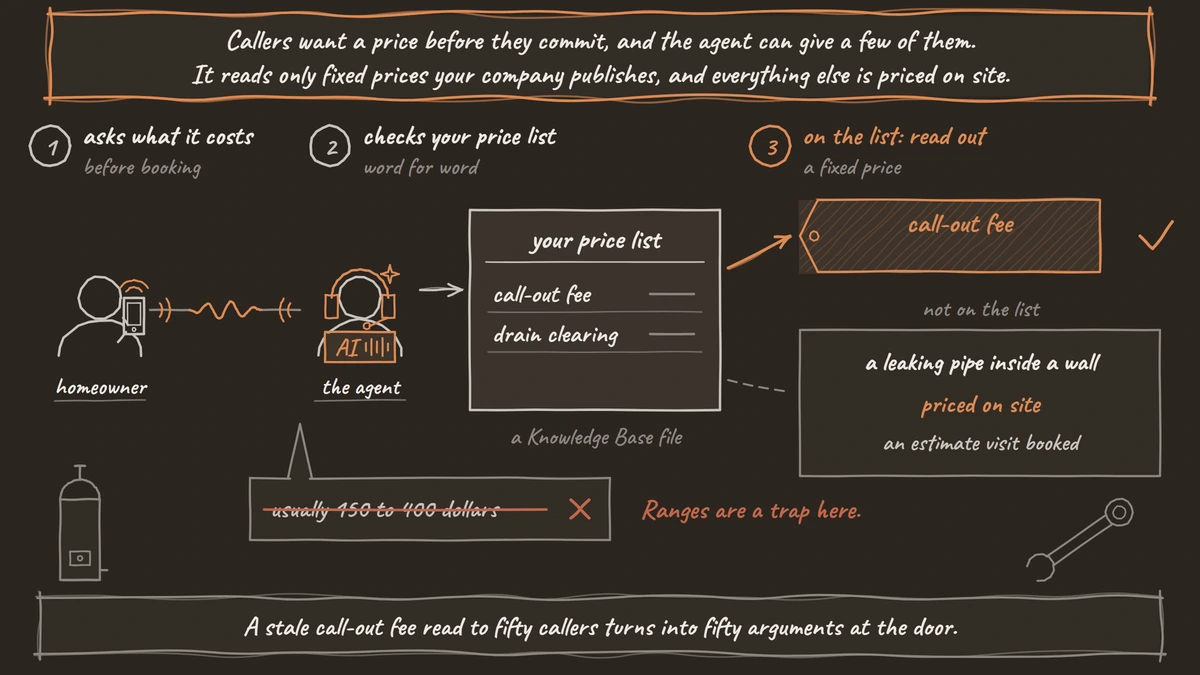
Fixed prices are the ones that do not depend on what the plumber finds. A call-out fee and flat-rate pricing for a drain clearing qualify. A leaking pipe inside a wall does not, because nobody knows the job until someone opens it. Ranges are a trap here. A caller who hears "usually 150 to 400 dollars" remembers 150.
Put the fixed prices in a Knowledge Base file the agent reads, such as a PDF or a DOCX of up to 5 MB, or serve them from an HTTP API tool if prices change often. The prompt tells the agent to read a price only when it appears in that file, word for word, and to say anything else is priced once the plumber sees the job. A caller who still wants a number gets an estimate visit booked.
Keep that file current. When a fee changes, upload the new file the same day and remove the old one, because the agent reads whatever the file says. A stale call-out fee read to fifty callers turns into fifty arguments at the door.
Written quotes for bigger jobs, such as a repipe, need a follow-up once they are sent. AI voice agents for quote follow-up in home services covers that call.

Open Source Alternative to Vapi / Retell
Self-hosted voice agent platform — no per-minute fees
dograh-hq/dograh
Star on GitHub
After-hours emergencies and the on-call plumber
Night calls split into two groups, the ones that can wait for morning and the ones that cannot. A running toilet at 10 p.m. books the first window tomorrow. A burst pipe goes to the on-call plumber now.
The owner writes the list of what counts as a night emergency, such as a burst pipe or sewage coming back into the house. The agent follows that list and never decides urgency on its own. A caller whose problem is not on it hears the first morning window and a promise that the office has the details.
Transfer Call works for plumbers on Twilio, Telnyx, Plivo, Cloudonix and Asterisk ARI. Dograh dials the on-call plumber before moving the caller, and joins the two only after the plumber picks up. With Twilio, a brief spoken introduction can play to each side first.
Your on-call rota changes through the week, so set the destination source to Dynamic HTTP Resolver. Dograh asks your rota system for tonight's number during the call. No summary travels with the transfer by default, so the agent writes the address and the problem, including whether water is still running, to your system through an HTTP API tool first.
When the plumber's phone goes unanswered for the 30-second default, the caller is still on the line with the agent. Tell it in the prompt to take a callback request and set off your paging system through an HTTP API tool, so the plumber's phone rings again even after the call ends. AI voice agents for after-hours coverage covers the night shift and its escalation list in detail.
Join the Dograh Community
Dograh is an OSS alternative to Vapi. Join our Slack community for queries, releases, best practices & community interactions.
Water heater calls
Water heater calls come in two kinds, and the agent treats them differently. A leaking tank is an active leak and takes that path. No hot water from an old unit is usually a repair or replacement decision, and that belongs to a plumber.
The agent does not walk anyone through relighting a pilot or resetting a gas valve. It records what the caller says about the unit, such as its age and whether it runs on gas or electricity, and books a visit. If the caller asks whether to replace it, the agent books an estimate and writes the question down for the plumber.
Those notes save a trip. A plumber who knows it is a 15-year-old gas tank can bring the right parts, or a replacement quote, the first time.
Where the call data sits
Plumbing calls carry home addresses and access details, so decide where they live before the first call. Dograh is self-hostable. Run it on your own servers and the recordings and transcripts stay in your own storage.
Dograh handles the orchestration, meaning the call flow, the tools and the telephony, while the speech and language models are a separate layer a plumbing company picks. Using your own keys to a model provider (BYOK) puts the contract in your name, yet the caller's audio still goes to that provider. Keeping audio in-house takes open-weight models on your own servers, for example Qwen3.8 27B for language, Parakeet TDT 0.6B v2 for speech-to-text and Magpie TTS for the voice.
Self-hosted installs also report anonymous usage telemetry by default, and setting ENABLE_TELEMETRY=false and removing POSTHOG_API_KEY switches that off. Self-hosting Dograh carries no per-minute platform fee, but the plumbing company still pays for servers, model keys and phone minutes. A plumber on Dograh Cloud pays a 1¢-a-minute platform fee. Our page on self-hosted voice agents for HVAC and plumbing companies covers that setup.
Where to start
Start with the night line, because those calls go to voicemail today. Build the safety paths first and test them until they hold, then let the agent take night calls and book morning windows. Daytime bookings come next. Quotes come last, once your price list is clean enough for the agent to read word for word.
Test on a real phone line as well as in the browser. Most phone calls still reach the agent as 8 kHz audio, while a browser test runs at 16 kHz, so street names and brand names can sound different to the speech model. Add words such as PEX, backflow and your water heater brands to the Dictionary in the agent's Settings. Then read a week of night transcripts before you widen anything, and look for calls the agent sent to the morning that your on-call plumber would have taken that night.
Heating and cooling companies face the same safety questions with different equipment, and AI voice agents for HVAC companies covers their calls.
Glossary
- Call-out fee
- A fixed charge for sending a plumber to the property, before any repair. It is one of the few prices the agent can read out, because it does not depend on what the plumber finds.
- Flat-rate pricing
- A set price for a defined job, such as clearing one drain, whatever the time it takes. The agent reads it only when it appears in the company's own price list.
- Main shut-off valve
- The valve that stops water to the whole property. Whether the agent tells callers where it usually is, and how, is the plumbing company's approved wording, played as fixed text.
- On-call rota
- The schedule of which plumber takes emergencies each night. A Dynamic HTTP Resolver lets Dograh ask the rota system for tonight's number during the call.