
AI voice agents for senior living answer family and prospect calls, book tours from your calendar and place check-in calls residents have agreed to, while care questions go to staff. For communities that want resident calls on their own servers, Dograh, the open-source AI voice agent platform, can run every one of these calls self-hosted.
Key Takeaways
- Pricing comes from your published sheet, and care-level questions go to staff.
- Check-in calls need consent first, and the agent never judges how someone is.
- In Dograh, a missed check-in is written to your system for staff.
Senior living phones carry very different calls, from families comparing communities to residents expecting a friendly check-in. We cover daytime family and prospect calls, then we talk about how tours are booked, how check-in calls work with consent, where privacy rules apply, and how each runs in Dograh.
Who calls a senior living community
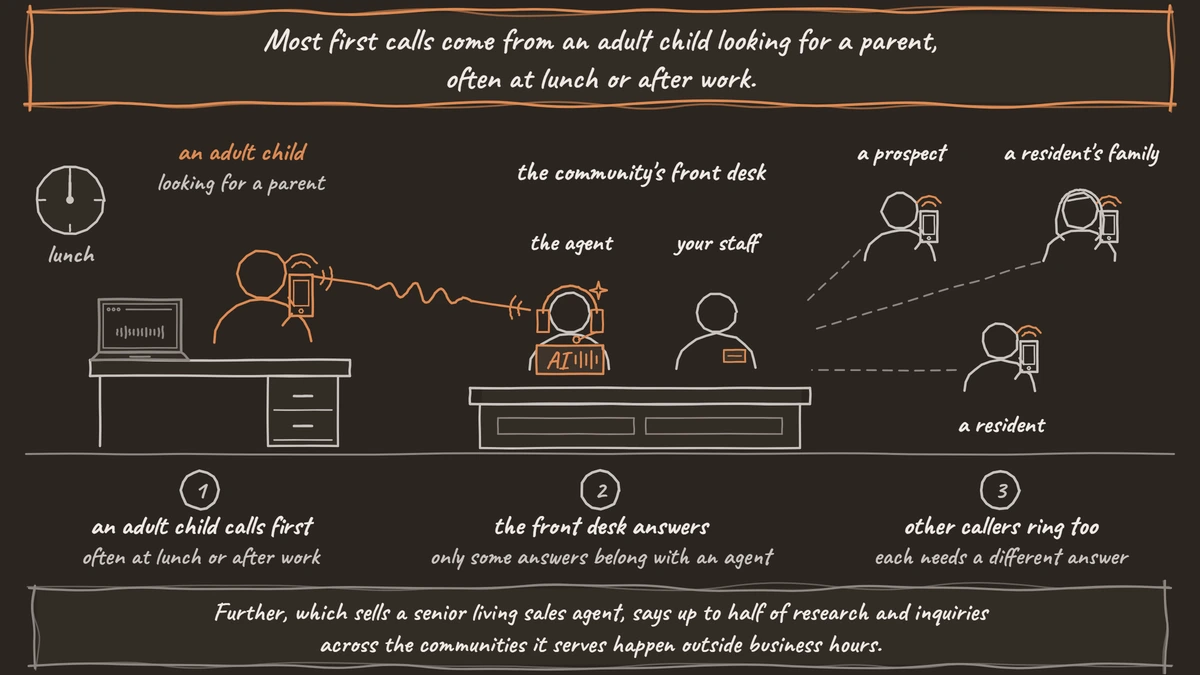
Most first calls come from an adult child looking for a parent, often at lunch or after work. Prospects call for themselves too, and families of current residents ring about visits, events and billing, while residents call the front desk for almost anything. Each caller needs a different answer, and only some of those answers belong with an agent.
Demand is high. NIC MAP's third-quarter figures put occupancy at 91.7% in majority independent living properties and 89.1% in majority assisted living in Q3 2026, both up on the quarter before. With communities that full, a missed inquiry can cost a move-in, and waitlist calls grow.
Many of those calls come late. Further, which sells a senior living sales agent, says up to half of research and inquiries across the communities it serves happen outside business hours. Nighttime family questions about a resident are their own case, with stricter limits on what the agent may say, and our post on answering family questions after hours covers that call.
Pricing and care questions from prospects
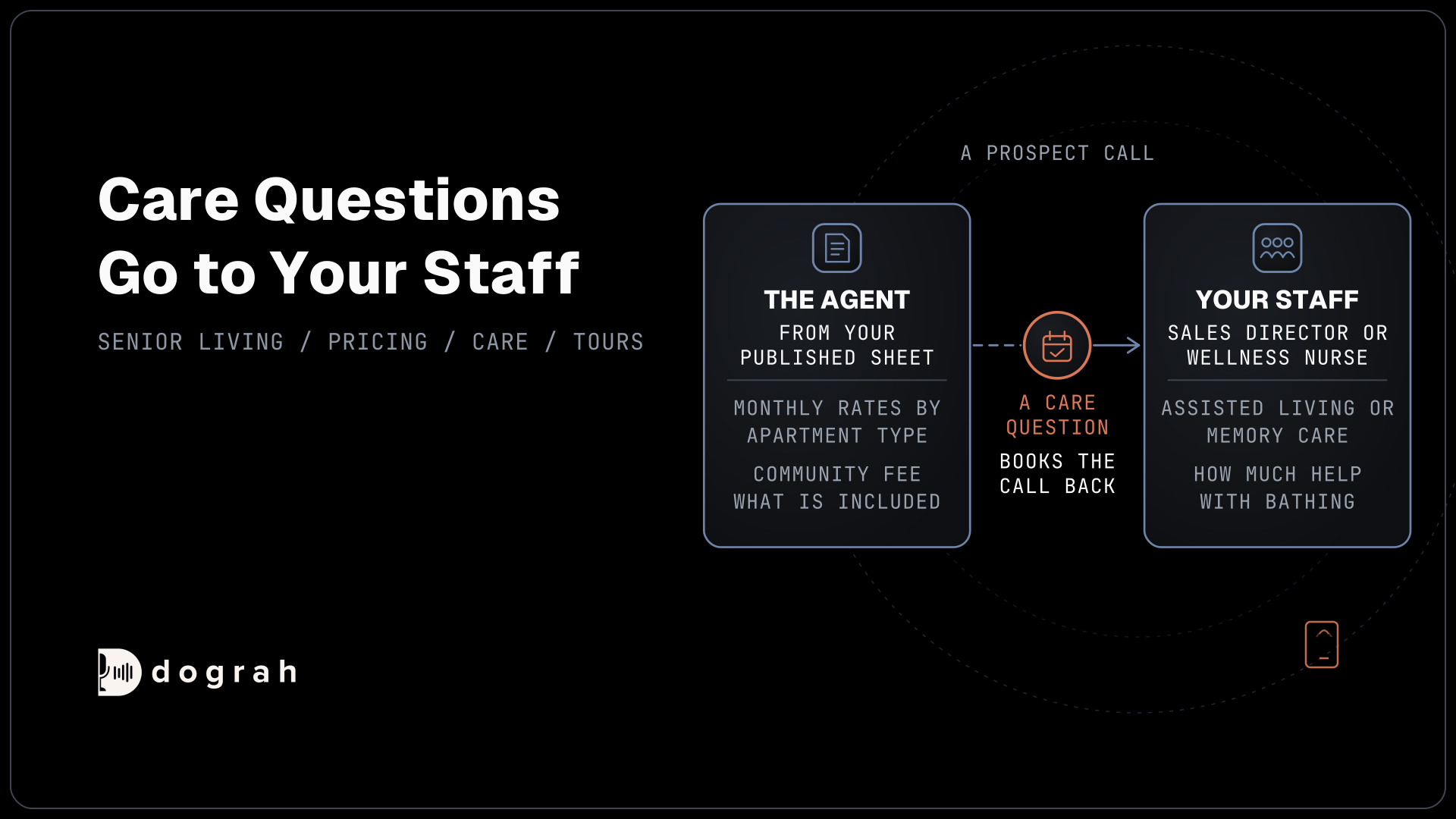
Prospects ask about price early, and the agent should answer from your own published sheet, never a guess. Put the monthly rates by apartment type, the community fee and what is included into a file in the Knowledge Base or the prompt. When a price depends on an assessment, the agent says so and offers a call with the sales director.
Care questions are different. Whether a parent with early memory loss fits assisted living or memory care, or how much help with bathing is included, is a judgment for your sales director or wellness nurse. The agent never screens care needs, never asks about diagnoses and never tells a family that a parent qualifies. It takes the question, the parent's first name and the best time to call back, and books that call.
That split protects families as much as the community. An adult child who hears "your mother would be fine in assisted living" from an agent may plan a move on it, and nobody has met her yet.
Booking a tour, and the waitlist
Tours are the call to get right, since they turn an inquiry into a visit. During the call, an HTTP API tool reads open tour slots from your CRM or calendar, the agent offers two or three, and the same tool writes the chosen one back. The tour counts only once your system confirms it.
The agent asks who is coming, whether the parent will join and whether anyone needs a ramp or wheelchair access, then reads the day, time and names back. Adult children often book from another city, so it also asks which number to call if the time changes. The visit details go into the lead record your sales team already works from.
When the apartment type a family wants is full, the agent says so plainly and offers the waitlist. An HTTP API tool writes the family to it in your CRM with the apartment type and timing they gave. The agent never promises an apartment or a move-in date, because your team decides who is offered the next one.

Open Source Alternative to Vapi / Retell
Self-hosted voice agent platform — no per-minute fees
dograh-hq/dograh
Star on GitHub
Resident check-in calls and the four rules
Check-in calls to residents are outbound calls to older adults, so they run on four rules. First, consent. A resident, or the person legally able to agree for them, says yes to these calls, and your system records it before any call is placed.
Second, the agent never judges how someone is. It asks the questions your care team wrote, such as "Did you sleep well?" or "Are you joining lunch today?", and records the answers as the resident gave them, with the recording and transcript as the exact record. It never decides that someone sounds fine.
Third, a missed check-in is written for staff. In a Dograh campaign, you set calling hours by weekday in one time zone and choose how many times to retry, from 0 to 10, with a delay between tries. Turn voicemail handling on and leave "When voicemail is detected" on Disconnect the call, so the agent never leaves a check-in message. When the last try goes unanswered, a Webhook node or an HTTP API tool writes "no answer" to your system so a person goes to the door.
Fourth, any worry goes to a person, every time. A resident who mentions a fall, pain, dizziness or feeling low is connected to the duty nurse or front desk straight away. Anyone in danger is told to get to safety and call 911.
Privacy and consent rules that apply
The Health Insurance Portability and Accountability Act (HIPAA) applies only to covered entities, meaning health plans, clearinghouses and providers that send standard electronic transactions such as bills to a health plan. Many assisted living communities may fall outside it and most independent living does, while state privacy laws can still apply. Our post on answering family questions after hours in assisted living covers what a family caller may hear where HIPAA does apply.
Outbound calls have their own rule. Under the FCC's 2024 ruling, AI-generated voices count as an artificial voice under the Telephone Consumer Protection Act (TCPA), so a call in an AI voice needs the called person's prior express consent unless an emergency or exemption applies, and marketing calls such as tour follow-ups need consent in writing. That is why check-in consent is recorded before the first call.
Age rules matter on prospect calls too. The Fair Housing Act exempts qualifying housing for older persons, at 55 and over or 62 and over, from its familial status rules, so the agent reads your written age and eligibility policy word for word and never decides who qualifies. These points are general, and your community's own position on HIPAA, consent and age rules is worth confirming with counsel before the first call goes out.
Join the Dograh Community
Dograh is an OSS alternative to Vapi. Join our Slack community for queries, releases, best practices & community interactions.
Running senior living calls in Dograh
You describe each agent in the Agent Builder, approve the "Your agent requirements" card and let it build, then add the tools for your CRM and calendar. As the orchestration layer, Dograh runs the call flow, tools and telephony, and you choose the speech and language models for each agent. A community can give prospects and families one number and still keep the conversations separate, a pattern our post on AI voice agents for home health and hospice shows with several focused agents behind one line.
Transfer Call works on Twilio, Telnyx, Plivo, Cloudonix and Asterisk ARI. Dograh calls the destination first and connects the caller only when someone answers, so a worried resident is never put through to an empty desk. If nobody answers within the timeout, the agent stays with the caller and an HTTP API tool writes an urgent callback request for staff. Built-in QA then scores each step of a sample of calls and can tag any call where the agent drifted into a resident's health, so your team reviews it and tightens the prompt.
Self-hosting keeps resident and family calls on servers you control, and a self-hosted install needs no BAA with Dograh. Model providers that handle protected health information may need their own, the phone carrier may need one depending on what it stores, and a cloud account running the servers needs one too. In your own data center, that last agreement falls away.
Running Dograh yourself means no per-minute platform fee. You still pay for servers, model keys and phone minutes, and your team looks after the database and upgrades. Support comes from the open-source community, and Enterprise adds custom SLAs. If you would rather not host it, Dograh Cloud runs it for a 1 cent a minute platform fee.
Where to start
Start with daytime prospect calls and tour booking, where the rules are simplest. Add family calls next, and leave check-in calls until consent is recorded for each resident and your care team has written the questions and the list of worries that always go to a person.
Glossary
- Covered entity
- A health plan, clearinghouse or provider that sends standard electronic transactions, such as bills to a health plan. HIPAA applies to these, so many senior living communities fall outside it.
- Prior express consent
- Permission the called person gives before an AI-voice call is placed. Marketing calls such as tour follow-ups need it in writing.
- Housing for older persons
- Communities for people 55 and over or 62 and over that meet the Fair Housing Act's tests and are exempt from its familial status rules.
- Missed check-in
- A check-in call with no answer after the set retries. It is written to the community's system as a task, so a staff member follows up in person.