
AI voice agents for home health and hospice take the logistics calls: referral details from hospitals, coverage read-backs, visit windows, caregiver call-outs, open shifts and after-hours calls on the hospice line. The agent reads and writes the agency's own systems after a check. Anything clinical, including a report of a death, goes straight to a nurse.
Key Takeaways
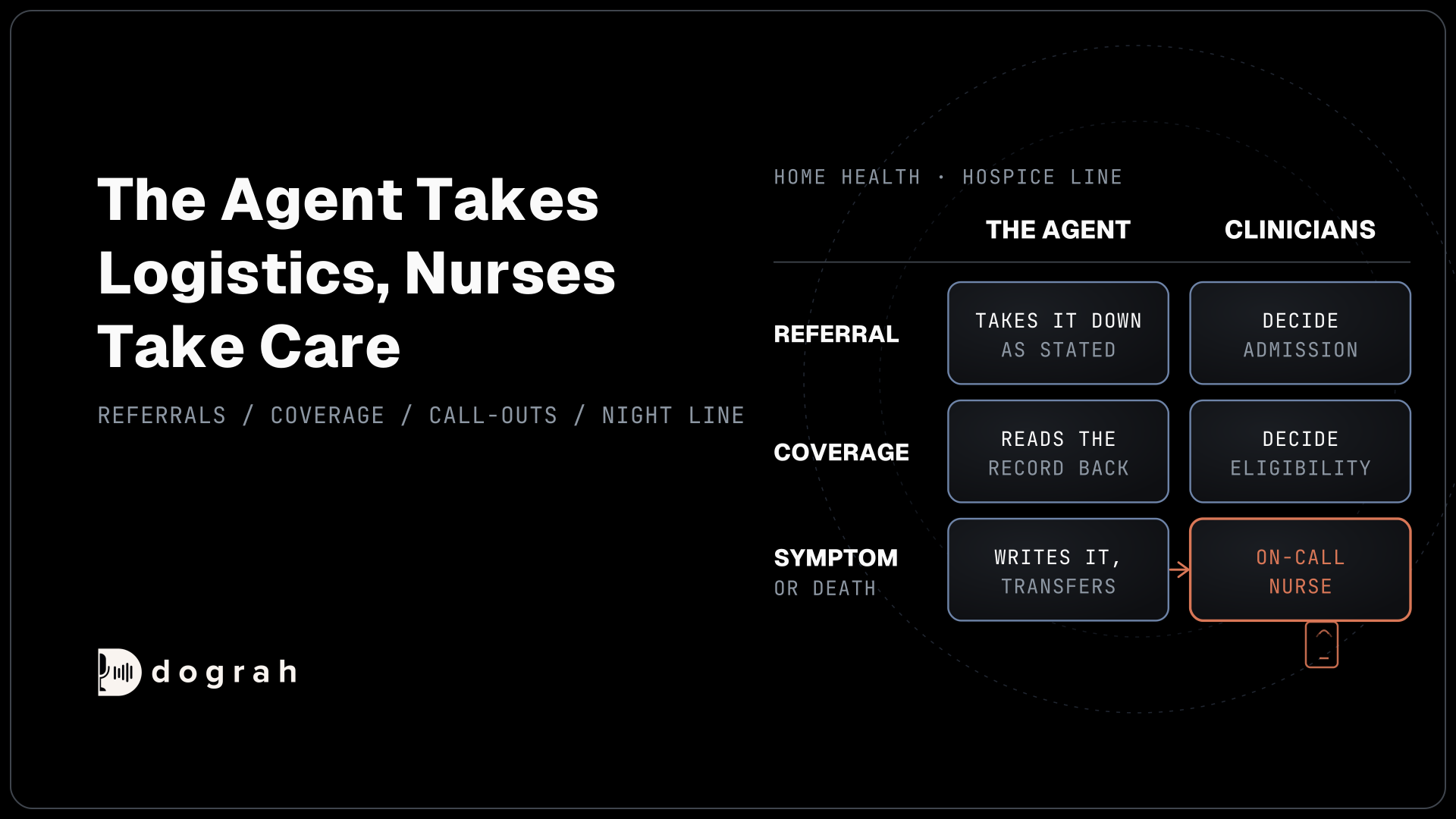
- Any symptom or death report goes to the on-call hospice nurse at once.
- The agent records referrals and coverage results. Clinicians decide eligibility and admission.
- Shift-fill campaigns share one call limit with the inbound hospice line.
This guide maps the calls a home health or hospice agency can hand to a voice agent, and the clinical line it never crosses. We show how each part works in Dograh, the open-source AI voice agent platform we build. You can self-host it or run it on Dograh Cloud.
What a home health and hospice phone line hears
Most calls to a home health or hospice agency are about logistics, and the answers already sit in the agency's own systems. Hospital case managers and physician offices call with referrals. Families ask when care starts and whether Medicare will pay. Patients confirm tomorrow's visit, and aides call at 6 a.m. to say they can't make a shift. On a hospice line, families also call at night.
The people who could answer are often out on visits. The Bureau of Labor Statistics counted about 4.7 million home health and personal care aide jobs in 2025. That work happens in patients' homes, and the office line keeps ringing while it does.
A voice agent can take the logistics calls if it reads and writes your systems during the call. In Dograh, an HTTP API tool asks your EHR or scheduling system for a visit window, or writes a referral or a call-out to it. There is no built-in connector for home health EHRs, so each tool points at your system's own API, or at a small service your team puts in front of it.
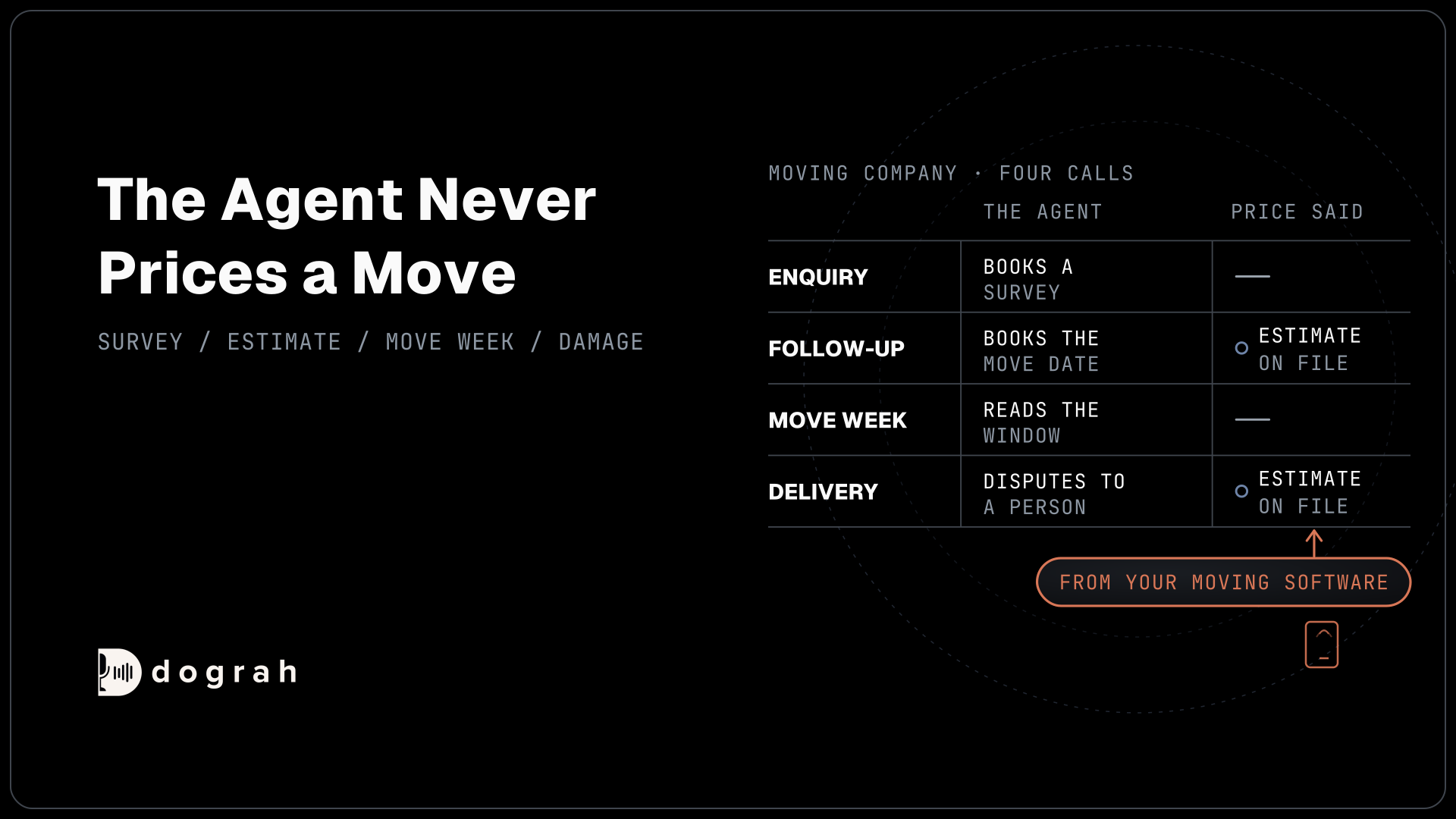
So one rule runs through this guide. The agent takes logistics, and nurses take care.
Anything clinical goes to a nurse
Any clinical call, including a report of a death, goes to a nurse at once, and the agent never judges how serious it is. Hospice makes this a hard rule. Medicare's hospice conditions of participation require a hospice to keep nursing services available around the clock, every day of the week. So the hospice night line always has a nurse on call, and the agent's job is to get each family to that nurse fast, with the details already written down.
On a night call, the agent asks for the patient's name, the caller's name and a callback number, and lets the family say what is happening in their own words. It writes that to your system through an HTTP API tool, then hands the call to the on-call nurse.
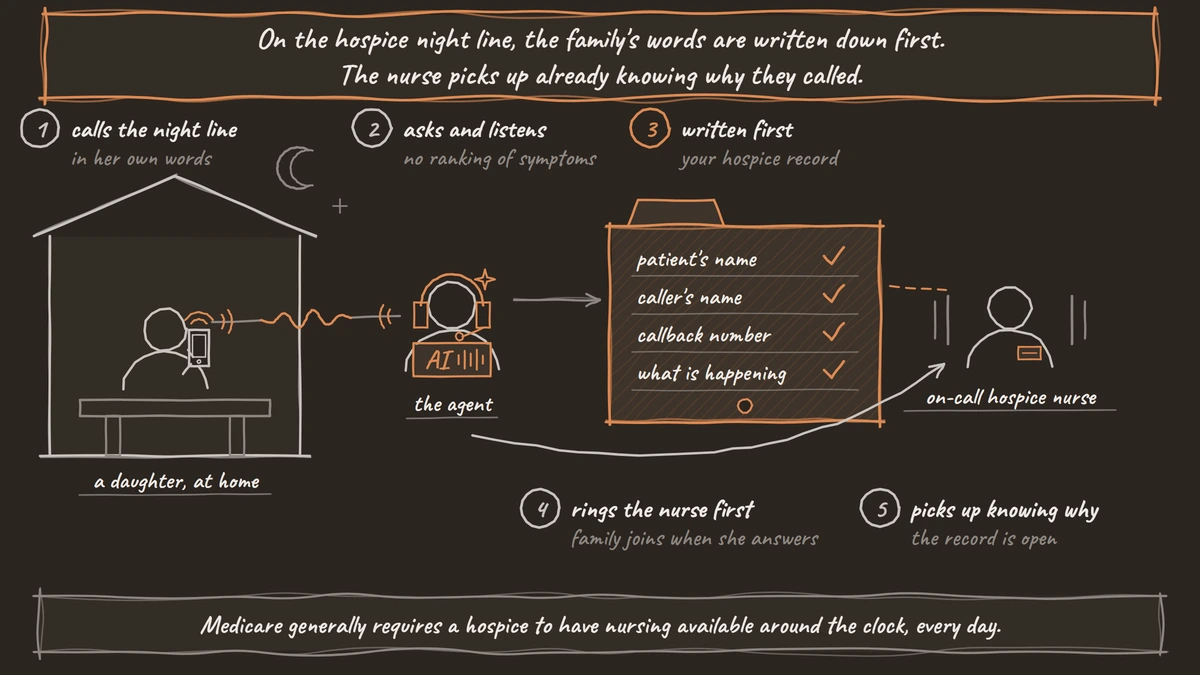
Transfer Call works on Twilio, Telnyx, Plivo, Cloudonix and Asterisk ARI. Dograh calls the nurse first and connects the family only when the nurse answers. On Twilio, it can play a short spoken introduction to both people before connecting them. No summary travels with the call by default, which is why the details are written first.
Verification only matters before the agent shares something from the record. A family describing a symptom needs no check before the transfer, because the agent tells them nothing.
Tell the agent in the prompt never to rank how urgent a symptom sounds, and never to give advice. Sorting a refill question from a crisis is triage, and triage is a nurse's job. A death at home goes to the nurse the same way. The agent says it is sorry in one plain sentence and transfers the call, with the details written first.
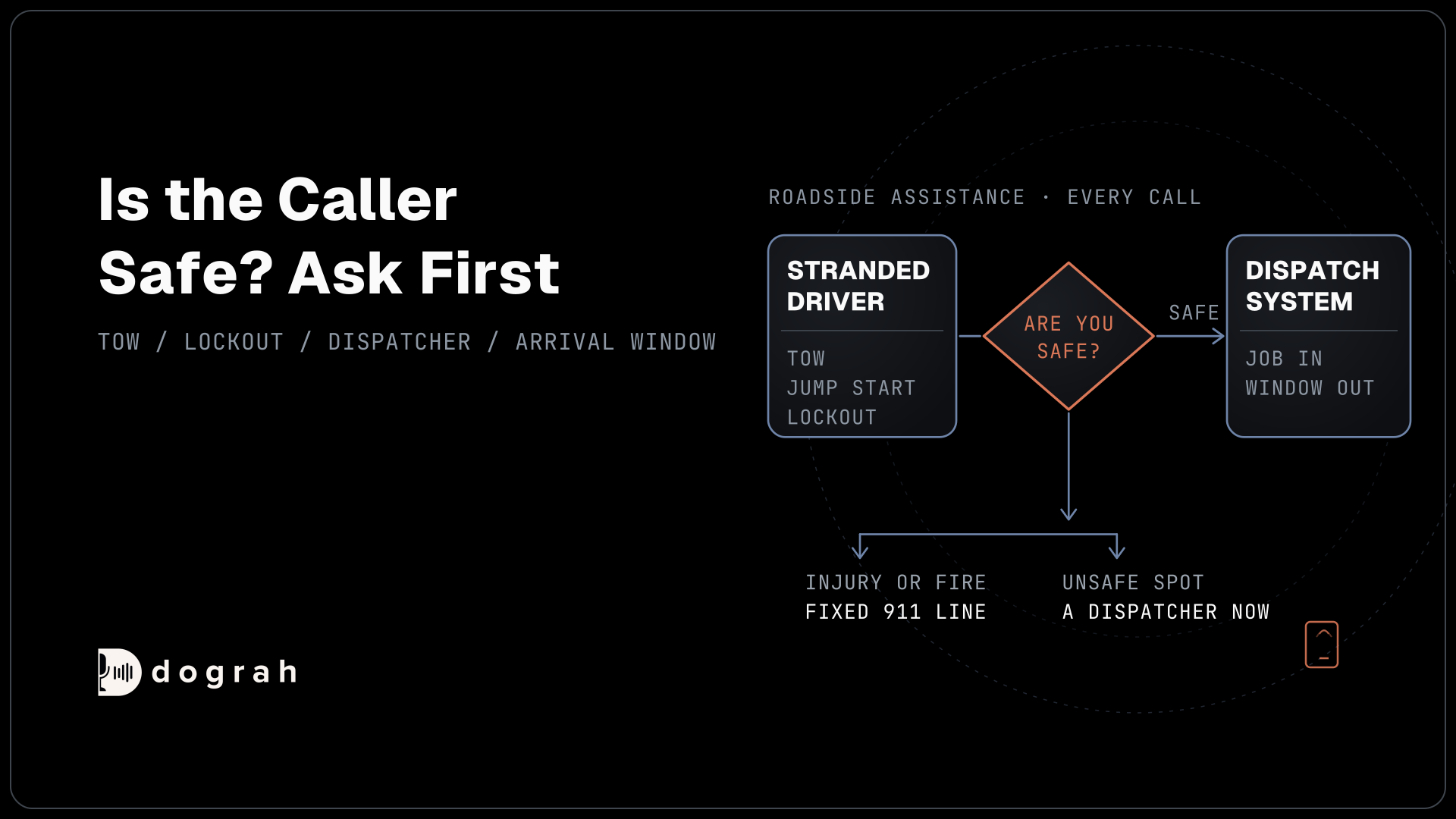
If the nurse doesn't answer within the timeout, 30 seconds by default, the family stays with the agent. Tell it in the prompt to write an urgent callback request to your on-call system, which can page a backup nurse, and to tell the family the nurse will call back. Anyone in danger hears one fixed line: "If you're in danger, get to safety and call 911."
Home health patients outside hospice get a different fixed line. Hospice symptom calls go to the nurse first, but a home health patient describing a medical emergency hears: "If this is a medical emergency, please hang up and call 911." Any other symptom goes to the agency's clinical line, written first and then transferred. Both fixed lines play as Transition Speech, which Dograh speaks word for word, or as a recorded clip on speech-to-speech models. Choosing that pathway is still the language model reading the condition you wrote, so test it with many phrasings.
Referral intake: take it down, never accept it
Referral intake is where an agency wins or loses a patient, and the agent's part is to record the referral, not to accept it. Most referrals arrive as documents. The phone carries the rest, such as a case manager calling after hours or a call back to the source for a missing face-to-face note.
The time a referral comes in matters. Medicare's home health assessment rule requires a registered nurse's initial assessment within 48 hours of the referral, or of the patient's return home, unless the physician orders a different start of care date. So the agent writes the time received along with the referral, and your intake team sees the clock from the first minute.
The agent records the referral source, the patient's details, the services ordered and the payer, all as the caller states them. It never takes a verbal order from a physician's office. That belongs to your intake nurse, so the agent records that an order is waiting and transfers the caller. It never tells anyone the patient is accepted, and it never gives a start date. For hospice, the hospice physician decides admission.
AI Voice Agents for Referral Intake in Home Health & Hospice covers what to collect on each referral and the calls back for missing items.

Open Source Alternative to Vapi / Retell
Self-hosted voice agent platform — no per-minute fees
dograh-hq/dograh
Star on GitHub
Coverage checks: read the record, never decide
Coverage and eligibility are different questions, and the agent only reads coverage. Coverage is which plan a patient has, whether it is active and whether another agency or a hospice already has an open period. Eligibility is clinical. It asks whether a patient is homebound and needs skilled care, or has a terminal prognosis. Clinicians decide it, and it never comes up on the call.
Your system gets coverage electronically or through payer portals. The agent reads that result through an HTTP API tool and states it plainly: "Your record shows a Medicare Advantage plan, and our intake team will confirm what it covers." It never says "you're covered" or "you qualify". An empty result is not a no, so it goes to staff as well.
The agent never phones payers. Dograh has no keypad (DTMF) tool, so it can't press through an insurer's phone menu. A coverage question it can't answer from the record goes to your intake or billing staff.
Hospice adds paperwork the agent should not explain. Under the FY 2027 hospice payment rule, every hospice election statement signed from October 1, 2026 comes with a written addendum of items, services and drugs the hospice won't cover, given within the first 5 days. Staff walk the family through it, and the agent only says the paperwork is coming. The same rule raised hospice payments by 2.3% for FY 2027, about $755 million across the 6,673 hospices in CMS's FY 2025 claims data.
AI Voice Agents for Home Health Eligibility Checks follows the coverage call to the family step by step, including the words the agent never says.
Visit windows and medication check-ins
Two patient calls in home health already have their own posts. Confirming tomorrow's visit window, moving a visit or warning that a nurse is running late is covered in AI voice agents for home health visit coordination, where the scheduling system starts each call.
Between visits, some agencies call patients to ask whether they are taking their medicines and what gets in the way. AI voice agents for medication adherence covers that call, and why side effects go to a clinician.
When a caregiver's call-out moves a patient's visit, the patient call is a visit coordination call. The scheduling system starts it once the shift is settled.
Caregiver call-outs and open shifts
Caregiver calls are the only ones in this guide where the caller works for you, and the scheduling system makes every assignment. They come in two directions.
An aide calls out. Pre-Call Data Fetch sends the calling number as the call connects, so the scheduling system can return that caregiver's record and today's shifts. The agent still asks for an approved check, such as the last digits of an employee ID. It records the reason and the shifts affected as stated and writes the call-out to the scheduling system. Then it says what happens next.
To fill the shift, the scheduling system picks the qualified caregivers and starts the calls, one at a time through the API Trigger for an urgent shift, or as a campaign from a CSV list for next week's open shifts. When a caregiver says yes, an HTTP API tool asks the scheduling system to assign the shift and reads back its answer, "assigned" or "already filled".
A campaign keeps dialling until it is paused, and calls already ringing finish, so every shift-fill agent needs the "already filled" path. Hard cases, such as a client who objects to a new caregiver, go to a coordinator. Dograh is not an electronic visit verification (EVV) system and clocks nobody in, so the visit record stays in your EVV system.
AI Voice Agents for Caregiver Shift Scheduling & Call-Outs shows both calls in full.
Verification and consent on every call
Every call runs greet, verify, disclose. The Greeting Text names the agency. If you want to tell callers they're speaking with an automated assistant, or your location requires it by law, write that in the Greeting Text too. It plays before verification, so it never names a patient or a visit.
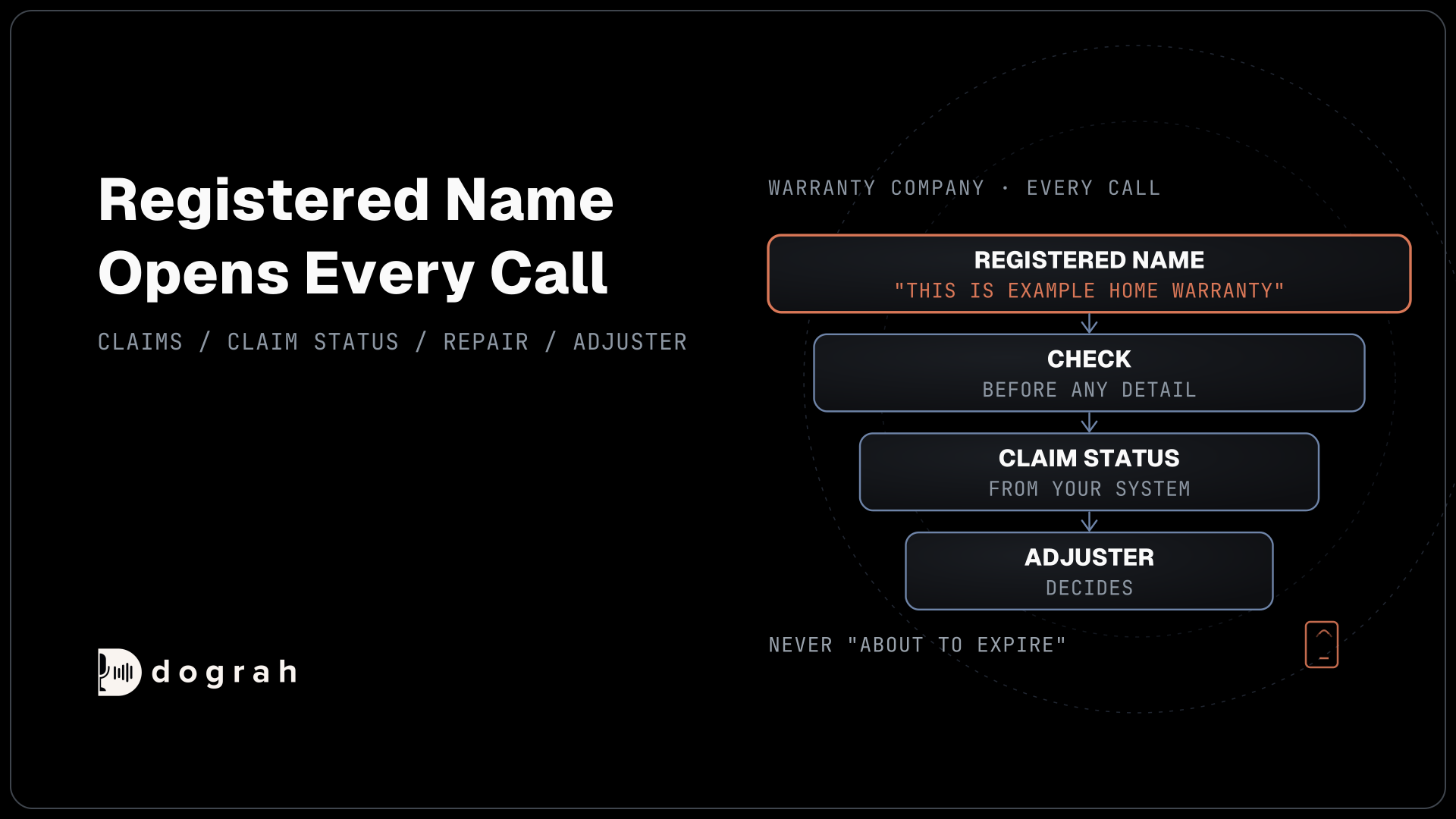
A phone number finds a record, but it doesn't prove who is calling. Before it shares anything from the record, the agent asks for your agency's approved check, such as date of birth plus one more item on file. A family member hears details only if the patient has authorized them in your record. Voicemail handling is off by default. If you turn it on, a message gives only the agency's name and a callback number.
Outbound calls add consent rules. Under the Telephone Consumer Protection Act (TCPA), an AI voice counts as an artificial voice, so the FCC's calling rules require prior express consent for such a call to a mobile phone. Calls to patients about their care can fall under a healthcare exemption, which allows at most one call a day and three a week, with no financial content.
The consent section of our guide to AI voice agents for hospitals and health systems lists that exemption's conditions. Calls to caregivers are calls to your own staff, so the exemption doesn't apply to them. A call about a caregiver's own shifts offers nothing for sale, so it is generally not telemarketing, and the consent a caregiver gives with their number at hiring is the usual basis. When anyone asks not to be called again, the agent writes the opt-out to your system, which removes the number from the next list. Confirm your agency's position with counsel before the first outbound campaign.
Join the Dograh Community
Dograh is an OSS alternative to Vapi. Join our Slack community for queries, releases, best practices & community interactions.
One phone number, several focused agents
An agency can keep one main number and give each kind of call its own agent. A short routing agent greets the caller and asks what they need. Transfer to Agent then hands the call to the referral intake agent or the caregiver call-out agent. The next agent receives a labelled transcript of the conversation so far, so the caller never repeats themselves. It works on cascade agents, not on speech-to-speech ones.
Give the hospice night line its own number. A family in distress should reach the transfer path at once, with no routing question first.
Every call shares one ceiling. Inbound calls, campaign calls, API Trigger calls and browser test calls all draw from one organization concurrency limit. Self-hosted Dograh runs 10 concurrent calls by default, adjustable with DEFAULT_ORG_CONCURRENCY_LIMIT, and Dograh Cloud's Pay as you go plan includes 10. A shift-fill campaign that uses every slot leaves none for a family calling the hospice line. So set the campaign's Max Concurrent Calls below the limit, and keep a few slots free for inbound calls.
Where home health call data sits
Every home health call carries protected health information, so decide where the audio and transcripts live before the first call. Dograh is self-hostable. Run it on your own servers, and the recordings and transcripts stay there, with no business associate agreement (BAA) with Dograh needed.
Dograh is the orchestration layer that runs the call flow, tools and telephony, and the speech and language models are a separate layer you choose. Bringing your own keys (BYOK) to a model provider changes whose contract covers the models, but the audio still reaches that provider, so each one that hears patient calls may need its own BAA. Data stays fully in-house only with open-weight models on your own servers, such as Qwen3.8 27B for language, Parakeet TDT 0.6B v2 for speech-to-text and Magpie TTS for the voice.
The phone carrier may need a BAA too, depending on what it stores, and many, such as Twilio, offer one. If your servers run in a cloud account, that cloud provider needs one as well. Our post on HIPAA-compliant voice AI for hospitals walks through each layer.
Dograh has no retention setting for recordings and transcripts, so your own schedule deletes them. The self-hosting guide covers the install. Self-hosted Dograh has no per-minute platform fee, though servers, model keys and phone minutes still cost money. Dograh Cloud has a 1¢-a-minute platform fee, and Dograh's managed models cost about $0.07 a minute for most models, billed apart from that fee.
Our page on self-hosted voice AI for home health agencies shows the same setup for visit calls.
Which call to hand over first
Start with the caregiver call-out line and after-hours referrals, where the agent only records. Nobody hears a patient's details on a call-out, and a referral is written down for your intake team to act on. Add coverage read-backs and visit confirmations next. Put the hospice night line last, once tests show that every way a family might describe a symptom reaches the nurse.
Test on a real phone number before launch. Browser test calls can't transfer a call, and most phone calls reach the agent as 8 kHz audio while a browser test runs at 16 kHz, so drug names and street names can sound different to the speech model. On the hospice line, have staff call in with symptoms phrased as many ways as they can, leave the on-call phone unanswered once, and read every transcript. After launch, a QA node can review the night line's calls with its Sample Rate at 100%.
Each call above has its own deep dive:
- AI Voice Agents for Referral Intake in Home Health & Hospice
- AI Voice Agents for Caregiver Shift Scheduling & Call-Outs
- AI Voice Agents for Home Health Eligibility Checks
Glossary
- Start of care
- The date home health services begin for a patient. Medicare ties the first nursing assessment to the referral or the patient's return home, so the time a referral comes in starts a clock the intake team has to meet.
- Hospice election statement
- The form a Medicare patient signs to choose hospice care instead of curative treatment for the terminal illness. From October 1, 2026 it comes with a written addendum of items the hospice won't cover, which staff explain, never the agent.
- Electronic visit verification (EVV)
- The state system that records who visited which Medicaid patient, where and when. A call-out agent writes to the scheduling system, and the visit record stays in the EVV system.
- Organization concurrency limit
- The ceiling on simultaneous calls that every Dograh call path shares, 10 by default when self-hosted. A big outbound campaign can use every slot unless its Max Concurrent Calls is set below the limit.