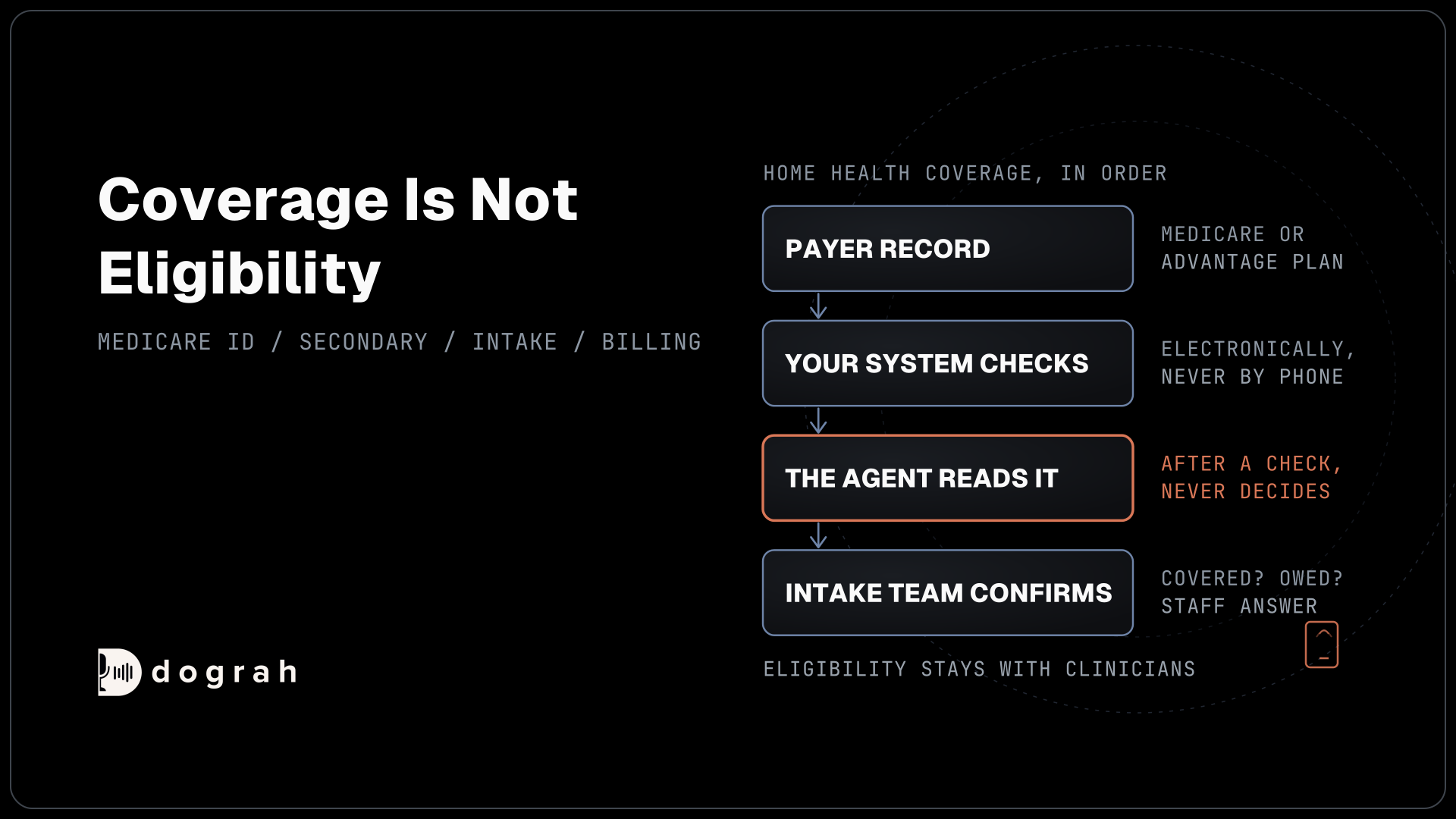

AI voice agents for home health eligibility checks call the patient or family before care starts. After an approved check, the agent confirms the plan on the card, the Medicare ID and any secondary insurance, then states what the agency's Medicare and insurance check found. It never decides eligibility or tells anyone they are covered.
Key Takeaways
- Coverage is read from your system. Eligibility is a clinician's finding, never discussed.
- An empty Medicare result is not a no. Staff confirm it.
- The agent never phones payers. Your system checks coverage electronically.
This post is part of our guide to AI Voice Agents for Home Health & Hospice, where coverage checks mean reading the record and never deciding. Below, we cover what a coverage check shows. Then we follow the family call in Dograh, the open-source AI voice agent platform we build.
Coverage and eligibility are different questions
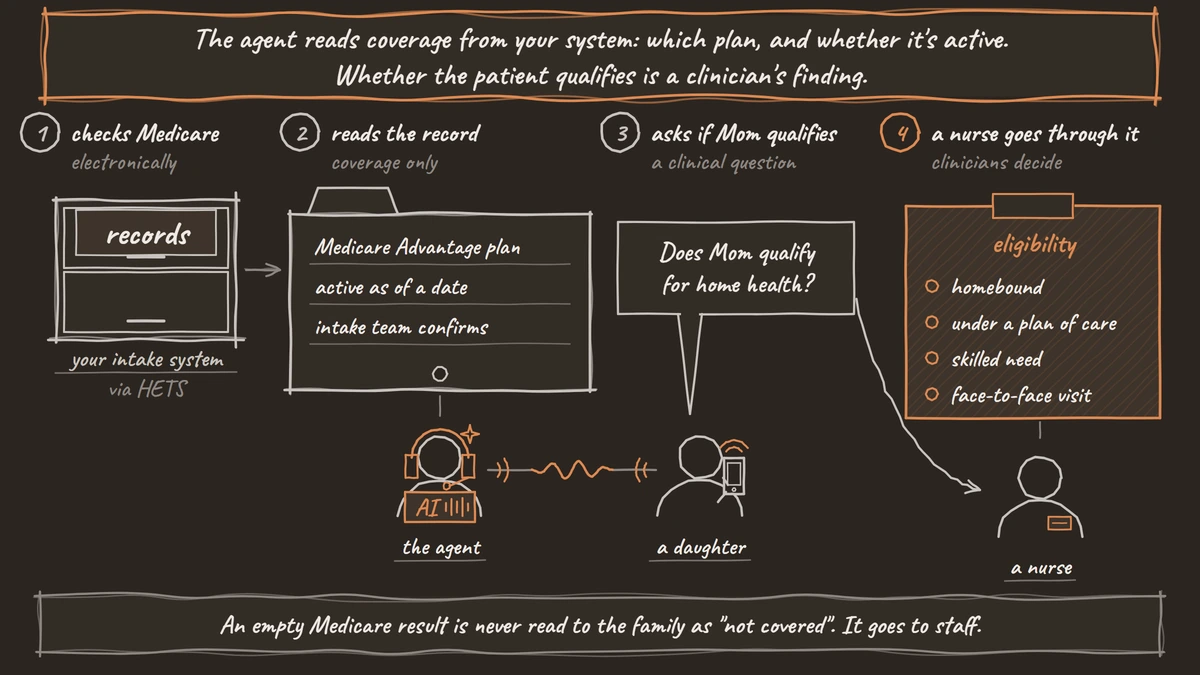
Coverage is which plan pays and whether it's active, and eligibility is whether the patient meets Medicare's clinical conditions. The agent only ever talks about the first.
Eligibility is clinical. Medicare's home health conditions require a patient to be confined to the home, under the care of a physician or allowed practitioner, under a plan of care, and in need of intermittent skilled nursing or therapy. A face-to-face encounter about the main reason for home care has to be documented too. For hospice, Medicare's certification rule needs a physician to certify that the patient is terminally ill.
Those are findings for clinicians, never questions the agent asks or scores. So tell the agent in the prompt never to say "eligible", "you qualify", "you're covered", "not covered" or "approved". It says what the record shows and that the intake team will confirm. A family who asks whether their mother qualifies for home health hears that a nurse will go through it with them.
What a coverage check can and can't show
Your system gets Medicare coverage from the HIPAA Eligibility Transaction System (HETS), usually through a clearinghouse or the Medicare contractor's portal. The result can show Part A dates, a Medicare Advantage plan, Medicare Secondary Payer details and a home health or hospice period another provider has open.
It has limits that matter on a call. CGS's eligibility manual, written by one of Medicare's own contractors, says every field entered in a search must exactly match Medicare's records, and that the hospice and home health tab can't be opened when no claims have been received. It also says data is refreshed only at set times. So a missing tab can simply mean no claims have arrived yet, and an empty result is never read to a family as "not covered". It goes to staff.
Medicare Advantage changes who answers. KFF counted 35.2 million of 64.2 million eligible beneficiaries in Medicare Advantage in March 2026, or 55%. For those patients, the plan sets its own authorization rules, and the Medicare check only tells you which plan to ask.
Run the check at referral and again before start of care, because a plan can change in between. The agent always reads the latest result.
Why the agent never phones payers
Your system reads payers electronically, and the agent reads your system. Dograh has no keypad (DTMF) tool, so the agent can't press through an insurer's phone menu or hold for a payer's staff line.
During the call, an HTTP API tool asks your endpoint for the latest coverage result. That endpoint can run the check or return the stored one. The tool hands the whole response to the language model, so return only what the agent may say, such as the plan type found, active or not as of a date, whether another agency or a hospice has an open period, and "needs staff review". Leave out balances and codes the agent shouldn't read.
The tool waits 5 seconds by default and doesn't retry. A slow lookup needs a Custom Message on the tool, a short line such as "One moment while I pull up your record", so the family isn't left in silence.

Open Source Alternative to Vapi / Retell
Self-hosted voice agent platform — no per-minute fees
dograh-hq/dograh
Star on GitHub
The call to the family before care starts
The family call confirms what's on the card and says what the record shows, after a check. Your intake system starts it through the API Trigger once a referral is in, with the referral and the payer on file in the call's context. Pre-Call Data Fetch, set to Outbound calls only, can refresh that record as the call connects.
Every call runs greet, verify, disclose. The Greeting Text names the agency. If you want to tell callers they're speaking with an automated assistant, or your location requires it by law, write that there too. Before any detail, the agent asks for your approved check, such as the patient's date of birth plus one more item on file.
Then the agent confirms the plan named on the card and reads the Medicare ID back as stated. The transcript is the exact record if a digit is in doubt. It asks about any secondary insurance, and whether the patient had home health or hospice from another provider recently. It writes each answer to your system for staff.
Next, it states what your check found, in plain words: "Your record shows a Medicare Advantage plan. Our intake team will confirm what it covers and call you." Any "am I covered" or "what will I owe" question goes to intake or billing staff by Transfer Call, which works on Twilio, Telnyx, Plivo, Cloudonix and Asterisk ARI. Dograh calls staff first and connects the family only when someone answers. On Twilio, it can play a short spoken introduction to both people before connecting them. The agent writes the details first, because no summary travels with the call by default.
The agent takes no payments and quotes no amounts. For hospice, the written notice of items the hospice won't cover is staff's job too. The agent only says it is coming. The referral that starts this call is in AI voice agents for referral intake in home health and hospice.
Join the Dograh Community
Dograh is an OSS alternative to Vapi. Join our Slack community for queries, releases, best practices & community interactions.
Consent and money on coverage calls
A coverage call may not fit the healthcare exemption, so check its consent basis before the first campaign. Under the Telephone Consumer Protection Act (TCPA), an AI voice counts as an artificial voice. Calls to patients about their care can use a healthcare exemption in the FCC's calling rules, but it allows no financial content and generally a minute or less per call. The consent section of our guide to AI voice agents for hospitals and health systems lists its conditions.
A coverage call talks about payers and can run longer, so it may sit outside that exemption and rest on the patient's prior express consent instead. A family who gave their number with the referral has generally given it, because the call is about care the patient already has arranged. Any offer of another service would make it telemarketing, so keep offers off these calls. When someone asks not to be called again, the agent writes the opt-out to your system, which removes the number from the next list. Confirm your agency's position with counsel.
Therapy practices run a similar check with different rules. AI voice agents for behavioral health insurance verification covers session limits and plan types there.
Glossary
- HETS
- The HIPAA Eligibility Transaction System, Medicare's service behind contractor portals and clearinghouse eligibility checks. Its result shows plan and period data, and a missing home health or hospice tab can simply mean no claims have arrived.
- Open period
- A home health or hospice period that another provider has already started for the patient. The agency's check can show it, and staff handle what it means for admission and billing.
- Medicare Advantage
- A private plan that covers a Medicare beneficiary in place of traditional Medicare, with its own authorization rules. The Medicare check shows the plan, and the plan itself confirms what it covers.
- Face-to-face encounter
- The visit with a physician or allowed practitioner that home health certification must document, related to the main reason for home care. It is a clinical finding, so the agent never asks about it.