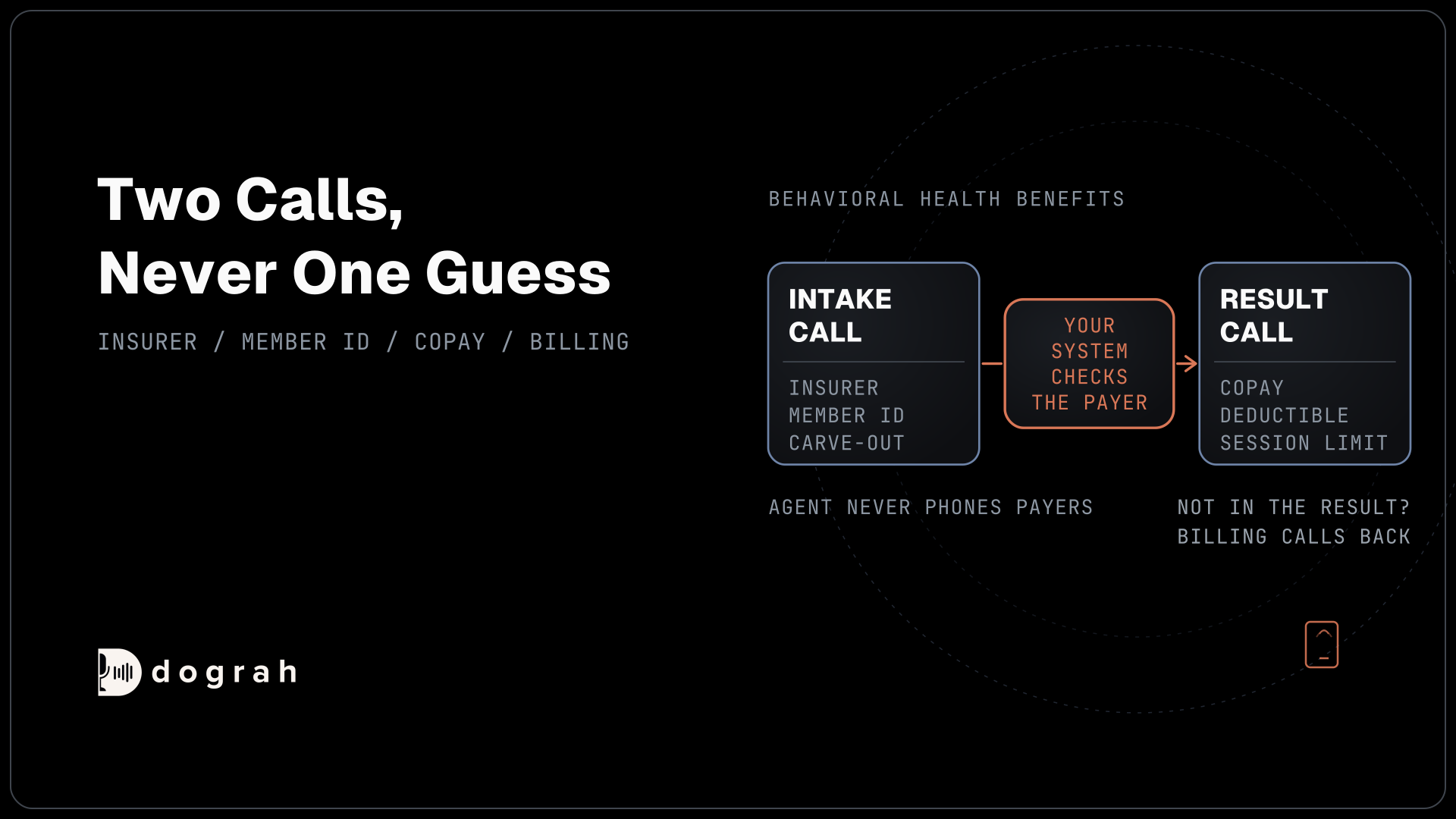

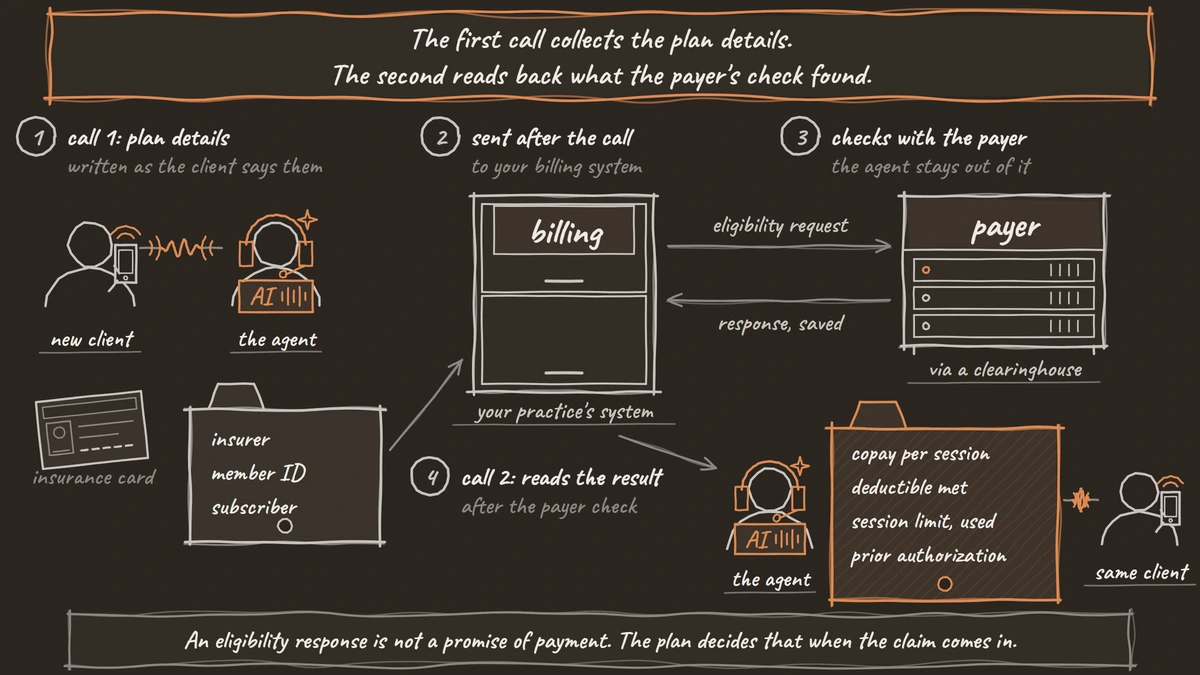
AI voice agents for insurance and benefits verification in behavioral health collect a new client's plan details for your eligibility check, then tell the verified client what the check found: copay or coinsurance, deductible status, session limits and whether prior authorization is needed. They never guess coverage or phone payers. Missing details go to your billing team.
Key Takeaways
- The intake call records plan details, and your system checks them with the payer.
- The agent reads only fields your endpoint returns, so it cannot guess coverage.
- Dograh has no keypad tool, so payer phone calls stay with your billing staff.
This post is part of our guide to AI voice agents for mental and behavioral health. Below, we cover the two calls behind a benefits answer and what the agent may say. Then we set up both calls in Dograh, the open-source AI voice agent platform we build.
Two calls, never one guess
The first call collects the plan details and the second reads back what the check found. Between them, your practice management or billing system sends the electronic eligibility request to the payer, usually through a clearinghouse, and stores the response. The agent never sits in the middle of that exchange, and it never fills a gap with its own estimate.
That order matters because the easy answers are often wrong. In a secret shopper study of mental health networks published in JAMA Health Forum in October 2026, directory errors showed up on 55.6% of the calls the researchers could evaluate, from wrong contact details to wrong specialties. A clinician listed as in network on a directory is not proof of coverage. The payer's eligibility response is the record to read.
The agent never phones the payer either. Dograh has no keypad (DTMF) tool, so it cannot press through an insurance company's phone menu. When the electronic response comes back with blanks, your billing staff call the payer, and the agent reads their answer once it is saved.
The intake call collects the plan details
The intake call writes down the plan exactly as the client gives it, so the check can run before the first session. A new caller has no record yet, so the agent collects their name, date of birth and a callback number first. An existing client passes the practice's approved check before anything on file is named.
Then the agent asks whether the client wants to use insurance or pay for themselves. If insurance, it records the insurer, the member ID, and the subscriber's name and date of birth when the plan belongs to someone else. It also asks whether the card names a separate company for mental health benefits, because a behavioral health carve-out sends the check to that company instead of the medical plan.
The agent records each answer as the client stated it. This is an AI step, so the transcript and recording stay the exact record of what was said. After the call, a Webhook node sends the details to your billing system, and a temporary failure is retried automatically. The rest of the first call is in AI voice agents for behavioral health intake and triage.

Open Source Alternative to Vapi / Retell
Self-hosted voice agent platform — no per-minute fees
dograh-hq/dograh
Star on GitHub
The result call reads only what was found
Once the response is saved, your billing system starts a call and the agent reads the result to the verified client. The API Trigger lets your system start that call the moment the check is done, with the client's name and number in the request.
The greeting names the practice and asks for the client by first name. Asking for someone by name only finds them, so the agent runs the practice's approved check, for example date of birth together with the date of the booked first session, before it says anything about coverage.
Then an HTTP API tool reads the result from your system. The tool hands the whole response to the language model, so build the result endpoint to return only the fields the agent may say: copay or coinsurance per session, how much of the deductible is met, any session limit and the sessions used, and whether prior authorization is needed and where it stands. Anything the endpoint does not send, the agent cannot invent.
When the client asks about something missing, the agent says: "I don't have that detail yet. Our billing team will confirm it and call you back." It never says a claim will be paid, because an eligibility response is not a promise of payment. The plan decides that when the claim comes in. Run the payer check before the call, since the tool waits 5 seconds by default and a clearinghouse can take longer.
Prior authorization and session limits
Prior authorization and session limits are the answers clients most need before they start, and the agent states them as your system holds them. Some plans cap covered sessions in a year, and some need prior authorization before more intensive care. The agent reads the count, the status and any date on file. It never predicts whether a request will be approved.
Timelines depend on the plan type. Under the CMS Interoperability and Prior Authorization final rule, Medicare Advantage, Medicaid and Children's Health Insurance Program (CHIP) plans have had to decide prior authorization requests within 7 calendar days for standard requests and 72 hours for expedited ones since January 2026.
Regulators are watching this step for mental health. In Field Assistance Bulletin 2026-03, the Department of Labor says its enforcement of the Mental Health Parity and Addiction Equity Act will focus on prior authorization and network adequacy for mental health and substance use benefits. The agent reports what the plan said and never argues parity with a client. A practice that wants to question a denial does it through its billing team.
The same pattern of counting approved visits shows up in physical therapy, covered in AI voice agents for PT authorization and visit limits.
Join the Dograh Community
Dograh is an OSS alternative to Vapi. Join our Slack community for queries, releases, best practices & community interactions.
Part 2 consent and where the answers live
Substance use programs need consent before plan details go to a payer, and every practice needs to decide where these calls are stored. Under the Confidentiality of Substance Use Disorder Patient Records rules (42 CFR Part 2), a Part 2 program discloses information whenever it communicates anything that identifies a person as a patient of the program. Sending a client's details to a payer for a benefits check is generally one of those disclosures, so it runs through the program's consent process. Since the 2024 rule, one written consent can cover all future treatment, payment and health care operations uses. Whether that covers your check, and how your consent form should read, is worth confirming with counsel.
Benefits calls carry plan numbers and sometimes the kind of care, so many practices keep them on their own servers. Dograh is self-hostable, and self-hosted, no business associate agreement (BAA) with Dograh is needed. Model providers that hear client audio need their own BAA, and our post on HIPAA-compliant voice AI for hospitals walks through each one. Self-hosted Dograh has no per-minute platform fee (servers, model keys and phone minutes still cost). Dograh Cloud has a 1¢-a-minute platform fee.
Test both calls on a real phone line before launch. Most phone calls still reach the agent as 8 kHz audio, while a browser test runs at 16 kHz, so a member ID read aloud can come out differently. Have staff read a few real cards over the phone and check the saved fields against each card.
Glossary
- Eligibility request and response (270/271)
- The electronic question a practice's system sends a payer about a member's coverage, and the payer's answer. The agent reads the saved answer and never asks the payer itself.
- Behavioral health carve-out
- A plan that hands its mental health benefits to a separate company. The check has to go to that company, which is why the intake call asks about a second name on the card.
- Session limit
- A cap on how many therapy sessions a plan covers in a set period. The agent reads the cap and the sessions used from your system and never estimates what is left.
- Prior authorization
- The plan's approval before a service is covered. The agent states whether it is needed and its status as recorded, and never predicts the plan's decision.