
AI voice agents for mental and behavioral health answer and place a practice's logistics calls: new-client intake, session changes, insurance answers read from the practice's system, waitlist fills and after-hours requests. They verify the caller before naming anything and never counsel. Any sign of crisis gets fixed words with 988 and 911, then a transfer to a person.
Key Takeaways
- Measure the agent by booked sessions, because most calls to clinicians already reach a machine.
- Confirming that someone is a client discloses health information, so verify before naming anything.
- Start with after-hours logistics or waitlist fills, and add first-contact intake later.
This guide covers the calls a mental or behavioral health practice can hand to a voice agent and which one to start with. We show how each part works in Dograh, the open-source AI voice agent platform we build. You can self-host it or run it on Dograh Cloud.
What a practice's phone line hears
Most calls to a mental health practice are about logistics, and many of them go unanswered. New clients ask whether anyone has openings and whether their plan is accepted. Existing clients move or cancel sessions. People on the waitlist ask where they stand, and after the office closes, clients call about tomorrow's telehealth link or a refill request.
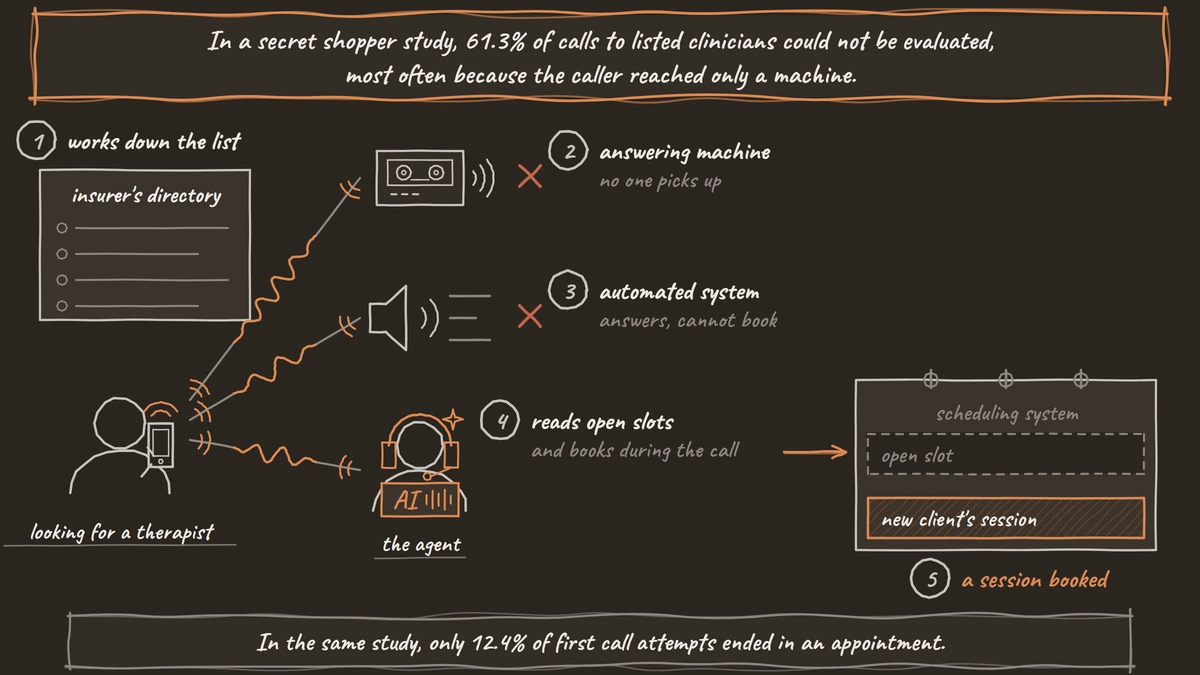
In a secret shopper study of mental health networks published in JAMA Health Forum in October 2026, researchers placed 5,822 calls between October 2025 and March 2026 to psychiatrists and psychologists listed by the largest commercial insurer in five states. 61.3% of the calls could not be evaluated, most often because the caller reached only an answering machine or an automated system. Only 12.4% of first call attempts ended in an appointment, and the mean wait for one was 20.5 days. The authors call a directory like that a ghost network: plenty of names, very little care.
That sets the bar for a voice agent. An automated system that answers and then cannot book is part of the problem the study found. The agent earns its place when the call ends with a session on the calendar, so it has to read open slots from your scheduling system during the call and book one. In Dograh, an HTTP API tool does that against your practice management system's own API. There is no built-in connector for any practice management system, so the tool points at its API or at a small service your team runs in front of it.
Logistics on every call, never care
The agent's job on every call is logistics, and nothing it says should sound like therapy. State lawmakers draw the same line. In ASTHO's March 2026 legislative snapshot, Illinois allows AI in mental health care only for administrative or supplemental tasks under professional oversight, and Nevada allows licensed professionals to use it only for administrative or supportive purposes. A line that books sessions and reads insurance results generally sits on the administrative side of both.
Write that rule once, in the Global Node. Dograh adds its prompt to every step that has Add Global Prompt switched on. Tell the agent it never offers emotional support or comments on symptoms, and that any clinical question goes to a person.
A prompt shapes what the model does, but it cannot fix the words it uses. That matters most on a crisis call, which is why crisis wording lives somewhere else, covered below. For everyday calls, warmth comes from short, plain questions and a quick route to a person.
Verify before naming anything
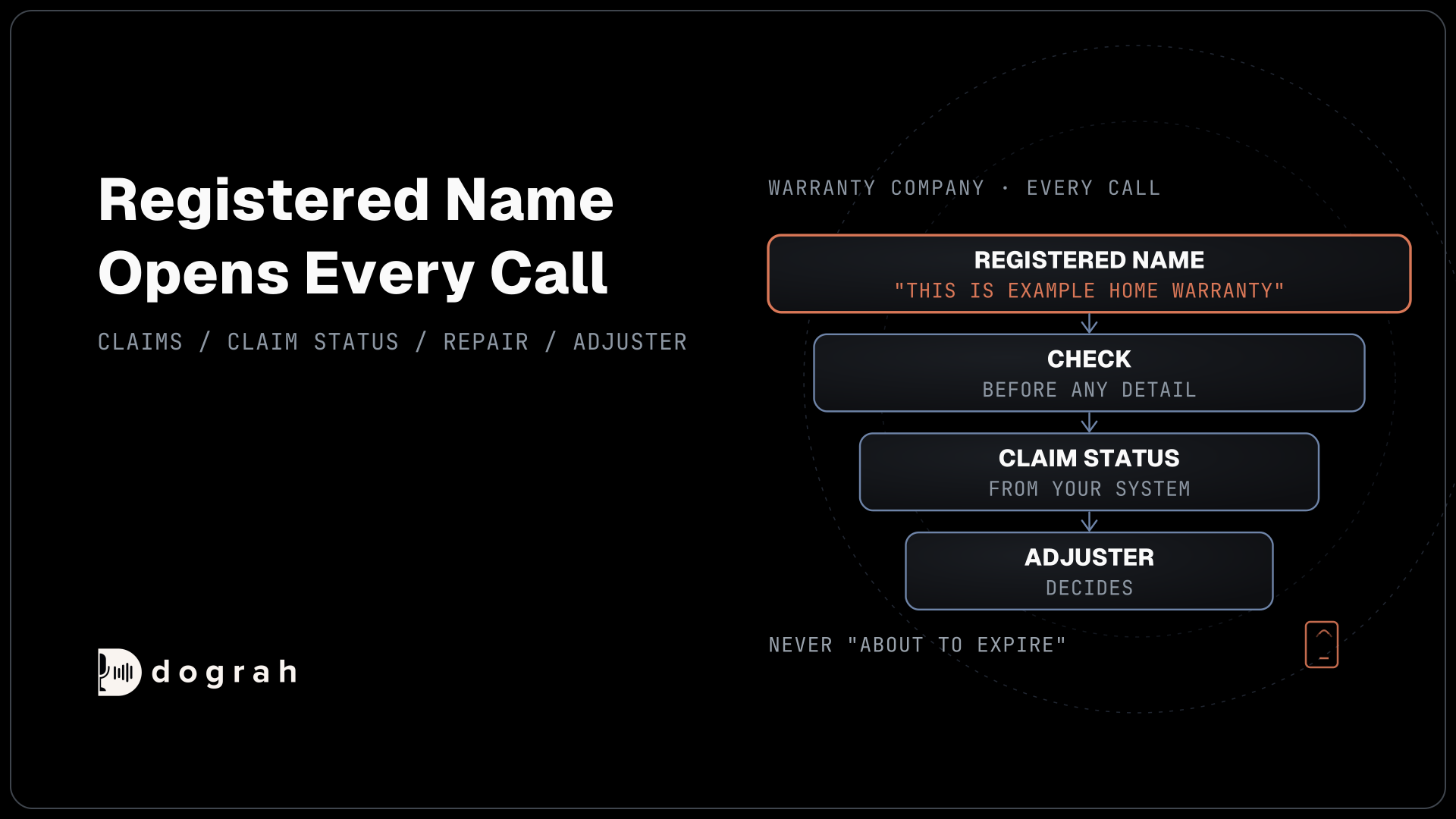
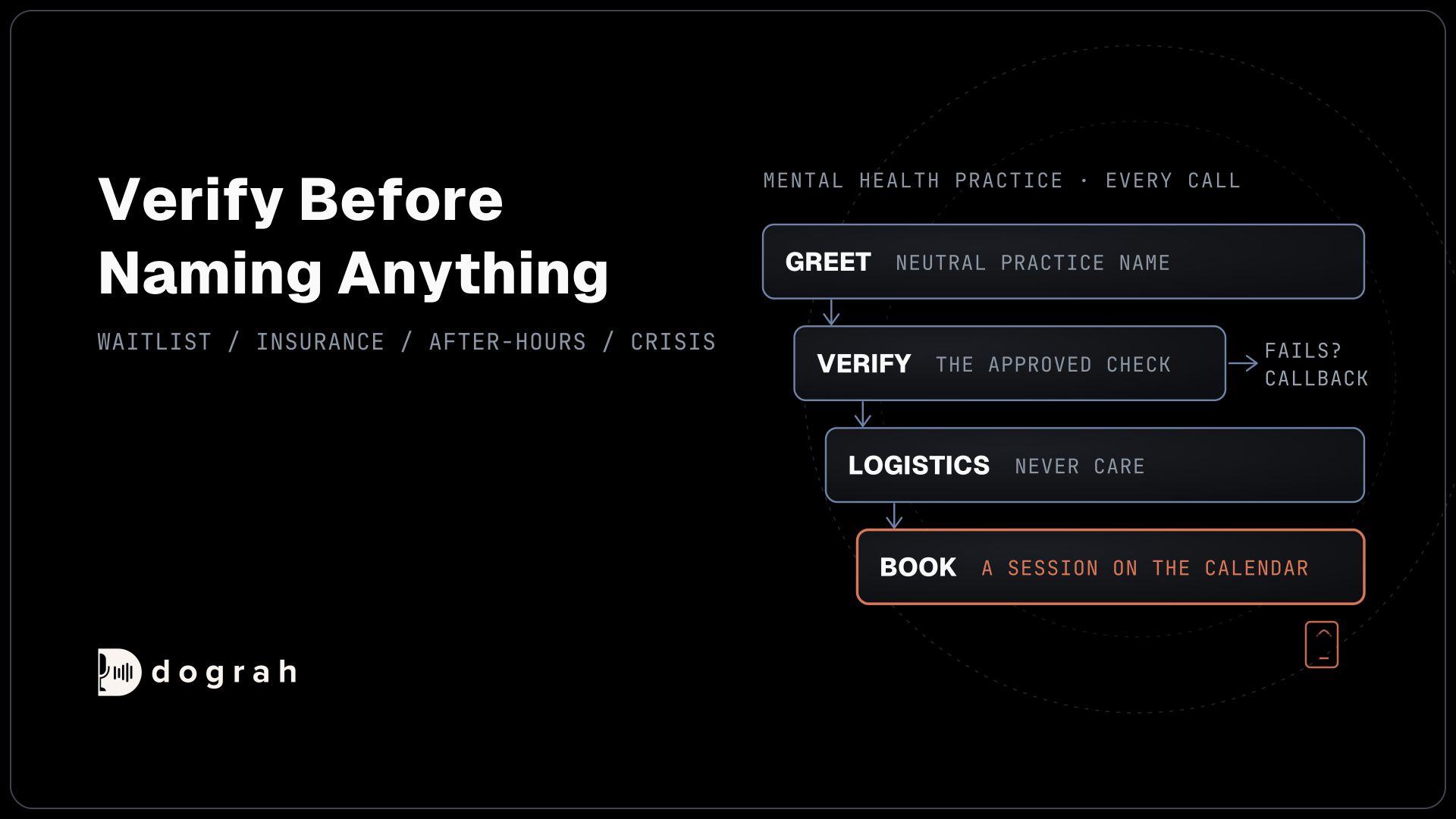
Even confirming that someone is a client of a mental health practice discloses health information, so the agent names nothing until the caller passes a check. Every call runs greet, verify, then disclose.
The Greeting Text names the practice and nothing else. If the practice's legal name says counseling or recovery, use the neutral name clients agreed to when they signed up. If you want to tell callers they're speaking with an automated assistant, or your location requires it by law, write it in the Greeting Text along with that name.
A phone number finds the record. It does not prove who is calling. Use the practice's approved check before anything is named, for example date of birth together with the date of the client's next session. Pre-Call Data Fetch can load the record that matches the calling number as the call connects, and the prompt keeps every detail from it unspoken until the check passes.
If the check fails, the agent shares nothing and records a callback request. If someone other than the client answers an outbound call, they hear the practice's neutral name and a callback number, and nothing about their care.

Open Source Alternative to Vapi / Retell
Self-hosted voice agent platform — no per-minute fees
dograh-hq/dograh
Star on GitHub
New-client intake and session reminders
Intake and reminder calls are the two jobs most practices think of first, and each already has its own walkthrough. On a first-contact call, the agent asks what the caller is looking for (therapy, a medication appointment or a substance use program), whether they want telehealth or in person, and their plan and member ID. It leaves the clinical history to the clinician. AI voice agents for behavioral health intake and triage follows that call from the greeting to the booking.
Reminder calls do more than a text when they settle the appointment during the call. The agent confirms the session, moves it if the client cannot make it, or releases the slot. Our post on healthcare no-show reduction shows how that works and what the numbers say. A released slot is where the waitlist call below starts.
Insurance and benefits questions
The agent tells clients what your eligibility check found, and it never guesses coverage. Your practice management or billing system sends the electronic eligibility request to the payer, usually through a clearinghouse, and stores the response. After the caller passes the check, the agent reads that stored result: the copay or coinsurance, how much of the deductible is met, any session limit, and whether prior authorization is needed. Anything the result does not hold goes to the billing team, who call the client back.
The agent never phones payers. Dograh has no keypad (DTMF) tool, so it cannot press through an insurance company's phone menu, and payer calls stay with your billing staff.
Prior authorization is where regulators are looking. In Field Assistance Bulletin 2026-03, the Department of Labor says its enforcement of the Mental Health Parity and Addiction Equity Act (MHPAEA) will focus on prior authorization and on network adequacy for mental health and substance use benefits. The agent reports what the plan said. It never argues parity with a client.
AI voice agents for insurance and benefits verification in behavioral health covers the intake side and the result call in detail.
Waitlist and cancellation fills
When a session opens, the agent calls the next client your scheduling system names and books from live slots. With waits near three weeks in the study above, a freed hour is worth filling the same day.
The system decides who is next, using rules your practice sets: time on the list, clinician match, insurance accepted, telehealth or in person. The agent never judges who is more urgent. It offers only slots the booking endpoint returns, and if another client took the slot a moment earlier, it offers the next live one or keeps the client's place.
The voicemail is the line clients hear most, because so many calls end there. Voicemail handling is off by default. Turn on "Enable voicemail and screening handling", set "When voicemail is detected" to "Leave a message", and keep the message to the client's first name, the practice's neutral name and a callback number. The voicemail action is set per agent, so clients who asked for no messages go on a separate agent set to "Disconnect the call".
AI voice agents for waitlist and cancellation-fill calls in behavioral health covers who gets called first and what to do when someone else answers.
After-hours calls and crisis routing
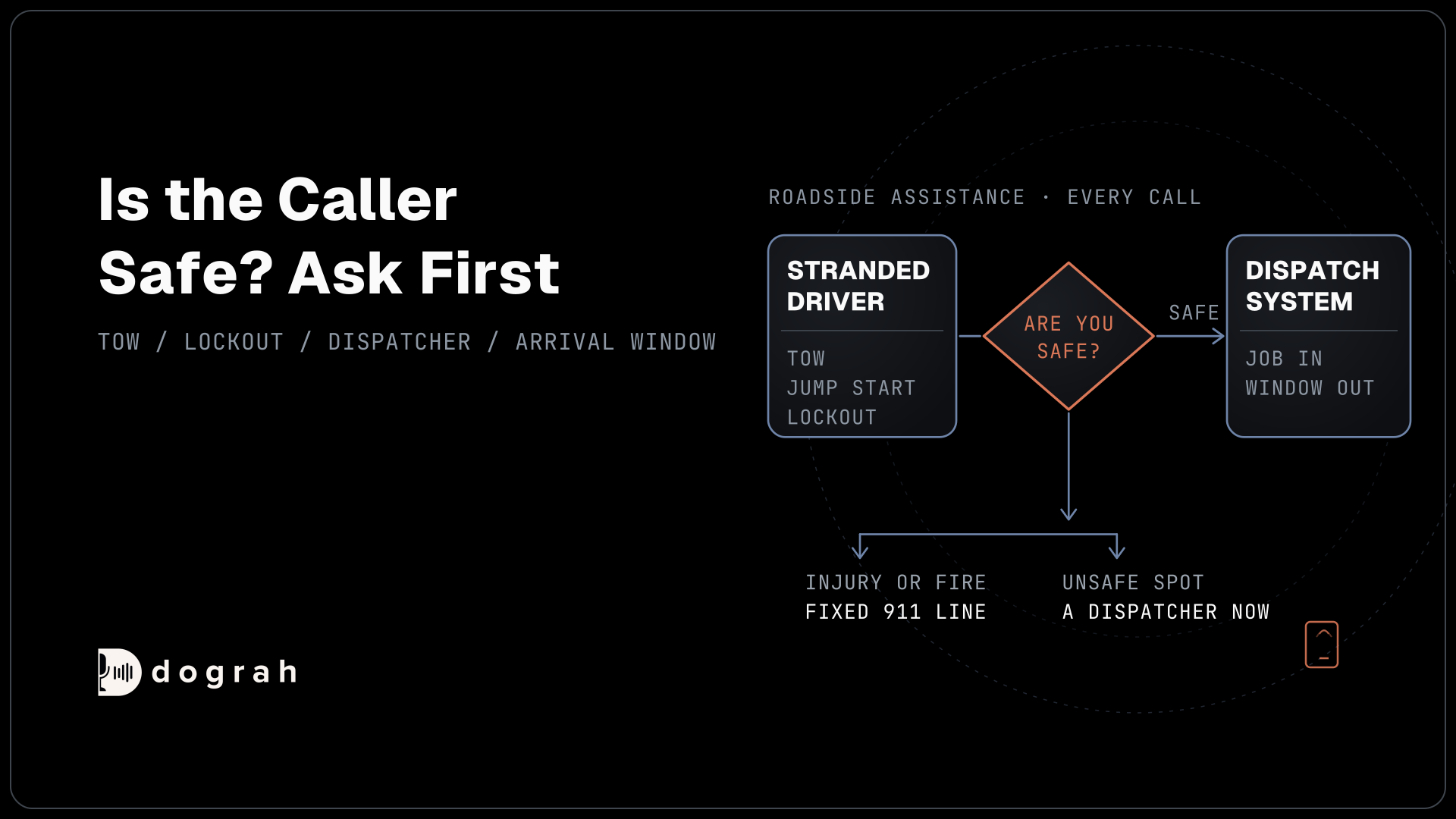
After hours, the agent takes logistics calls, and any sign of crisis on any call gets fixed words and a person. The logistics are simple: move tomorrow's session from live slots, help with a telehealth link, record a refill request for the prescriber, and record billing questions for the morning. Dograh has no built-in business-hours routing, so your phone system forwards calls after closing to the number the after-hours agent answers.
The crisis line must be word for word, every time. Prompts leak by paraphrase: the model avoids the banned phrase and then says the banned meaning in other words. Exact wording holds only where Dograh plays fixed text or a recording, such as a pathway's Transition Speech. Put this line on the crisis pathway:
"If you're thinking about harming yourself, call or text 988 to reach the Suicide and Crisis Lifeline. If you're in immediate danger, get to safety and call 911."
Choosing that pathway is still the model reading the condition you wrote, so keep the condition short and explicit, test it with many phrasings, and read the transcripts. The Global Node has no edges, so add a crisis pathway that leaves from every node. Our post on prompt and flow design patterns explains why this split holds. On a speech-to-speech model, text Transition Speech does not play, so record the line as a clip.
Then the call goes to a person. Transfer Call works on Twilio, Telnyx, Plivo, Cloudonix and Asterisk ARI. Dograh calls the destination first and connects the caller only when someone answers. On Twilio, it can play a short spoken introduction to both people before connecting them. Set its destination to Dynamic HTTP Resolver, and your system returns tonight's on-call clinician. No summary travels with the call by default, so an HTTP API tool writes a crisis flag and the callback number to your system first.
If nobody answers within the 30-second default, the caller stays with the agent. The 988 and 911 line has already played, and your prompt decides what comes next, such as trying a backup clinician. The Government Accountability Office's July 2026 report says that as of March 2026, 988 calls are generally routed to local crisis centers by the caller's approximate location, so the number reaches a nearby staffed center. AI voice agents for after-hours calls and crisis routing in behavioral health covers the on-call rota and the transfer nobody answers.
Join the Dograh Community
Dograh is an OSS alternative to Vapi. Join our Slack community for queries, releases, best practices & community interactions.
Substance use programs and Part 2
Some practices also fall under federal rules for substance use disorder records, which go further than HIPAA, the Health Insurance Portability and Accountability Act. The Confidentiality of Substance Use Disorder Patient Records rules (42 CFR Part 2) apply to federally assisted programs that present themselves as providing, and do provide, substance use disorder diagnosis, treatment or referral for treatment. Many mental health practices are not Part 2 programs at all.
Where the rules apply, the stakes rose in 2026. Programs had to comply with the 2024 final rule by February 16, 2026, and the rule added civil penalties. Part 2 also treats someone who has applied for treatment as a patient, so a waitlist voicemail or a word to a housemate that names the program is a disclosure.
For a voice agent, that generally means collecting as little as each call needs, keeping it where the program controls it, and saying nothing that names the program until the caller is verified. Whether your practice is a Part 2 program, and what that changes for each call, is a question to settle with counsel before the first call goes live.
Where the recordings live
A behavioral health call can carry a diagnosis or a medication in the caller's own words, so decide where recordings and transcripts live before the first call. Dograh is self-hostable. Run it on your own servers and Dograh itself never sees your clients' calls, so no business associate agreement (BAA) with Dograh is needed.
Dograh is the orchestration layer that runs the call flow, tools and telephony, and the speech and language models are a separate layer you choose. Bringing your own keys (BYOK) to a model provider changes whose contract covers the models. The audio still reaches that provider, so each one that handles client data needs its own BAA. Call audio stays fully in-house only with open-weight models on your own servers, such as Qwen3.8 27B for language, Parakeet TDT 0.6B v2 for speech-to-text and Magpie TTS for the voice.
The phone carrier may need a BAA too, depending on what it stores, and many, such as Twilio, offer one. If your servers run in a cloud account, that cloud provider needs a BAA as well. A BAA delegates obligations to the vendor and never transfers your liability. Our post on HIPAA-compliant voice AI for hospitals walks through each agreement.
Dograh has no retention setting and deletes nothing automatically, so your own retention schedule handles recordings and transcripts. Self-hosted, recording can be switched off only server-wide, and transcripts are still saved. The self-hosting guide covers the install. Self-hosted Dograh has no per-minute platform fee (servers, model keys and phone minutes still cost). Dograh Cloud has a 1¢-a-minute platform fee.
Our page on self-hosted voice AI for behavioral health practices shows the whole setup on your own servers.
Which call to hand over first
Start with after-hours logistics or waitlist fills, because both carry little clinical risk and cost the practice a client when nobody picks up. First-contact intake comes later, once the crisis path has been tested on real calls.
Test on a real phone number before launch. Most phone calls still reach the agent as 8 kHz audio, while a browser test runs at 16 kHz, so client names and medication names can sound different to the speech model. Browser test calls cannot transfer, so run the crisis path and the on-call transfer, including one nobody answers, on a real phone line.
Once live, set up QA to flag every call where crisis language came up, with its Sample Rate at 100%, and have a clinician read those calls the next morning. A missed pathway shows up in that review before it shows up anywhere else.
Each call above has its own deep dive:
- AI Voice Agents for Behavioral Health Insurance Verification
- AI Voice Agents for Therapy Waitlist and Cancellation Calls
- After-Hours AI Voice Agents for Mental Health Crisis Routing
Glossary
- Ghost network
- A health plan's directory of clinicians who cannot be reached or are not taking new clients. Callers who work through it mostly reach machines, which is why the agent's measure is a booked session.
- Transition Speech
- Fixed text or a recorded clip that Dograh plays word for word when the agent moves onto a pathway. It is where the crisis line lives, so the model never rewords it.
- Dynamic HTTP Resolver
- A Transfer Call setting that asks your system for the destination at the moment of transfer. A practice uses it to reach tonight's on-call clinician instead of a fixed number.
- 42 CFR Part 2
- The federal confidentiality rules for records of federally assisted substance use disorder programs. They apply on top of HIPAA, and under them even a waitlist applicant counts as a patient.