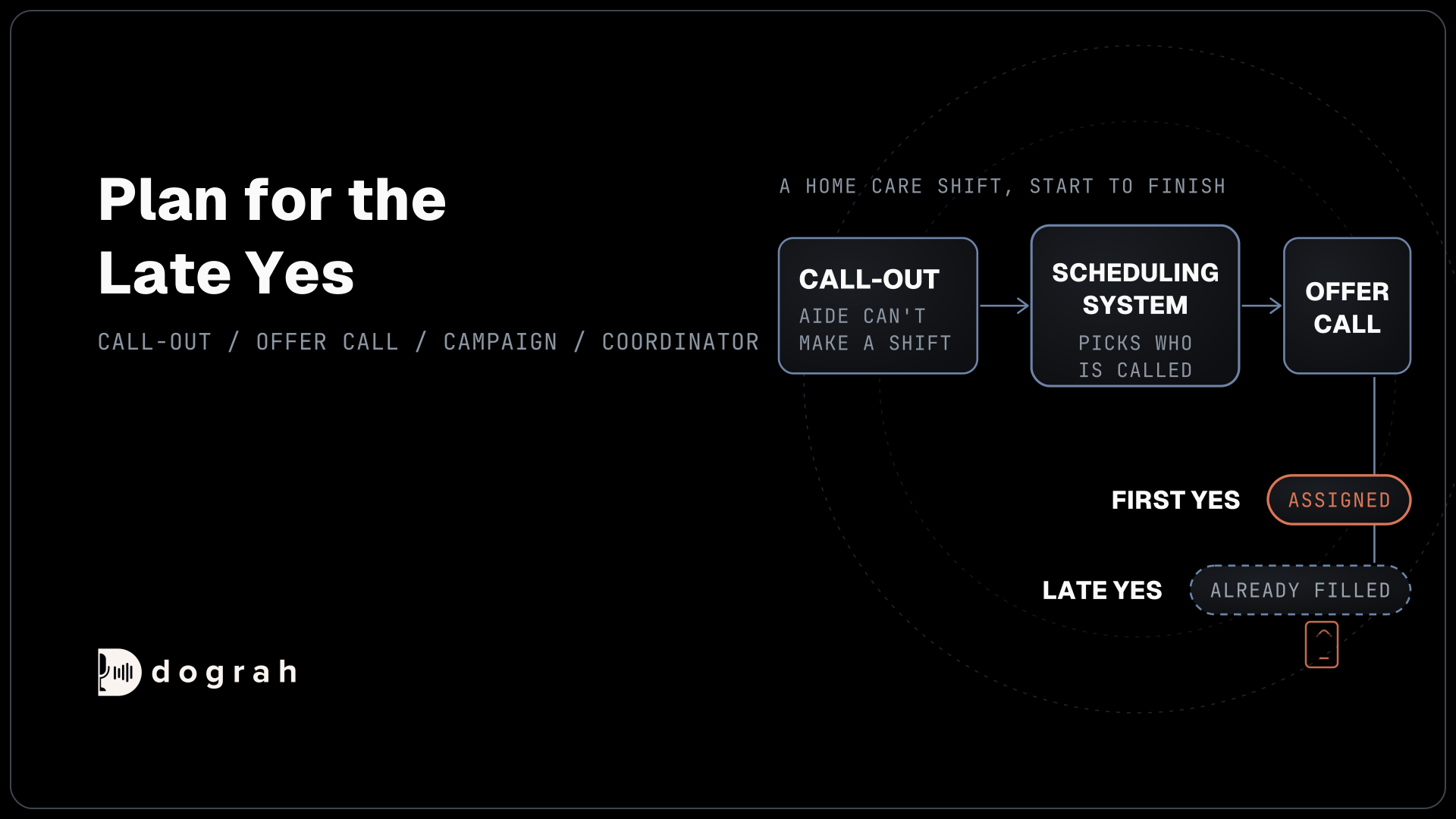

AI voice agents for caregiver shift scheduling take call-outs from aides and write the reason and the shifts affected to your scheduling system. To fill a shift, that system picks qualified caregivers and starts the calls. When a caregiver says yes, the agent asks the system to assign the shift. A coordinator takes the hard cases.
Key Takeaways
- The scheduling system picks who gets called and decides who gets the shift.
- A campaign keeps dialling until paused, so plan the "already filled" answer.
- Keep campaign Max Concurrent Calls below your limit so call-outs still get through.
This post is part of our guide to AI Voice Agents for Home Health & Hospice, where caregiver calls are the only ones from your own staff. Below, we cover the call-out line. Then we set up the shift-fill calls in Dograh, the open-source AI voice agent platform we build.
The call-out line: verify, record, write back
The call-out line answers aides who can't make a shift, and its job ends when the call-out is in your scheduling system. Those calls come early and often. The Bureau of Labor Statistics projects about 760,500 openings a year for home health and personal care aides from 2025 to 2035, so most agencies are always scheduling around someone.
Pre-Call Data Fetch sends the calling number as the call connects, and your scheduling system can return that caregiver's record and today's shifts. A number finds the record, but it doesn't prove who is calling. So the agent asks for an approved check, such as the last digits of the caregiver's employee ID, before it names a client or a shift.
Then the agent asks which shifts are affected and the reason, and records both as the caregiver states them. An HTTP API tool writes the call-out to your scheduling system during the call. The agent closes by saying what happens next, for example that a coordinator will confirm cover and whether the caregiver needs to do anything else.
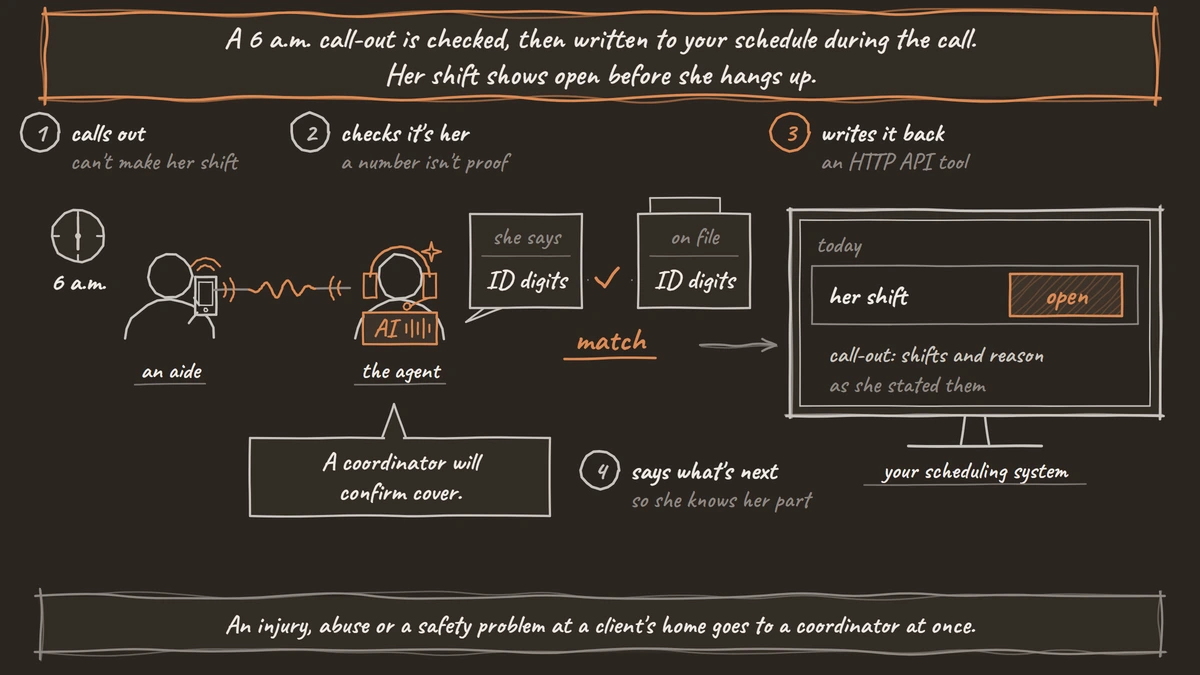
One kind of call-out can't wait for the schedule. If a caregiver reports an injury, abuse or a safety problem at a client's home, the agent records it and transfers the call to a coordinator at once.
Who gets offered the shift
Your scheduling system decides who is qualified and in what order, and Dograh doesn't rank caregivers. The system knows each caregiver's skills, hours, location and the client's preferences. It also knows overtime and travel rules, so the agent offers only shifts the system returns as allowed for that caregiver.
For one urgent shift, the system starts one call at a time through the API Trigger, in the order it chooses, and stops once the shift is filled. This suits a same-day call-out, because the system controls every call.
For next week's open shifts, a campaign dials a CSV list. Each extra column, such as the shift time and area, becomes a variable the agent can use. Max Concurrent Calls caps how many ring at once. Retries run from 0 to 10, 2 by default, and for a same-day shift 0 is often right. A campaign's calling hours run in one time zone, so split a list that spans zones.

Open Source Alternative to Vapi / Retell
Self-hosted voice agent platform — no per-minute fees
dograh-hq/dograh
Star on GitHub
The offer call and the first yes
The offer call checks who answered before it offers anything, and your system decides whether a yes counts. The agent asks for the caregiver by name, then for the approved check. Only after that does it give the shift time and the client's area. The full address and the client's name follow only once the shift is assigned.
When a caregiver says yes, an HTTP API tool asks the scheduling system to assign the shift and reads back its answer, "assigned" or "already filled". The tool hands the whole response to the language model, so the endpoint should return only what the agent may say. A request can be sent twice after a slow reply. Add a Preset Parameter named workflow_run_id with the value {{initial_context.workflow_run_id}}, and your system uses it to ignore the duplicate.
Campaigns have no "stop once filled" setting. A campaign keeps dialling until it is paused, and your system can pause it by API as soon as the shift is taken. Calls already ringing still finish, so a late yes hears "this shift has been filled" and a thank-you. Voicemail handling is off by default. If you turn it on, a message names only the agency and a callback number, never the client or the address.
Some agencies will want fewer automated offers, and that is reasonable. Comfort Keepers, with more than 600 franchise locations, is testing calls to all qualified caregivers at once, with the shift going to the first to answer. Its chief operating officer told Home Health Care News that the feature is in very early stages and has seen mixed results, and that many franchises haven't taken it up because they believe the scheduler's relationship with caregivers is key. Keep personal calls for the caregivers who prefer them, and let the agent work the rest of the list.
Hard cases go to a coordinator
A coordinator takes every call the schedule can't settle. That covers a client or family who objects to a new caregiver, a shift that needs a skill nobody on the list has, a hospice or end-of-life client, and a caregiver who fails the check.
Transfer Call works on Twilio, Telnyx, Plivo, Cloudonix and Asterisk ARI. Dograh calls the coordinator first and connects the caller only when someone answers. On Twilio, it can play a short spoken introduction to both people before connecting them. No summary travels with the call by default, so the agent writes the details first. If nobody answers within 30 seconds, the default, it writes a callback request.
When a call-out moves a patient's visit, the call to the patient is a separate one. AI voice agents for home health visit coordination covers it, started by the scheduling system once the new caregiver is set.
Dograh is not an electronic visit verification (EVV) system. The federal EVV requirement has states verify each Medicaid personal care and home health visit electronically, including who gave the care and when it began and ended. The call-out agent never clocks anyone in or out, and the visit record stays in your EVV system.
Join the Dograh Community
Dograh is an OSS alternative to Vapi. Join our Slack community for queries, releases, best practices & community interactions.
Consent, call limits and cost
Shift calls go to caregivers' mobiles, so consent comes first. Under the Telephone Consumer Protection Act (TCPA), an AI voice counts as an artificial voice, and the FCC's calling rules require prior express consent for such a call to a mobile phone. Calls to your own staff fall outside the healthcare exemption for patient calls. A call about a caregiver's own shifts offers nothing for sale, so it is generally not telemarketing, and the consent a caregiver gives with their number at hiring is the usual basis. A caregiver who asks to stop these calls has the opt-out written to your system, which removes their number from the next list. Confirm your agency's position with counsel before the first campaign.
Inbound and outbound calls share one ceiling. Campaign calls, API Trigger calls, browser test calls and inbound call-outs all draw from one organization concurrency limit. Self-hosted Dograh allows 10 concurrent calls by default, and Dograh Cloud's Pay as you go plan includes 10. Set Max Concurrent Calls below the limit, so an aide calling out at 6 a.m. never meets a full line. If Max Concurrent Calls is higher than your number of caller IDs, Dograh warns that caller IDs rotate and may be reused on simultaneous calls.
Shift offers add up in minutes. Self-hosted Dograh has no per-minute platform fee, though servers, model keys and phone minutes still cost money. Dograh Cloud has a 1¢-a-minute platform fee, and Dograh's managed models cost about $0.07 a minute for most models, billed apart from that fee. For the confirmation call a staffing agency makes before a temp's first shift, see AI voice agents for candidate reminder and confirmation calls.
Glossary
- Call-out
- A caregiver telling the agency they can't work a scheduled shift. The agent verifies the caregiver, records the reason and the shifts affected as stated, and writes the call-out to the scheduling system.
- Open shift
- A client visit with no caregiver assigned. The scheduling system decides which caregivers hear about it and in what order, and assigns it when one says yes.
- Electronic visit verification (EVV)
- The state system that records each Medicaid personal care and home health visit, including who gave the care, where and when. A voice agent that takes call-outs doesn't replace it or clock anyone in.
- Max Concurrent Calls
- The campaign setting that caps how many calls ring at once. Keep it below the organization concurrency limit so inbound call-outs always find a free slot.