
An AI phone assistant for medical practices in Germany answers in German, books appointments, passes prescription and referral requests to staff and gives opening hours. Anyone in danger hears fixed words: get to safety and call 112. You can build it in Dograh, the open-source AI voice agent platform, and self-host it or run it on Dograh Cloud.
Key Takeaways
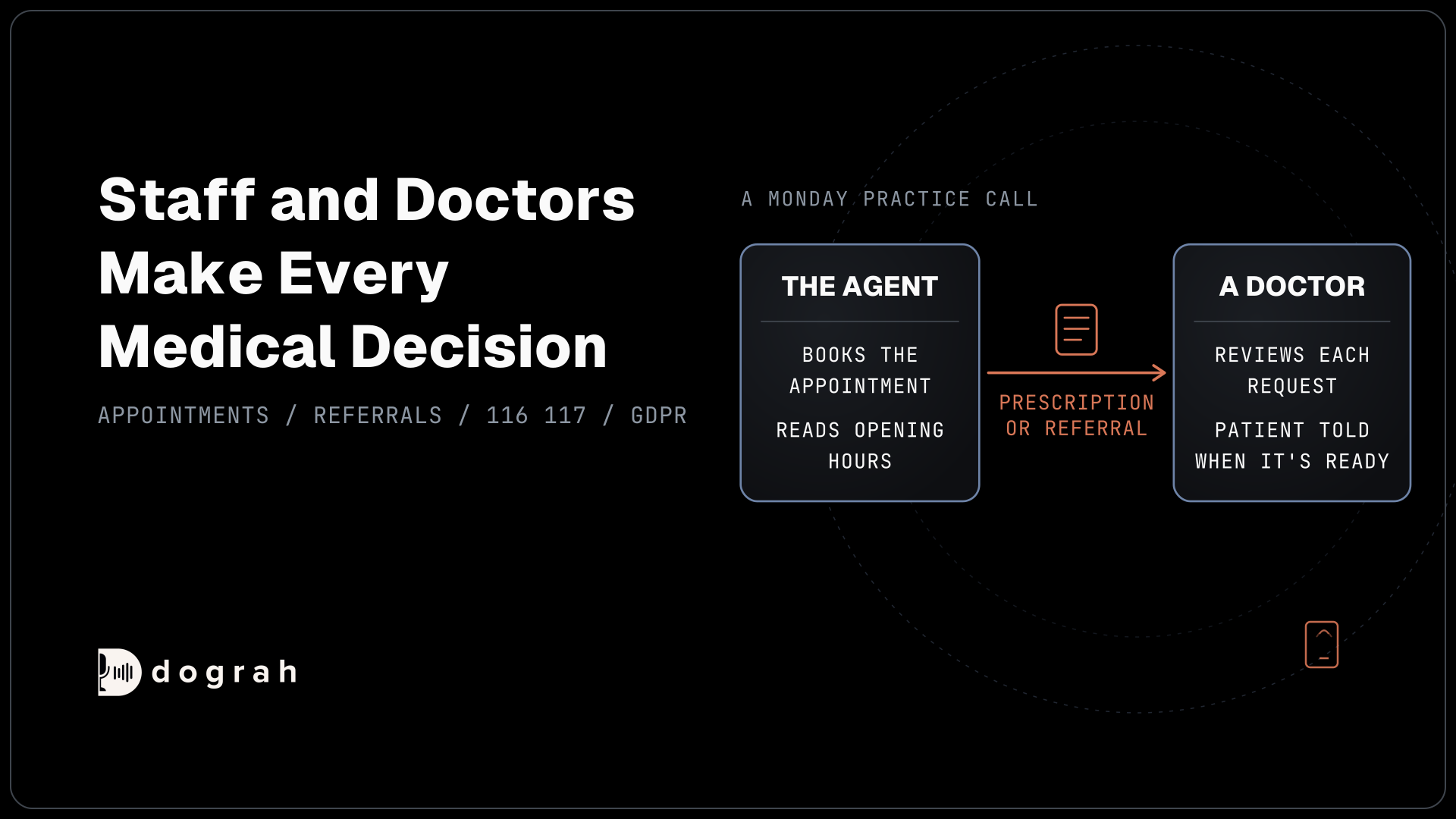
- The assistant takes requests and books slots. Staff and doctors make every medical decision.
- The 112 and 116 117 lines play as fixed words, never generated ones.
- Patient audio stays in Germany only when the models run there too.
Every German practice knows the Monday line: the phone rings before the doors open and keeps ringing. This post covers what an assistant takes and what staff keep, the emergency lines, a German greeting, Schweigepflicht and the DSGVO, and where the call runs, with each part shown in Dograh.
Monday morning on the practice phone
The practice phone jams at the same times every week, and the people who answer it also run the front desk. On Monday morning, patients who fell ill over the weekend want an appointment. Others need a repeat prescription, and a few need a referral before a specialist visit. The Medizinische Fachangestellte (MFA) at reception is checking in a patient while three lines ring.
Out-of-hours demand shows how much of patient care starts on the phone. The Kassenärztliche Vereinigung Baden-Württemberg reports 1,050,000 calls to the 116117 service hotline in 2025 in Baden-Württemberg alone, 60,000 more than the year before.
An AI phone assistant takes the routine part of the practice's own load. It answers every call in German and handles the requests that follow a set pattern. The rest goes to the team with the details already written down.
What the assistant takes and what staff decide
The assistant handles four kinds of calls, and in each one a person keeps the decision. Appointments come first. During the call, an HTTP API tool asks the practice management system (PVS) or calendar for open slots, the agent offers them, and a second tool writes the booking back once the patient agrees. The agent offers the same slots to every caller, whatever their insurance.
That design answers a worry the consumer federation vzbv raised in the Deutsches Ärzteblatt: assistants that sort private patients ahead of statutory ones. The vzbv also called AI too error-prone for triage, and the agent here never triages.
Before the agent names an existing appointment, it confirms the caller with a check the practice approves, such as date of birth plus one more detail from the record. A phone number finds a record, and it does not prove who is calling. Our post on patient appointment scheduling covers booking, rescheduling and cancelling on one call.
Repeat prescriptions (Folgerezepte) and referrals (Überweisungen) are requests. The agent asks which medicine or which specialist, records the request as the patient said it, and writes it to the practice's task list through the same kind of tool. Recording the answer is an AI step, so the transcript and the recording keep the exact words. A doctor reviews each request, and the practice lets the patient know when it is ready.
Opening hours, holiday closures and practice rules, such as bringing the insurance card, go into a Knowledge Base file the agent reads.
112, 116 117 and the lines that never change
Emergency wording is the one part of the call the language model never writes. The KBV's patient service at 116117.de sets the split. In a life-threatening case, the caller alerts the emergency service on 112. For illness outside opening hours that cannot wait until the next day, the ärztlicher Bereitschaftsdienst on 116 117 helps.
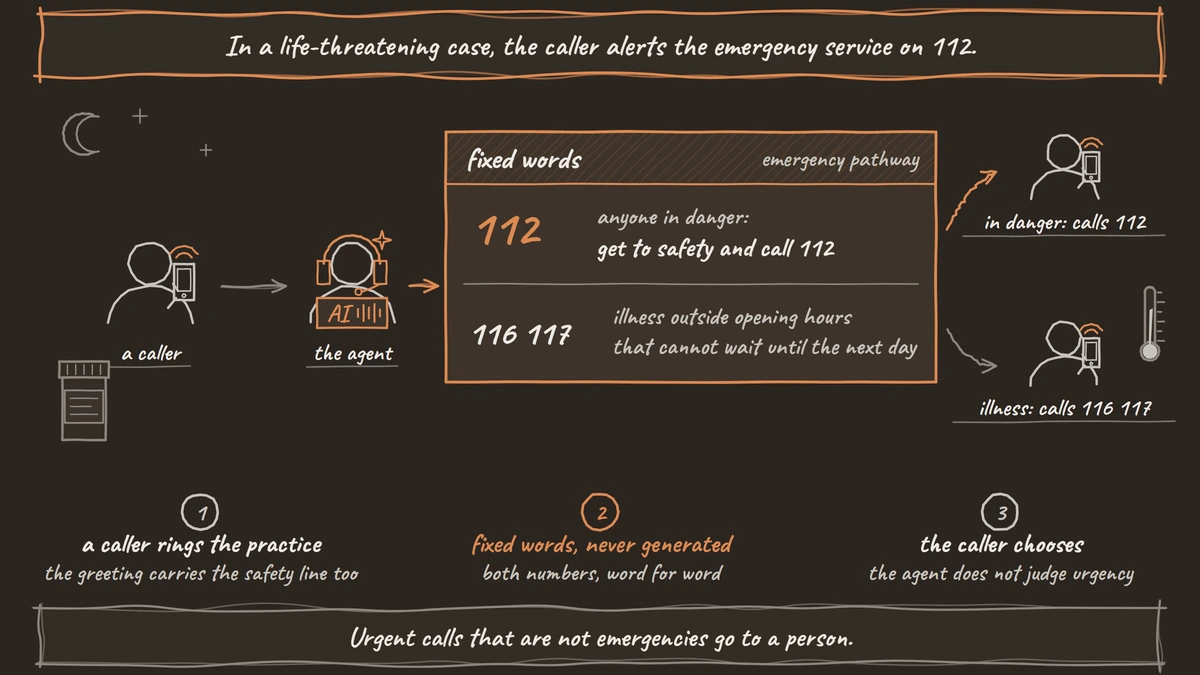
Put the safety line in the Greeting Text, which every caller hears word for word. Then add an emergency pathway whose Transition Speech plays a fixed line, as text or a recorded clip, with the caller muted so it plays in full: "Wenn jemand in Gefahr ist, bringen Sie sich in Sicherheit und rufen Sie jetzt die 112. Außerhalb unserer Sprechzeiten erreichen Sie den ärztlichen Bereitschaftsdienst unter 116 117."
The agent does not judge how urgent a symptom is. Choosing a pathway is the model reading its written condition, so detection is never a hard rule, and that is why the greeting carries the safety line too.
Urgent calls that are not emergencies go to a person. In opening hours, Transfer Call hands the patient to the team, and it works on Twilio, Telnyx, Plivo, Cloudonix and Asterisk ARI. Dograh calls the practice line first and connects the patient only when someone answers. If nobody picks up within the timeout, 30 seconds by default, the patient stays with the agent, which writes a callback request to the practice's system.

Open Source Alternative to Vapi / Retell
Self-hosted voice agent platform — no per-minute fees
dograh-hq/dograh
Star on GitHub
A German-speaking agent on a German line
A German practice line needs German speech in both directions and a greeting that carries the notices. In the agent's Model tab, tick German under Language Hints, which work with Dograh models or Deepgram Flux, and pick a voice from a text-to-speech provider that supports German. Add drug names, doctors' names and local street names to the Dictionary in the agent's Settings. Whether those words help depends on the speech-to-text provider. The prompt keeps the agent in Sie throughout.
The Greeting Text on the Start Call node is fixed text spoken word for word, so the practice name and the notices go there. Since 2 August 2026, Article 50 of the EU AI Act requires AI systems that talk directly with people to be designed so they are told, at the latest at the first interaction, unless it is obvious.
Recording needs the caller's agreement. Under the German Criminal Code (StGB), recording someone's non-public spoken words without authorisation is a crime. On a self-hosted install, recording is switched on or off for the whole server, and transcripts are kept either way. So the greeting says the call is recorded, in words your counsel approves, or recording stays off.
A greeting that carries all three might read: "Guten Tag, Praxis Dr. Becker. Sie sprechen mit unserem KI-Assistenten, und das Gespräch wird aufgezeichnet. Wenn jemand in Gefahr ist, bringen Sie sich in Sicherheit und rufen Sie die 112." Allow Greeting Interruption is on by default, so switch it off on the Start Call node and the full notice plays. Our post on German AI voice agents for banking uses the same notice for a bank line.
A member of the team can record that greeting. Dograh plays pre-recorded clips where they fit and falls back to text-to-speech for the rest, so the first words patients hear sound like their own practice.
Schweigepflicht and the DSGVO on a phone call
Every outside party that hears a patient call has to be bound to secrecy and covered by a contract. Health data is special-category data under the General Data Protection Regulation (GDPR), the DSGVO in German. A call about a prescription or a symptom falls under its strictest rules. Any vendor that processes call data for the practice also needs a processing agreement, the Auftragsverarbeitungsvertrag (AVV).
Medical confidentiality adds a criminal-law layer. Under the confidentiality offence in the German Criminal Code, a practice may let outside service providers see patient secrets only as far as their work needs, and must bind them to secrecy, or the doctor can be punished. A hosted assistant, and each speech or language model provider behind it, hears the patient's words, so each one generally counts as such a provider. Confirm how these duties apply to your practice with counsel or your Datenschutzbeauftragter.
The fewer parties hear the call, the fewer contracts and secrecy undertakings the practice has to manage. GDPR and voice AI covers controllers, processors and transfers in more depth.
Join the Dograh Community
Dograh is an OSS alternative to Vapi. Join our Slack community for queries, releases, best practices & community interactions.
Hosted assistant or servers in Germany
Most practice assistants are hosted services, so the question to ask each one is who hears the call. Hosted products promise servers in the EU and a DSGVO-compliant setup. That answers where recordings are stored. During the call, the patient's voice also goes to speech and language models, and each provider of those is one more party under the secrecy rule.
Dograh is the orchestration layer that runs the call flow, tools and telephony, and the speech and language models are a separate layer you choose. Dograh Cloud names no data region. Self-host the platform in a German data centre with Docker, and the recordings, transcripts and call records stay there. Patient audio stays in Germany only when the speech-to-text, language and voice models run on those servers too, so pick open-weight models that support German.
If you use model providers through your own keys, each one hears the audio and needs its own AVV and secrecy undertaking. Your own keys change who holds the contract, while the audio still reaches the provider.
The code is open source, so the practice's IT provider can read what it does. Every call has a full trace that shows what the agent heard and said at each turn, and QA scores a sample of calls you choose. QA summaries come out in English by default, so a German-speaking colleague reads the flagged transcripts. Self-hosted Dograh has no per-minute platform fee, but servers, model keys and phone minutes still cost money. Dograh Cloud charges a 1¢-a-minute platform fee.
Where to start
Start with the Monday booking line, because it carries the most calls and the simplest decisions. Build the greeting and the emergency pathway first, then test them on a real phone call, since browser test calls cannot run a transfer. Add prescription and referral requests once the team trusts the task list the agent writes to.
Glossary
- Schweigepflicht
- A German doctor's duty of medical confidentiality. Outside service providers may see patient secrets only as far as their work needs, and the practice must bind each one to secrecy.
- Auftragsverarbeitungsvertrag (AVV)
- The processing agreement the GDPR requires between a practice and any vendor that processes its call data, including each model provider that hears the audio.
- Ärztlicher Bereitschaftsdienst
- The out-of-hours medical service on 116 117 for illness that cannot wait until the next day. Life-threatening cases go to 112 instead.
- Transition Speech
- A fixed line or recorded clip that plays as the call moves to a new step, with the caller muted. The 112 line plays here on the emergency pathway.