
AI voice agents for third-party collections call under the agency's own name and confirm the right person before naming the debt or the client. The collector notice then plays as fixed words. Every attempt is logged, and every answered call is recorded, for the client's audit, and any dispute is written to the agency's system and handed to staff.
Key Takeaways
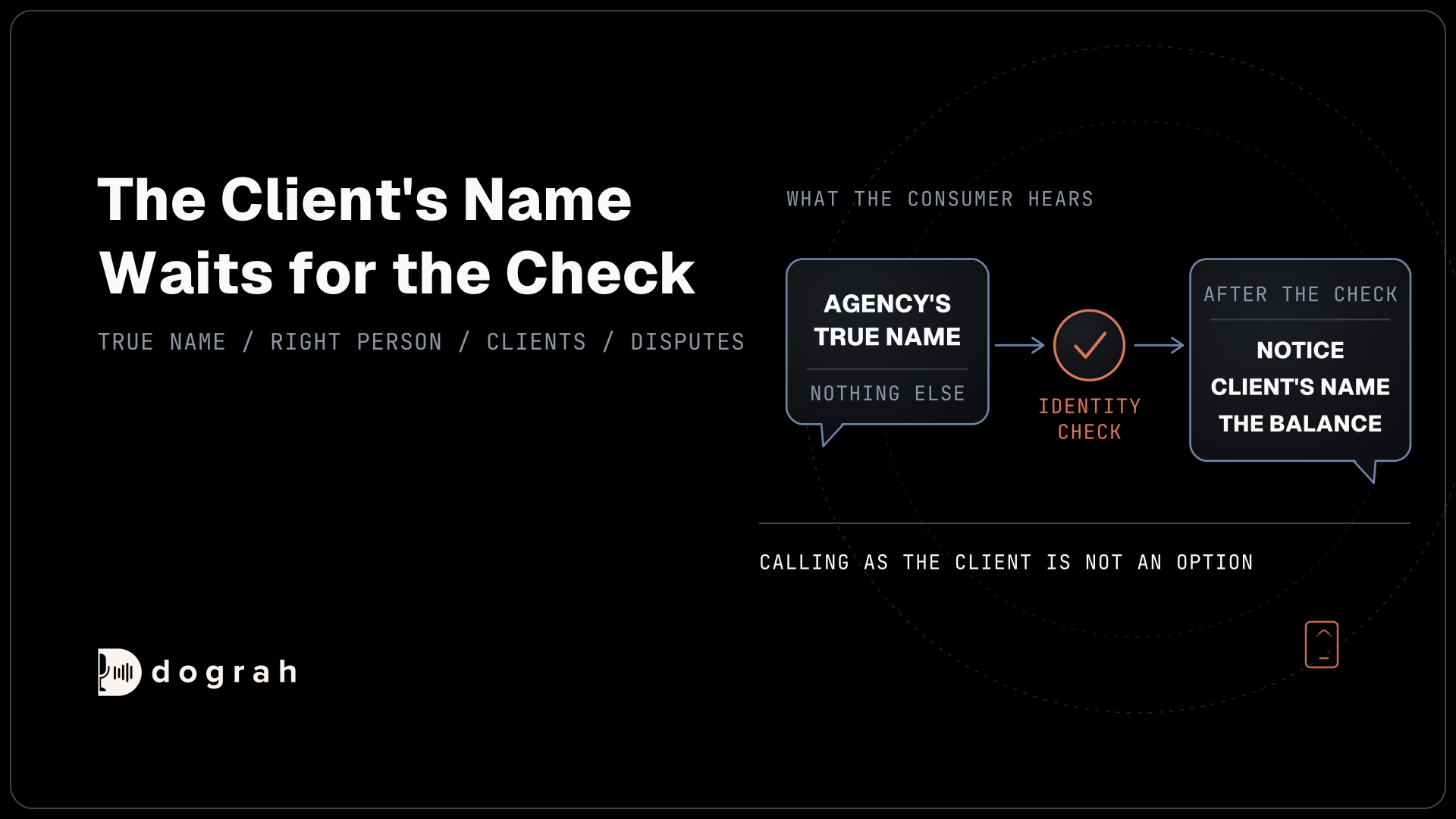
- The client's name is spoken only after the identity check passes.
- Every attempt, answered or not, is a record your client can ask for.
- Disputes stop the payment talk and reach staff the same way every time.
This post is part of our guide to AI debt collection software for agencies, where an agency calls under its own true name. Below, we cover the client's name, right-person checks, logging and disputes. Each section shows how that part runs in Dograh, the open-source AI voice agent platform we build.
Whose name the consumer hears
The consumer hears the agency's name first, and the client's name only once they are confirmed. An agency collecting for creditors is a debt collector under the Fair Debt Collection Practices Act (FDCPA), and Regulation F requires it to use its true business name. Calling as the client is not an option.
In Dograh, the agency's name sits in the Greeting Text on the Start Call node, which plays word for word, with Allow Greeting Interruption switched off. The client's name is account information, so it follows the same rule as the balance. Pre-Call Data Fetch loads the creditor name with the rest of the account, and the prompt lets the agent say it only on the step after the identity check passes.
The client's name is at risk in a second way. Complaints name the company that called, and a creditor reads them. In the first ten months of 2026, the CFPB's complaint database logged 80,848 debt collection complaints saying the debt was not the person's and 27,118 saying the collector asked for the wrong amount. Each one lands on the agency and, through it, on the client relationship.
Your client agreements may also say how calls on their accounts can be made. Check them before the first AI campaign goes out.
Right person first, every time
A name match finds the person and proves nothing about who answered. The prompt asks for an approved check, such as a date of birth or the last digits of the account number, and compares it with the value the lookup returned. Our post on AI voice agents for debt collection covers verification and the polite exit when someone else picks up.
Sometimes the agency calls a relative or a neighbour to find a consumer it cannot reach. The Fair Debt Collection Practices Act's rule on location calls sets tight terms for that call. The caller gives its own name and says it is confirming location information. It never says the consumer owes a debt, and names its employer only if asked. Run these from a separate agent with its own fixed opening, so a location call can never wander into account talk.
Once the check passes, the collector notice plays as fixed Transition Speech, and later calls use the shorter debt collector line. Our post on compliance-safe collection disclosures shows where each version plays.

Open Source Alternative to Vapi / Retell
Self-hosted voice agent platform — no per-minute fees
dograh-hq/dograh
Star on GitHub
Log every attempt for the client
Every attempt is a record, and a client audit can ask for any of them. Regulation F's record-keeping rule has a collector keep records that show compliance for three years after the last collection activity on a debt, and each recorded call for three years after the call.
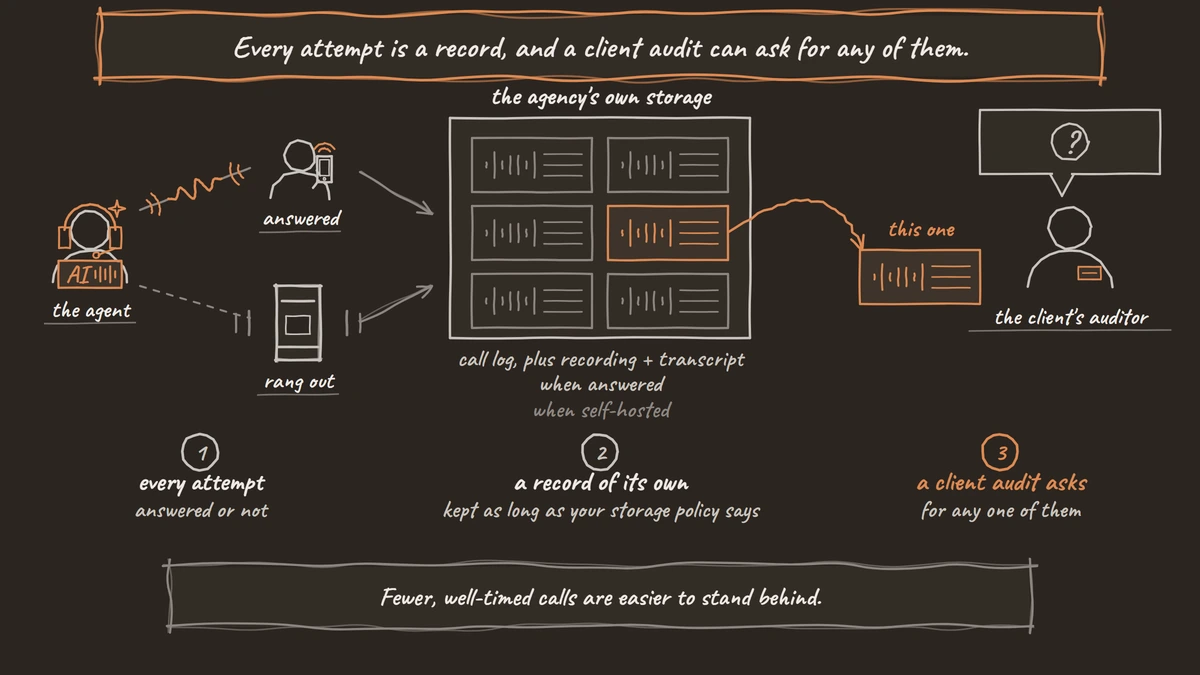
Clients have their own reason to ask. The CFPB's service provider bulletin expects the banks and lenders it supervises to oversee the companies working for them, and says using one does not remove their own duty to comply. Their audit of your calls is how they do that.
In Dograh, each call is a run with its own recording and transcript. A Webhook node posts the outcome, the attempt and any dispute to the agency's collection system when the call ends, and a temporary failure on that request is retried automatically. Calls that ring out are attempts too, and they count toward the per-debt limit in your own system.
Some pitches treat more follow-up as the goal. For an agency, each extra call is one more record to defend and one more step toward the seven-in-seven line. Fewer, well-timed calls are easier to stand behind.
Where the records live matters most here. Self-host Dograh and the recordings and transcripts land in the agency's own storage, with no retention timer and no automatic deletion, so your storage policy sets the three years. On Dograh Cloud, keep each client in its own team and switch between them from the sidebar. On a self-hosted install, each client gets its own agent, with a separate phone setup and its own caller IDs. Our page on self-hosted voice agents for collection agencies covers that setup.
Either route has running costs. Self-hosted Dograh has no per-minute platform fee, but servers, model keys and phone minutes still cost money. Dograh Cloud charges a 1¢-a-minute platform fee.
Disputes go to staff
A dispute stops the payment talk the moment the consumer raises it. When someone says the debt is not theirs or the amount is wrong, the agent says it will pass this to the team. It then writes their words to the agency's system through an HTTP API tool and passes the call on.
Transfer Call works on Twilio, Telnyx, Plivo, Cloudonix and Asterisk ARI. Dograh calls the destination first and connects the consumer only when someone answers, and on Twilio it can play a short spoken introduction to both people. Context Mapping sends the call to the dispute team's number. If nobody answers within the timeout, the consumer stays with the agent, which takes a callback request.
The staff side has rules of its own. A dispute made in writing within the validation period stops collection of the disputed part until the agency sends verification, and a debt the agency reports to a credit bureau has to be marked as disputed once it knows. A consumer who names an attorney is contacted through that attorney. These duties sit with the agency whoever made the call, so confirm your dispute process with counsel before the agent takes live calls.
Join the Dograh Community
Dograh is an OSS alternative to Vapi. Join our Slack community for queries, releases, best practices & community interactions.
When the account belongs to a creditor
Creditors collecting their own accounts work under different rules. A creditor calling in its own name generally sits outside the FDCPA, so its opening line carries a different legal weight. AI voice agents for first-party collections covers those calls and the point when an account moves to an agency like yours.
Glossary
- True business name
- The name a collection agency actually does business under. It plays in the fixed opening of every call, and the client's name comes only after the identity check.
- Location call
- A call to someone other than the consumer to find where the consumer lives or works. The caller says it is confirming location information and never mentions a debt.
- Validation period
- The window after the validation notice in which a consumer can dispute a debt. A written dispute in that window stops collection of the disputed part until verification is sent.
- Context Mapping
- A Transfer Call setting that picks the destination from a value gathered on the call, such as the issue type, so disputes reach the dispute team.