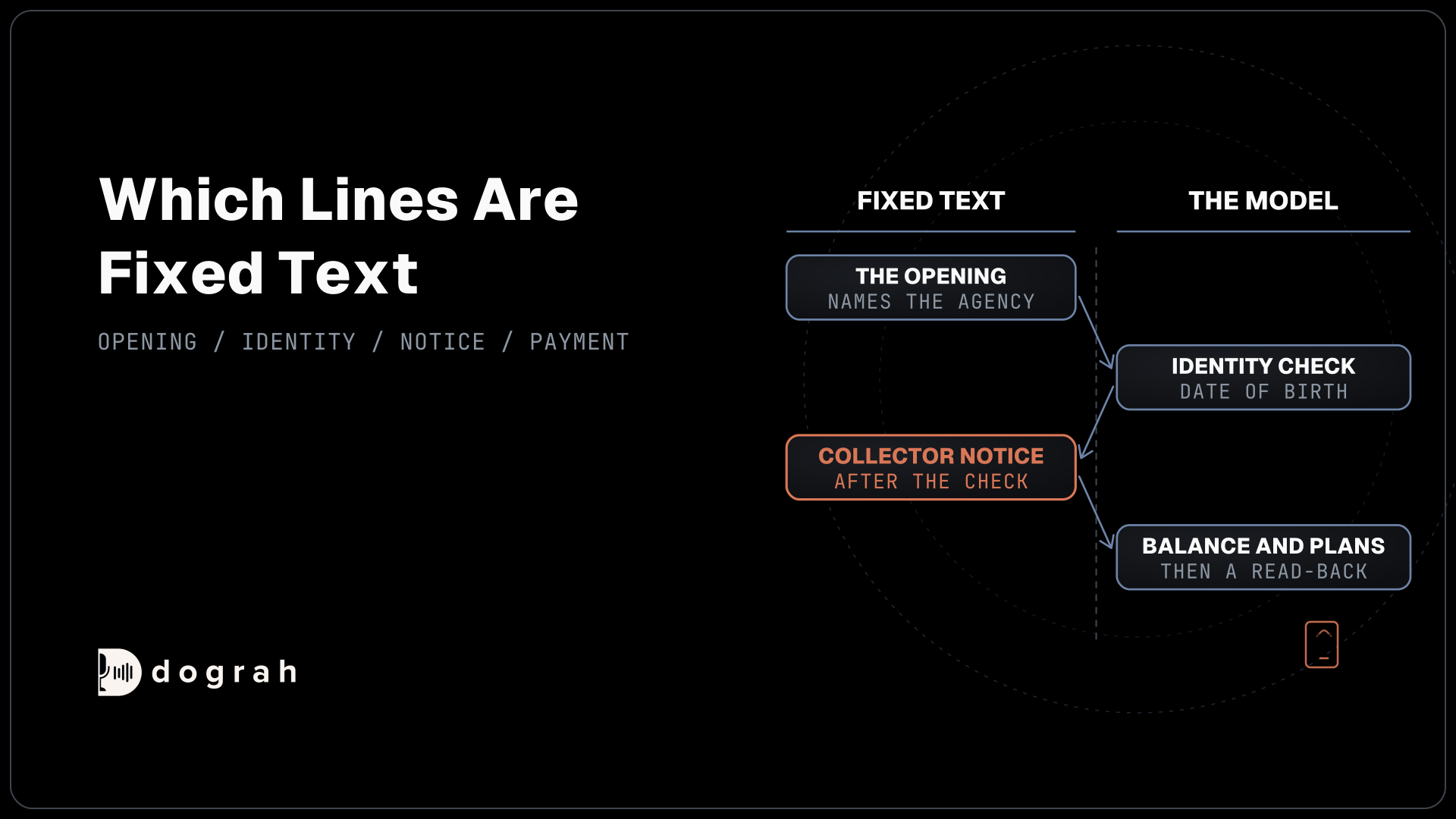

An AI collection call names the agency and asks for the consumer, then confirms identity with an approved check before the collector notice plays as fixed words. Only after that does the agent state the balance and offer the agency's payment options, ending with an agreed date and amount read back. Disputes and hardship go to a person.
Key Takeaways
- The opening names the agency and the person, never the debt.
- The collector notice plays as fixed text once the identity check passes.
- A dispute or hardship answer stops the money talk and reaches a person.
This post is part of our guide to AI debt collection software for agencies, where every call runs greet, verify, disclose, then money. Below, we cover one sample call line by line. Along the way, we show how each step runs in Dograh, the open-source AI voice agent platform we build.
Before the phone rings
The call starts with data, so the agent never guesses a name or a number. Our sample agency is Ridgeline Recovery, collecting a card balance for a made-up creditor, Northfield Card Services. The campaign row holds the consumer's phone number and an account reference, nothing more.
Once the call connects, Pre-Call Data Fetch sends the numbers to Ridgeline's system and gets back the consumer's first name, the balance, the date of birth on file and the payment plans allowed for this account. The greeting waits for that answer, and the consumer hears ringing meanwhile. Every value the agent uses later in the call comes from this lookup.
The opening and the identity check
The opening is fixed text, and it asks for the person without saying why. It sits in the Greeting Text on the Start Call node, so it plays word for word:
Agent (Greeting Text, fixed): "Hi, this is Ridgeline Recovery. May I speak with Dana?"
Consumer: "Speaking."
Agent (model): "Thanks, Dana. Before we go on, can you confirm your date of birth for me?"
Consumer: "Sure, it's the 3rd of March, 84."
Switch off Allow Greeting Interruption, which is on by default, so a quick "hello?" never cuts the agency's name short. The FCC has ruled that an AI voice is an artificial voice under the Telephone Consumer Protection Act (TCPA), so the call names the business at the start and gives a callback number before it ends. If you want to tell consumers they're speaking with an automated assistant, or a law where you call requires it, add that to the Greeting Text as well.
The account stays closed until the check passes. "Speaking" only tells the agent that someone answered to the name. The prompt has the agent compare the date of birth with the fetched value, and only a match takes the "identity confirmed" pathway. Some scripts name the invoice and the amount right after a role check. That works for a business paying a supplier. For a consumer debt, Regulation F's rule on talking to third parties means the debt stays unnamed until right-party contact is confirmed.
If the check fails or someone else answered, the agent says it will try another time, asks when Dana is usually free and ends the call with nothing about why it called. Our post on AI voice agents for debt collection covers that exit and what a voicemail may say.
The collector notice, then the balance
The notice plays as Transition Speech on the "identity confirmed" pathway, as fixed text or a recorded clip, with the caller muted so it plays in full:
Agent (Transition Speech, fixed): "Thank you. This is Ridgeline Recovery, a debt collector. This is an attempt to collect a debt, and any information obtained will be used for that purpose."
On a speech-to-speech model, text transition lines do not play, so record the notice as a clip there. A notice the model phrases itself can drop a clause, and complaints show what that costs. In the first ten months of 2026, the CFPB's complaint database logged 6,015 debt collection complaints saying a notice did not disclose it was an attempt to collect a debt, and 1,413 about talking to a third party about the debt.
Regulation F's disclosure rule asks for this full line in the first conversation and a shorter "this call is from a debt collector" after that. Our post on compliance-safe collection disclosures shows how later calls and state versions get their own approved text.
Only now does the agent talk money, from the fetched values:
Agent (model): "Dana, our records show a balance of $1,240 on your Northfield Card Services account. Would you be able to clear that today, or would a payment plan suit you better?"

Open Source Alternative to Vapi / Retell
Self-hosted voice agent platform — no per-minute fees
dograh-hq/dograh
Star on GitHub
Agreeing the payment
The agent offers only the plans the lookup returned, then reads the choice back before anything is sent.
Consumer: "I can't do all of it. Maybe $200 now?"
Agent (model): "I can set that up. It would be $200 today, then $260 on the 15th of each month for four months. Does that work?"
Consumer: "Yes, that's fine."
Agent (model): "To confirm, $200 today and $260 on the 15th for the next four months, $1,240 in total. I'm asking our payment partner to text you a secure link now."
That last request is an HTTP API tool asking Ridgeline's payment provider to send its link by text or email. A short message plays when the tool starts, while the request runs, and you can add a later update if the provider is slow. Dana accepts the plan on the provider's page, so no card numbers are spoken. Variable extraction records the plan as she stated it, and the recording is the exact record. AI debt payment plan calls covers the plan step in depth.
The moment a person takes over
A dispute ends the money talk at once. Say Dana answers the balance differently:
Consumer: "Hang on, I paid this off in June."
Agent (model): "Thank you for telling me. I'll stop here and pass this to a member of our team who can look into it with you."
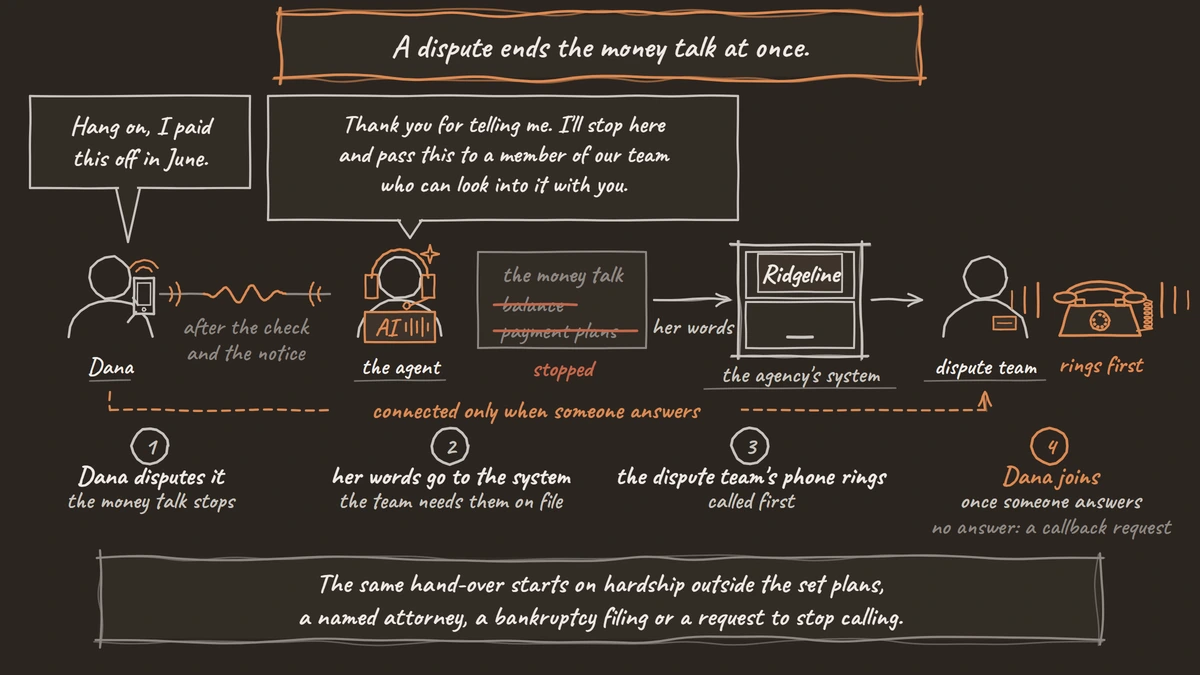
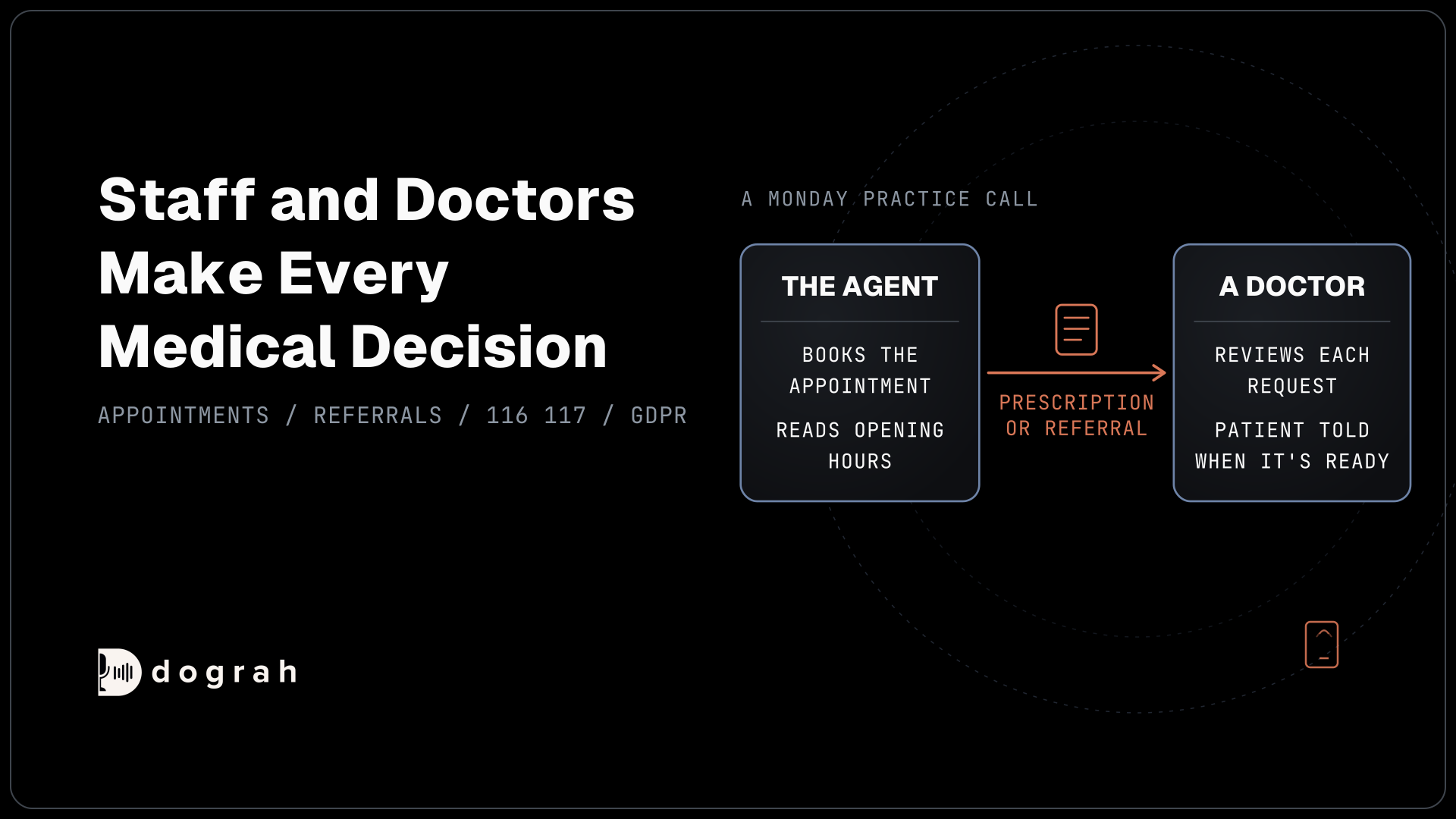
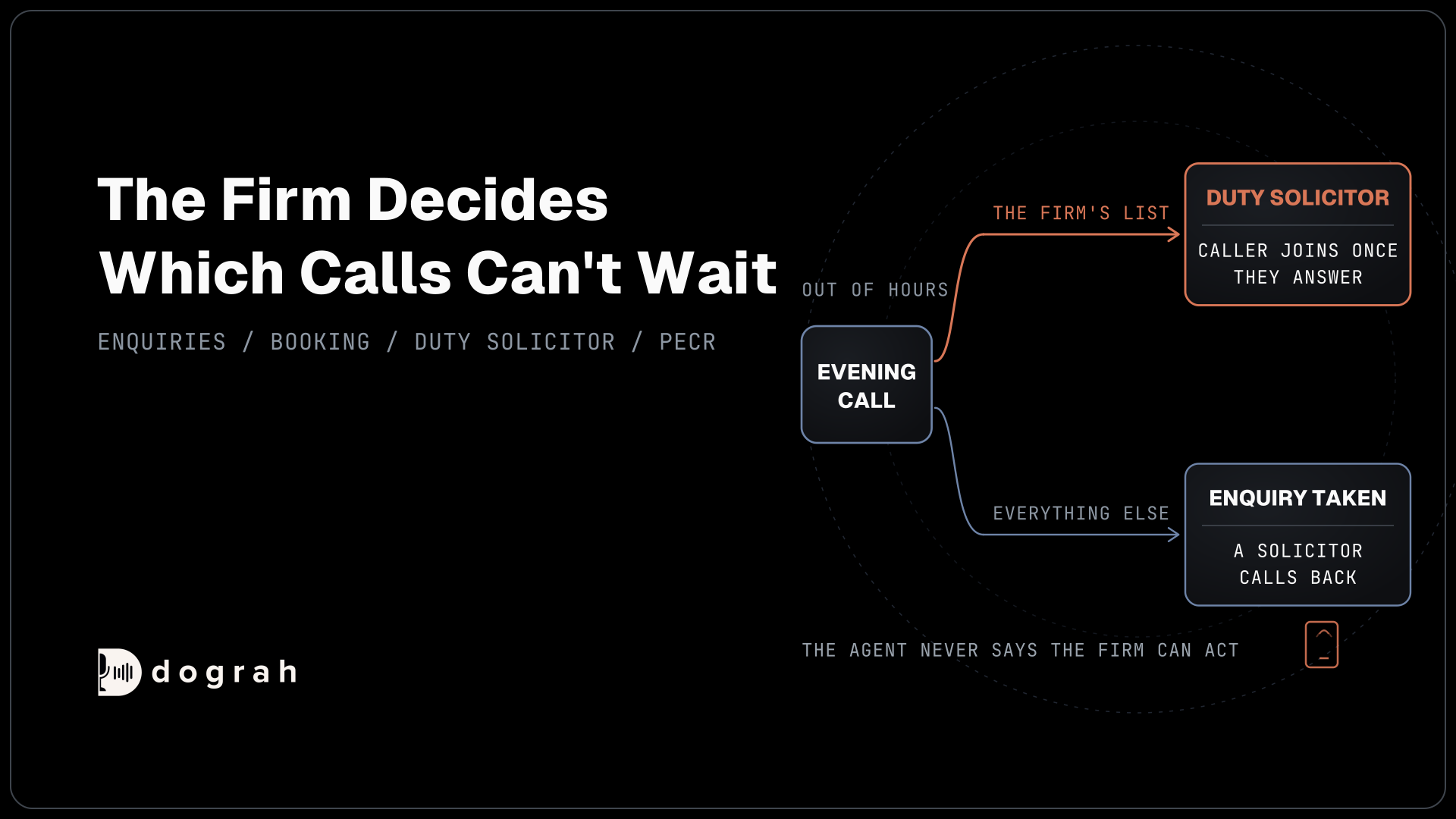
The agent writes Dana's words to Ridgeline's system through an HTTP API tool, then uses Transfer Call. Dograh calls the destination first and connects Dana only when someone answers. On Twilio, a short spoken introduction can play to both of them before they are connected. Context Mapping sends disputes to the dispute team's number and hardship to another. If nobody answers within 30 seconds, the default, Dana stays with the agent, which takes a callback request and writes it to the system.
The same hand-over starts on hardship outside the set plans, a named attorney, a bankruptcy filing or a request to stop calling. Regulation F's dispute rule stops collection of a debt disputed in writing within the validation period until the collector sends verification, so the dispute team needs Dana's words on file. Confirm your own triggers and wording with counsel before the first live call.
Join the Dograh Community
Dograh is an OSS alternative to Vapi. Join our Slack community for queries, releases, best practices & community interactions.
Checking the call afterwards
Every call leaves a record you can replay. View Trace opens the call in Langfuse with the speech-to-text, AI and voice time for each turn, so you can see what the agent heard when it chose a pathway.
Choosing the "identity confirmed" pathway is the model reading its written condition, so check it after the call. Replace the QA System Prompt with checks such as whether the balance came before the date of birth matched, and review every flagged call. A Webhook node sends the outcome, the agreed plan and any dispute to Ridgeline's system when the call ends.
Glossary
- Right-party contact
- Reaching the consumer who owes the debt and confirming it is them with an approved check. Until then, the agent says nothing about the debt.
- Collector notice
- The line Regulation F asks for that the call is an attempt to collect a debt and any information obtained will be used for that purpose. Later calls use a shorter debt collector line.
- Transition Speech
- A fixed line or recorded clip that plays when the call moves along a pathway, with the caller muted. The collector notice plays here, after the identity check.
- Context Mapping
- A Transfer Call setting that picks the destination number from a value gathered on the call, so a dispute and a hardship case reach different teams.