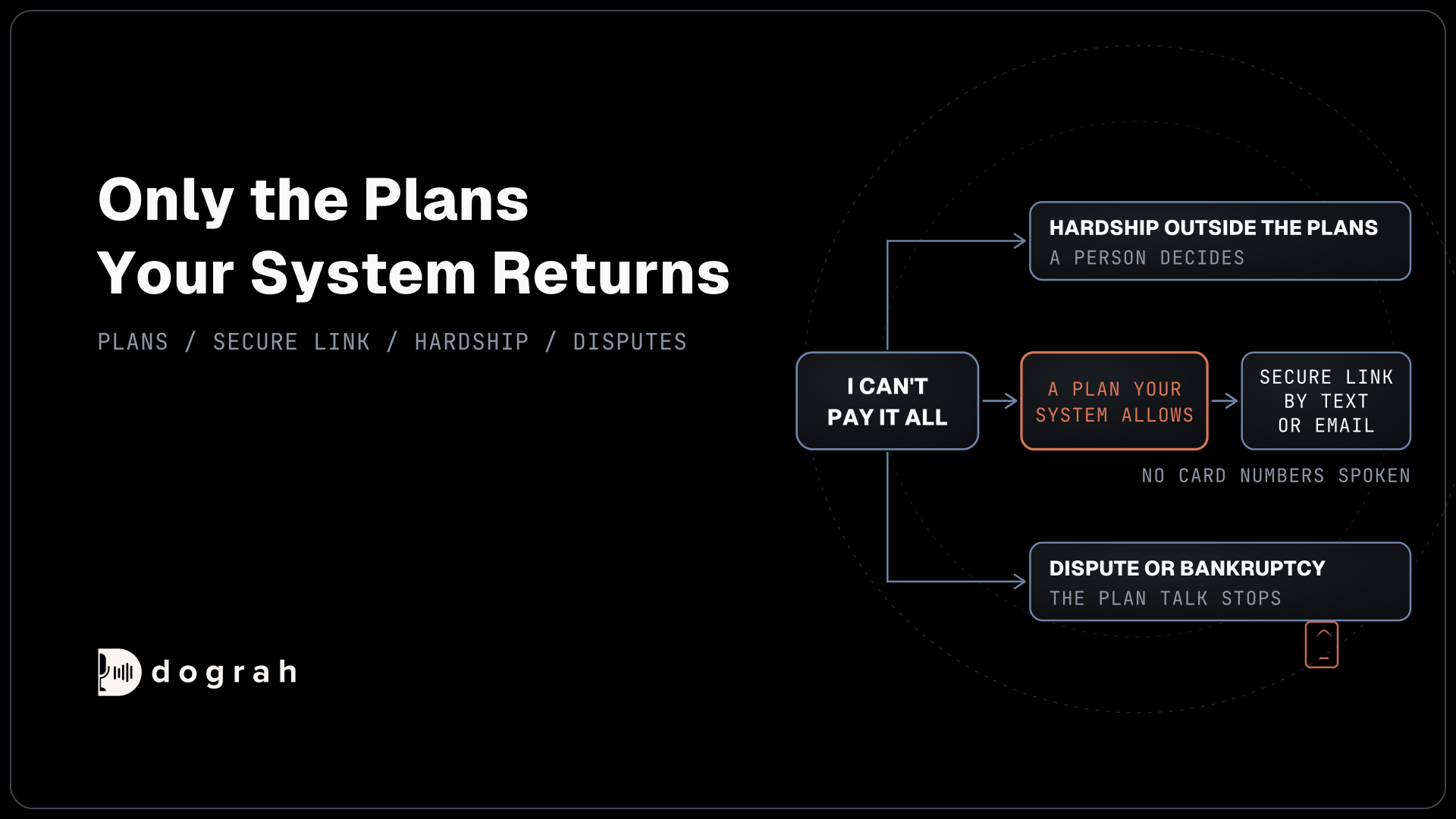

On an AI debt payment plan call, the agent confirms the person, then offers only the plans the agency's system returns for that account. It reads back each date and amount, and an HTTP API tool asks the agency's payment provider to send its secure link. The person accepts the plan there, so no card numbers are spoken.
Key Takeaways
- The agent offers only plans your system returns, never one it invents.
- Read back every date and amount before asking for the link.
- The person accepts the plan on the provider's page, never by voice.
This post is part of our guide to AI debt collection software for agencies, where payment plans come from the agency's own options. Below, we turn "I can't pay it all" into an agreed plan. Each step also shows how the plan call runs in Dograh, the open-source AI voice agent platform we build.
Where the plan options come from
The plans the agent can offer are set by the agency and returned by its own system for each account. That keeps every offer inside your policy and every number tied to the record.
The simplest source is Pre-Call Data Fetch. Once the call connects, it asks your collection system for the balance and the plans allowed on this account, such as two to six monthly payments with a minimum first payment. The prompt tells the agent to offer only the plans that came back and to say no when a request falls outside them. If the plans depend on something said on the call, an HTTP API tool can ask for them mid-call instead.
Fees need the same care. Regulation F's rule on amounts and payments bars a collector from collecting any amount, interest and fees included, unless the agreement that created the debt or the law allows it. A plan that adds a charge the agreement does not allow is a problem before the first payment is made.
Wrong numbers drive complaints. In the first ten months of 2026, the CFPB's complaint database logged 27,118 debt collection complaints about attempts to collect the wrong amount and 8,284 saying the debt was already paid. A plan built from the system's own balance avoids the first kind.
From "I can't pay it all" to a plan
The turn starts with a question about what the person can manage. After the identity check and the collector notice, the call might go like this:
Consumer: "I can't pay all of that right now."
Agent: "That's all right. What could you manage this month?"
Consumer: "Maybe $150, and the same each month after."
Agent: "I can offer $150 today and then $150 on the 1st of each month for five months, which clears the $900 balance. Would that work for you?"
The agent picks the allowed plan closest to what the person said. It never invents a new one, and it does not push for a bigger first payment than the plan needs.
Some answers fall outside every plan. A lost job or a request to pause payments is hardship, and hardship needs a person who can decide. Transfer Call hands the call over, and Context Mapping sends it to your hardship team's number. Dograh calls that number first and connects the consumer only when someone answers.

Open Source Alternative to Vapi / Retell
Self-hosted voice agent platform — no per-minute fees
dograh-hq/dograh
Star on GitHub
Some agencies run plans through a separate agent. Transfer to Agent hands the call to that agent with the conversation so far, so the consumer does not repeat themselves. Use it for plan set-up only. Disputes and hardship still go to a person.
Read back every date and amount
The agent reads the whole plan back before anything is sent:
Agent: "To confirm, $150 today, then $150 on the 1st of each month from next month for five months. That's $900 in total. Is that right?"
Read-back catches a misheard number while the person is still on the line. Variable extraction then records the plan, the first payment date and the amount as the person stated them, and a final extraction runs after the call ends. The recording and transcript stay the exact record.
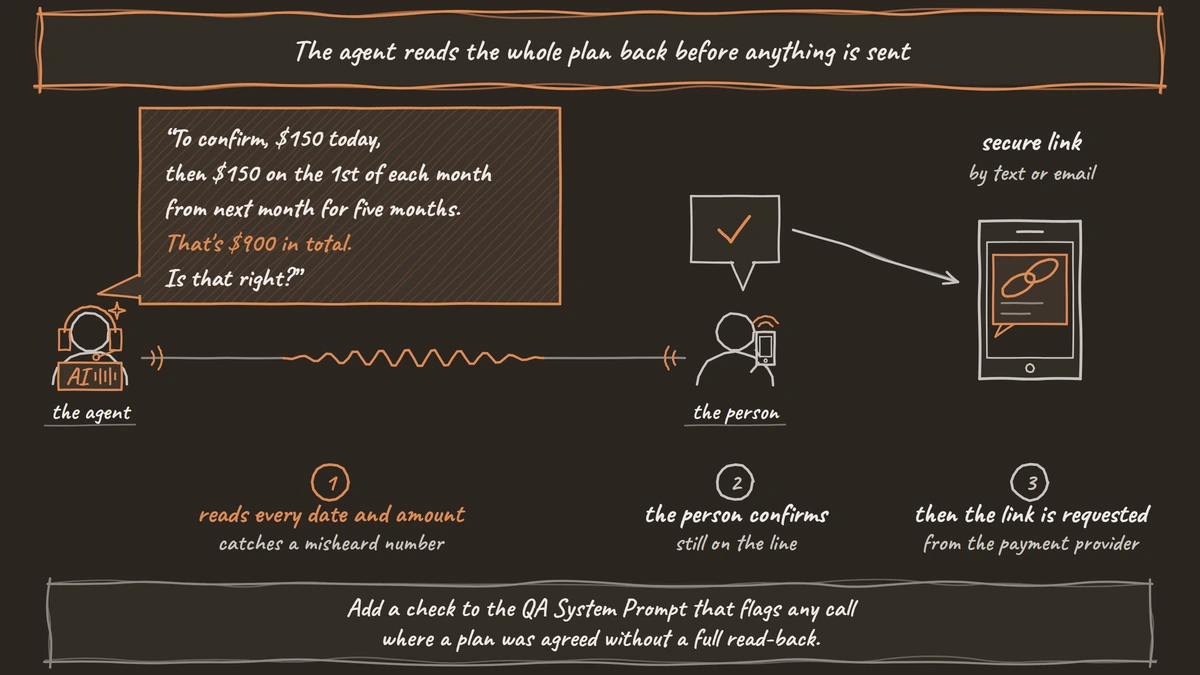
Add a check to the QA System Prompt that flags any call where a plan was agreed without a full read-back. Those are the calls most likely to come back as a complaint about the wrong amount.
The payment link, never card numbers
Card numbers never enter the call. Once the person confirms, an HTTP API tool asks the agency's payment provider to send its secure link by text or email. A short message plays when the tool starts, such as "I'm asking our payment partner to text you a secure link now", while the request runs. Add a Preset Parameter named workflow_run_id with the value {{initial_context.workflow_run_id}}, so the provider can ignore a duplicate request for the same call.
If the request fails, the error comes back to the agent and the tool does not retry by itself. The prompt says what to do then, such as telling the person the link will follow by email, and the Webhook node records the outcome after the call.
The person accepts the plan on the provider's own page, and the law is part of the reason. Regulation E's rule on recurring debits requires the consumer's written or electronically signed authorization for preauthorized debits from their account, and a copy of it. A spoken yes on the call does not create that record, so check with counsel how your provider captures it.
Some payment vendors argue for taking the card by keypad during the call, because people drop off between a call and a link. The link answers that by arriving while the person is still on the line, so they can open it before the agent says goodbye. Our post on handling payment-sensitive calls covers why card data stays out of recordings and transcripts.
Join the Dograh Community
Dograh is an OSS alternative to Vapi. Join our Slack community for queries, releases, best practices & community interactions.
When the plan talk stops
Two answers end the plan talk at once. If the person disputes the debt or the amount, the agent stops offering plans, records what they said and passes it to a person. If they say they have filed for bankruptcy, the automatic stay halts collection of debts from before the case, so the agent ends the collection part of the call and records it.
AI collection calls shows the full call around the plan step, from the opening to the hand-over.
Glossary
- Plan options
- The payment plans an agency allows on one account, returned by its own system at the start of the call. The agent offers only these.
- Read-back
- The agent repeating every date and amount of the agreed plan before any link is requested, so a misheard number is fixed on the call.
- Preset Parameter
- A fixed value an HTTP API tool sends with every request. Setting workflow_run_id lets the payment provider ignore a duplicate request for the same call.
- Recurring debits
- Repeated payments taken from a consumer's bank account. Regulation E requires the consumer's written or electronically signed authorization for them, which the provider's page captures.