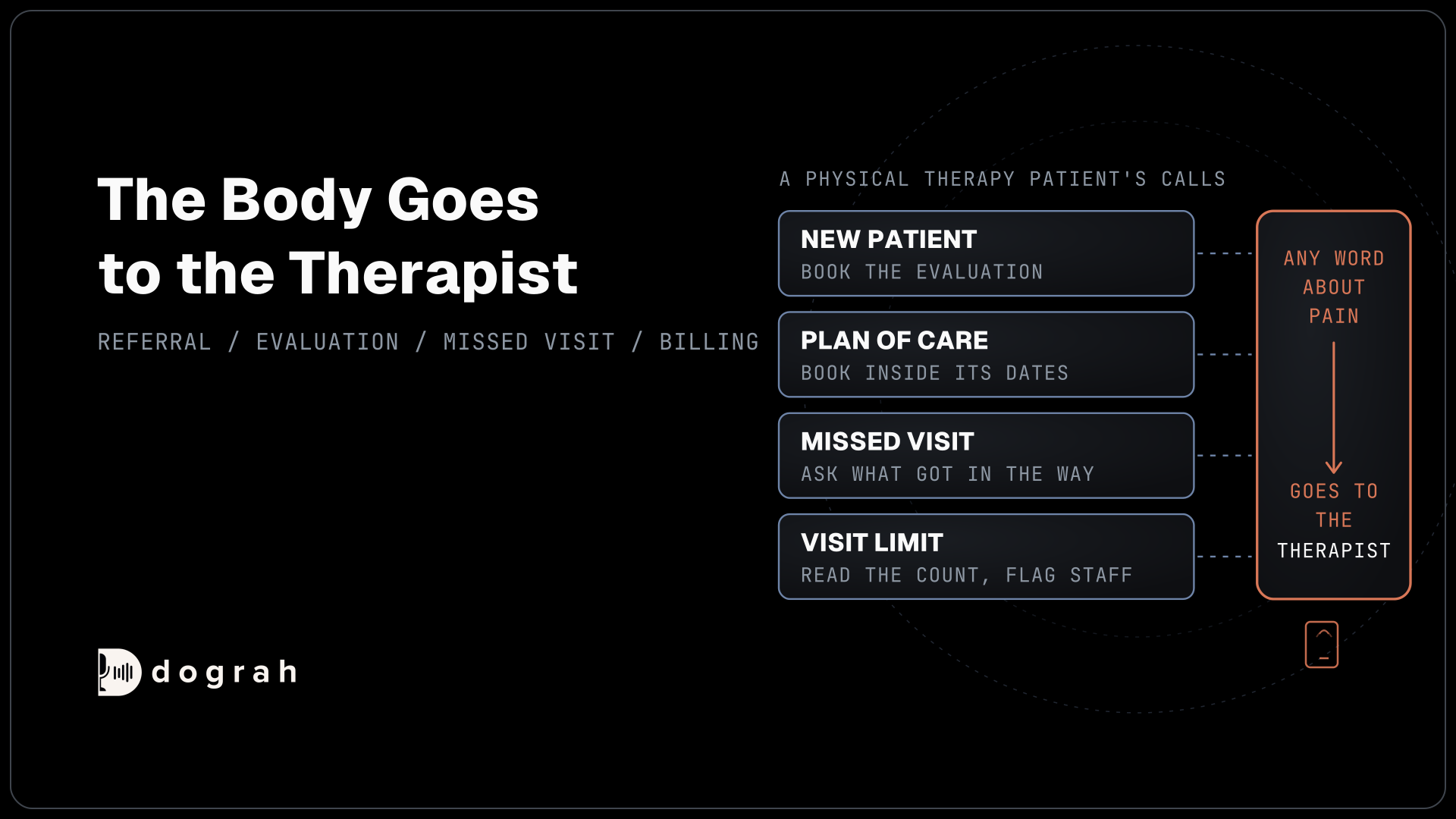

AI voice agents for physical therapy and rehab answer new-patient calls and book evaluations and plan-of-care visits from live slots. After a missed visit, they call to rebook. They read visit counts and authorization dates from the clinic's own system once the patient is verified. Pain and exercise questions go to the therapist, and coverage questions to billing staff.
Key Takeaways
- The agent books and rebooks visits, and any word about pain goes to a therapist.
- Visit counts and authorization dates come from your system, never from the agent's guess.
- After a missed visit, ask what got in the way, then rebook or hand over.
This guide covers every call a physical therapy clinic can hand to a voice agent, and the no-advice rule on each one. We show how each part works in Dograh, the open-source AI voice agent platform we build. You can self-host it or run it on Dograh Cloud.
What a PT clinic's phone line hears
Most calls to a physical therapy clinic are about time and paperwork. New patients ask for an evaluation, some with a referral from a surgeon or family doctor and some on their own. Patients already in care call to move a visit or to ask how many visits they have left. Referring offices call to check that their patient booked.
A plan of care is what makes PT calls different from a one-off appointment. A patient may come two or three times a week for several weeks, so one patient means many bookings, and each one is a chance to drift away. The clinic's EMR or scheduling system already holds the answers, from the next visit to the date the plan ends.
A voice agent can take these calls if it reads those answers from your system during the call. In Dograh, an HTTP API tool asks your system for open slots and visit details, and a second one writes the booking or a note back. Dograh has no built-in EMR or practice-management connector, so each tool points at an API your system offers, or at a small service your team builds in front of it.
No clinical advice on any call
The agent handles time and paperwork, and anything about the body goes to a therapist. Patients in the middle of a plan of care mention pain all the time. A knee feels worse after Tuesday's session, or an exercise hurts. Each of those is a question for the therapist who examined them.
Tell the agent in the prompt never to comment on symptoms or exercises, and never to say whether a patient should keep coming. It records what the patient said, in their words, and writes it to your system before offering to connect them. Transfer Call works on Twilio, Telnyx, Plivo, Cloudonix and Asterisk ARI. Dograh calls the destination first and connects the caller only when someone answers. On Twilio, it can play a short spoken introduction to both people before connecting them.
No summary travels with the call by default, which is why the note goes to your system first. If nobody answers within the 30-second default, the patient stays with the agent. Tell it in the prompt to offer a callback and write the request to your system, so the therapist calls back with the note in front of them.
A prompt cannot guarantee exact words. A model told to avoid a phrase can still say the same thing in other words. Exact wording holds only where Dograh plays fixed text or a recording, such as a pathway's Transition Speech, which plays with the caller muted so it runs in full. Put the emergency line there:
"If this is a medical emergency, please hang up and call 911."
Choosing that pathway is the model reading the condition you wrote, so test it with many phrasings from your clinic's own list, such as chest pain or a fall with a head injury. On a speech-to-speech model, text lines do not play, so record the line as a clip.
The endpoint adds a hard limit. An HTTP API tool hands the whole response to the language model, so build the endpoint to return scheduling and visit-count fields only, never clinical notes or diagnoses. Data the agent never receives is data it cannot read out. Exercise reminders follow the same rule. The agent plays only fixed text the therapist wrote, and any question about an exercise goes back to the therapist.
New patients, referrals and direct access
The first call has one job: a booked evaluation with the referral facts on file. Patients in every state can now see a physical therapist without a referral in some form. APTA's 2025 report on direct access says that as of July 1, 2025, patients in all 50 states, the District of Columbia and the U.S. Virgin Islands have provisional or unrestricted direct access. In 29 states, plus DC and the Virgin Islands, it comes with provisions such as a time or visit limit. The other 21 states set no restrictions.
Payers add their own rules. The same report says Medicare covers PT without a physician referral, but the patient must be under a physician's care, which the certified plan of care shows. Most commercial plans do not explicitly require a referral, though each contract can differ.
None of those rules is the agent's to apply. It asks whether the caller has a referral and from whom, and records the reason for the visit in their words. Then it books the evaluation from live slots. It never tells a caller they need a referral, or that they don't. Referral paperwork never goes through the call either. An HTTP API tool asks your own system to text or email its secure upload link. AI voice agents for referral and new-patient intake in PT covers this call, including the after-hours version.

Open Source Alternative to Vapi / Retell
Self-hosted voice agent platform — no per-minute fees
dograh-hq/dograh
Star on GitHub
Booking the plan of care, visit by visit
Once the therapist sets the plan, the agent books inside it and nowhere else. The evaluation ends with a frequency and a length, such as twice a week for six weeks. Booking that series is your system's job. Dograh has no recurring-booking feature, so your booking endpoint takes the pattern in one request and returns the visits it booked, and the agent reads them back to the patient.
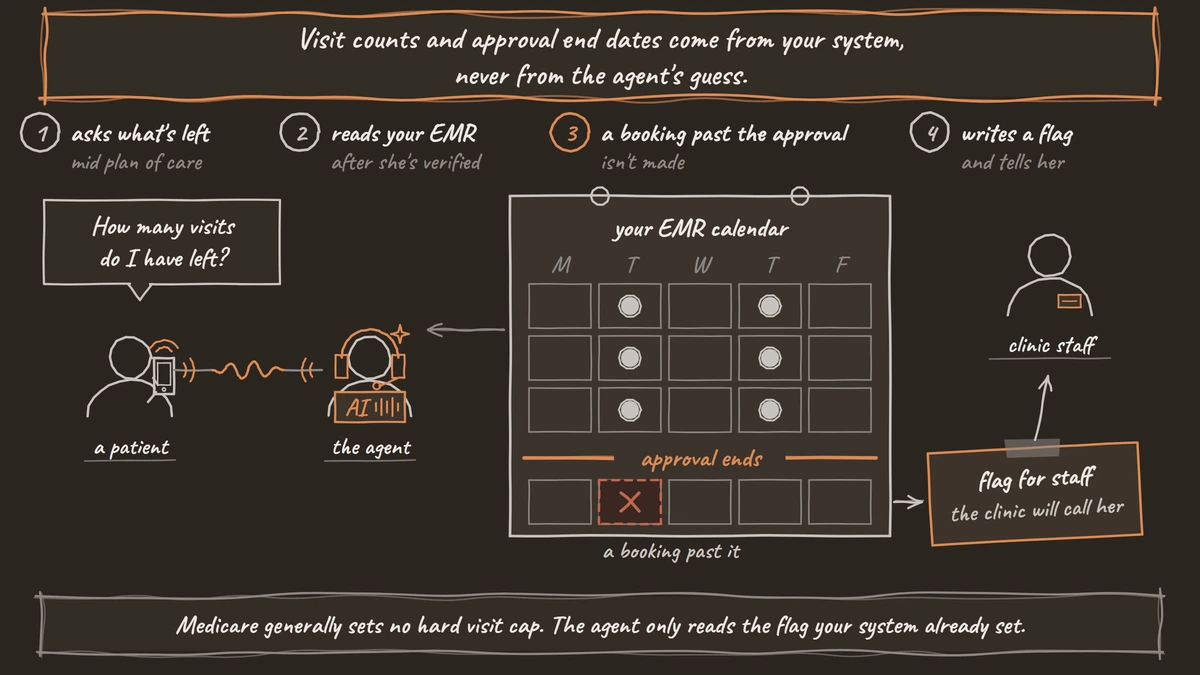
Every later change works the same way. A patient who can't make Thursday asks to move it, and the agent offers only slots the system returns, inside the plan dates. If the next booking would pass the visits approved or the plan's end date, tell the agent in the prompt not to book it. It writes a flag for staff instead and tells the patient the clinic will call.
Add a Preset Parameter named workflow_run_id with the value {{initial_context.workflow_run_id}} to the booking tool. Dograh sends no duplicate-protection header of its own, so your system uses that ID to ignore the same booking if it arrives twice.
Booking from live slots in general is covered in AI voice agents for patient appointment scheduling, and AI voice agents for PT scheduling and plan-of-care follow-up goes through the PT version call by call.
The call after a missed visit
A missed visit is the moment a plan of care starts to slip, and one short call can find out why. In a 2025 study of patients who stopped after their evaluation, researchers interviewed 26 people who did not return within 30 days. Access problems were the most common reason, given by 26.9%. Feeling better came next at 23.1%, level with not seeing the value or choosing to do it alone.
Those reasons need different people. Access is a scheduling problem the agent can solve, with a different time or a different location. Feeling better or not seeing the point is a conversation for the therapist, because only they can say whether stopping is safe.
So the call asks one question, what got in the way. If the answer is about time or travel, the agent rebooks from live slots. Anything else, including more pain, is recorded as the patient said it and handed to the therapist with a callback request. Our post on healthcare no-show reduction explains why a call that settles the slot does more than a reminder.
The trigger comes from your system. When a visit is marked missed, your system can start the call through Dograh's API Trigger, or you can upload the day's list as a CSV campaign. A campaign's calling hours run in one time zone, so split a multi-state list by time zone. Voicemail handling is off by default. If you turn it on and choose Leave a message, keep the message to the clinic's name and a request to call back, with nothing about the visit.
Visits, authorizations and the KX threshold
Payers cap visits and approvals expire, so a patient's next booking can run into a limit nobody mentioned. In APTA's 2025 survey on administrative burden, 30.2% of respondents said they wait one to two weeks for a prior authorization decision. Nearly 83% agreed that prior authorization has caused patients to abandon treatment. Those are therapists' views from 856 responses, not a measured dropout rate, but they show where the friction sits.
The agent cannot speed up a payer. It can make sure the patient hears about a limit before it bites. Your system holds each patient's visit count against the approval, and the date the approval ends. The agent reads them after the patient is verified and tells the patient what the system shows. When the next booking would pass either one, it writes a flag for staff.
It never says whether insurance will pay, and never quotes a copay it did not read from your system. It also never phones the payer. Dograh has no keypad (DTMF) tool, so the agent cannot press through an insurer's phone menu. Your system gets coverage from the payer electronically, and staff submit authorizations.
Medicare works differently. It sets no visit cap, but CMS's 2026 payment rule puts the KX modifier threshold at $2,480 for PT and speech-language pathology combined. Above it, the therapist adds the KX modifier to confirm the care is medically necessary, and claims without it are denied. The figure changes every year, and Medicare counts the patient's therapy spending at every provider, not just yours. So the agent never computes a running total. It reads whether your system has flagged the threshold, and the therapist decides.
AI voice agents for PT authorization and visit limits walks through each of these calls.
Join the Dograh Community
Dograh is an OSS alternative to Vapi. Join our Slack community for queries, releases, best practices & community interactions.
Verify the patient before any detail
A phone number finds a chart, but it cannot prove who is calling. Every call runs greet, verify, then disclose. The Greeting Text names the clinic. If you want to tell callers they're speaking with an automated assistant, or your location requires it by law, write that in the Greeting Text too.
Pre-Call Data Fetch can load the patient that matches the calling number as the call connects. Tell the agent in the prompt to keep every detail from it unspoken until the check passes. Your clinic sets the check. Date of birth alone is weak, so pair it with a second item your system holds, such as the ZIP code on file.
If the check fails, the agent shares nothing about visits or the plan. It records a callback request instead. Family members who call for a patient get only what your clinic's policy allows, and the endpoint can enforce that. Pass the verified caller's role to it and return only what that caller may hear.
Call limits and consent on patient calls
A call about a patient's own visits is a service call, and the rules for it are narrower than they look. The FCC's calling rules under the Telephone Consumer Protection Act (TCPA) treat an AI voice as an artificial voice. A call with one to a patient's mobile needs the patient's prior express consent. A patient who gave the clinic their number for their care has generally given that consent for calls about that care. Any offer, such as a wellness package, makes the call telemarketing, which needs prior express written consent.
The rules also exempt some healthcare calls, such as appointment reminders and confirmations, when they stay short, carry no billing content and come at most once a day and three times a week, with an easy opt-out. Our guide to AI voice agents for hospitals and health systems sets out each condition. Campaigns have no per-patient cap, so your own call list has to hold that limit.
A patient who asks not to be called again comes off your list. The agent writes the opt-out to your system during the call, and your system removes the number from the next list. This is our reading of the rules for PT calls, so confirm your clinic's position with counsel.
Where PT call data sits
Every PT call carries protected health information (PHI), from the injury to the insurer, so decide where the audio and transcripts live before the first call. Dograh is self-hostable. Run it on your own servers and no business associate agreement (BAA) with Dograh is needed, because it never receives the PHI. Our page on self-hosted voice agents for PT clinics covers booking plan-of-care visits from your own system, with every pain or exercise question sent to the therapist.
Dograh is the orchestration layer that runs the call flow, tools and telephony, and the speech and language models are a separate layer you choose. Model providers you reach with your own keys may need their own BAAs when they handle PHI, because the audio still reaches them. Call data stays fully in-house only with open-weight models on your own servers, such as Qwen3.8 27B for language, Parakeet TDT 0.6B v2 for speech-to-text and Magpie TTS for the voice.
The phone carrier may need a BAA too, depending on what it stores, and many, such as Twilio, offer one. If your servers run in a cloud account such as AWS, Google Cloud or Azure, that cloud provider needs a BAA. In your own data centre, it doesn't. Our post on HIPAA-compliant voice AI for hospitals counts every vendor that hears a call.
Recordings and transcripts have no retention setting and no automatic deletion, so your own retention schedule handles them. Self-hosted, recording can be switched off only server-wide, and transcripts are still saved. The self-hosting guide covers the install. Self-hosted Dograh has no per-minute platform fee (servers, model keys and phone minutes still cost), and Dograh Cloud has a 1¢-a-minute platform fee.
Which call to hand over first
Start with inbound reschedules, because the agent only reads slots and writes a booking inside dates your system sets. Add the missed-visit call next. Visit-count questions come last, once your endpoint returns counts and flags you trust.
Test on a real phone number before launch. Most phone calls still reach the agent as 8 kHz audio, while a browser demo runs at 16 kHz, so the names of referring doctors and streets can sound different to the speech model. Say "my knee is killing me" and "can I skip the exercises" in as many ways as your staff can think of, and check that each one reaches the therapist pathway. Browser test calls cannot transfer, so test every handover on a real line.
Once live, use QA as the safety net. Replace its system prompt with PT-specific instructions that flag any call where the agent commented on pain or exercises, or guessed at coverage. Keep the Sample Rate at 100% for that check, and send a flagged call to the clinic lead the same day.
Each call above has its own deep dive:
- AI Voice Agents for Referral & New-Patient Intake in PT
- AI Voice Agents for PT Scheduling & Plan-of-Care Follow-up
- AI Voice Agents for PT Authorization and Visit Limits
Glossary
- Plan of care
- The therapist's written plan after the evaluation, with goals, visit frequency and an end date. Medicare needs it certified by a physician or other practitioner, and the voice agent books visits only inside its dates.
- Direct access
- Seeing a physical therapist without a physician referral. Every US state allows it in some form, 29 of them with provisions, so the agent records whether a caller has a referral and never rules on whether they need one.
- KX modifier threshold
- Medicare's yearly therapy spending amount, $2,480 in 2026 for PT and speech-language pathology combined, above which claims need the KX modifier. Medicare counts spending at every provider, so the agent reads the clinic's flag and never computes a total.
- Prior authorization
- A payer's approval before visits are covered, usually for a set number of visits within set dates. Staff submit it, and the agent only reads the count and end date from the clinic's system.