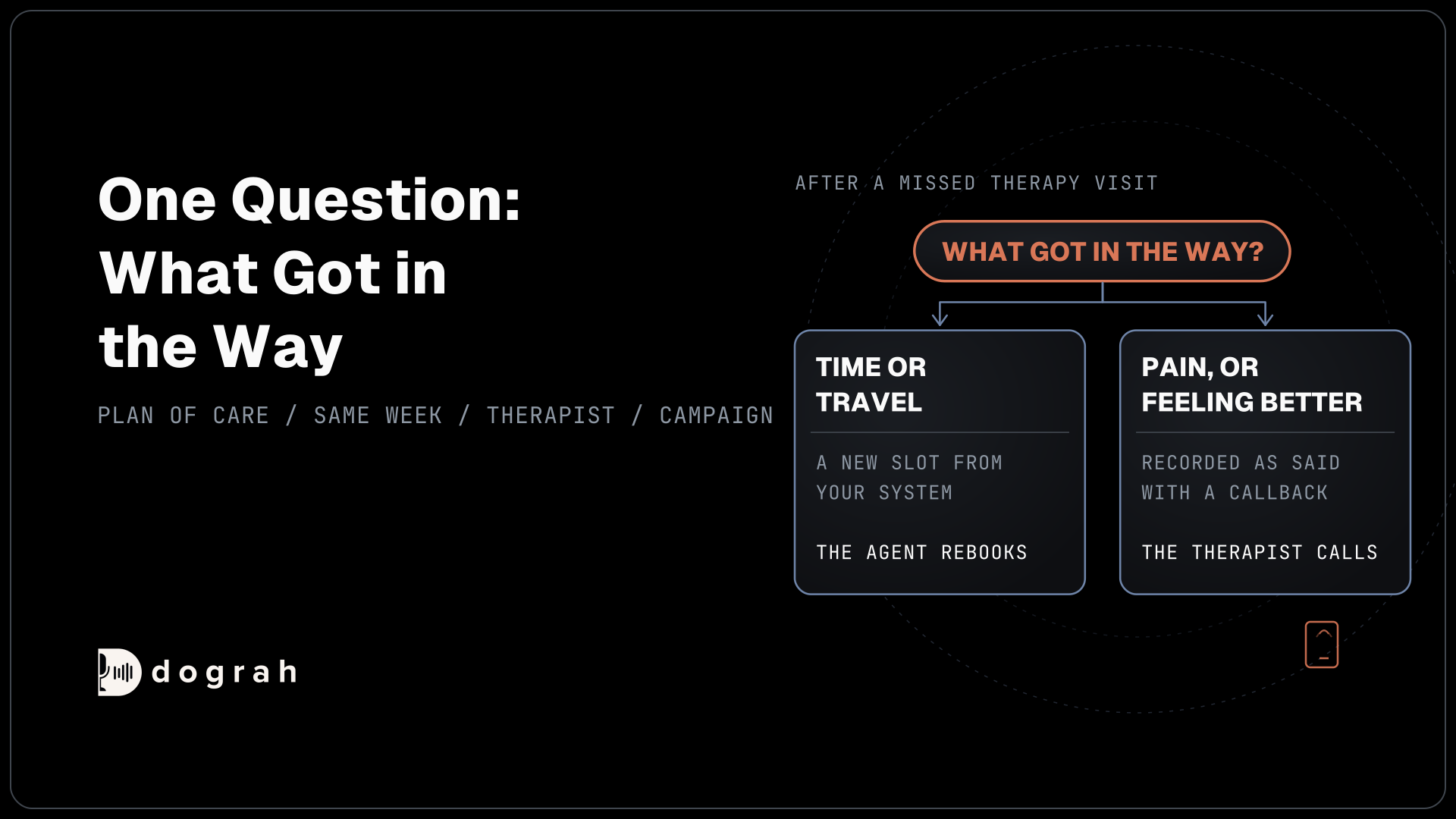

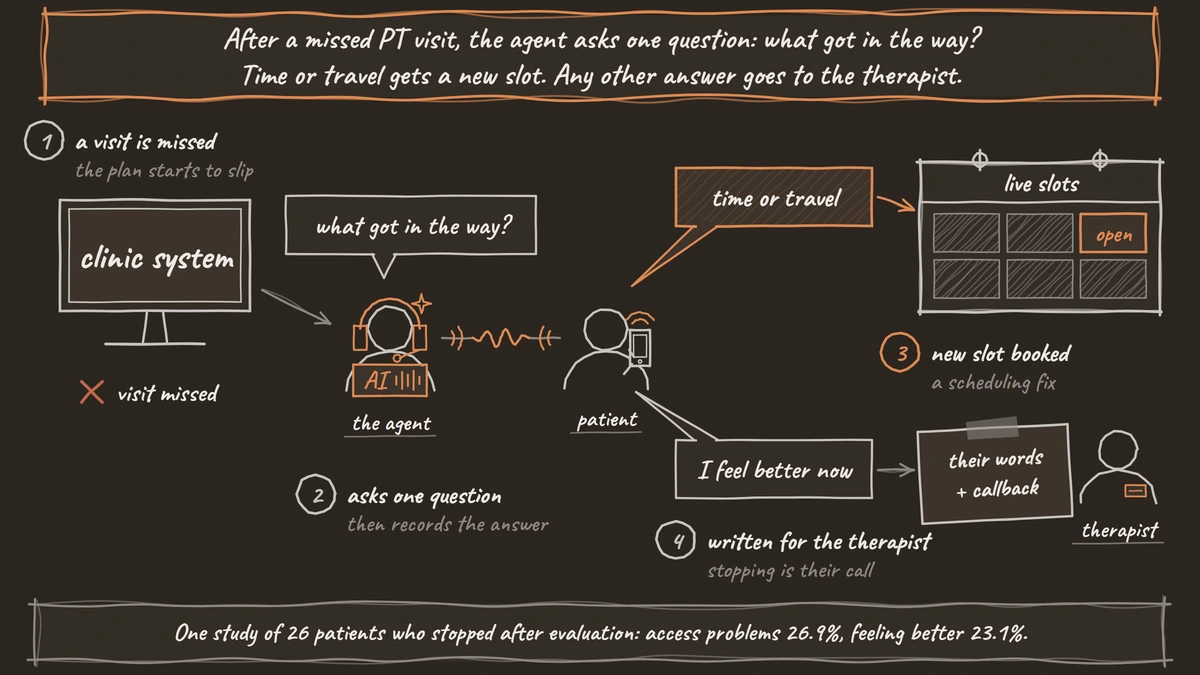
AI voice agents for PT scheduling and plan-of-care follow-up book a patient's visits from live slots, inside the plan dates the clinic's system returns. After a missed visit, they call and ask what got in the way, then rebook when the answer is about time or travel. Pain, or wanting to stop, goes to the therapist.
Key Takeaways
- Book only inside the plan dates and approved visits your system returns.
- After a missed visit, ask one question, what got in the way.
- Time or travel gets rebooked, and pain or "I feel better" goes to the therapist.
This post is part of our guide to AI voice agents for physical therapy and rehab clinics, where no call gives clinical advice. Below, we cover booking the plan of care and the missed-visit call. Then we set both up in Dograh, the open-source AI voice agent platform we build.
Book the whole plan, inside its dates
The evaluation sets the plan, and the agent's job is to fill it with visits the patient can keep. A therapist might set twice a week for six weeks. Booking that series is your system's job. Dograh has no recurring-booking feature, so an HTTP API tool sends the pattern to your booking endpoint in one request, and the agent reads back the visits it booked.
The plan has an end date, and the agent books nothing past it. Under Medicare's plan-of-care certification rule, the plan needs recertification at least every 90 days, and many commercial plans approve visits for set dates too. When a patient asks for a visit after the end date, tell the agent in the prompt to write a flag for staff to book the re-evaluation, and to tell the patient the clinic will call.
Approved visits work the same way. If the next booking would pass the number your system shows as approved, the agent does not book it. AI voice agents for PT authorization and visit limits covers how the agent reads those counts and flags them.
Moving a visit without losing the week
A patient who can't make Thursday needs another visit that week, or the plan quietly loses one. The call runs greet, verify, then disclose, so the agent confirms who is calling with your clinic's approved check before it names any visit. Then it reads the open slots your system returns.
Tell the agent in the prompt to offer slots in the same week first, so the frequency the therapist set still holds. If none fit, it offers the next open slot and records the reason for the change as the patient stated it. The transcript and recording stay as the exact record.
Add a Preset Parameter named workflow_run_id with the value {{initial_context.workflow_run_id}} to the booking tool. Your system then uses that ID to ignore a duplicate if the same request arrives twice. The general pattern of booking from live slots applies to every visit in the series.
The call after a missed visit
A missed visit is where a plan of care starts to slip, and the follow-up call is there to find out why. In a 2025 study of patients who stopped after their evaluation, researchers interviewed 26 people who did not return within 30 days. Access problems were the most common reason, given by 26.9%. Feeling better came next at 23.1%, level with not seeing the value or choosing to do it alone.
The study is small, but the split it shows decides how the call should run. An access problem is scheduling work, such as a later slot or a visit before work. Feeling better or not seeing the point is a conversation only the therapist can have, because only they can say whether stopping is safe.
So the agent asks one question, what got in the way. A time or travel answer gets a new slot from your system. Any other answer is recorded as the patient said it and written to your system with a callback request for the therapist. Our post on healthcare no-show reduction explains why a call that settles the slot does more than a reminder.

Open Source Alternative to Vapi / Retell
Self-hosted voice agent platform — no per-minute fees
dograh-hq/dograh
Star on GitHub
Pain and "can I stop?" go to the therapist
Anything about the body ends the scheduling part of the call. A patient may say the knee hurts more since Tuesday, or ask whether they can skip the exercises. Tell the agent in the prompt never to answer either, and to record the words and hand them over.
Give that handover fixed words. A pathway's Transition Speech plays fixed text or a recording with the caller muted, so it runs in full, for example "I'll pass that to your therapist, and the clinic will call you back." Put the emergency line on its own pathway: "If this is a medical emergency, please hang up and call 911." Choosing a pathway is the model reading the condition you wrote, so test both with many phrasings.
During clinic hours, the agent writes the note to your system, then uses Transfer Call. It works on Twilio, Telnyx, Plivo, Cloudonix and Asterisk ARI. Dograh calls the destination first and connects the caller only when someone answers. On Twilio, it can play a short spoken introduction to both people before connecting them. If nobody answers within the 30-second default, the patient stays with the agent, which records a callback request.
Home exercise reminders follow the same rule. The agent plays only fixed text the therapist wrote, and any question about an exercise goes back to the therapist.
Join the Dograh Community
Dograh is an OSS alternative to Vapi. Join our Slack community for queries, releases, best practices & community interactions.
Setting up the follow-up call in Dograh
The missed-visit call starts when your system marks a visit missed. It can start the call through the API Trigger with the patient's details. A daily CSV campaign works too. Campaign retries go from 0 to 10, default 2, with a delay between 30 seconds and 1 hour, default 2 minutes, and you choose whether busy, no answer or voicemail triggers a retry.
Call limits sit in your system too. The FCC's calling rules under the Telephone Consumer Protection Act (TCPA) treat an AI voice as an artificial voice. A patient who gave the clinic their number for their care has generally consented to calls about that care, but any offer turns the call into telemarketing, which needs written consent.
The rules also exempt some healthcare calls, such as appointment reminders, when they come at most once a day and three times a week. Campaigns have no per-patient cap, so your list enforces the limit. A patient who asks for no more calls is written to your system as an opt-out, and your system removes the number from the next list. Confirm your clinic's position with counsel.
A campaign's calling hours run in one time zone, so split a multi-state list by time zone. Voicemail handling is off by default. If you turn it on and choose Leave a message, keep the message to the clinic's name and a request to call back.
Once live, add a QA prompt that flags any call where the agent commented on pain or exercises, and review those calls first.
Glossary
- Plan of care
- The therapist's written plan after the evaluation, with visit frequency and an end date. The voice agent books visits only inside its dates and flags any request beyond them for staff.
- Recertification
- Medicare's requirement that a physician or other practitioner re-certify the plan of care at least every 90 days. A plan near its end date is a staff task, not a booking the agent makes.
- Access problem
- A practical reason a patient misses visits, such as work hours or travel. It is the one reason a scheduling call can fix, so the agent rebooks it and hands every other reason to the therapist.