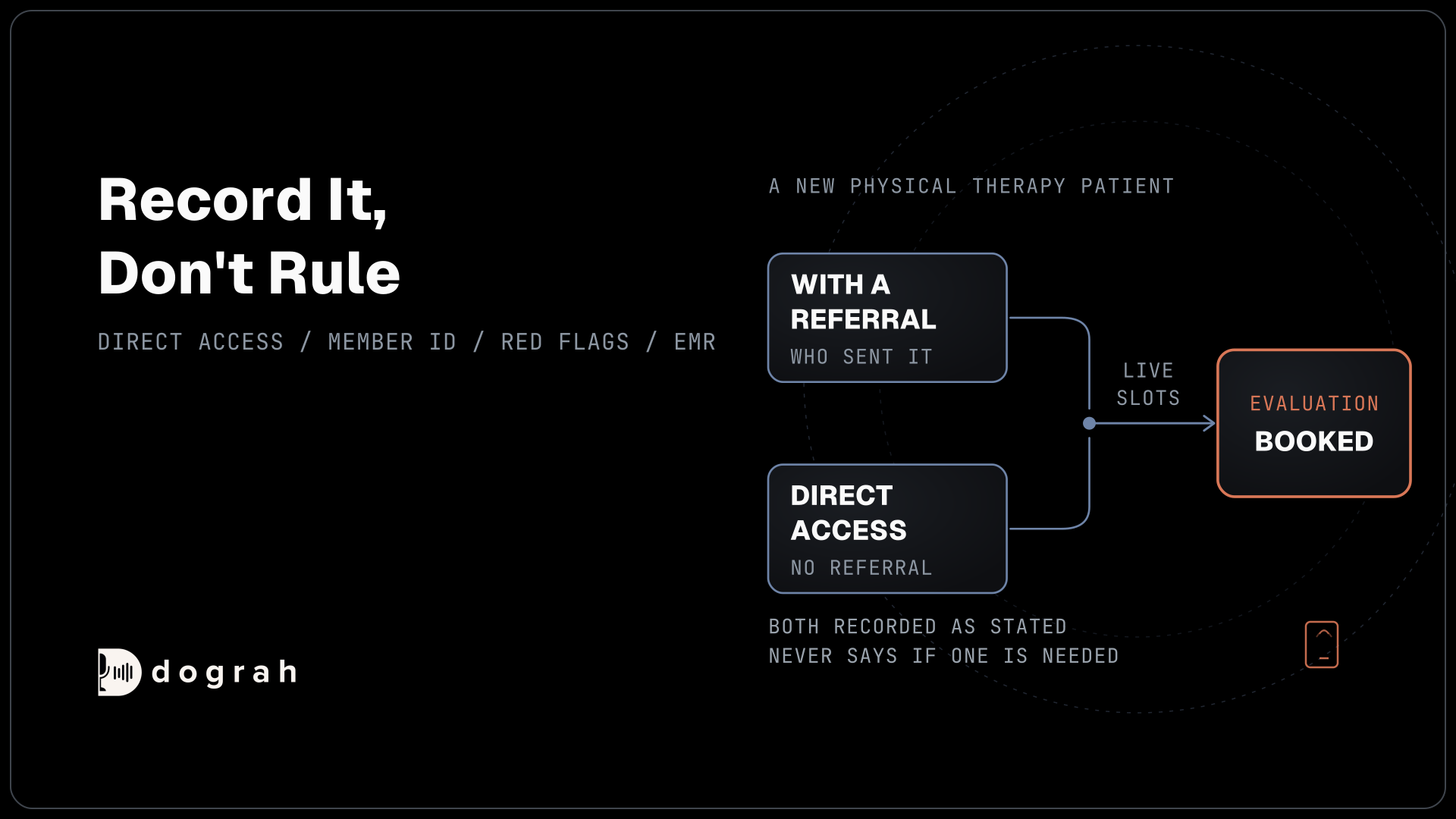

AI voice agents for referral and new-patient intake in PT answer every new-patient call, including after hours. They record whether the caller has a referral, and the reason for the visit in the caller's words, then book the evaluation from live slots. They never judge whether PT suits the injury, and red-flag symptoms get a fixed line.
Key Takeaways
- The first call ends with a booked evaluation and the referral facts on file.
- The agent records the referral and never says whether one is needed.
- Red-flag symptoms from your clinic's list get fixed words and a person.
This post is part of our guide to AI voice agents for physical therapy and rehab clinics, where the first call ends in a booked evaluation. Below, we cover what intake collects and never decides. Then we set it up in Dograh, the open-source AI voice agent platform we build.
Referral or direct access: record it, don't rule
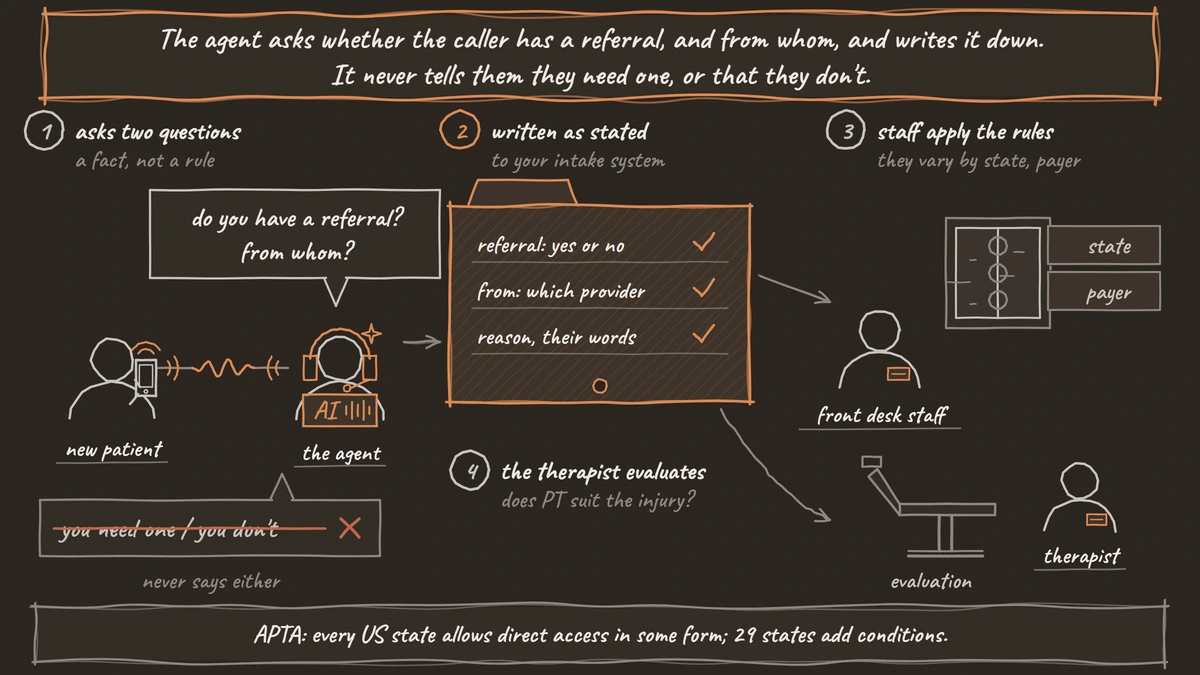
Whether a caller needs a referral depends on their state and their payer, so the agent records the facts and leaves the rule to staff. APTA's 2025 report on direct access says that as of July 1, 2025, patients in all 50 states, DC and the U.S. Virgin Islands have provisional or unrestricted direct access. In 29 states, plus DC and the Virgin Islands, provisional direct access sets conditions such as a time or visit limit. The same report says most commercial plans do not explicitly require a referral, though contracts differ.
Medicare needs no referral either. Under Medicare's rule on orders and plan certification, a written order on file still helps. If the therapist sends the plan to the physician or other practitioner within 30 days of the evaluation, no separate certification signature is needed. So a referral changes the paperwork, even when it changes nothing about access.
That is why the agent asks whether the caller has a referral and from whom, and records the answer. It never tells a caller they need one, or that they don't, and it never screens whether physical therapy suits the injury. That is the therapist's evaluation. State practice acts and payer contracts change, so confirm your clinic's rules with counsel.
What the intake call collects
Intake takes only what staff need before the evaluation. The agent records the referring provider and date, if there is one, and the reason for the visit in the caller's words. It also records the insurance name and member ID, and the times and location that suit the patient. Each answer is recorded as the caller stated it, and the transcript and recording stay as the exact record.
An HTTP API tool writes those details to your EMR or intake system during the call. Referral documents never go through the call. The same kind of tool asks your own system to text or email its secure upload link, because Dograh sends no texts itself.
New callers also ask about parking and which insurers the clinic takes. Upload those answers to the Knowledge Base and the agent answers from your own documents. A referring office that calls to check on a patient gets only what your clinic's policy allows, after the agent confirms which office is calling.

Open Source Alternative to Vapi / Retell
Self-hosted voice agent platform — no per-minute fees
dograh-hq/dograh
Star on GitHub
Booking the evaluation from live slots
The evaluation is the first visit of many, so book a time the patient can keep for weeks. In a 2025 study of patients who stopped after their evaluation, access problems were the most common reason, given by 26.9% of 26 people interviewed. Tell the agent in the prompt to ask about the patient's usual week before offering a slot, and to offer the location nearest them.
The agent books only slots your system returns. Add a Preset Parameter named workflow_run_id with the value {{initial_context.workflow_run_id}} to the booking tool, so your system can ignore a duplicate. Once the therapist sets the plan, the bookings move to AI voice agents for PT scheduling and plan-of-care follow-up.
After hours and red flags
New patients often call in the evening, after their own workday, and the same agent answers then. Most of those calls are routine and end in a booking. A few are not, and your clinic's red-flag list decides which phrases count, such as chest pain or a fall with a head injury.
Give those phrases a pathway with fixed words. A pathway's Transition Speech plays fixed text or a recording with the caller muted, so it runs in full: "If this is a medical emergency, please hang up and call 911." Choosing that pathway is the model reading the condition you wrote, so test it with many phrasings. On a speech-to-speech model, record the line as a clip, because text lines there do not play.
An urgent problem that is not an emergency goes to the on-call clinician. An HTTP API tool calls your paging service, and the agent tells the caller when to expect a call back. Our post on AI voice agents for after-hours coverage covers that callback promise, and patient intake and triage covers collecting first and routing after.
In clinic hours, the agent writes the note first, then uses Transfer Call. It works on Twilio, Telnyx, Plivo, Cloudonix and Asterisk ARI. Dograh calls the destination first and connects the caller only when someone answers. On Twilio, it can play a short spoken introduction to both people before connecting them.
Join the Dograh Community
Dograh is an OSS alternative to Vapi. Join our Slack community for queries, releases, best practices & community interactions.
Setting up the intake agent in Dograh
One agent can answer every clinic line. Point each phone number's Inbound workflow setting at the same agent, and the number dialled reaches Pre-Call Data Fetch as to_number, so your system can tell which location was called. The same fetch can recognize a returning patient by the calling number. The agent still verifies them before naming any visit.
The Greeting Text names the clinic. If you want to tell callers they're speaking with an automated assistant, or your location requires it by law, write that in the Greeting Text too. Once live, add a QA prompt that flags any call where the agent said whether physical therapy would help, and review those calls first.
Glossary
- Direct access
- Seeing a physical therapist without a physician referral. Every US state allows it in some form, so the intake agent records whether a caller has a referral and never rules on whether they need one.
- Provisional direct access
- Direct access with conditions, such as a time or visit limit before a referral is needed. 29 states set provisions, and the clinic's staff, not the agent, apply them.
- Written order
- A physician's or other practitioner's order for therapy. Medicare does not require one, but with an order on file and the plan sent within 30 days of the evaluation, no separate certification signature is needed.
- Red-flag list
- The clinic's own list of symptoms that must leave the booking path, such as chest pain. The agent plays fixed words for them and never judges how serious a symptom is.