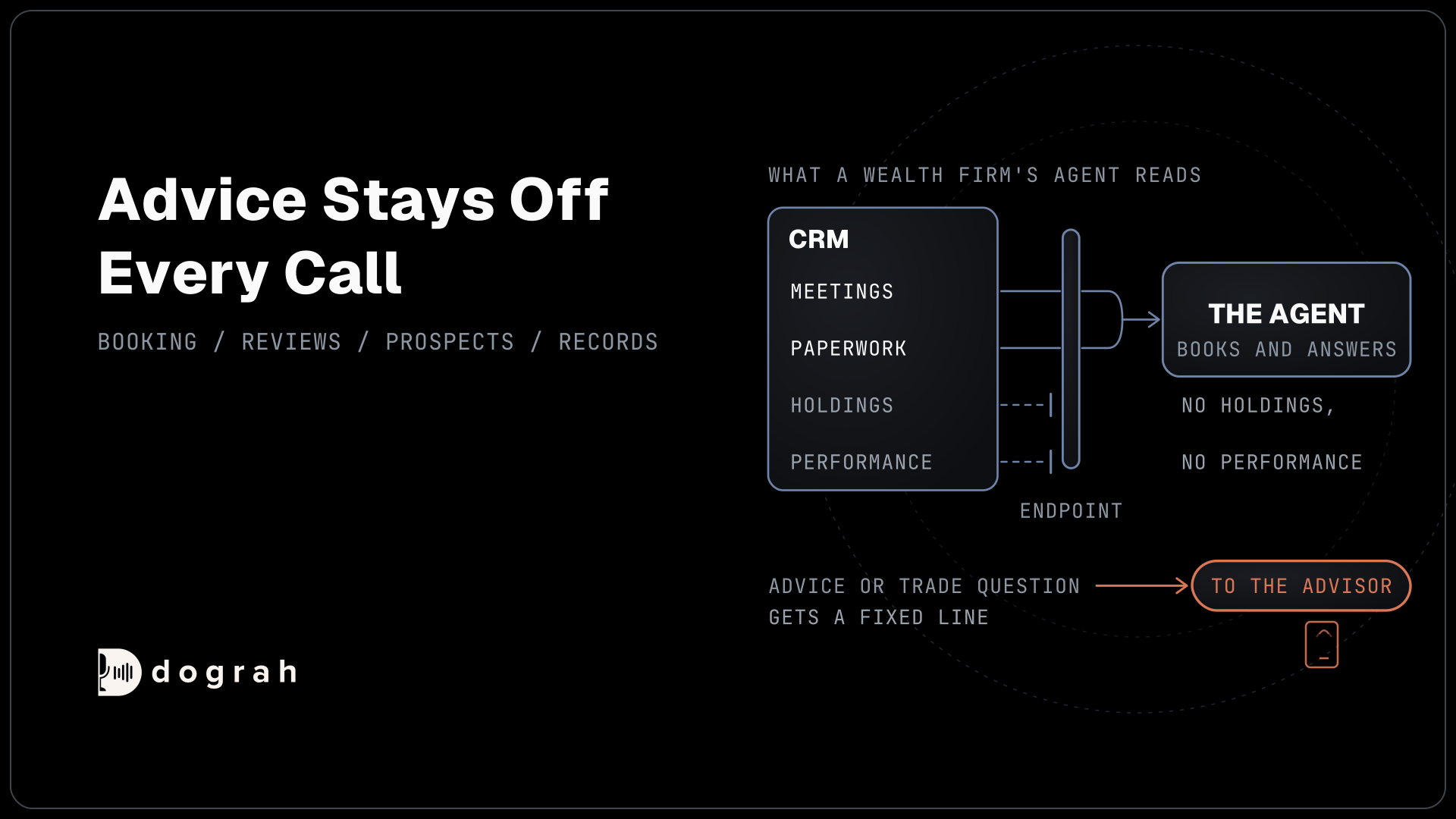

AI voice agents for wealth management book and move advisor meetings, call clients who are due for a review, screen new prospects and answer paperwork questions. They read each answer from the firm's CRM after verifying the caller and never give investment advice. Any question about holdings or trades goes to the advisor, written to the CRM first.
Key Takeaways
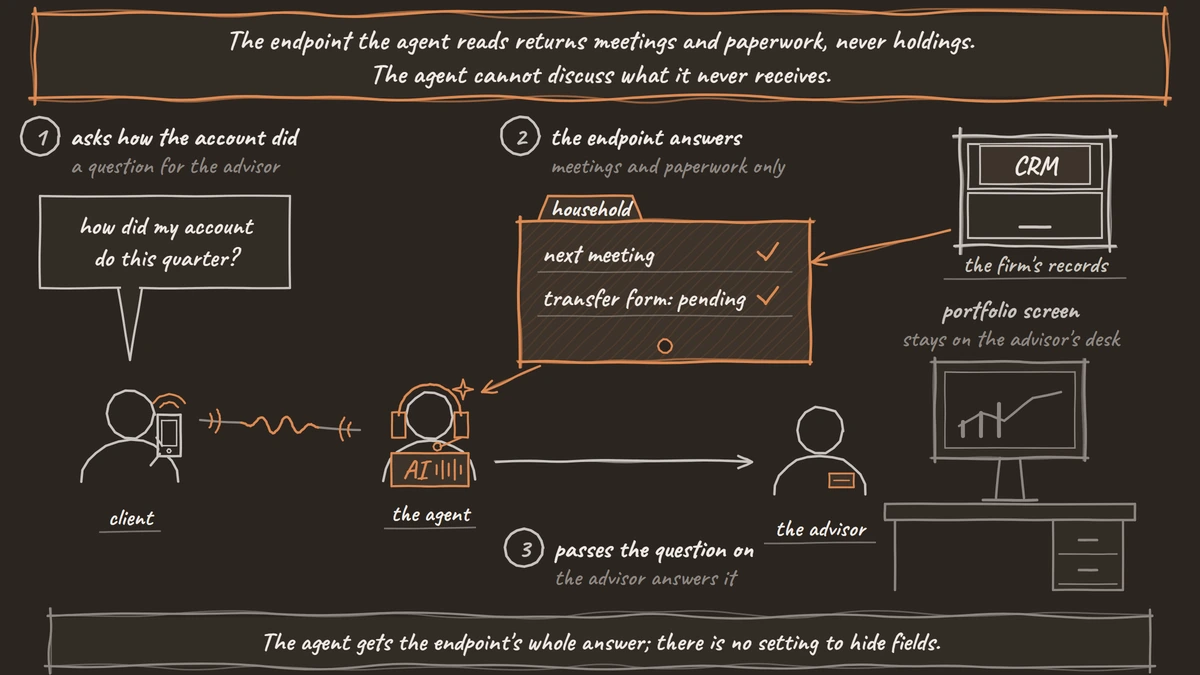
- The agent's data holds no balances or performance, so it cannot discuss them.
- A fixed line sends every advice or trade question to the client's advisor.
- The firm's archive saves each call's recording and transcript files, not only links.
This guide walks through each call an advisory firm can hand to a voice agent, and how advice stays off every one of them. We show how each part works in Dograh, the open-source AI voice agent platform we build. You can self-host it or run it on Dograh Cloud.
What a wealth firm's phone line hears
Most calls to an advisory firm are about meetings and paperwork, and the answers already sit in the firm's CRM. Clients call to book or move a meeting with their advisor, or to ask whether a transfer form arrived. Prospects call after a referral or a seminar. A few callers ask the question no agent should answer, such as how their account did this quarter or whether they should sell.
Most of these firms are small. The Investment Adviser Association's 2026 industry snapshot counts 16,544 investment advisers serving 73.7 million clients in 2025, and 92.8% of those advisers employ 100 people or fewer. In many of them, the phone rings at the advisor's own desk, in the middle of a client meeting.
A voice agent can take the routine calls if it reads each answer from your system during the call. In Dograh, an HTTP API tool asks your CRM for the household's next meeting or the status of a form, and a second tool writes a note back after the call. There is no built-in connector for Redtail or Wealthbox, so each tool points at your CRM's own API, or at a small service your team builds in front of it.
A tax practice's phone line has the same shape, and AI voice agents for tax and accounting firms covers it. This guide stays with advisory firms, where one kind of question changes everything.
No investment advice on any call
The agent never gives investment advice, and the firm builds that into the call itself. Keeping advice off the phone is the firm's own design choice. It keeps the agent away from recommendations, where the firm's duties to its clients apply in full, and FINRA has said its rules apply to AI tools the same way they apply to people.
A spoken disclaimer does not do this job. An agent that says "this is general information, not personalized advice" and then talks about bond funds has still talked about bond funds. So the firm holds the line in two ways.
First, keep holdings out of the agent's data. Build the endpoint the agent reads so it returns meetings and paperwork status, and never holdings or performance. An HTTP API tool hands the whole response to the language model, with no setting to filter fields, so anything the endpoint returns, the agent can say. Data the agent never receives is data it cannot discuss, even with a persistent caller.
Second, play the handover as fixed words. Inside a step, the model writes its own sentences, so a prompt cannot guarantee wording. Exact wording holds where Dograh plays fixed text or a recording, such as a pathway's Transition Speech, which plays with the caller muted so it runs in full. Put a line like this on an "advice or trade question" pathway:
"I can't give investment advice or take trade instructions on this line. I'll pass your question to your advisor, who will call you back."
Choosing that pathway is the model reading the condition you wrote, so test it with many phrasings and read the transcripts to prove the line played. Our post on prompt and flow design patterns explains why exact wording lives there. On a speech-to-speech model, text lines on a pathway don't play, so record the line as a clip.
The prompt adds the softer rules. The agent never comments on markets or products, and never takes an order to trade or move money. It writes the caller's question to the CRM as the caller stated it, then offers a callback from the advisor or a transfer.
Verify the caller before any account detail
A phone number finds the household, but it does not prove who is calling. Every call runs greet, verify, then disclose. The Greeting Text names the firm. If you want to tell callers they're speaking with an automated assistant, or your location requires it by law, write that in the Greeting Text too.
Pre-Call Data Fetch can load the household that matches the calling number as the call connects, and the prompt tells the agent to keep every detail from it unspoken until the check passes. Your firm decides the check. Date of birth works only with a second item, such as a passcode set at onboarding or the last digits of an account number on file. Tell the agent that if the check fails, it shares nothing about the household and records a callback request. A new prospect booking a first meeting needs no check beyond a name and a phone number, because the agent shares nothing about an account.
The endpoint can also decide who hears what. Pass the verified caller's identity to it, and return only what that person may hear. One spouse on a joint household may be authorized for the shared meetings but not for a separate trust account. Our guide to AI voice agents for banking and credit unions follows the same order of checks.

Open Source Alternative to Vapi / Retell
Self-hosted voice agent platform — no per-minute fees
dograh-hq/dograh
Star on GitHub
Booking meetings on the advisor's calendar
Booking is the most common call, and it goes into the calendar of the household's own advisor, not the first free slot in the firm. An HTTP API tool asks your systems which advisor owns the household and reads that advisor's free time, and a second tool writes the booking back.
Meeting type sets the length. A discovery meeting and an annual review can each have their own length and prep time, held in your scheduling system, not in the prompt. Joint clients get one slot that suits both. A caller who mixes in a trade request gets the fixed handover line, and the request never sits in a meeting note.
AI voice agents for advisory appointment scheduling covers each of those steps, including reschedules and retry-safe bookings.
Review reminder calls
Review reminders are outbound calls to clients who are due for their annual or quarterly review and have not booked one yet. The agent names the firm and the advisor, then offers live slots and the list of documents to bring. It never mentions markets or performance.
That limit also settles the consent question. Under the Telephone Consumer Protection Act (TCPA), the FCC's 2024 ruling on AI-generated voices treats an AI voice as an artificial voice, so a call to a mobile needs the client's prior consent. A reminder about a review the client already has is generally an informational call and needs that prior express consent. Mention a new product, an extra account or a rollover, and the call becomes telemarketing, which needs prior express written consent.
If a client mentions a life change, such as a retirement date or a death in the family, the prompt tells the agent to record it as stated for the advisor to read before the meeting, and never to answer with a planning idea. AI voice agents for client review reminders covers the campaign and its script.
Prospect calls: facts, then an advisor
A prospect call collects the facts an advisor needs for a first meeting, then books that meeting or connects an advisor. The agent asks how the prospect heard about the firm, what they want help with, their timeline and a rough band of investable assets against the firm's minimum. It never asks about risk tolerance or current holdings. Those questions start a client profile, and that is the advisor's work.
Inbound calls are the safe start, because the prospect called you. An outbound AI-voice call to a prospect is a sales call, so it needs prior express written consent. Your own system checks that consent record before it starts the call through the API Trigger. Broker-dealers also have FINRA's own telemarketing rules on top, with calling hours and set disclosures.
Anything the agent says about the firm's services is scripted, so the script goes through the same compliance review as any other material that describes those services. AI voice agents for prospect qualification in wealth management covers the questions and the consent check.
Handing a call to the client's advisor
Advice questions and trade requests go to a person, and the call should reach the advisor who knows the household. Transfer Call works on Twilio, Telnyx, Plivo, Cloudonix and Asterisk ARI. Dograh calls the destination first and connects the caller only when someone answers. On Twilio, it can play a short spoken introduction to both people before connecting them.
To reach the advisor on the household, set the destination source to Dynamic HTTP Resolver. During the call, Dograh asks your system for the number, and your system returns that advisor's line, or a service desk when the advisor is out. No summary travels with the call by default, so the agent writes the question to the CRM through an HTTP API tool first. The advisor opens the record already knowing why the client called.
If nobody answers within the 30-second default, the caller stays with the agent. Tell it in the prompt to offer a callback and write that request to the CRM. Browser test calls cannot transfer, so test every transfer on a real phone line.
Join the Dograh Community
Dograh is an OSS alternative to Vapi. Join our Slack community for queries, releases, best practices & community interactions.
Records and supervision, in general terms
Call records matter as much as the call, because regulators look hard at business communications a firm cannot produce. Advisers keep written communications about advice, money and trades for five years under the SEC's books and records rule for advisers, and broker-dealers keep business communications under SEC and FINRA rules. Which call recordings and transcripts a firm keeps is a decision for its compliance team. The agent makes keeping them easy.
The risk is records that sit outside the firm's systems. In January 2025, the SEC announced that twelve firms, nine of them investment advisers, would pay $63.1 million combined after staff sent business messages the firms were required to keep on unapproved apps, known as off-channel communications. A voice agent whose call records the firm cannot pull back would repeat that problem.
In Dograh, a Webhook node at the end of the call sends your system the call's recording and transcript links. Each link gives a download that works for one hour, so your archive should save the files themselves, not only the links. Self-hosted, Dograh saves recordings and transcripts in your own storage, where your archive can collect them. There is no retention setting and no automatic deletion, so your own schedule decides how long they stay. Recordings keep whatever is said, so the agent never asks for a full account number or a Social Security number.
Supervision needs more than storage. FINRA's 2026 oversight report on AI names AI agents that act beyond their intended scope as a risk, and among current practices it points to storing prompt and output logs, with people reviewing the outputs. Every Dograh call keeps its transcript, and the agent version that ran it is recorded.
Use QA as the review aid. Replace its System Prompt with instructions that flag any call where holdings, products, performance or markets came up, and keep the Sample Rate at 100% for that check. A flagged call goes to the person who reviews calls the same week. QA supports that review, and it is not a supervisory system by itself. Automated QA for voice agents shows how the node scores each step. Treat this guide's points on consent and records as general information, and confirm your firm's position with counsel.
Where client call data sits
Every company that hears a client call handles the firm's client information, so decide where the audio and transcripts live before the first call. Under the SEC's 2024 amendments to Regulation S-P, firms must oversee their service providers, and those providers must tell the firm within 72 hours of learning of a breach. Each vendor on a call is one more provider on that list.
Dograh is self-hostable. Run it on your own servers and we never receive your clients' call data. Dograh is the orchestration layer that runs the call flow, tools and telephony, and the speech and language models are a separate layer you choose. Bringing your own keys (BYOK) to a model provider changes whose contract covers the models, while the audio still reaches that provider. Call audio stays in-house only with open-weight models on your own servers, such as Qwen3.8 27B for language, Parakeet TDT 0.6B v2 for speech-to-text and Magpie TTS for the voice. The phone carrier stays on the call either way, and so does your cloud provider if the servers run in one. We put together a page on self-hosted voice agents for wealth firms and RIAs on booking advisor meetings from your CRM through an endpoint that returns no holdings or performance.
Self-hosted, recording can be switched off only server-wide, and transcripts are still saved. The self-hosting guide covers the install. Self-hosted Dograh has no per-minute platform fee, though servers, model keys and phone minutes still cost money. Dograh Cloud has a 1¢-a-minute platform fee, and Dograh's managed models cost about $0.07 a minute for most models on top of it.
Which call to hand over first
Start with booking calls, because the agent reads a calendar and shares no account details. Add review reminders next, once your consent records are clean. Prospect calls come last, after compliance has reviewed the script.
Test on a real phone number before launch. Most phone calls reach the agent as 8 kHz audio, while a browser test runs at 16 kHz, so names and figures can sound different to the speech model. Add terms such as AUM, RMD, Roth and your custodians' names to the Dictionary in the agent's Settings. Those words reach the speech-to-text model on Deepgram, Dograh's own speech-to-text, AssemblyAI, Soniox and Speechmatics.
Then ask about markets and trades in as many ways as your advisors can think of, and check that the fixed handover line plays every time. Each call above has its own deep dive:
- AI Voice Agents for Advisory Appointment Scheduling
- AI Voice Agents for Client Review Reminders
- AI Voice Agents for Prospect Qualification in Wealth Management
Glossary
- Off-channel communications
- Business messages sent on a tool the firm has not approved, so they never reach its records. The SEC's January 2025 settlements were about these, which is why call recordings and transcripts should land in the firm's own archive.
- Books and records rule
- The SEC rule that tells advisers which records to keep and for how long, including written communications about advice, money and trades. A firm decides with compliance which call transcripts fall under it.
- Service provider (Regulation S-P)
- Any company that receives client information while working for the firm. The firm must oversee each one, so every vendor that hears a call is on that list unless the call runs on the firm's own servers.
- Prior express written consent
- A signed agreement, electronic signatures included, that allows sales calls with an artificial or AI voice to a named number. A review reminder that adds an offer needs it.