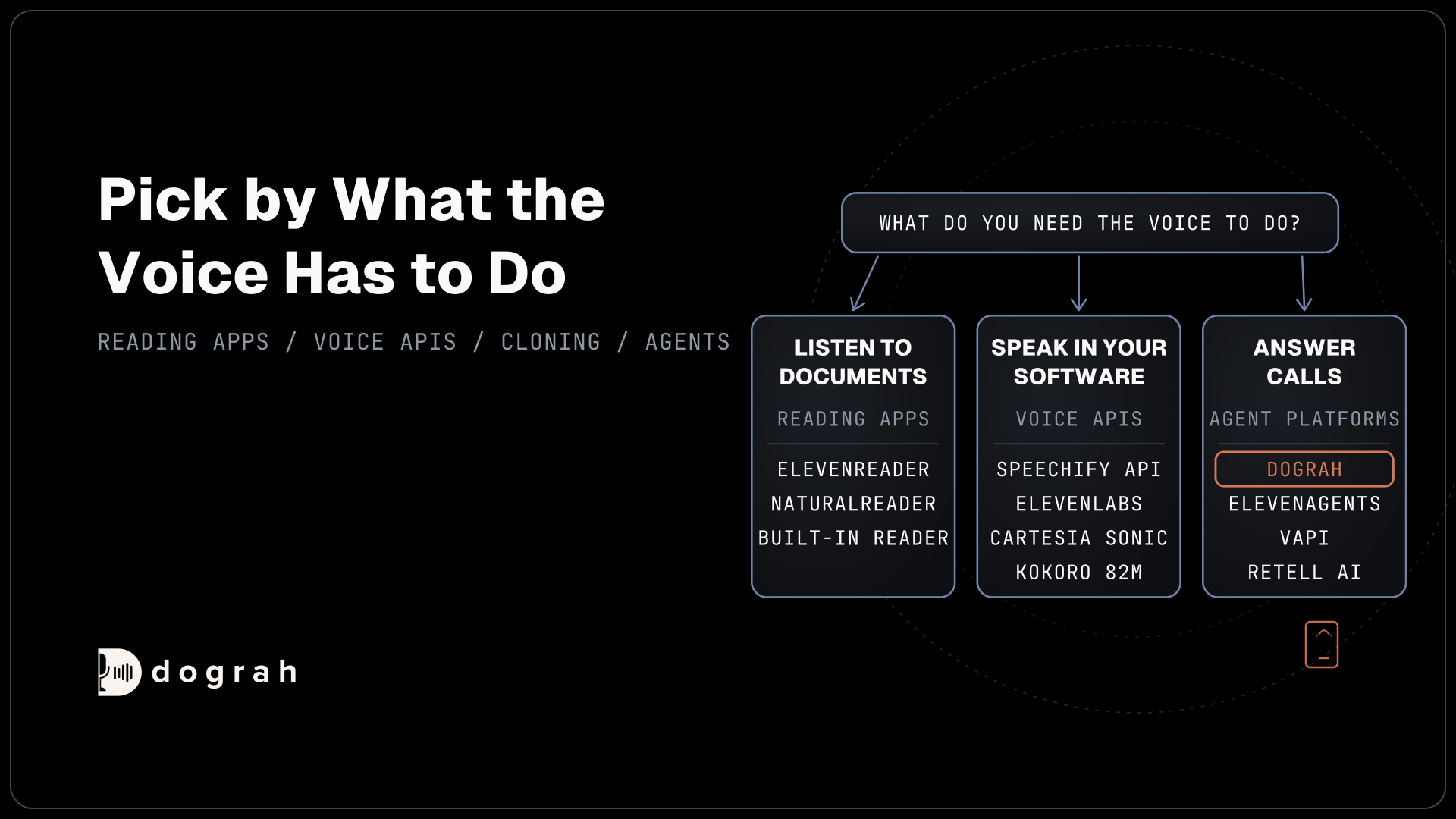

Speechify alternatives fall into two groups. For reading aloud, ElevenReader, NaturalReader and built-in readers compete with the Speechify app. For a business voice that answers calls, you need an agent around the voice. Dograh, the open-source AI voice agent platform we build, runs Speechify, ElevenLabs or Kokoro voices, and you can self-host it or run it on Dograh Cloud.
Key Takeaways
- Speechify's Reader app and its developer API are separate products with separate bills.
- A voice alone does not answer a phone. Business calls need an agent around it.
- Dograh runs Speechify's Simba 3.2 and 3.0 voices with your own key.
This guide starts with what Speechify sells, then splits the alternatives into reading apps and voice tools, with one table for license, voices, cloning and price. After that come the voice agent platforms, cloning across the list, when Speechify still fits and how to pick the alternative for your job.
What Speechify sells today
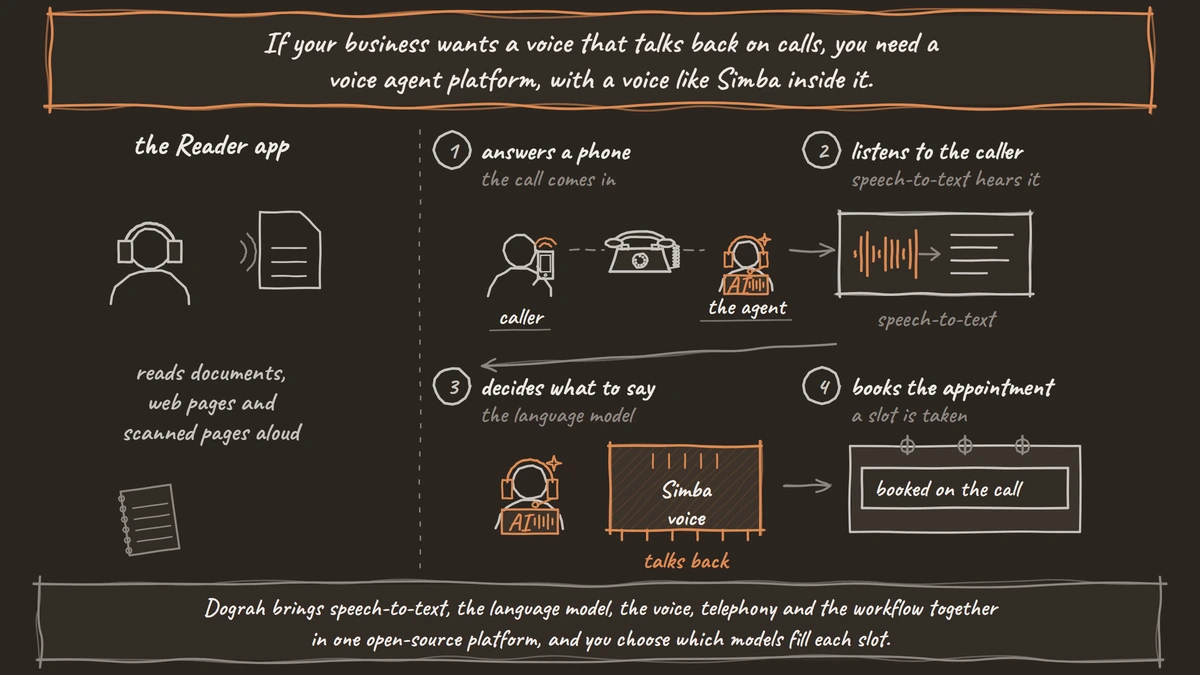
Speechify sells two products, and they sit on two separate bills. The first is the Speechify Reader app, which reads documents, web pages and scanned pages aloud. The second is SpeechifyAI, a developer API that turns text into speech inside your own software. A Reader subscription does not include API usage.
The Reader app has a free plan and a Premium plan. Speechify's free plan reads at speeds up to 1.5x, with 10 robotic sounding voices and text to speech features only. Premium costs $29 a month, or $139 billed yearly. It adds more than 1,000 voices in over 60 languages, 5x speed, Scan & Listen for printed pages, AI summaries, voice typing and AI podcasts.
The API runs on Speechify's Simba models. Simba 3.5 is the one Speechify recommends, with 48 languages under one model ID. Simba 3.2 is English only and built for speed, and Simba 3.0 covers six languages. Voice cloning works on all three, on paid plans.
What Speechify does not sell is the agent. It offers a reading app and a voice API, and nothing that answers a phone, listens to the caller, decides what to say and books the appointment. That split shapes this guide. If you want a different app for listening, the reading apps below are your list. If your business wants a voice that talks back on calls, you need a voice agent platform, with a voice like Simba inside it.
Reading apps like Speechify
Reading apps turn your own documents into audio for you to listen to, so the choice comes down to voices, speed and how much free listening you get. Our Speechify review answers whether Premium is worth paying for, reader by reader.
ElevenReader is the reading app from ElevenLabs. ElevenReader's free plan gives 10 hours of text to audio a month, more than 1,000 voices and up to 4.0x speed. The paid Ultra plan costs $8.25 a month billed yearly, with unlimited listening to your own imports inside a daily fair-use cap, plus offline downloads and custom voices.
NaturalReader is the closest match to Speechify's own feature set. It reads PDFs, Word files, ePub books and web pages, scans printed pages through a camera scanner, and speaks more than 90 languages. It has a free plan that needs no card, and it now offers voice cloning as well.
Most phones and browsers also have a read-aloud feature built in. For a few articles a week, that is often enough, and it costs nothing extra. The free Speechify plan sits in the same place, with its 1.5x cap and robotic voices.
What each Speechify plan costs, exactly what the free version stops you doing and the API's per-character rates are all in our breakdown of Speechify pricing.
Voice APIs and open voice models
Voice APIs are the second group, and they are what a developer reaches for when software needs to speak. They sell the voice by the character and leave the rest of the product to you.
SpeechifyAI's free plan includes 500,000 characters a month. Paid plans start at $10 a month for Starter, then $99 for Pro and $499 for Scale. Simba 3.0 and 3.2 bill $10, $8 and $6 per million characters on those three plans, and Simba 3.5 lists at $20, $16 and $12. On the Artificial Analysis Speech Arena, where listeners vote blind between two clips, Simba 3.2 ranks 11th of 103 voices. Simba 3.5 is not on the board yet, so this guide gives it no rank.
ElevenLabs is the voice most teams compare against. Eleven v4 and Eleven v4 Turbo hold the top two places on the same board. Through the API, Eleven v4 costs $0.08 per 1,000 characters in more than 90 languages, and v4 Turbo costs $0.04, which ElevenLabs calls its best model for real-time and agents. Our Speechify vs ElevenLabs comparison runs one sentence through both and judges each for reading and for live calls.
Cartesia's Sonic sits in the same group. Sonic 3.6 speaks 44 languages, and Cartesia sells it on credit plans, from a free 20,000 credits a month, at one credit per character, with instant cloning from its $5 Pro plan. Our guide to Cartesia alternatives covers Sonic and Cartesia's new agent platform.
Whether Speechify's API holds up on a live phone call is a question of its own. It streams audio, offers 8 kHz and 16 kHz formats for phone lines and counts concurrency per account. Our post on the Speechify API for voice agents goes through each one.
Open voice models are the other option here. Kokoro 82M is under Apache-2.0, with fixed voices and no cloning. Chatterbox is under MIT and clones a voice from a short clip. Both run on your own servers with no per-character bill, though the servers are yours to pay for. On the Speech Arena they sit far lower, with Kokoro 82M v1.0 at 63rd and Chatterbox at 83rd.
A ranking of clips is one test, and reading tricky text is another. Our TTS verbalization benchmark measured how seven open models read dates, prices and phone numbers. Kokoro-82m was the most accurate at 0.61, with about 18 times less compute per clip than orpheus-3b, the runner-up. Dates were hard for all of them, and the best date score of any model was 0.23.
Speechify alternatives in one table
The table sets the voice tools and agent platforms side by side on license, where they run, voices and cloning, and list price. Reading apps stay out of it, because they sell listening time rather than a voice for your product. Latency is left out too, since it depends on your network and phone path more than on the vendor.
| Product | Group | Open source | Where it runs | Voices and cloning | List price |
|---|---|---|---|---|---|
| Speechify API (baseline) | Voice API | No | Speechify's cloud | Simba 3.5, 3.2 and 3.0. Cloning from a short sample plus a spoken consent phrase, on paid plans | Free: 500K characters a month. Simba 3.0 and 3.2: $10 to $6 per 1M characters. Simba 3.5: $20 to $12 |
| Dograh | Voice agent platform | Yes, BSD-2-Clause | Your servers with Docker Compose, or Dograh Cloud | 16 voice providers with your own key, Speechify and ElevenLabs included, with cloned voice IDs. Or Kokoro on your servers | Self-hosted: no per-minute platform fee. Dograh Cloud: 1¢/min platform fee. Models and phone billed by their providers |
| ElevenLabs API | Voice API | No | ElevenLabs' cloud | Eleven v4 and v4 Turbo top the Speech Arena. Instant cloning from the $6 Starter plan | Eleven v4 $0.08 and v4 Turbo $0.04 per 1K characters |
| Cartesia Sonic | Voice API | No | Cartesia's cloud | Sonic 3.6 in 44 languages. Instant cloning from the $5 Pro plan | Credit plans from a free 20K credits a month, 1 credit per character |
| Kokoro 82M | Open voice model | Yes, Apache-2.0 | Your servers | Fixed voices, no cloning | Free model. You pay for the servers |
| Chatterbox | Open voice model | Yes, MIT | Your servers | Clones from a short clip, with a watermark in every output | Free model. You pay for the servers |
| ElevenAgents | Voice agent platform | No | ElevenLabs' cloud | ElevenLabs' own voices | Plans with included minutes. Extra minutes $0.08, LLM and carrier on top |
| Vapi | Voice agent platform | No | Vapi's cloud | Provider voices, such as ElevenLabs voice IDs | $0.05/min hosting, plus models and phone |
| Retell AI | Voice agent platform | No | Retell's cloud | Preset voices from Retell, Cartesia, ElevenLabs, OpenAI, MiniMax, Fish and Inworld | $0.07 to $0.31/min, from $0.055/min voice infrastructure |
| Cartesia Managed Agents | Voice agent platform | No | Cartesia's cloud | Cartesia's Sonic voices | $0.03/min, LLM and Cartesia numbers on top |
Of the voice agent platforms in the table, Dograh is the one whose code is open, and Speechify is one of its built-in voices. The open models are voices only, so they need a platform around them to take a call.

Open Source Alternative to Vapi / Retell
Self-hosted voice agent platform — no per-minute fees
dograh-hq/dograh
Star on GitHub
Dograh: keep Speechify's voice, add the phone agent
Dograh brings speech-to-text, the language model, the voice, telephony and the workflow together in one open-source platform, and you choose which models fill each slot. It runs the call flow, tools and phone lines, and the speech and language models stay a separate layer you pick.
Speechify is one of the built-in voice providers. In the voice settings you add your own Speechify API key, pick Simba 3.2, the default, for English, or Simba 3.0 for German, Spanish, French, Italian or Portuguese, and choose a voice or paste your own cloned voice ID. The clone has to support the model you picked. So a team that likes Speechify's voice keeps it and gets the phone agent around it. For that setup in one place, see Speechify voices running in Dograh, with your own key, the Simba model choice and self-hosted or cloud hosting.
That is bring your own key (BYOK). The Speechify account is in your name and the bill stays on it, while Speechify still processes every line the agent speaks. Speechify sits next to 15 other voice providers, ElevenLabs among them, from Flash v2.5, the default, up to Eleven v4 and v4 Turbo with any voice ID.
For voices on your own servers, Kokoro runs through Local Models (Speaches), an OpenAI-compatible speech server, and it is the default local voice. Chatterbox, the open model that can clone, can go through the same route behind a server that returns raw 24 kHz audio. Run a test call with your own setup before callers hear it.
The voice bill also shrinks with pre-recorded clips. You record the lines your agent says on most calls, such as the greeting, insert them in the prompt by typing "@", and the agent plays a recording when one fits and uses the TTS fallback for everything else. Clips play directly, so those lines carry no per-character charge.
Every call also leaves a record you can open. View Trace shows the speech-to-text, AI and voice time for each turn in Langfuse, and built-in QA scores each step of the call with its own tags, score and summary. When a voice misreads a price, you find the turn where it happened.
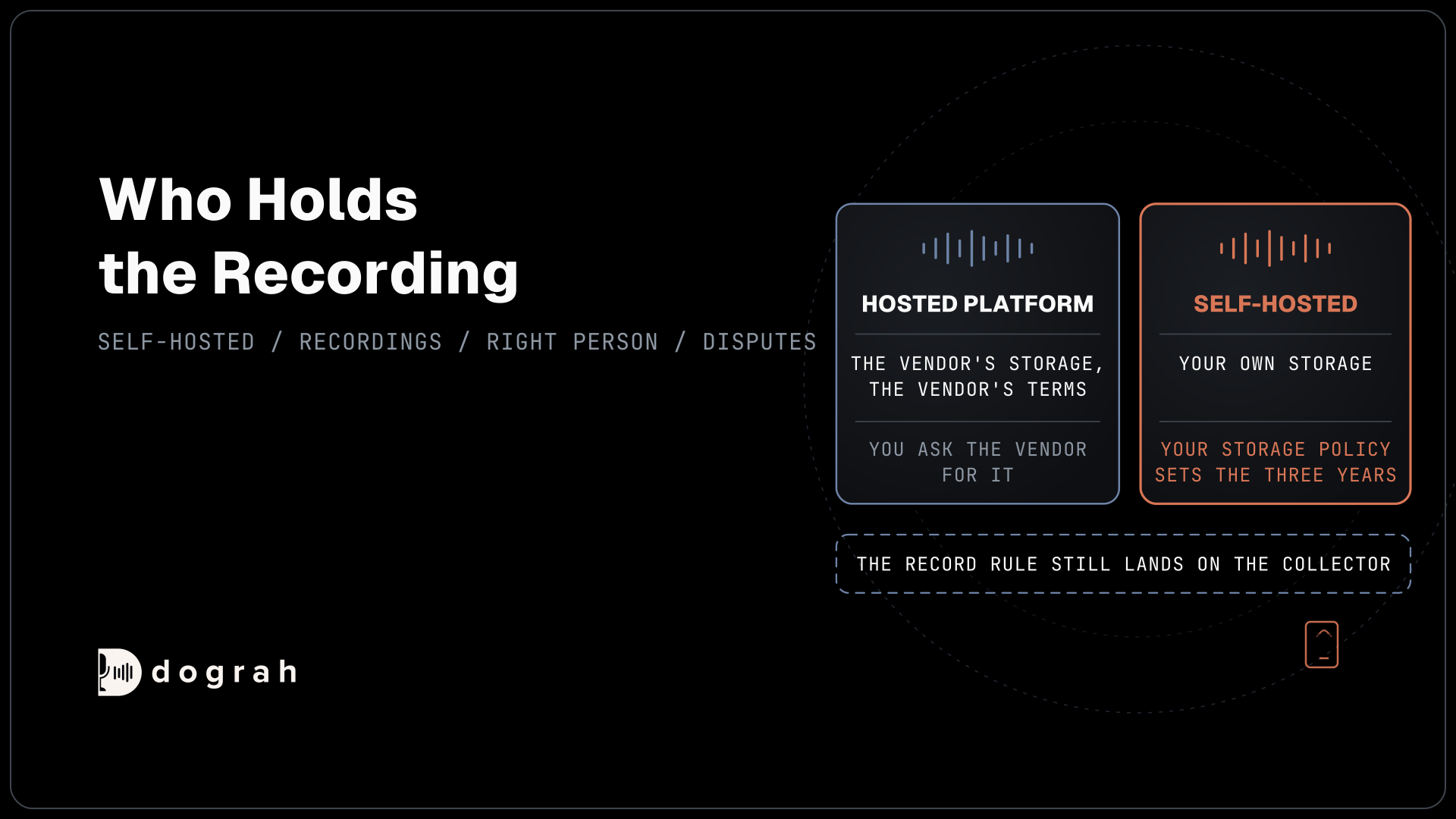
Self-hosting with Docker Compose runs 10 calls at once by default, a limit you can raise, and the servers and updates sit with your team. Self-hosted Dograh has no per-minute platform fee, but servers, model keys and phone minutes still cost money. Dograh Cloud charges a 1¢-a-minute platform fee. Its pay-as-you-go plan includes 10 concurrent calls.
Other voice agent platforms
Hosted voice agent platforms sell the whole agent by the minute and run it in their own cloud. ElevenAgents wraps ElevenLabs' voices in a hosted agent, with its own speech-to-text, workflows and tests. Paid plans include minutes, extra minutes cost $0.08, and the language model and carrier come on top. Our guide to ElevenLabs alternatives compares it in depth.
Vapi is a developer platform with a $0.05-a-minute hosting fee, with models and phone billed on top. Voice IDs from providers such as ElevenLabs work there. Our guide to Vapi alternatives covers its field.
Retell AI lists $0.07 to $0.31 a minute for a full agent, from $0.055 for its voice infrastructure. It bills each voice per minute, from $0.015 for its own platform voices and Cartesia up to $0.10 for Eleven v4, and its visual Conversation Flow builder suits teams that want a studio. See our guide to Retell AI alternatives.
Cartesia Managed Agents comes from the company behind Sonic. It charges $0.03 a minute, with the language model and Cartesia phone numbers billed on top, and the Cartesia guide linked above covers it.
All four are closed platforms. If the reason you left Speechify was a voice that can take calls, any of them gets you there. If you also want the platform's code, and your own pick of voice provider down to Speechify's Simba, Dograh is the one on this list that gives you both.
Voice cloning across the alternatives
Cloning gives you a voice ID that reads any script in one person's voice, and each option above handles it differently. Speechify's API clones from 10 to 30 seconds of clean speech on any paid plan, and only after the speaker reads an issued consent phrase aloud. Speechify keeps that recording as the consent record. ElevenLabs offers Instant Voice Cloning from its $6 Starter plan and Professional Voice Cloning from the $22 Creator plan. Cartesia's instant cloning starts on its $5 Pro plan.
Among open models, Chatterbox is the permissively licensed one that clones, and every output carries Resemble AI's Perth watermark. Kokoro has fixed voices only.
In Dograh, a clone made at Speechify, ElevenLabs or Cartesia runs as a voice ID with your own key. The pattern we recommend pairs real recordings of a person with that same person's clone for everything else, so the call sounds like one voice from start to finish. Get the speaker's permission first. Our post on Speechify voice cloning covers the steps, the limits, the price and the consent you need.
Join the Dograh Community
Dograh is an OSS alternative to Vapi. Join our Slack community for queries, releases, best practices & community interactions.
When staying on Speechify makes sense
Speechify is still the right buy for many people. Heavy readers who listen to documents every day, and students who want scanning, summaries and fast playback in one app, get a polished tool for $139 a year. Developers who need a fast English voice for their own product get Simba 3.2, 11th on the Speech Arena, at $10 to $6 per million characters.
For phone agents, staying with Speechify's voice and moving to an agent platform go together. The voice can stay where it is. What changes is the layer around it, which listens to the caller and acts on what it hears.
Picking your Speechify alternative
Pick by what you need the voice to do. If you want to listen to documents, try ElevenReader, NaturalReader and the reader built into your phone against Speechify's free plan before you pay. If you want a voice inside your own software, run the same script through the Speechify, ElevenLabs and Cartesia APIs, and try Kokoro if the voice has to run on your servers.
If you want a voice that answers or makes calls, pick the agent platform first and the voice second. In Dograh you can try Speechify, ElevenLabs and Kokoro on the same agent by switching the voice provider, so test them on a real phone line with a script that includes a date, a price and a phone number.
The phone line matters as much as the script. Most phone calls still reach the agent as 8 kHz audio, while a browser demo runs at 16 kHz, so a voice that shines in a demo can sound flatter on a call.
Each part of this guide has its own deep dive:
- Speechify Review in 2026: Is It Worth It?
- Speechify Pricing in 2026: Plans and Free Version Limits
- Speechify vs ElevenLabs in 2026: Reading and Live Calls
- Speechify API for Voice Agents: What It Can and Can't Do
- Speechify Voice Cloning: How It Works and Alternatives
Glossary
- Speech Arena
- Artificial Analysis's text-to-speech leaderboard, where listeners vote blind between two clips. Ranks move as votes come in, so name the exact model, such as Simba 3.2, whenever you quote one.
- Voice ID
- The identifier a voice provider gives a stock or cloned voice. Pasting it into an agent's voice setting, with your own key, makes the agent speak in that voice.
- Bring your own key (BYOK)
- Using your own account with a model provider, such as Speechify, instead of the platform's. You hold the contract and the bill, while the provider still processes the text it voices.
- TTS fallback
- Text to speech used for any line that has no pre-recorded clip. With a clone of the recorded speaker, the clips and the fallback sound like one voice.