
Speechify's voice cloning turns a short recording into a voice ID. Its API makes one from 10 to 30 seconds of speech on paid plans from $10 a month, after the speaker reads an issued consent phrase aloud. Dograh, the open-source AI voice agent platform, runs that clone on phone calls, self-hosted or on Dograh Cloud.
Key Takeaways
- A clone is a voice ID that keeps the speaker's accent and recording quality.
- Speechify will not clone a voice until the speaker reads a consent phrase aloud.
- Dograh runs cloned voice IDs from Speechify, ElevenLabs or Cartesia, or Chatterbox.
This post is part of our guide to Speechify alternatives, where cloning gives you a voice ID that reads any script in one person's voice. Below, we cover what a Speechify clone gets you, the consent it needs first, how it is made, its limits and price, and the alternatives.
What you get from a voice clone
A clone gives you a voice ID. Any text you send with that ID comes back in the voice of the person you recorded, the same way a stock voice works.
The clone keeps the accent of its recording. A clone used in another language still carries the speaker's accent, and on Simba 3.2 a clone speaks English only. Simba 3.5 and Simba 3.0 cover more languages.
Quality follows the sample. Speechify asks for clean speech with little background noise, because a clone can only be as clear as the recording it was made from.
Speechify's reading app has its own option for listening to your documents in your own voice. This post covers the API clone, which is the one a voice agent can use.
Consent comes before the clone
Speechify's API will not create a clone until the speaker shows they agreed. You start a consent challenge with the speaker's full name, Speechify issues a phrase, and the same speaker reads it aloud on a recording. Speechify keeps that recording as the consent record for the voice, and no way of creating a clone skips it.
For a business, the recorded consent is the useful part, because it shows the person agreed to the voice being made. Our post on voice cloning for AI voice agents covers when a cloned voice helps a phone agent and when it backfires.
Calls bring their own rules. In the US, the FCC's ruling on AI-generated voices treats cloned voices as artificial voices under the Telephone Consumer Protection Act (TCPA), so the consent rules for artificial-voice calls apply. Our guide to compliant AI voice agents covers those calling rules.
In the EU, Article 50 of the AI Act applies from 2 August 2026. Providers of systems that make synthetic audio must mark it in a machine-readable way, and deployers must disclose deep fake audio as artificially generated. Rules differ by country and by use, so confirm your setup with counsel before a cloned voice calls anyone.
If you want to tell callers they are hearing an AI voice, or your location requires it by law, write it in the Greeting Text of the Start Call node in Dograh, along with the business's name. Then switch off Allow Greeting Interruption on that node, so the caller hears the whole line.
How Speechify makes a clone
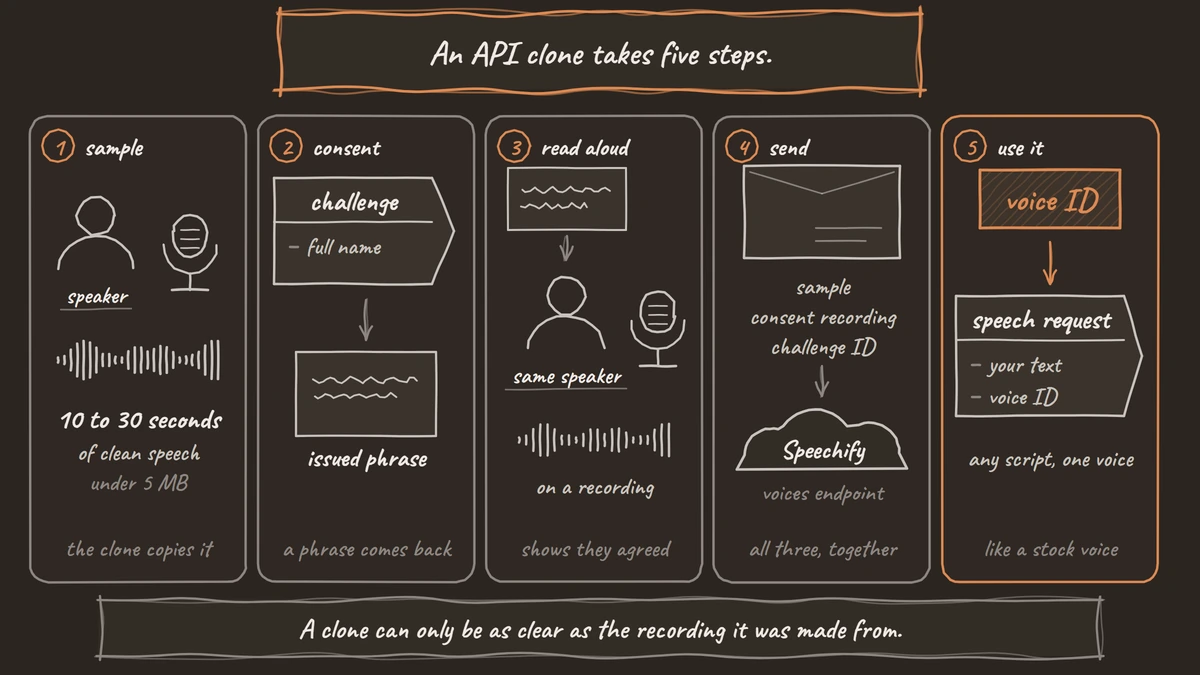
An API clone takes five steps:
- Record 10 to 30 seconds of clean speech from the speaker, under a minute long and under 5 MB.
- Create a consent challenge with the speaker's full name.
- Record the same speaker reading the issued phrase aloud.
- Send the sample, the consent recording and the challenge ID to Speechify's voices endpoint.
- Use the voice ID it returns in any speech request, like a stock voice.

Open Source Alternative to Vapi / Retell
Self-hosted voice agent platform — no per-minute fees
dograh-hq/dograh
Star on GitHub
Limits and price of Speechify cloning
Speechify sets no limit on how many voices you can create. Cloning is not offered in some jurisdictions, judged by the IP address of the machine making the request, so where your server runs counts, not where you sit. A blocked request gets a 403 error.
Cloning comes with Speechify's paid API plans, which start with Starter at $10 a month, and free accounts do not include it. Speech in a cloned voice bills at the model's per-character rate: $10, $8 and $6 per million characters for Simba 3.0 and 3.2 on Starter, Pro and Scale, and a list price of $20, $16 and $12 for Simba 3.5.
Speechify voice cloning alternatives
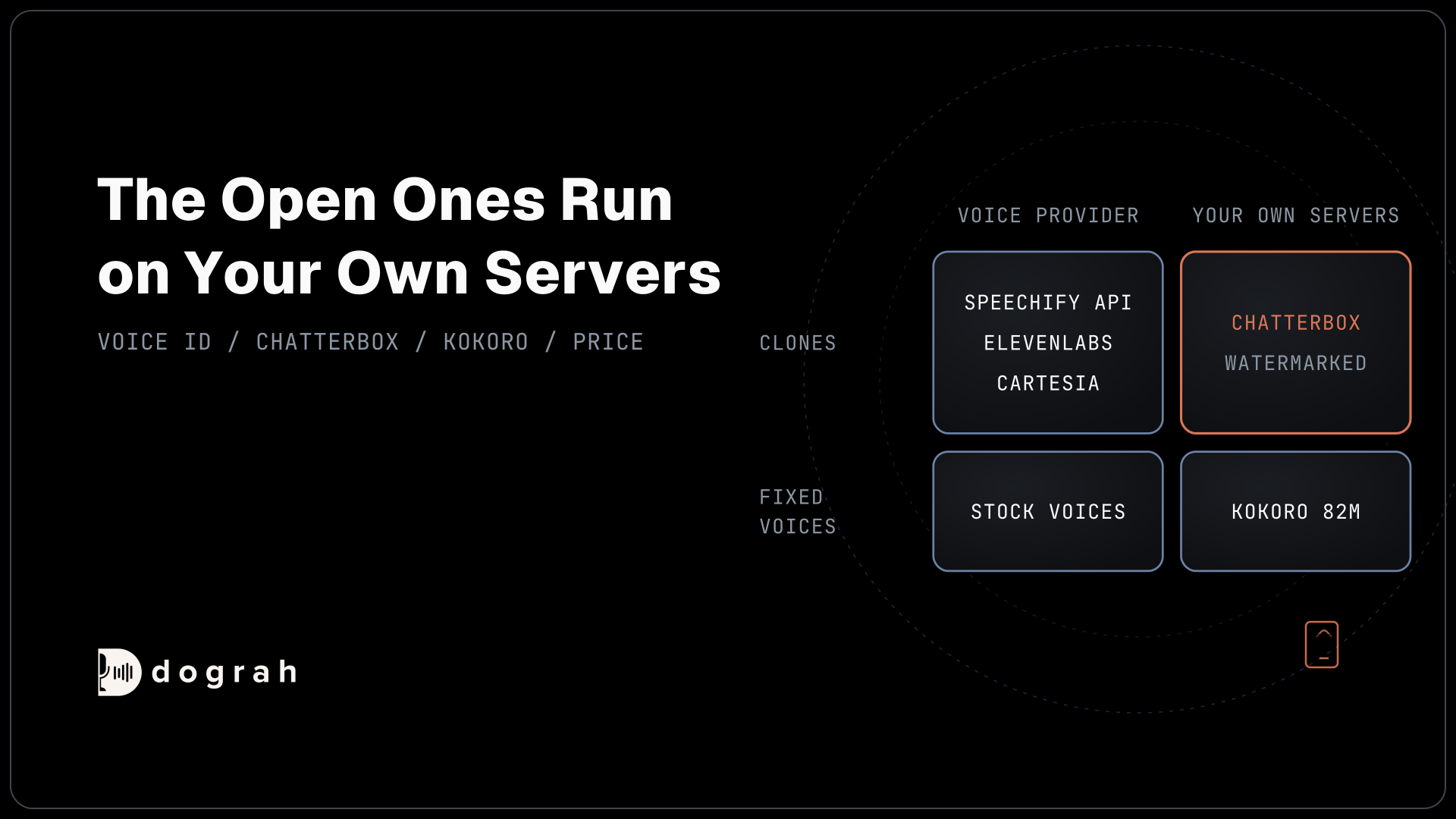
Each alternative makes a clone differently, and the open ones run on your own servers.
| Option | How it clones | Plan to start | Consent step | In Dograh |
|---|---|---|---|---|
| Speechify API | 10 to 30 seconds of speech | Paid plans from $10/mo | Speaker reads an issued phrase aloud | Voice ID on Simba 3.2 or 3.0 |
| ElevenLabs Instant | 1 to 2 minutes of audio | Starter, $6/mo | Confirm you have the right and consent | Any voice ID |
| ElevenLabs Professional | 30 to 180 minutes of audio | Creator, $22/mo | Voice verification | Any voice ID |
| Cartesia | Instant, or professional on Startup ($49/mo) | Pro, $5/mo | Check Cartesia's terms | Any voice ID |
| Chatterbox (MIT) | Short reference clip, watermarked output | Free, on your servers | Your own process | Local Models (Speaches) |
| Kokoro 82M (Apache-2.0) | No cloning, fixed voices | Free, on your servers | Not needed | Local Models (Speaches) |
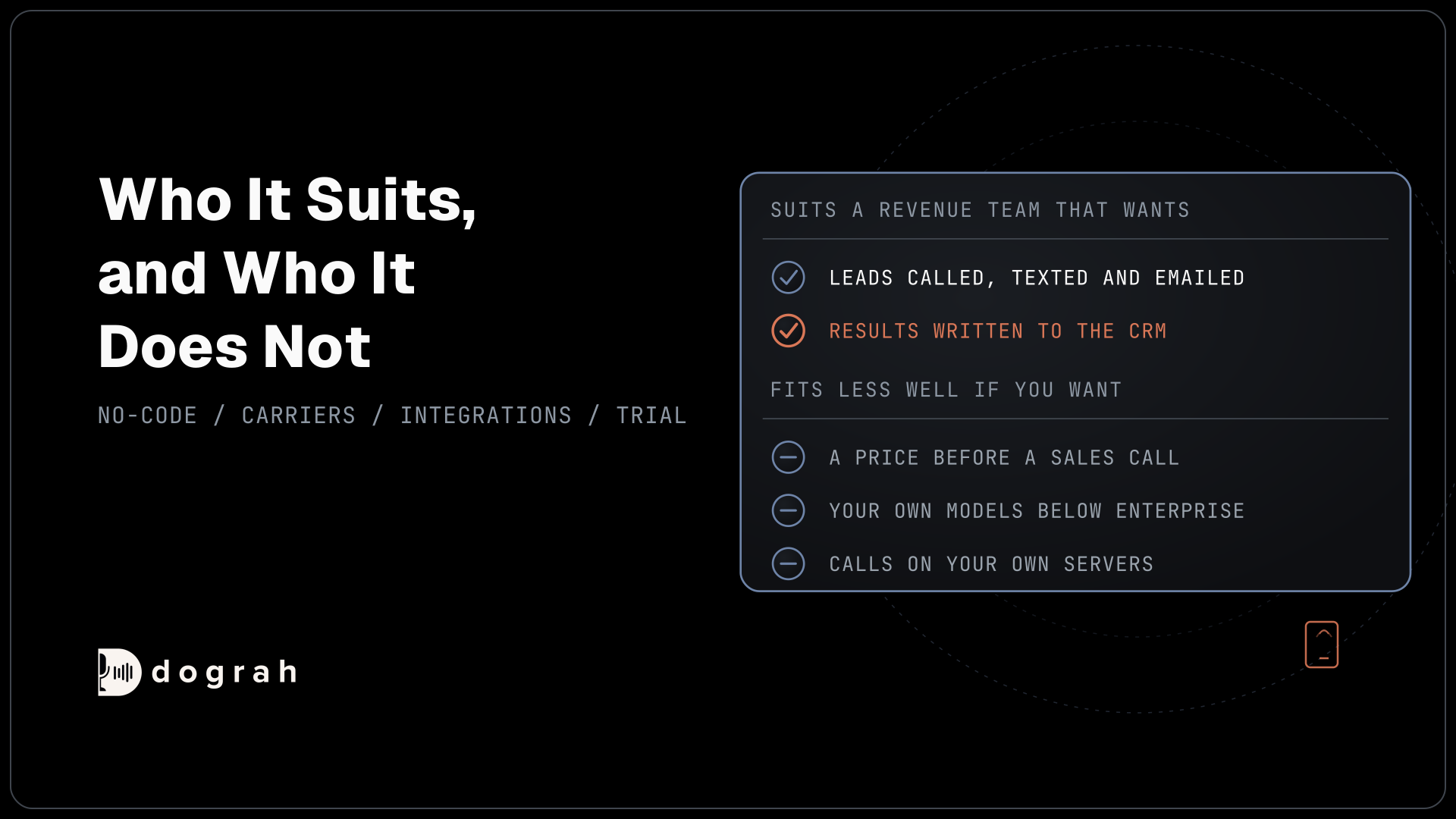
| Dograh | Runs any clone above, plus clips of the real person | Self-hosted: no per-minute platform fee. Cloud: 1¢-a-minute platform fee | Optional disclosure line in the Greeting Text | The agent platform |
ElevenLabs offers Instant Voice Cloning from its $6 Starter plan, from 1 to 2 minutes of good audio and a confirmation that you have the right and consent to clone the voice. Professional Voice Cloning starts on the $22 Creator plan, and it needs 30 to 180 minutes of audio plus voice verification.
Cartesia's instant cloning starts on its $5 Pro plan, and professional cloning on its $49 Startup plan.
Chatterbox is the open model that clones. It is under the MIT licence, clones from a short reference clip, about ten seconds in its own example, and marks every output with a Perth watermark. In our TTS verbalization benchmark, we measured how seven open models read dates, prices and phone numbers aloud. There, chatterbox scored 0.44 overall and chatterbox-turbo 0.49, and chatterbox had the best date score of any model at 0.23, with 0.60 on phone numbers.
Those scores measure how well a model reads tricky text, not how close a clone sounds to the speaker. Kokoro 82M, the other common open model, has fixed voices and does not clone.
Join the Dograh Community
Dograh is an OSS alternative to Vapi. Join our Slack community for queries, releases, best practices & community interactions.
Running a cloned voice on phone calls
In Dograh, a cloned voice is a voice ID. You pick the provider in the voice settings, add your key and paste the clone's ID. A Speechify clone works on Simba 3.2 or Simba 3.0, as long as it supports the model you pick, and ElevenLabs and Cartesia take any voice ID.
The pattern that sounds most human pairs the clone with real recordings. The real person records the lines the agent says on most calls as pre-recorded clips, and the cloned voice speaks everything else, so a caller hears one voice throughout. Our post on voice cloning with pre-recorded audio and TTS walks through the method.
To keep the clone on your own servers, Chatterbox runs through Local Models (Speaches) behind a server that returns raw 24 kHz audio. Run a test call before you put it in front of callers.
Self-hosted Dograh has no per-minute platform fee, but servers, model keys and phone minutes still cost money. Dograh Cloud charges a 1¢-a-minute platform fee. A Speechify clone's characters bill to your own Speechify account.
Whichever clone you choose, the order stays the same. Recorded consent comes first and a clean sample second. Then run a test call before any caller hears the voice.
Glossary
- Voice ID
- The identifier a voice provider gives a stock or cloned voice. You send it with each speech request, and in Dograh you paste it into the voice setting.
- Consent challenge
- Speechify's step where the speaker reads an issued phrase aloud on a recording. Speechify keeps that recording as the consent record for the clone.
- Instant voice cloning
- Making a voice from a short recording with no training run. ElevenLabs asks for 1 to 2 minutes of audio, and Speechify's API for 10 to 30 seconds.
- Audio watermark
- A mark hidden in generated audio so it can be identified as synthetic later. Chatterbox adds a Perth watermark to every output.