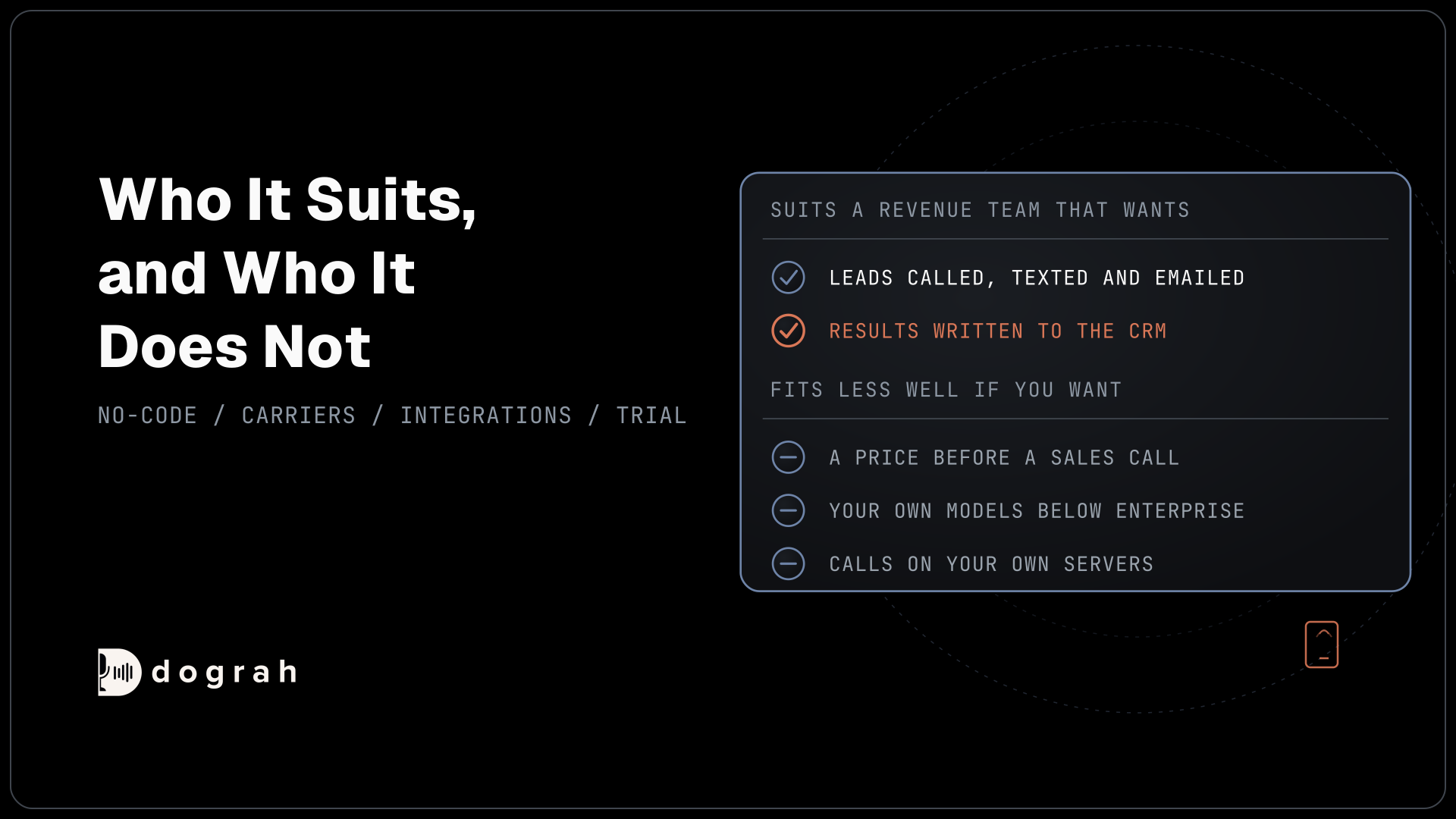

Thoughtly is a no-code platform for revenue teams that want inbound leads called, texted and emailed, with results written to the CRM. It fits less well if you want a price before a sales call, your own models below Enterprise or your own servers. Dograh, the open-source AI voice agent platform we build, fits there, self-hosted or on Dograh Cloud.
Key Takeaways
- Thoughtly suits inbound lead follow-up across calls, texts and email, bought through sales.
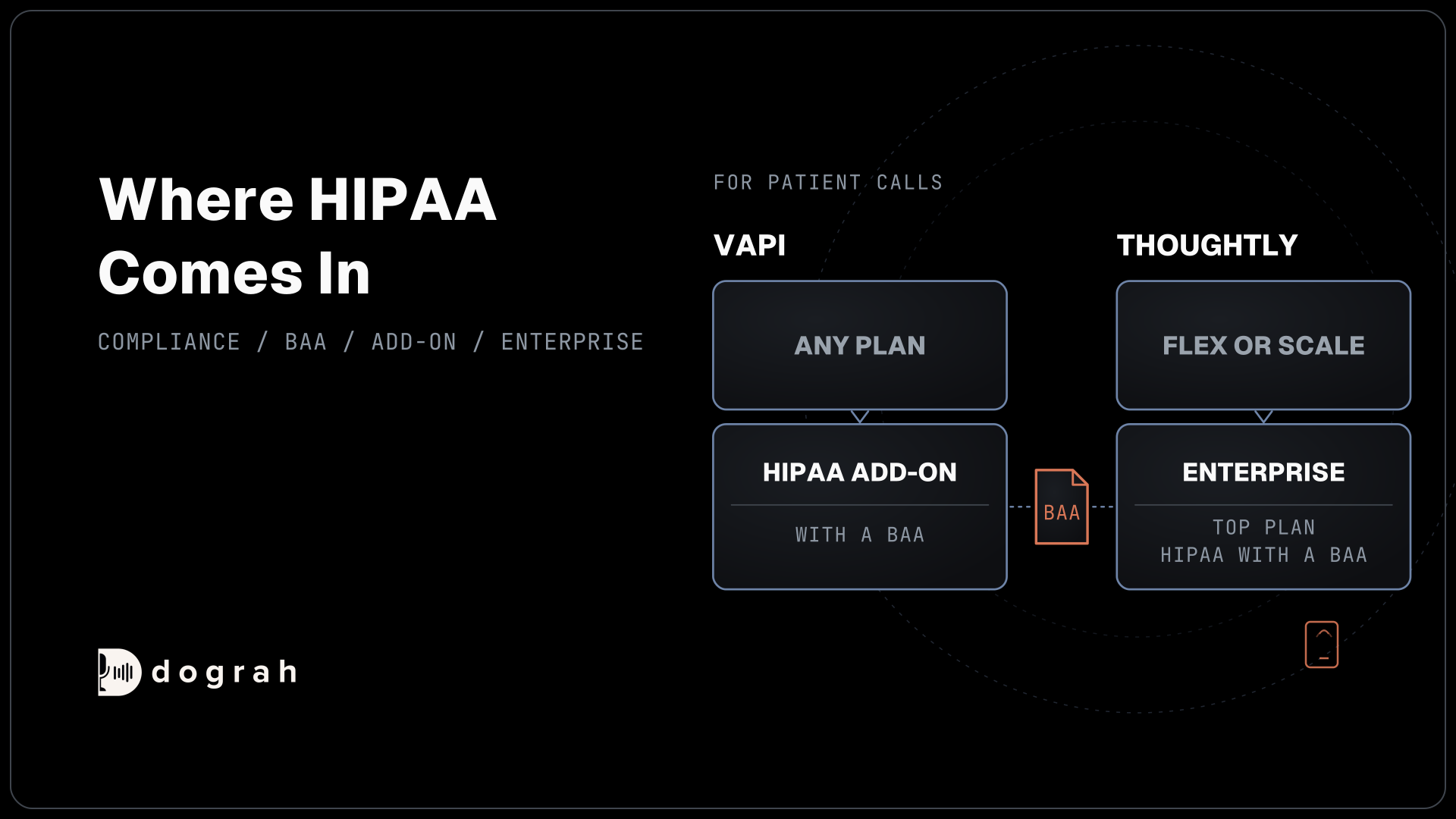
- Patient-data compliance and your own language model both need Enterprise.
- The free trial cannot call real leads, so plan a paid pilot.
This review is one part of our guide to Thoughtly alternatives, which compares hosted platforms and open-source options with Thoughtly on hosting, models, phone numbers, price and lock-in. Below, we judge Thoughtly on its own agent builder, phone numbers, integrations and plans, then show where Dograh differs.
Who Thoughtly suits, and who it does not
Thoughtly suits a revenue team that wants every new lead answered fast without hiring engineers. One agent can call, text and email the lead, qualify them, book the meeting and write the result back to HubSpot, Salesforce or Zoho. The agent builder is visual, and minutes are unlimited inside your plan's cap on concurrent calls.
It suits less well a team that wants to see the price before talking to sales, since every plan is quoted. Model choice is narrower too. You choose between GPT, Claude and Gemini, and using your own model requires Enterprise. For voices, you use Thoughtly's library, which includes Cartesia voices, or ElevenLabs through your own paid ElevenLabs key, an option limited on Flex.
The other group it fits less well is anyone who needs calls on their own servers. Thoughtly runs on its own cloud on AWS, and data residency and dedicated infrastructure come on Enterprise. So the verdict depends on who you are: a strong buy for a sales team that wants a finished product, and a harder fit for an engineering team that wants control of the stack.
The agent builder
Thoughtly's agent builder is a visual node editor, and it is easy to read. Thoughtly's node docs list four node types: Start, Speak, Transfer and End. A Speak node either plays a Message, with a Verbatim setting that makes the agent say the line exactly as written, or follows a Prompt that the AI answers in its own words.
Branching runs on outcomes, which can be prompt-based or rule-based, and actions for lookups, webhooks and scheduling run before an outcome is chosen. A Transfer node sends the call to a phone number or to another Thoughtly agent. Recent additions include a Code Node for all teams and Agent Version History with undo and redo.
Testing has two modes. Test Agent is a text chat, and Call Me rings your own phone. Thoughtly itself warns that text chat cannot show voice quality, interruptions or background noise, so do your real checks with Call Me. Our checklist for testing voice agents before you go live puts those checks in order.
Voices are a strength. You can pick from Thoughtly's library or clone your best rep's voice from a recorded sample, and Thoughtly requires that person's consent.
Phone numbers and carriers
You can buy numbers from Thoughtly or bring your own, and the choice affects both cost and how easily you can leave. Only Flex and Enterprise customers can buy numbers in the dashboard. A bought number is charged for the full month as soon as you buy it, with no proration, even if you cancel minutes later.
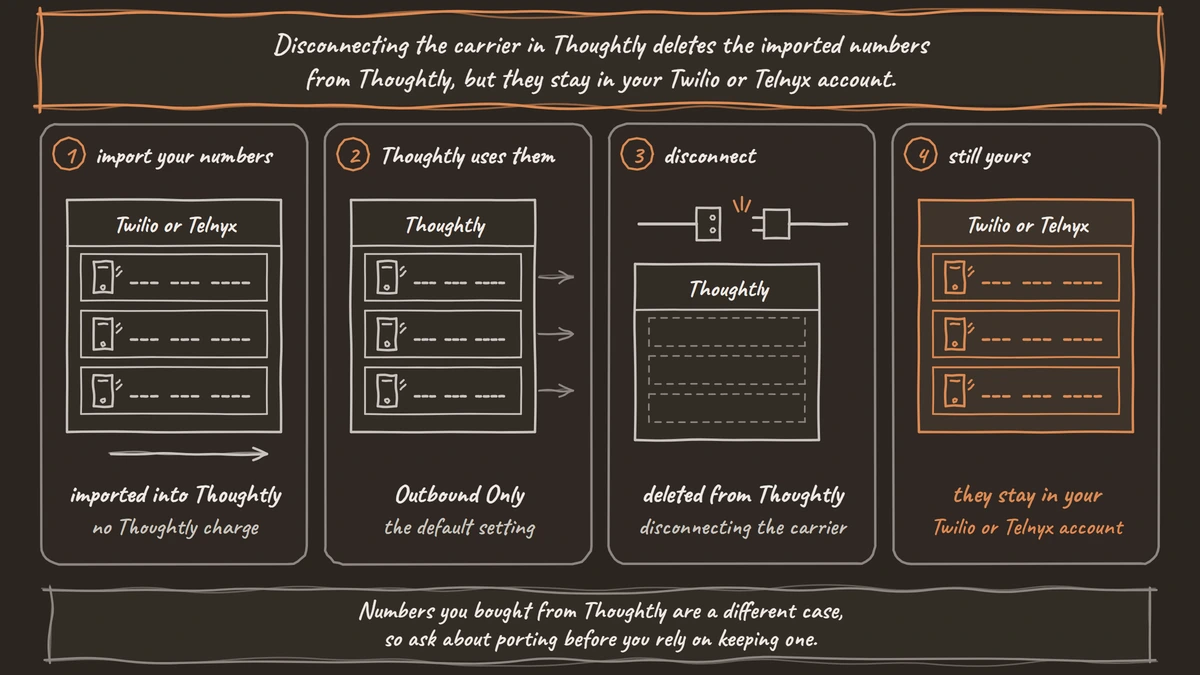
Thoughtly's carrier import docs let you bring numbers from Twilio or Telnyx, which Thoughtly calls bring your own carrier (BYOC). Imported numbers carry no Thoughtly charge, and you keep paying your carrier directly. The default setting is Outbound Only, which leaves your existing call and text settings alone. Turn on webhook updates and Thoughtly takes over the number's inbound calls and texts, which switches off any earlier integrations on it.
The import path is also your exit. Disconnecting the carrier in Thoughtly deletes the imported numbers from Thoughtly, but they stay in your Twilio or Telnyx account. Numbers you bought from Thoughtly are a different case, so ask about porting before you rely on keeping one.
Integrations and channels
Integrations are where Thoughtly does most for a team with no developers. Thoughtly connects to 24 tools: CRMs such as HubSpot, Salesforce, Zoho CRM, Pipedrive and GoHighLevel, schedulers such as Calendly and Cal.com, plus Slack, Gmail, Zapier, Make, Zendesk and Shopify. On top of those come webhooks and a REST API for contacts and calls.
Recordings, transcripts, intent scores and summaries sync back to the CRM, which is the main reason sales teams pick it. The same agent works across voice, SMS, email, WhatsApp and iMessage.
Developers get less. Thoughtly's Model Context Protocol (MCP) server is in limited availability, and it can read agents and contacts but can never change them. Custom integrations beyond the list are built case by case.
Plans, trial and compliance
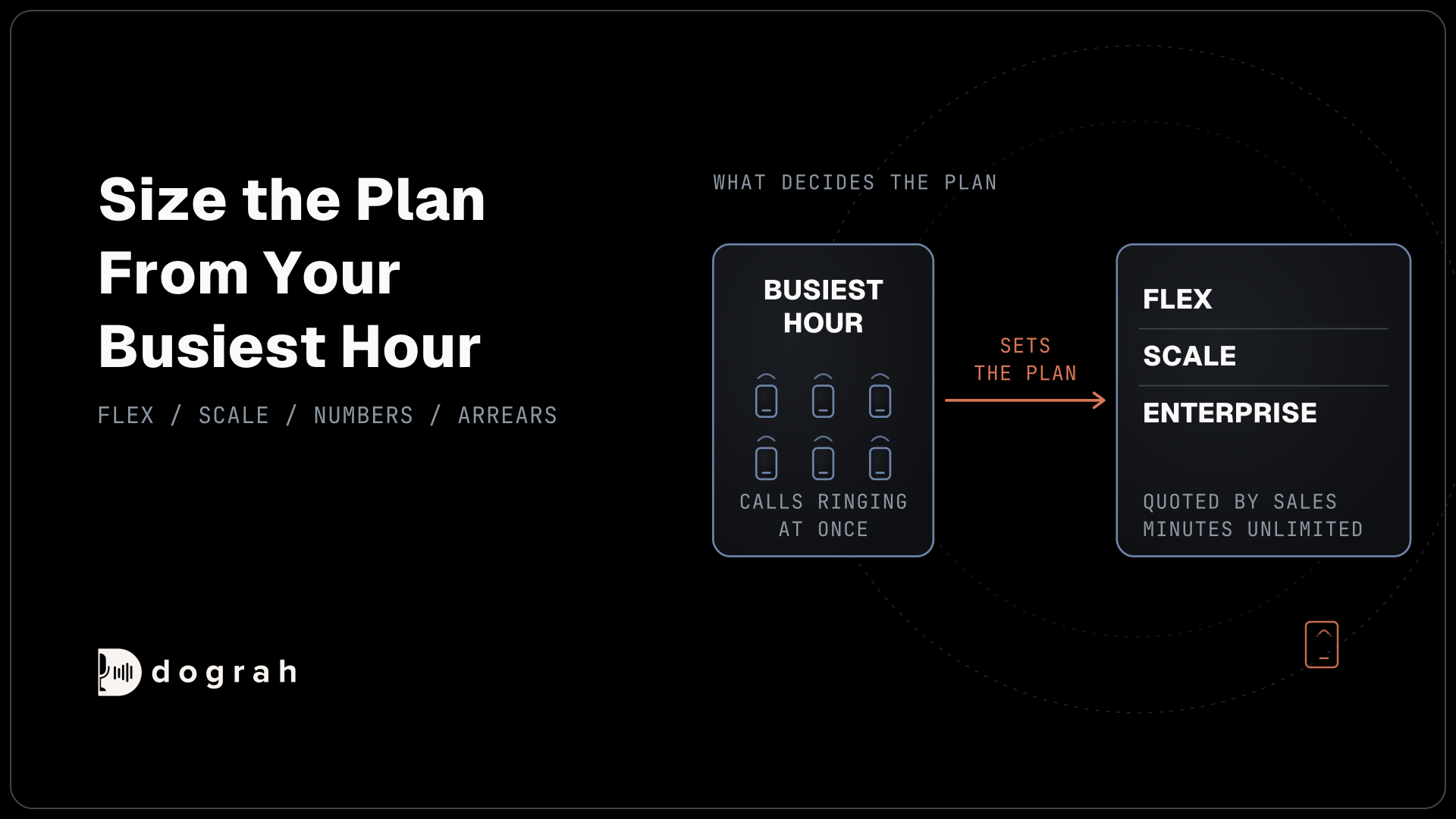
Every Thoughtly plan, whether Flex, Scale or Enterprise, is bought through its sales team and gives unlimited minutes under a cap on concurrent calls. Thoughtly's plans page sets that cap at 10 on Flex, 100 or more on Scale and a custom number on Enterprise.
What each tier adds matters more than the name. Scale brings Auto-QA and evals on every conversation, a SOC 2 Type II report on request, a review of your Telephone Consumer Protection Act (TCPA) and state do-not-call setup, and a 99.9% uptime service-level agreement. Enterprise adds your own language model, compliance with the Health Insurance Portability and Accountability Act (HIPAA) with a business associate agreement (BAA), single sign-on and data residency. Every plan covers 34 or more languages.
The trial is the weak spot for a fair test. The 14-day free trial cannot place outbound calls to leads or external numbers, leaves out bulk calling, and deletes the account after 14 days. So a real pilot happens on a paid plan, and you should run it on your own call mix, busiest hour included. Our breakdown of Thoughtly pricing works through one month's bill and the questions to ask sales.

Open Source Alternative to Vapi / Retell
Self-hosted voice agent platform — no per-minute fees
dograh-hq/dograh
Star on GitHub
Where Dograh differs
Dograh is the route for the teams the verdict says Thoughtly suits less well. Its code is open under BSD-2-Clause, so you can run it on your own servers or on Dograh Cloud, with no sales call either way.
Every model is your choice: Dograh's own, any supported LLM, speech-to-text or voice provider with your own keys, or open-weight models on your servers. Pre-recorded clips play your best rep's real voice where a line fits, and when a question falls outside them, the agent replies in a clone of that same voice.
Each call has a trace with the speech-to-text, AI and voice time for every turn. Built-in QA scores each step of a call on every plan, including test calls from the editor, where Thoughtly keeps Auto-QA for Scale and Enterprise.
The setup differs where Thoughtly is strongest. Dograh connects to HubSpot, Salesforce or a calendar through HTTP API tools that your developers write against those APIs, and follow-up texts and emails go out through your own messaging provider. In return, those connections are code your team owns.
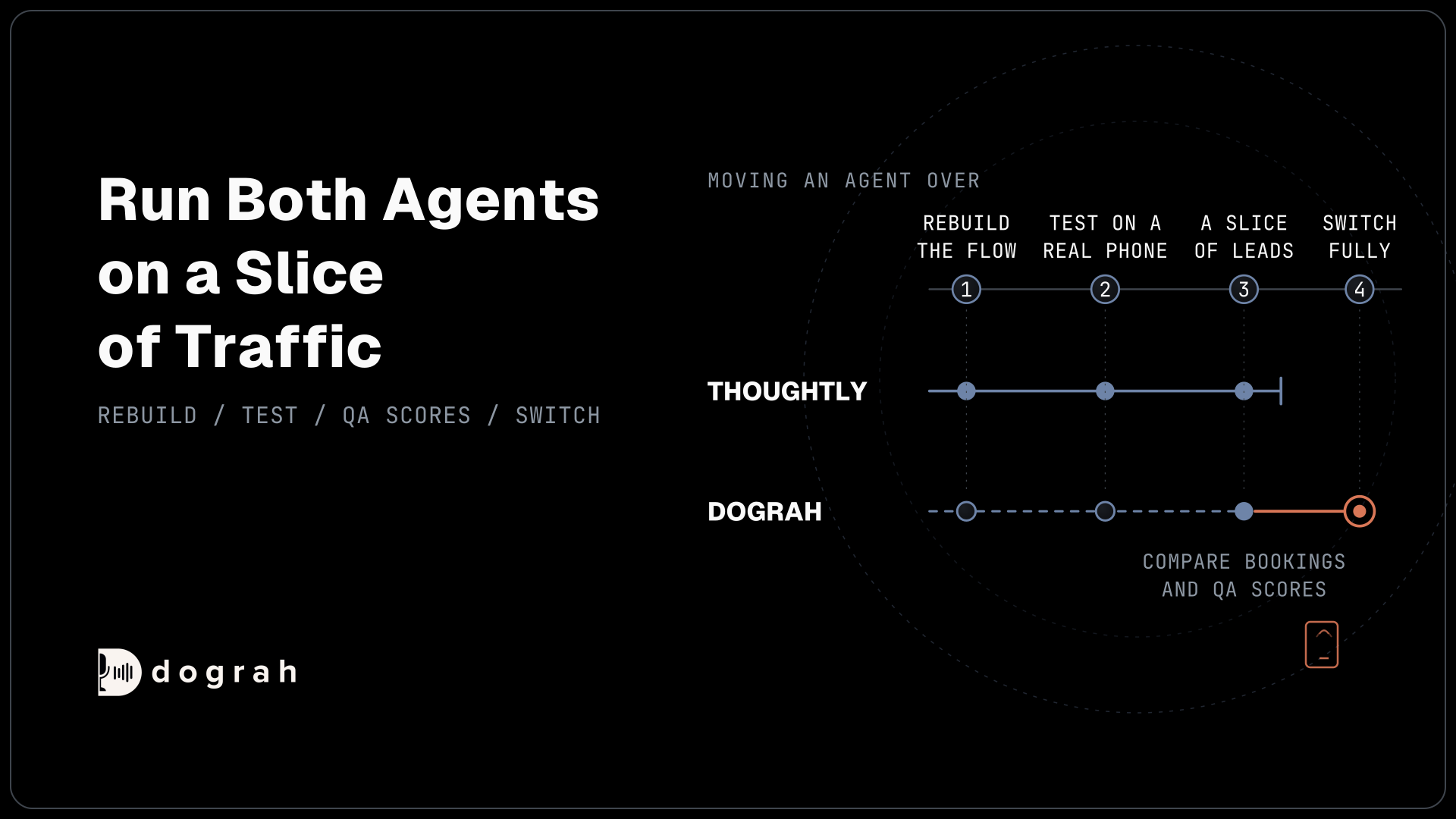
Self-hosted Dograh has no per-minute platform fee, but servers, model keys and phone minutes still cost money. Dograh Cloud charges a 1¢-a-minute platform fee. Our Thoughtly comparison builds the same lead agent on both and shows how to move one over.
Join the Dograh Community
Dograh is an OSS alternative to Vapi. Join our Slack community for queries, releases, best practices & community interactions.
Glossary
- Verbatim line
- A Thoughtly Speak node line played exactly as written, instead of words the AI generates. It is the place for openings and any wording a team must get right.
- Concurrent calls
- The number of calls running at the same moment. Thoughtly's plans include unlimited minutes but cap concurrent calls, so your busiest hour decides which plan you need.
- Bring your own carrier (BYOC)
- Connecting phone numbers from your own Twilio or Telnyx account instead of buying them from Thoughtly. The numbers stay in your carrier account, and Thoughtly adds no charge for them.
- Call trace
- The record of one call, turn by turn, showing what the caller said, what the AI decided, which tools ran and how long each step took. It is how you find where a bad call went wrong.