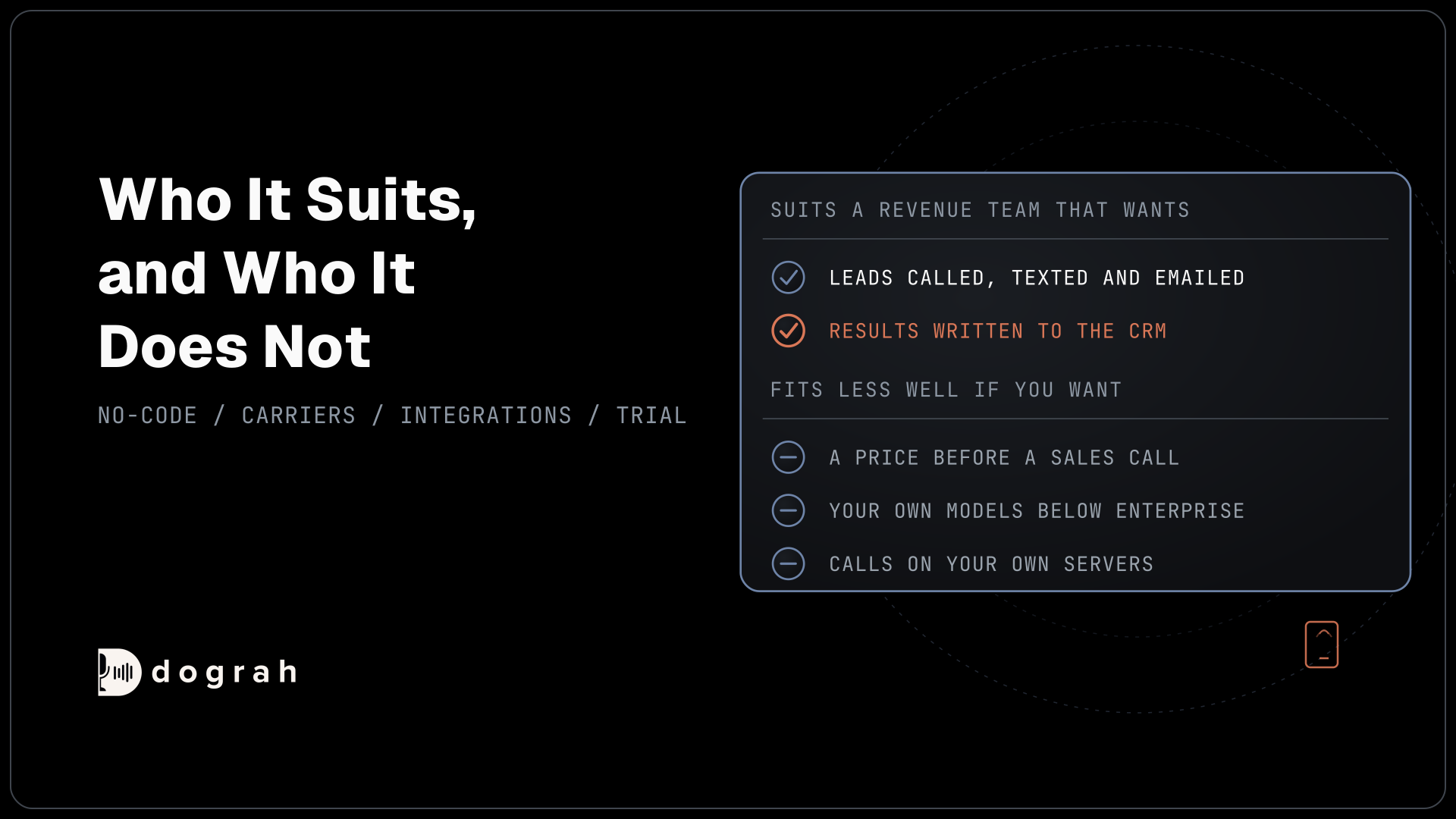

Choose Thoughtly if you want a hosted product that calls, texts and emails leads with native CRM connectors, bought through sales. Choose Dograh, the open-source AI voice agent platform we build, if you want to own the agent, the call data and the models. You can self-host it or use Dograh Cloud, and connect your CRM through HTTP API tools.
Key Takeaways
- Both can build the same inbound lead agent, with fixed lines, branching, booking and handover.
- Thoughtly sends texts and emails itself. Dograh calls your own systems for that.
- No importer exists, so moving over means rebuilding the flow and pointing your number.
This post is part of our guide to Thoughtly alternatives, where hosted platforms and open-source options are compared with Thoughtly on hosting, models, phone numbers, price and lock-in. Here we build one inbound lead agent on Thoughtly and on Dograh, then compare data control, models, price and moving over.
Dograh vs Thoughtly at a glance
The two answer the same call in different ways. Thoughtly bundles channels and connectors into one hosted product, while Dograh gives you the code and lets you wire it to your own systems.
| Dograh | Thoughtly | |
|---|---|---|
| Where it runs | Your own servers, or Dograh Cloud | Thoughtly's cloud on AWS |
| Source code | Open, BSD-2-Clause | Closed |
| Models | Any supported provider with your own key, or open-weight models on your servers | GPT, Claude or Gemini. Your own model on Enterprise |
| Channels | Voice calls | Voice, SMS, email, WhatsApp and iMessage |
| CRM and calendar | Your own APIs through HTTP API tools, Pre-Call Data Fetch and webhooks | 24 named native integrations, plus webhooks and a REST API |
| Phone numbers | Twilio, Vonage, Plivo, Telnyx, Cloudonix, Exotel, Vobiz or Asterisk ARI | Bought from Thoughtly, or imported from Twilio or Telnyx |
| Pricing | Self-hosted: no per-minute platform fee. Dograh Cloud: 1¢/min platform fee | Flex, Scale and Enterprise through sales |
| Quality review | Call traces and QA on every plan | Auto-QA on Scale and Enterprise |
The same lead agent, built on both
Take one job: a lead fills in a web form, the agent answers when they call, asks four qualifying questions, books a meeting and hands hot leads to a rep.
| Step | Thoughtly | Dograh |
|---|---|---|
| Greeting | Start node, spoken as written | Start Call greeting text, word for word, or a recorded clip |
| Fixed lines | Speak node set to Verbatim | Transition speech on a pathway, or a recorded clip |
| Questions and branching | Outcomes, based on a prompt or a rule | Pathways with a written condition the model reads |
| Lookups and booking | Actions and native Calendly, HubSpot or Salesforce | HTTP API tools to your calendar and CRM, plus Pre-Call Data Fetch |
| Handover | Transfer node to a number or another agent | Transfer Call on Twilio, Telnyx, Plivo, Cloudonix or Asterisk ARI |
| Follow-up text or email | Sent by Thoughtly | Sent by your own provider, called from a tool or the Webhook node |
| Testing and review | Test Agent chat, Call Me, Auto-QA on Scale and up | Browser and phone test calls, traces and QA on every plan |
The opening works the same on both. Thoughtly speaks the Start node as written, and Dograh's greeting text plays word for word, or you can play a recording of your best rep instead. On Dograh, any line outside the recordings is spoken in a cloned version of the same voice, as the pre-recorded audio guide shows.
Branching differs in one detail worth knowing. Thoughtly can branch on a rule, while Dograh's pathways are chosen by the model reading each written condition, so write each condition in plain words and test it with real phrasing.
Booking is the biggest gap in effort. Thoughtly has native Calendly, HubSpot and Salesforce integrations, and it can send the confirmation text itself. On Dograh you point an HTTP API tool at your calendar and CRM endpoints and send texts through your own messaging provider. That needs a developer, and in return the records stay in systems you already run.
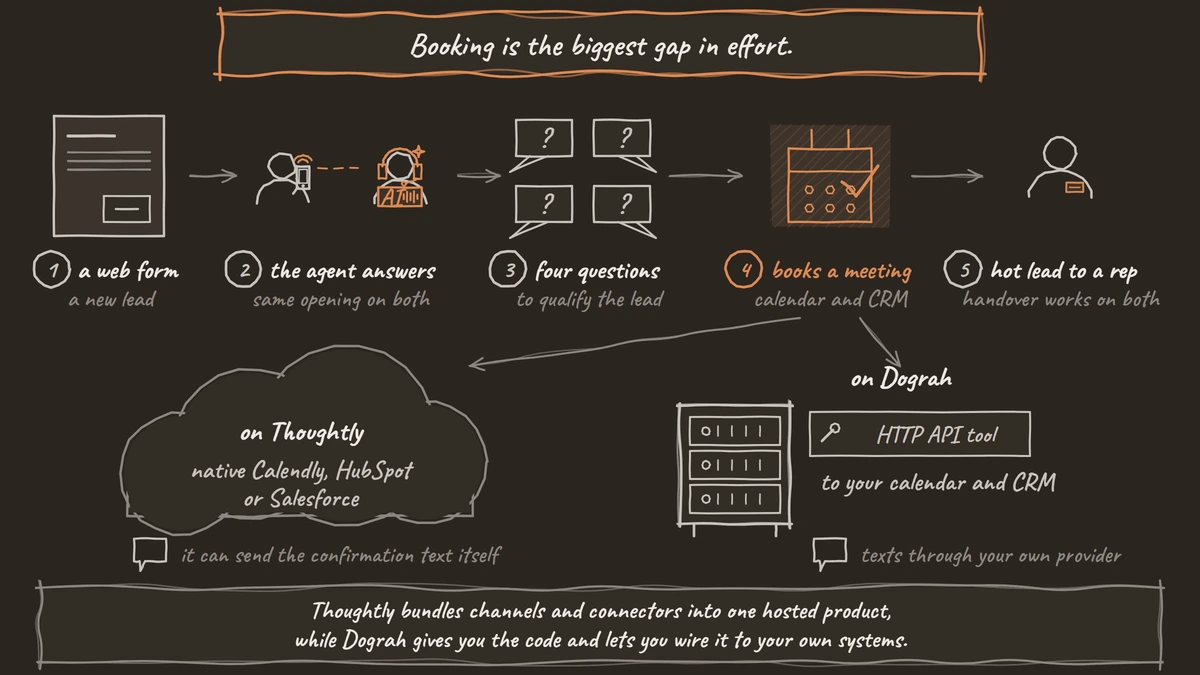
Handover works on both. Dograh's Transfer Call runs on five carriers, and on Twilio it can play a short spoken introduction to both people. Browser test calls cannot transfer, so test the handover over a real phone call.
Review is where the two split again. Thoughtly includes Auto-QA from the Scale plan up. Dograh scores every step of a call with automated QA on every plan, including test calls from the editor, and each call has call traces you can read turn by turn.
Who holds the call data
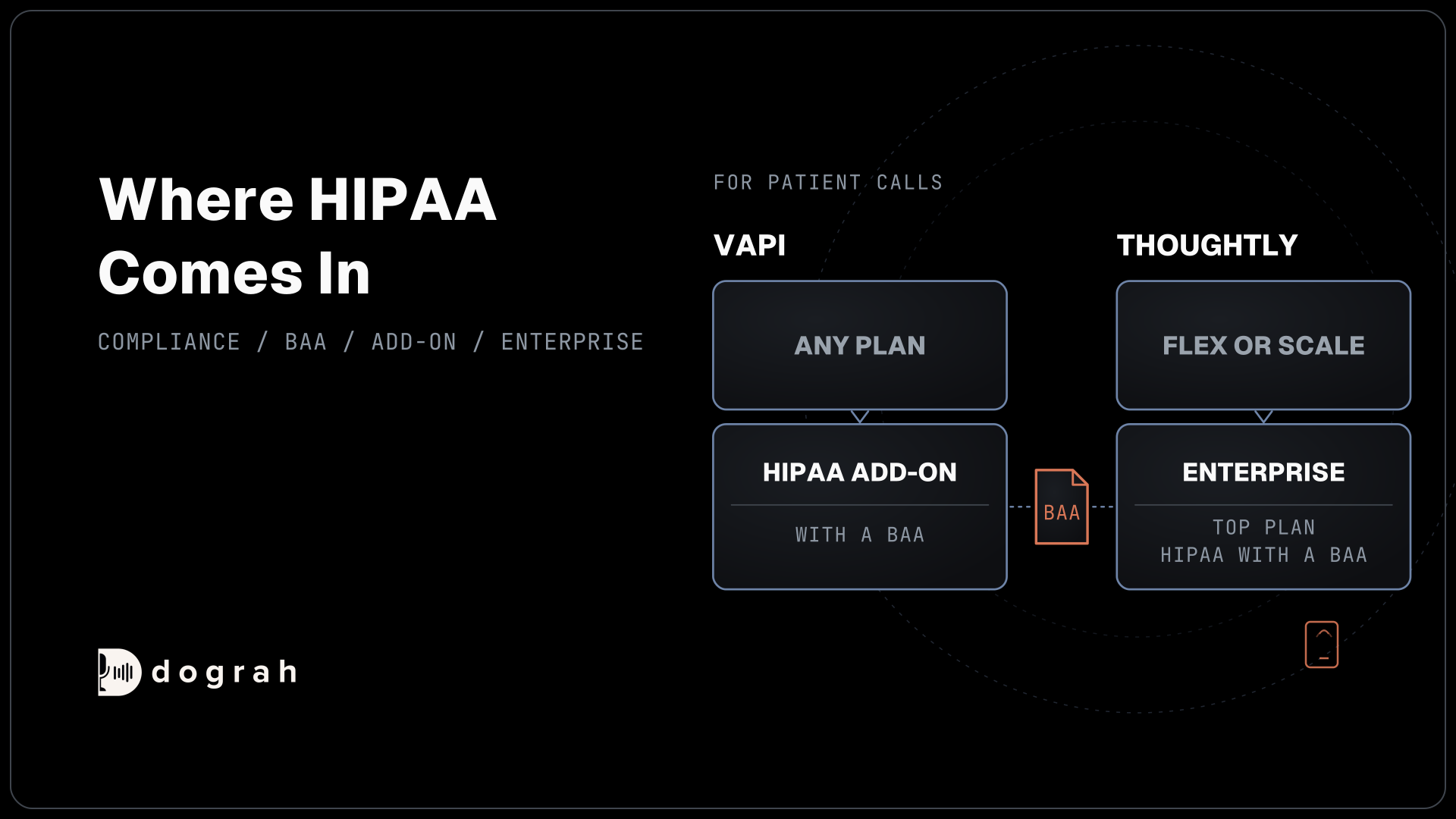
On Thoughtly, recordings and transcripts live in Thoughtly's cloud. Thoughtly runs on AWS in four regions, with a SOC 2 Type II report under NDA and HIPAA, the Health Insurance Portability and Accountability Act, with a business associate agreement (BAA). Data residency and dedicated infrastructure come with Enterprise.
Dograh can run inside your own network. Its source code is open, so your security team can read what runs on each call, and recordings, transcripts and traces stay on your servers.
Self-hosting does mean running Docker, applying updates and fixing what breaks, and independent reviewers are right to point that out. If that is more than your team wants, Dograh Cloud runs the same platform for you.
Models, voices and phone numbers
Thoughtly lets you pick GPT, Claude or Gemini, and your own model needs Enterprise. Voices come from Thoughtly's library, including Cartesia voices, or from ElevenLabs with your own paid ElevenLabs key (limited on Flex).
On Dograh, every layer is your choice on every plan. You can bring keys for OpenAI, Google, Azure, Groq, AWS Bedrock or OpenRouter, or run open-weight models on your own servers through an OpenAI-compatible endpoint. Changing one model does not mean rebuilding the agent.
Phone numbers are where moving gets easier. Thoughtly supports bring your own carrier (BYOC) for Twilio and Telnyx, as its carrier import docs explain, and numbers imported that way stay in your own carrier account. That same Twilio or Telnyx number can later point at Dograh, which also works with Vonage, Plivo, Cloudonix, Exotel, Vobiz and Asterisk ARI.

Open Source Alternative to Vapi / Retell
Self-hosted voice agent platform — no per-minute fees
dograh-hq/dograh
Star on GitHub
How each one charges
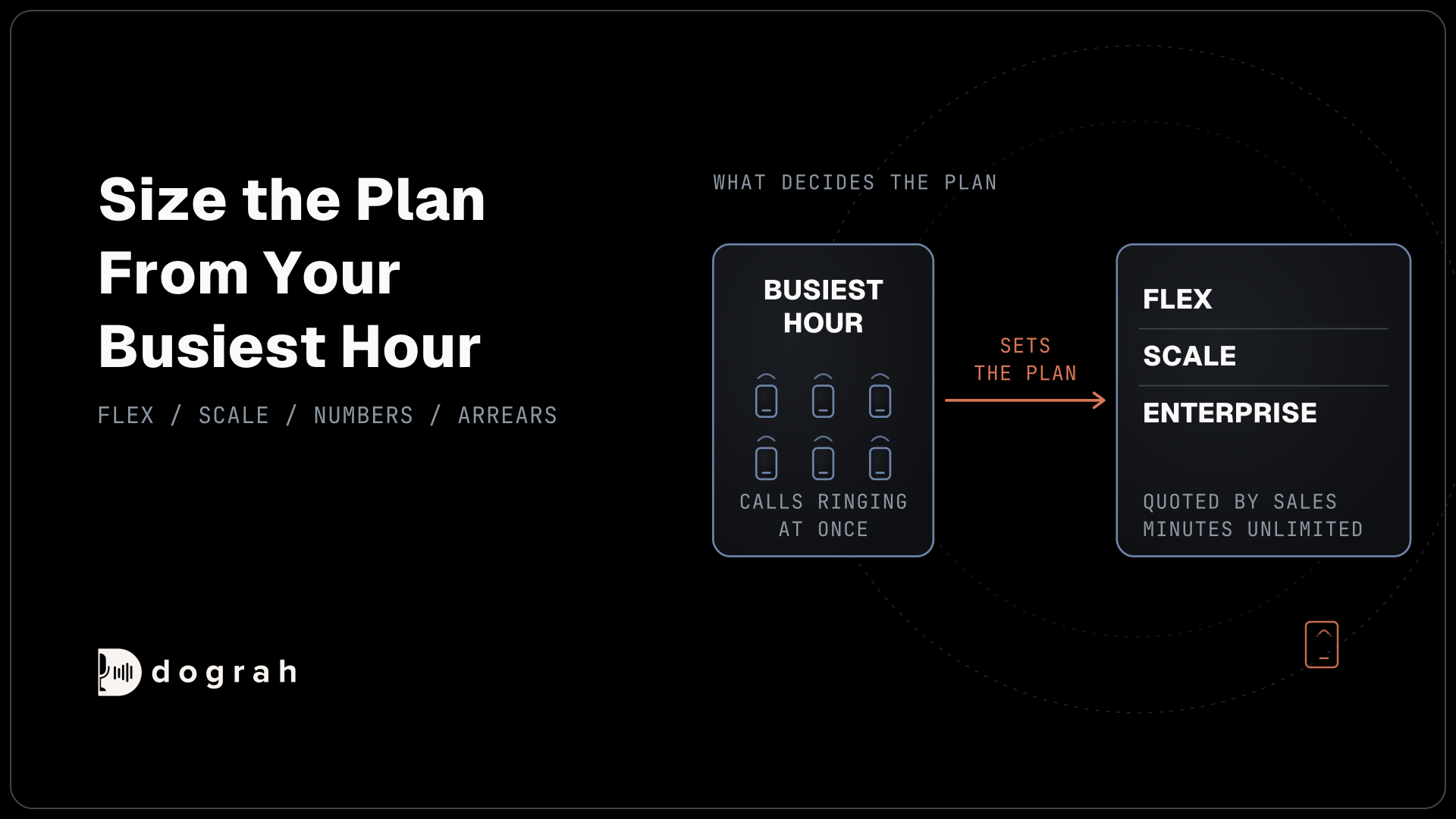
Thoughtly sells three plans, Flex, Scale and Enterprise, through its sales team, with unlimited minutes inside a cap on concurrent calls. You get a quote before you can work out a monthly figure, and our post on Thoughtly pricing works through one month for a lead team.
Our pricing covers the platform only, and models and phone lines are billed by your own providers. Self-hosted Dograh has no per-minute platform fee, but servers, model keys and phone minutes still cost money. Dograh Cloud charges a 1¢-a-minute platform fee. Self-hosted installs handle 10 concurrent calls by default, and the Cloud plan includes 10.
Moving an agent from Thoughtly to Dograh
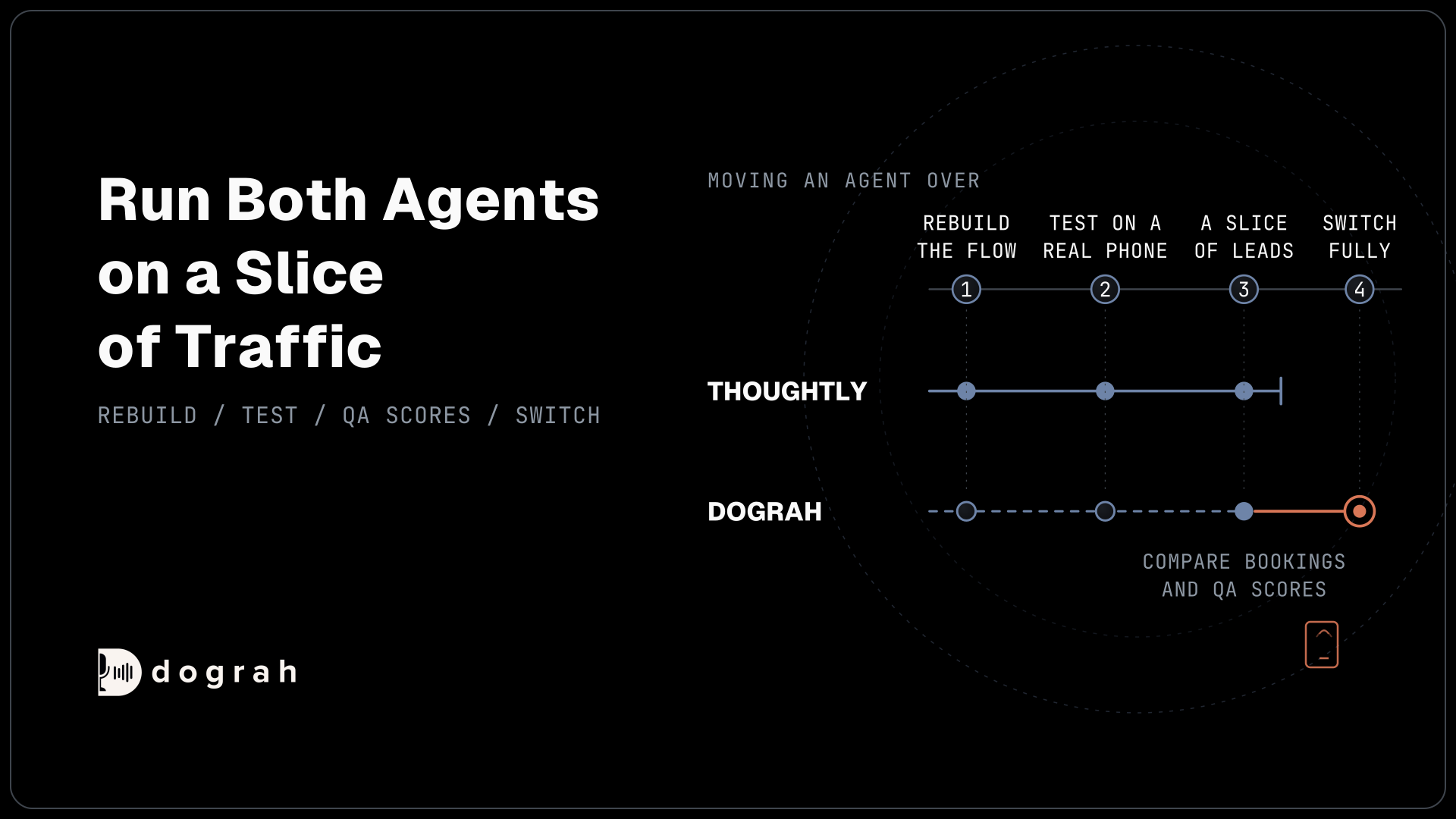
There is no importer on either side, so plan a rebuild. A typical inbound lead agent moves in six steps.
- Copy the agent out of Thoughtly by hand: the greeting, every Verbatim line, each node's prompt and the outcomes that branch the call.
- Draft the agent in Dograh. Describe the use case and let the template generator create a starting workflow, build it from your editor through the MCP (Model Context Protocol) server, or send a JSON definition to the API. Then check every node on the canvas.
- Rebuild lookups and booking as HTTP API tools pointed at your calendar and CRM, and move follow-up texts to your own messaging provider.
- Point your Twilio or Telnyx number at the new agent. On Twilio, saving an inbound workflow on the number switches it to Dograh straight away, so do this when you are ready to take calls.
- Test on a real phone, including the transfer, because browser calls cannot transfer and phone audio sounds different from a web call.
- Send a slice of leads to each agent for a week or two, compare bookings and QA scores, then switch fully.
Join the Dograh Community
Dograh is an OSS alternative to Vapi. Join our Slack community for queries, releases, best practices & community interactions.
Glossary
- Pathway
- A connection between two steps in a Dograh agent, with a written condition. The model reads the condition to decide which way the call goes, so plain wording and testing with real phrasing matter.
- HTTP API tool
- A Dograh tool that calls one of your own endpoints during a call, such as a calendar or CRM. It is how Dograh books meetings and reads or writes records without a native connector.
- Verbatim line
- A Speak node line in Thoughtly that plays exactly as typed, so the AI adds none of its own words. Dograh's equivalents are the greeting text, transition speech and recorded clips.
- Bring your own carrier (BYOC)
- Importing phone numbers from your own carrier account, such as Twilio or Telnyx, instead of buying them from the platform. The numbers stay in your account, which makes moving platforms easier.