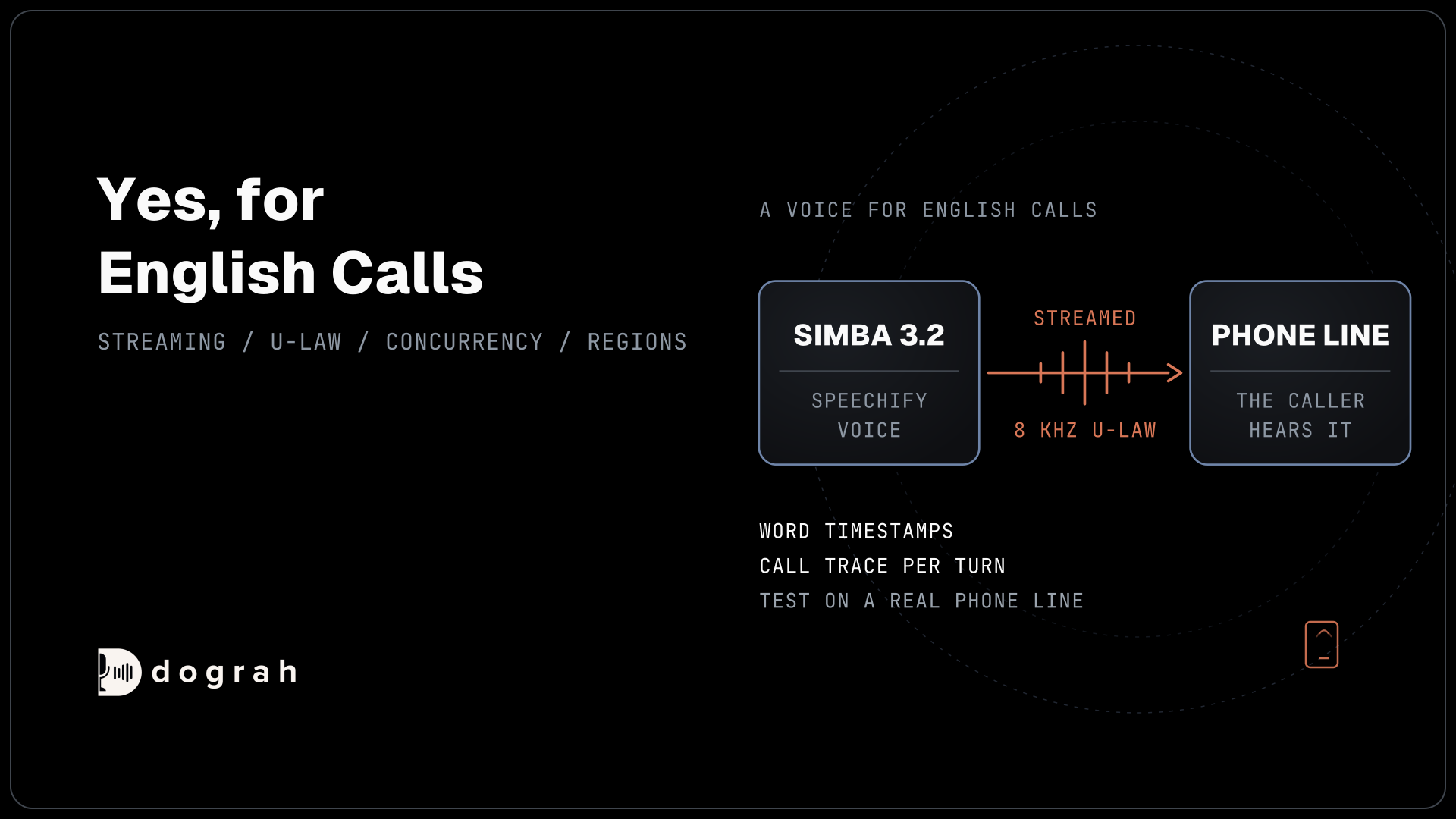

Yes, for English calls. Speechify's Simba 3.2 streams audio, sends 8 kHz u-law and 16 kHz PCM for phone lines, and ranks 11th of 103 on the Speech Arena. The limits are Speechify's own: speed measured from US East, concurrency counted per account, and English only on 3.2. Dograh runs Simba 3.2 and 3.0 with your key.
Key Takeaways
- Simba 3.2 streams English audio in phone formats and ranks 11th of 103.
- Speechify's speed figures come from US East, and limits count per account.
- Dograh runs Simba 3.2 and 3.0 by key, beside 15 other voice providers.
This post is part of our guide to Speechify alternatives, where we flag whether Speechify's API holds up on a live phone call as a question of its own. Dograh, the open-source AI voice agent platform we build, runs Speechify voices, so we checked Speechify's docs and our code.
Voices and models Speechify offers
Speechify's API has three current models. Simba 3.5 is the one Speechify recommends, and it covers 48 languages. Simba 3.2 speaks English only and is the fast model the speed figures below are about. Simba 3.0 covers six languages and is what the API uses when a request names no model.
The older simba-english and simba-multilingual models are retired, and new workspaces get an error if they ask for them. Emotion style tags are ignored by every Simba 3.x model, so a prompt cannot ask the voice to sound calm or cheerful.
On the Artificial Analysis Speech Arena, where listeners vote blind between two clips, Simba 3.2 ranks 11th of 103 and Simba 3.0 ranks 39th. Simba 3.5 does not appear on the board yet.
Cloning is part of the same API. On a paid plan, 10 to 30 seconds of speech plus a recorded consent phrase gives you a voice ID that works like any stock voice. Our post on Speechify voice cloning covers the steps and the consent.
Streaming and phone audio formats
A voice agent needs its first words fast, so the streaming endpoints matter more than the full-file one. Speechify offers two. The HTTP stream takes up to 20,000 spoken characters and sends audio back as it is made, and a version with word timestamps adds the timing of each word. A WebSocket input stream also accepts text as the language model writes it.
Audio comes back at 24 kHz mono by default, and WAV is not available on the streaming endpoints. For phone lines, Speechify recommends two audio formats with Twilio and LiveKit SIP, ulaw_8000, which is 8 kHz u-law, and pcm_16000. PCM is offered at any rate from 8,000 to 48,000 Hz.
Pipecat, the open-source framework many voice agents run on, ships a Speechify service that uses the HTTP stream with word timestamps and asks for PCM at the call's sample rate.
We have not found a published listening test of Speechify over a real phone line. Traditional phone calls run at 8 kHz while web calls run at 16 kHz, and a voice can sound flatter on the narrower line, so run your own script on a call before you commit.

Open Source Alternative to Vapi / Retell
Self-hosted voice agent platform — no per-minute fees
dograh-hq/dograh
Star on GitHub
How fast Simba 3.2 starts speaking
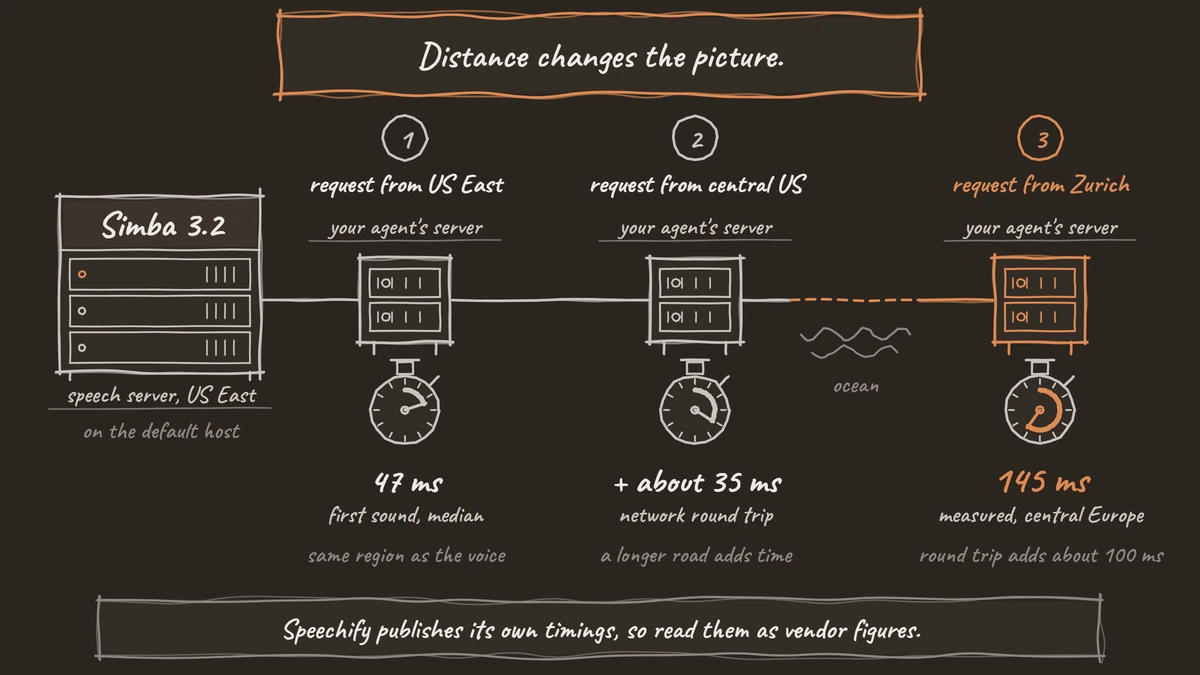
Speechify publishes its own timings, so read them as vendor figures. By its latency figures, Simba 3.2's first audible audio arrives at a median of 47 ms over the WebSocket input stream and 64 ms over HTTP, from a client in US East. On the server side, the first byte leaves in 56 ms at p50 and 102 ms at p90. Simba 3.0 is slower, with a median first byte of 161 ms.
Distance changes the picture. Speech is made in US East on the default host, and the network round trip adds about 35 ms from the central US and about 100 ms from central Europe. From Zurich, Speechify measured 145 ms over the WebSocket stream and 153 ms over HTTP, and ElevenLabs Flash v2.5 came out faster at 142 ms.
For a whole agent, the bar for a natural conversation is under 800 ms from the moment the caller stops to the moment the agent starts speaking. A voice that starts in under 100 ms leaves most of that budget for speech recognition, which is usually the slowest part, and for the language model.
Limits to plan for before go-live
Speechify counts concurrency per account, not per key. Its API limits allow 3 requests at once on Free, 15 on Starter, 30 on Pro, 60 on Scale and 100 on Enterprise, and a long stream holds its slot for the whole response.
Because the limit is per account, extra keys in the same account add no capacity. Our post on STT and TTS concurrency limits explains when several keys help and when they do not, so size your busiest hour against your plan's number.
Regions need a careful read. Speechify is clear that a region is not data residency. An EU host pins speech generation to the Netherlands, but the account, keys, voices, usage and logs stay in the United States on every host.
Cloning has its own limit. It is not available in some jurisdictions, judged by the IP address of the machine making the request, and a blocked request gets a 403 error.
Running Speechify voices in Dograh
Dograh has supported Speechify as a built-in voice provider since v1.47.0, so it is in v1.49.0 and in the current v1.50.0. You add your Speechify key in the voice settings and pick Simba 3.2, the default, or Simba 3.0.
Simba 3.2 speaks English, and Simba 3.0 adds German, Spanish, French, Italian and Portuguese. The stock voices are beatrice_32 and geffen_32 for Simba 3.2, with alicia and alton added for Simba 3.0. You can also paste any custom or cloned voice ID, as long as it supports the model you picked.
Under the hood, the agent uses Pipecat's HTTP stream with word timestamps and asks Speechify for audio at the call's own output sample rate.
Pre-recorded clips cover the lines your agent says on most calls, and Speechify speaks everything else. Every line played from a clip is one less request to Speechify.
To see where a slow reply's time went, use the call's View Trace button. It opens the call trace, with the speech-to-text, AI and voice time for every turn.
Join the Dograh Community
Dograh is an OSS alternative to Vapi. Join our Slack community for queries, releases, best practices & community interactions.
Other voices Dograh supports
Speechify is one of 16 built-in voice providers in Dograh v1.50.0: Deepgram, ElevenLabs, Google, OpenAI, Dograh, Cartesia, Inworld, Sarvam, Camb.ai, Rime, Local Models (Speaches), MiniMax, Azure Speech, Smallest AI, xAI and Speechify. Switching is a change of provider on the same agent.
Local Models runs Kokoro on your own server by default, with no per-character bill. Our TTS verbalization benchmark measured how seven open models read dates, prices and phone numbers, and kokoro-82m was the most accurate at 0.61, with about 18 times less compute per clip than orpheus-3b. Our comparison of Kokoro, Chatterbox and XTTS covers running each one.
Chatterbox, the open model that clones a voice, can run behind a server that returns raw 24 kHz audio. Run a test call with it before you put it in front of callers.
Self-hosted Dograh has no per-minute platform fee, but servers, model keys and phone minutes still cost money. Dograh Cloud charges a 1¢-a-minute platform fee. Speechify's characters bill to your own Speechify account either way.
So the straight answer stands. For English calls, Simba 3.2 is a fast, well-ranked voice. Test it on a real phone line and size your plan against the per-account limit. On your first calls, read the trace.
Glossary
- First audible audio
- The time from sending text to hearing the first real sound, not just the first byte. Speechify measures Simba 3.2 at a median of 64 ms over HTTP from US East.
- u-law
- The 8 kHz audio encoding most phone networks use. Speechify sends it as ulaw_8000, one of the two formats it recommends for phone lines.
- Concurrency limit
- How many requests an account can have in progress at once. Speechify counts it per account, so extra keys in one account do not raise it.
- Word timestamps
- Timing for each spoken word, sent alongside the audio. Speechify's HTTP stream offers them, and agents use them to know what the caller heard before an interruption.