
Pipecat vs Vocode comes down to how active each project is. Pipecat, under the BSD-2-Clause license, releases every few weeks and keeps adding carriers and services. Vocode, under MIT, was last updated in November 2024, and its team has invited community maintainers. Pipecat suits a new build, and a working Vocode app can keep running as it is.
Key Takeaways
- Pipecat ships releases every few weeks, while Vocode's code last changed in November 2024.
- Vocode ships a call transfer on Twilio and Vonage, and Pipecat on SIP.
- Both are frameworks, so the editor, campaigns and call history stay yours to build.
Pipecat and Vocode are both open-source Python frameworks for voice agents, and Pipecat is the one still releasing new versions. This post puts them side by side and shows how much each one still leaves you to build. If you would rather not build that part yourself, the last section shows how Dograh adds a full platform around Pipecat.
Pipecat vs Vocode in one table
Both projects do the same core job. They wire speech-to-text, a language model and a voice into a real-time loop, and your developers write the agent in Python on top. The differences sit in who still works on the code and how calls reach the agent.
| Pipecat | Vocode | |
|---|---|---|
| License | BSD-2-Clause | MIT |
| Maintained by | Daily and the community | Looking for community maintainers |
| Latest release | v1.16.0, 12 November 2026 | 0.1.113 stable, June 2024 |
| Last code change | 16 November 2026 | 15 November 2024 |
| Python | 3.11 or newer | 3.10 or newer |
| Phone carriers | Twilio, Telnyx, Plivo, Exotel, Vonage, Genesys, Jambonz, plus SIP and Daily's phone service | Twilio and Vonage, plus Zoom dial-in |
| Transfer to a person | Over SIP or Daily's phone service, not on WebSocket carrier routes | TransferCall action on Twilio and Vonage |
| Other ways in | WebRTC, Daily, LiveKit, WhatsApp and more | A React SDK for browser calls |
| Hosted option | Pipecat Cloud by Daily | None that loads today |
| What you still build | The editor, outbound lists, call history, QA and deployment | The same list, plus every fix the code needs from here on |
Read the activity rows first, because they decide most of the rest. A framework that ships every few weeks picks up new models and carrier changes for you, and one that has stopped leaves that work with whoever runs it.
How active each project is today
Pipecat is moving fast. Pipecat's repository shows v1.16.0 on 12 November 2026, after v1.15.0 on 29 October, v1.14.0 on 24 October and v1.13.0 on 19 October, with the latest commit on 16 November 2026. Daily, the company behind the Daily video platform, maintains it together with outside contributors, and new carrier serializers and services keep landing in each release.
Vocode's last update came in November 2024. The last commit in Vocode's repository is dated 15 November 2024 and updated its websockets and Cartesia clients. The last stable release on PyPI is 0.1.113 from June 2024, and a later pre-release followed in August 2024. The README still says the project is looking for community maintainers. The repository is public and not archived, and vocode.dev now forwards to the GitHub organization, while the hosted dashboard link in the README no longer loads.
Activity matters more for voice than for most libraries. Speech, language and voice providers change their APIs and retire models every few months, and Vocode pins client libraries from 2024, such as an OpenAI client from the 1.30 line and an early langchain-openai release. Before you build on it, check that its provider clients still work with today's APIs, and plan to update them yourself as providers change their APIs.
Licenses and Python versions
Both licenses are permissive, so neither one blocks a commercial product. BSD-2-Clause and MIT both let you change the code and ship it in a closed product as long as the copyright notice stays with it. Neither asks you to publish your changes, and either project can be forked freely. On licenses alone, the two come out even.
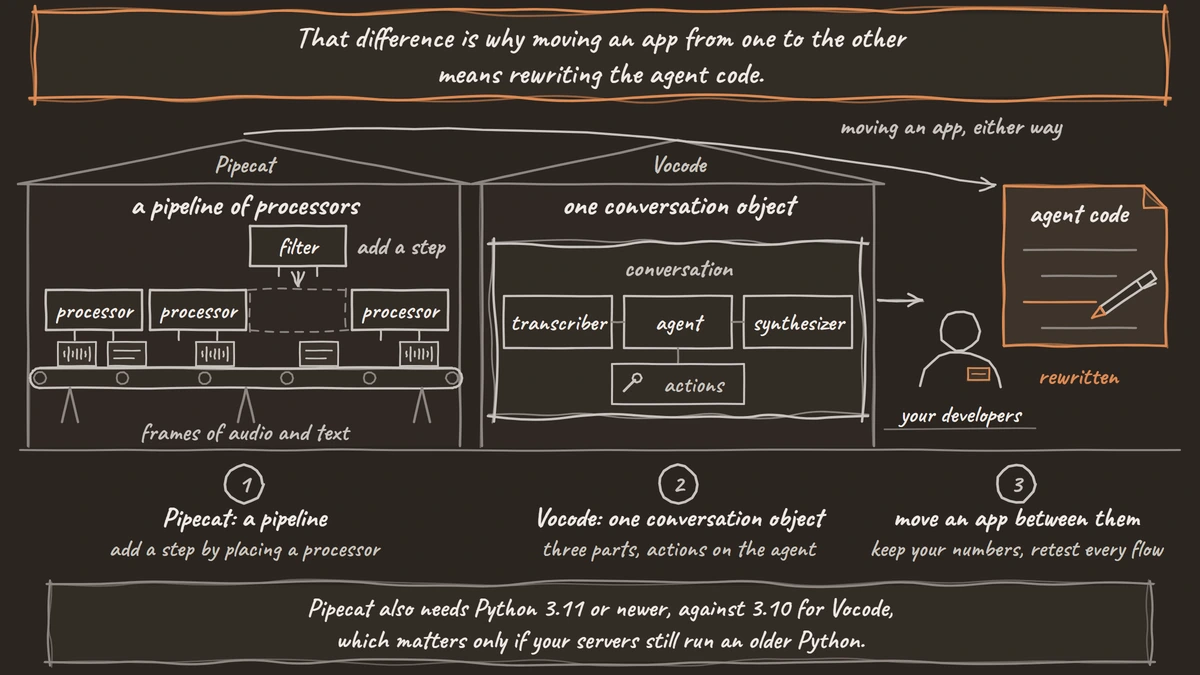
Both licenses let you fork and ship freely. The difference is who keeps the code current. With Pipecat, upstream fixes arrive in each release and a fork can keep merging them. With Vocode, your team makes and keeps its own fixes. Pipecat also needs Python 3.11 or newer, against 3.10 for Vocode, which matters only if your servers still run an older Python.
The framework license is also only one of the licenses in a working agent. Each speech, language and voice provider has its own terms, and open models carry their own model licenses. Check those before launch, because they often matter more than the choice between BSD-2-Clause and MIT.

Open Source Alternative to Vapi / Retell
Self-hosted voice agent platform — no per-minute fees
dograh-hq/dograh
Star on GitHub
Phone calls and transfers
Pipecat reaches phone calls in more ways. Its repository has serializers for Twilio, Telnyx, Plivo, Exotel, Vonage, Genesys and Jambonz, which stream call audio over a WebSocket, plus SIP and Daily's own phone service. Pipecat's telephony guide says the WebSocket routes for Twilio, Telnyx, Plivo and Exotel carry no advanced call center features like transfers or reconnects, while Daily's phone service and SIP do.
Vocode supports fewer carriers but ships more on them. Its telephony clients cover Twilio and Vonage for inbound and outbound calls, along with Zoom dial-in. The code includes its transfer action, TransferCall, for both carriers. On Twilio it redirects the live call to the new number through Twilio's API, which is a blind transfer.
In practice the choice of route decides the handoff. A Vocode agent on Twilio has a working blind transfer out of the box, written against 2024 code. A Pipecat agent on a Twilio WebSocket needs a transfer your team writes against Twilio's API, or a move to SIP or Daily's phone service. Test every transfer over a real phone call before launch, whichever framework you pick.
Outbound calls work the same way in both. Your code asks the carrier to dial the number, and once the person answers, the carrier streams the call audio back into the agent. Neither framework keeps a call list, retries a missed number or respects calling hours for you, so that logic sits in your own code.
Services, transports and what you still build
Pipecat covers far more services. Its repository holds more than 60 service folders, from Deepgram, Cartesia, ElevenLabs and Rime to OpenAI, Gemini, Ollama and open voices such as Kokoro and Piper. Calls can arrive over WebRTC, Daily, LiveKit, WhatsApp, a WebSocket or SIP, and our LiveKit vs Pipecat comparison covers how those transports differ.
The two also shape an agent differently. In Pipecat, a call is a pipeline of processors that pass frames of audio and text along, so you add steps such as a filter, a tool call or an audio buffer by placing a processor in the line. In Vocode, a call is a conversation object that joins three configured parts, a transcriber, an agent and a synthesizer, with actions attached to the agent. That difference is why moving an app from one to the other means rewriting the agent code.
Vocode's README lists a wide set of providers. Speech-to-text runs on AssemblyAI, Deepgram, Gladia, Google, Azure, Rev.ai or Whisper, language models on OpenAI or Anthropic, and voices on Rime, ElevenLabs, Cartesia, Azure, Google, Polly and others. Each of those clients is fixed at its 2024 version, so newer models from the same providers need a client update first.
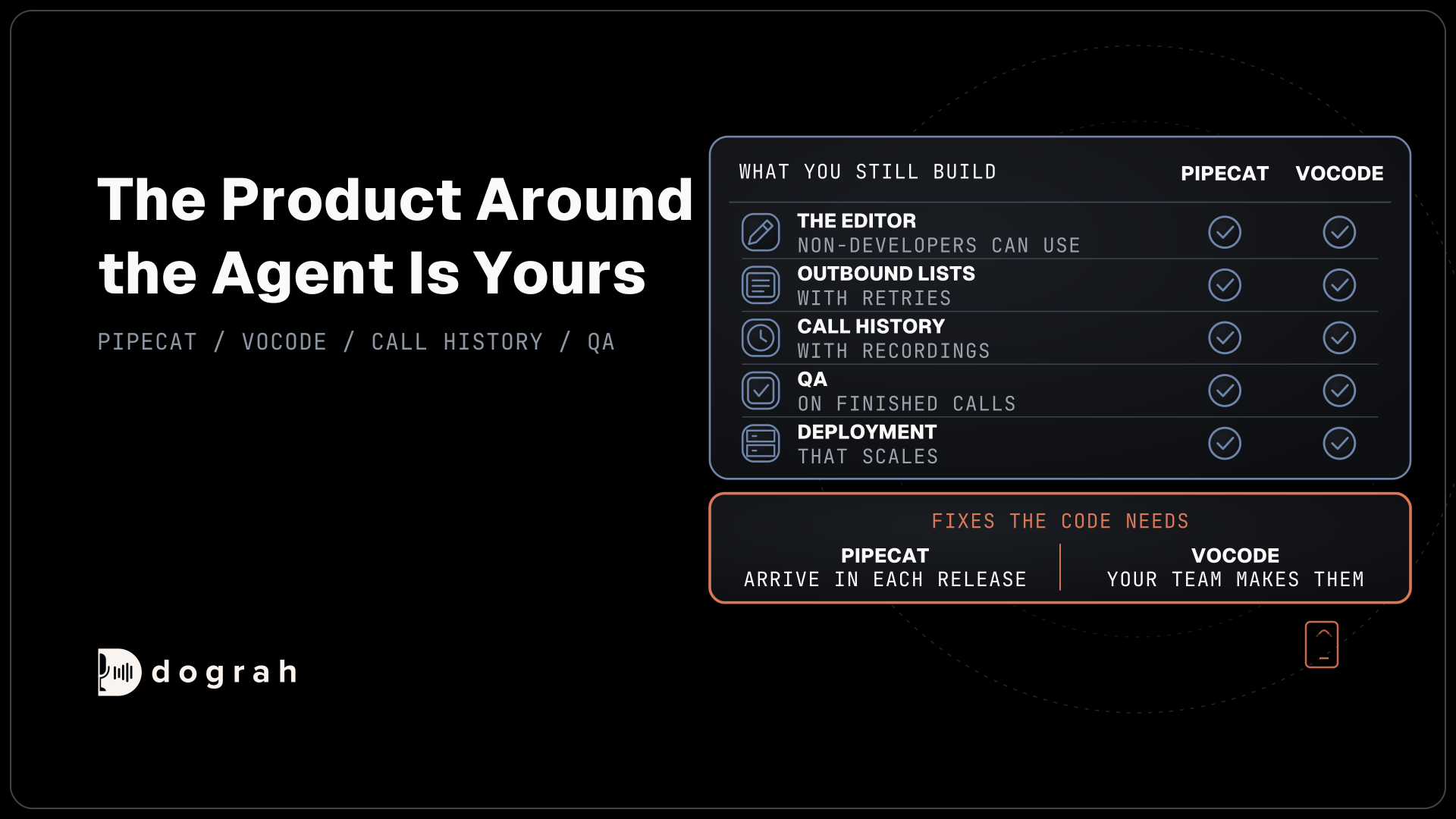
With either one, the product around the agent is yours. A phone agent in production needs an editor that non-developers can use, outbound lists with retries, call history with recordings, QA on finished calls and a deployment that scales. Pipecat at least offers a hosted runtime in Pipecat Cloud, run by Daily, and our breakdown of Pipecat Cloud pricing covers what it charges. Vocode has no hosted runtime today, so you host it yourself.
Which one to pick
For a new voice agent, start with Pipecat. It is maintained, covers more carriers and services, and gets the fixes that providers' API changes force on everyone. Its WebSocket carrier routes need your own transfer work, so plan the handoff to a person early. Releases also arrive quickly, so pin a version, read the changelog before each upgrade and rerun your call tests after it.
Vocode is still a fair choice for an existing app that works on Twilio or Vonage and needs no new providers. Pin its versions, and keep a plan ready in case a provider retires a model you rely on. Our guide to Vocode alternatives covers what a replacement needs and the order to move in.
Moving off Vocode does not have to mean another framework. Some teams pick a hosted voice API instead and trade control of the code and data for less to build and run, a fair choice when nobody wants to own servers. Our roundup of Pipecat alternatives sets Pipecat against LiveKit, TEN and hosted options for that wider decision.
Whichever way you lean, one short test settles most doubts. Build the same small call flow on your own carrier, place real calls, time the gap between the caller finishing and the agent speaking, and try a transfer to a person. Then update one provider client to its newest version and see what breaks. A framework that passes all of that in a week is worth building on.
Join the Dograh Community
Dograh is an OSS alternative to Vapi. Join our Slack community for queries, releases, best practices & community interactions.
Where Dograh fits
Dograh, the open-source AI voice agent platform, runs on a fork of Pipecat that it keeps in step with upstream releases, so read this section knowing that stake. It is for teams that picked Pipecat and want the product around it. New agents start in the Agent Builder, and the visual workflow builder handles hand edits, while our Dograh vs Pipecat comparison lists everything it adds.
The platform covers the list a framework leaves open. Campaigns call outbound lists with retries and calling hours, every call keeps its transcript, recording and trace, and a QA node reviews finished calls. Phone numbers connect through Twilio, Telnyx, Plivo, Vonage, Exotel, Vobiz, Cloudonix or Asterisk ARI. Transfer Call works on Twilio, Telnyx, Plivo, Cloudonix and Asterisk ARI. It calls the destination first and connects the caller only when someone answers.
It runs on your own servers or on a hosted cloud, and that choice sets both the cost and the work. Self-hosted Dograh has no per-minute platform fee, though servers, model keys and phone minutes still cost money. A Docker install needs a server with at least 8 GB of RAM and 4 vCPUs and runs 10 calls at once by default, and the server, the database and the upgrades become your team's job, with support through the open-source community and custom SLAs on Enterprise. Dograh Cloud handles the hosting for a 1¢-a-minute platform fee.
Glossary
- Serializer
- The Pipecat piece that converts a carrier's WebSocket audio messages into the frames the pipeline uses. Twilio, Telnyx, Plivo and Exotel each have one.
- Transport
- The way audio gets in and out of a voice agent, such as WebRTC, a WebSocket, SIP or a phone service. It decides which call features are available.
- Blind transfer
- A handoff that moves the live call to another number without checking that anyone answers first. Vocode's TransferCall on Twilio works this way.
- Fork
- A copy of an open-source project that its owner changes and maintains separately. A well-kept fork keeps merging the original project's releases.