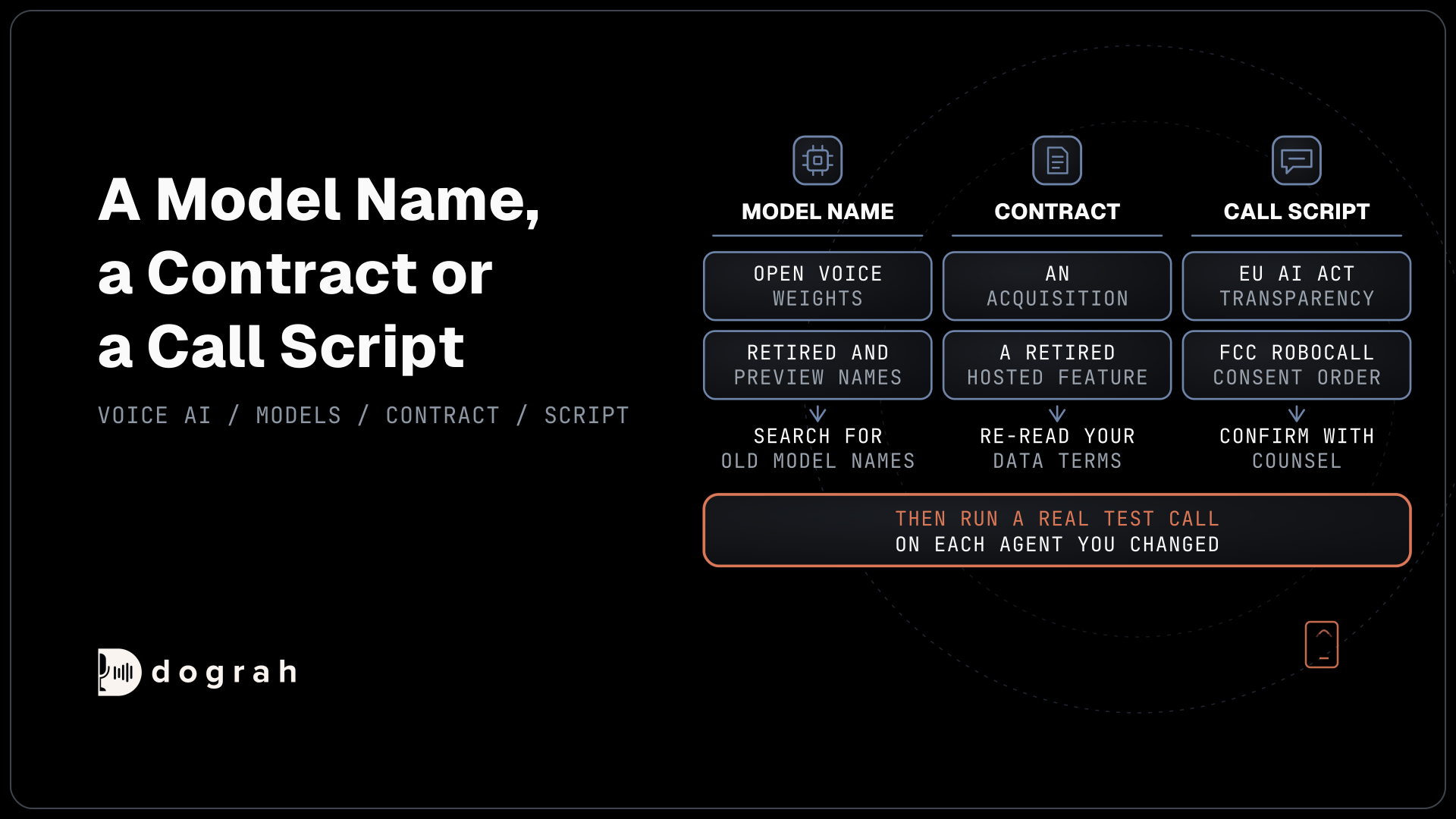

The voice AI changes builders should know in 2026 are new open speech models, realtime voice APIs reaching general availability, model retirements at Rime and Murf, Inworld buying Ultravox, EU AI Act Article 50 applying from 2 August and FCC 26-67 taking effect on 25 November. Each one changes a model name, a contract or a call script.
Key Takeaways
- EU AI Act Article 50 transparency duties have applied since 2 August 2026.
- FCC 26-67 takes effect on 25 November 2026 and narrows robocall opt-out scope.
- Rime retired Arcana and Murf's Gen2 no longer streams, so check model names.
This is a dated list of what shipped or took effect in voice AI this year for voice agent teams. Each change has its date, a primary source and one thing a builder should do about it, ordered from January to November, with legal items explained in plain words.
1. Qwen3-TTS releases open voice weights (22 January)
Alibaba's Qwen team released Qwen3-TTS on 22 January 2026, including the 1.7B CustomVoice model under the Apache-2.0 license. It is an open voice model a team can download and run on its own GPU.
If audio must stay on your own servers, an open voice is now a real option for production calls. Our post on Qwen3-TTS for voice agents covers its voices, hardware and how it sounds on phone audio.
2. MiniMax ships Speech 2.8 (23 January)
MiniMax launched Speech 2.8 on 23 January 2026 in HD and Turbo versions. It adds sound tags such as (breath) and (chuckle) and fillers like "um" and "uh", so a reply can sound less read aloud. The launch post gives no speed figure, and the often-quoted figure under 250 milliseconds belongs to the older Speech 2.6.
Test 2.8 Turbo first on phone audio, and measure its speed on your own calls before you plan around a number. Our guide to MiniMax Speech for voice agents covers prices and phone setup.
3. NVIDIA opens an 11B voice chat model (July)
NVIDIA published NemotronLabs VoiceChat 11B on Hugging Face in July 2026 under its openmdw-1.1 license. It is a voice chat model with open weights a team can host itself.
Open voice chat models are worth a test for teams that need full data control. Read the license terms before production use, since openmdw-1.1 is NVIDIA's own license and differs from Apache-2.0.
4. Article 50 applies, with Omnibus dates (2 August)
The EU AI Act's Article 50 transparency duties have applied since 2 August 2026. The European Commission's Article 50 FAQ explains that people must be told when they are interacting with an AI system, unless it is obvious, and that AI-made audio must be marked in a machine-readable way.
The Digital Omnibus on AI, Regulation (EU) 2026/1744, was adopted and entered into force on 27 July 2026. It gives systems already on the market until 2 December 2026 for the audio marking duty, and moves high-risk duties to 2 December 2027 for Annex III uses and 2 August 2028 for Annex I products.
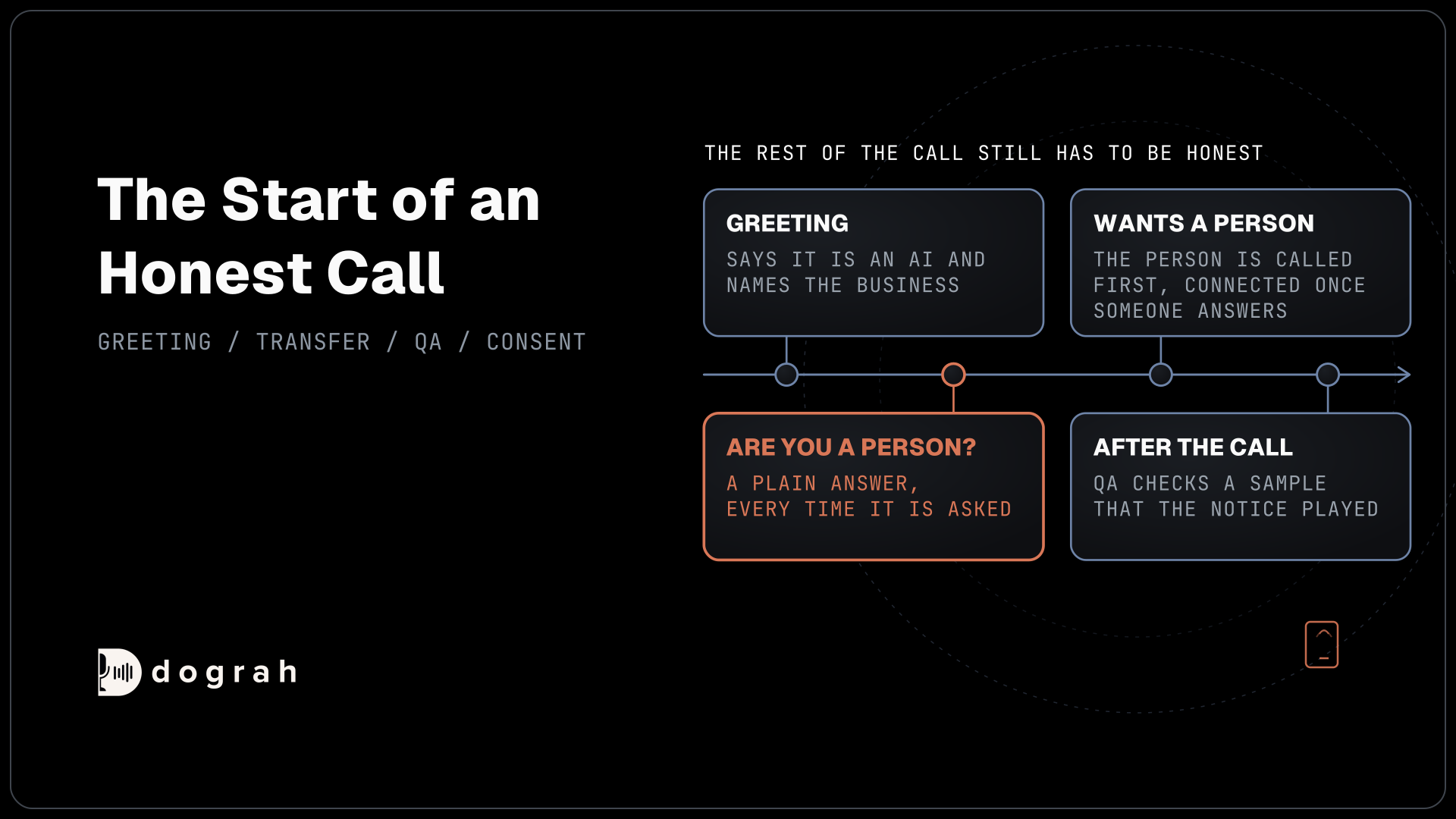
If you want to tell callers they are speaking with an automated assistant, or your location requires it by law, write it in the Greeting Text of your Dograh agent along with the business's name. Our post on Article 50 for voice agents covers which calls it reaches.

Open Source Alternative to Vapi / Retell
Self-hosted voice agent platform — no per-minute fees
dograh-hq/dograh
Star on GitHub
5. Rime and Murf retire older voice models (15 August)
Rime retired its Arcana model from the cloud API on 15 August 2026. Requests that still name Arcana keep working and are served by Coda, Rime's flagship model, so nothing errors, but the voice can change. Mist v1 and v2 retire on 3 December 2026. Murf's Gen2 model has been decommissioned for streaming, and Falcon 2.1 is now Murf's only model on its WebSocket API.
Search your configurations for old model names, and pick a current model and voice by name, since a silent redirect can change the voice. Our guide to Rime TTS for voice agents shows how to set Coda or Mist v3 by name.
6. Vapi retires Workflows (18 August)
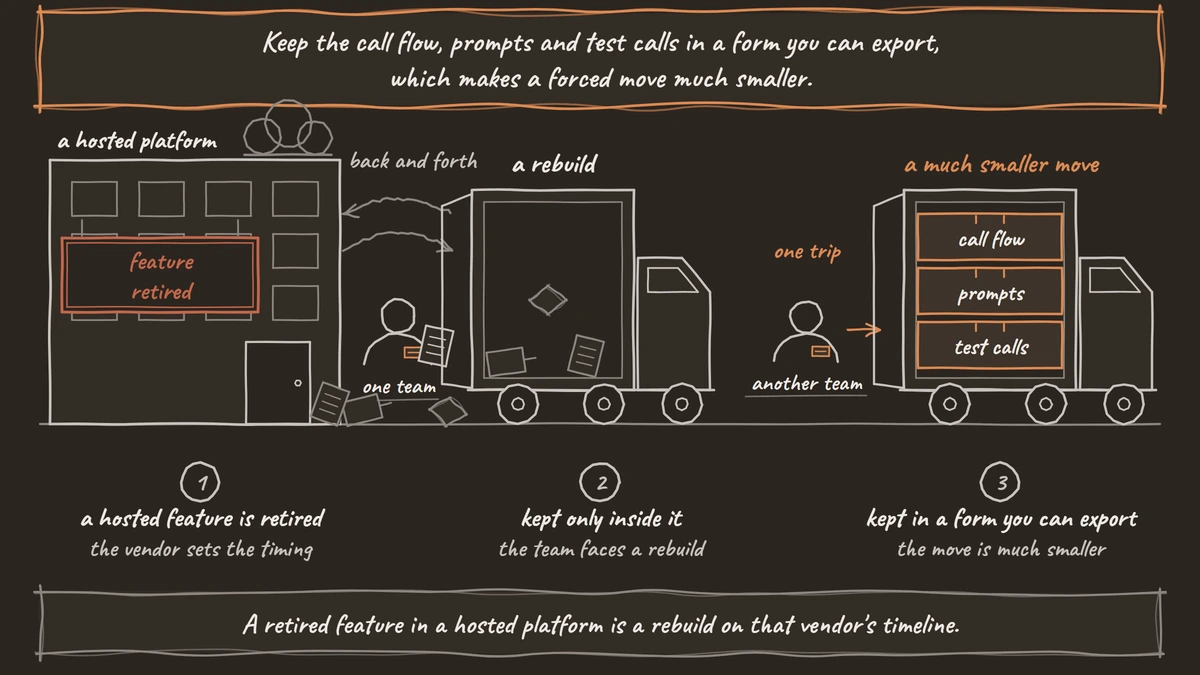
Vapi retired its Workflows feature on 18 August 2026, and workflows stopped running on 19 August. Vapi's migration guide moves users to Assistants or Squads.
A retired feature in a hosted platform is a rebuild on that vendor's timeline. Keep the call flow, prompts and test calls in a form you can export, which makes a forced move much smaller.
7. Gemini 3.5 Transcribe and 3.8 Live (26 Aug, 15 Sep)
Google released Gemini 3.5 Transcribe on 26 August 2026, then Gemini 3.8 Live with Extended Thinking on 15 September. The Gemini API changelog also lists gemini-omni-flash-preview as deprecated from 30 September 2026.
If an agent still points at a preview model, move it to a generally available one, since preview names are the first to go. Re-run your test calls after the switch, because a new model changes turn timing and wording.
8. OpenAI GPT-Live-1 and outbound SIP (10 September)
OpenAI made GPT-Live-1, its realtime speech model, generally available on 10 September 2026 at $0.05 a minute, billed by the second. On 2 November 2026 the OpenAI API changelog opened outbound SIP calling to all organizations, so the model can place phone calls over a SIP trunk.
Compare a speech-to-speech model with your current chain of speech-to-text, LLM and voice on the same calls. In Dograh, GPT-Live-1 and Gemini 3.8 Live are both selectable in Realtime mode on your own key. Our guide to realtime voice APIs for phone agents explains the trade-offs.
Join the Dograh Community
Dograh is an OSS alternative to Vapi. Join our Slack community for queries, releases, best practices & community interactions.
9. Inworld acquires Ultravox (30 September)
Inworld announced on 30 September 2026 that it has acquired Ultravox, the speech-to-speech model and voice agent platform. Inworld's announcement says existing customers continue with no migration or code change required.
Nothing has to change on day one, but an acquisition is a good moment to re-read your contract and data terms. Our Ultravox review covers the platform as it stands.
10. FCC 26-67 takes effect (25 November)
The FCC's order 26-67 on robocall consent was published in the Federal Register on 26 October 2026 and takes effect on 25 November 2026. A caller may treat a consumer's revocation as covering only the category of informational robocalls it was aimed at, and may name an exclusive way for consumers to revoke. The order also amends the fraud-alert exemption for financial institutions.
A companion proposal is open for comments until 25 November 2026, with replies due 28 December 2026. Update your opt-out handling and scripts before the effective date, and confirm with counsel how the rule applies to your calling program.
What to check before the year ends
Three dates fall in the next few weeks. FCC 26-67 takes effect on 25 November, the Article 50 audio-marking grace period for existing systems ends on 2 December, and Rime's Mist v1 and v2 retire on 3 December.
Go through every agent once. Check that model names are current, that the opening line says what your market requires, and that opt-out handling matches the new FCC rule. Then run a real test call on each agent you changed.
Glossary
- Article 50
- The EU AI Act article on transparency. It requires telling people when they are interacting with an AI system and marking AI-made audio in a machine-readable way.
- Digital Omnibus
- Regulation (EU) 2026/1744, in force since 27 July 2026. It moved the AI Act's high-risk dates and set 2 December 2026 for audio marking by existing systems.
- General availability
- The point at which a vendor declares a model ready for production use with stable naming. Preview models before GA can be deprecated on short notice.
- Revocation
- A consumer withdrawing permission to receive robocalls. FCC 26-67 lets a revocation cover only the category of informational calls it was aimed at.