
Rime TTS gives voice agents Coda for quality and Mist v3 for speed, and Rime produces 8 kHz phone audio natively. Flex pricing is $0.030 a minute for Mist v3 and $0.050 for Coda v2. Teams that want to own the platform can run Rime on Dograh, the open-source AI voice agent platform, self-hosted or on Dograh Cloud.
Key Takeaways
- Rime now serves Arcana requests with Coda, so type coda or mistv3.
- Mist v3 costs $0.030 a minute on Flex, and Coda v2 costs $0.050.
- In Dograh, a Rime voice speaks English, German, French, Spanish or Hindi.
A voice agent's voice is judged on a phone line, where most calls still arrive as 8 kHz audio. Below we cover Rime's two models, their speed and languages, what a month of speech costs, and how Dograh sets up a Rime voice and tests it on a real call.
What Rime's two models are built for
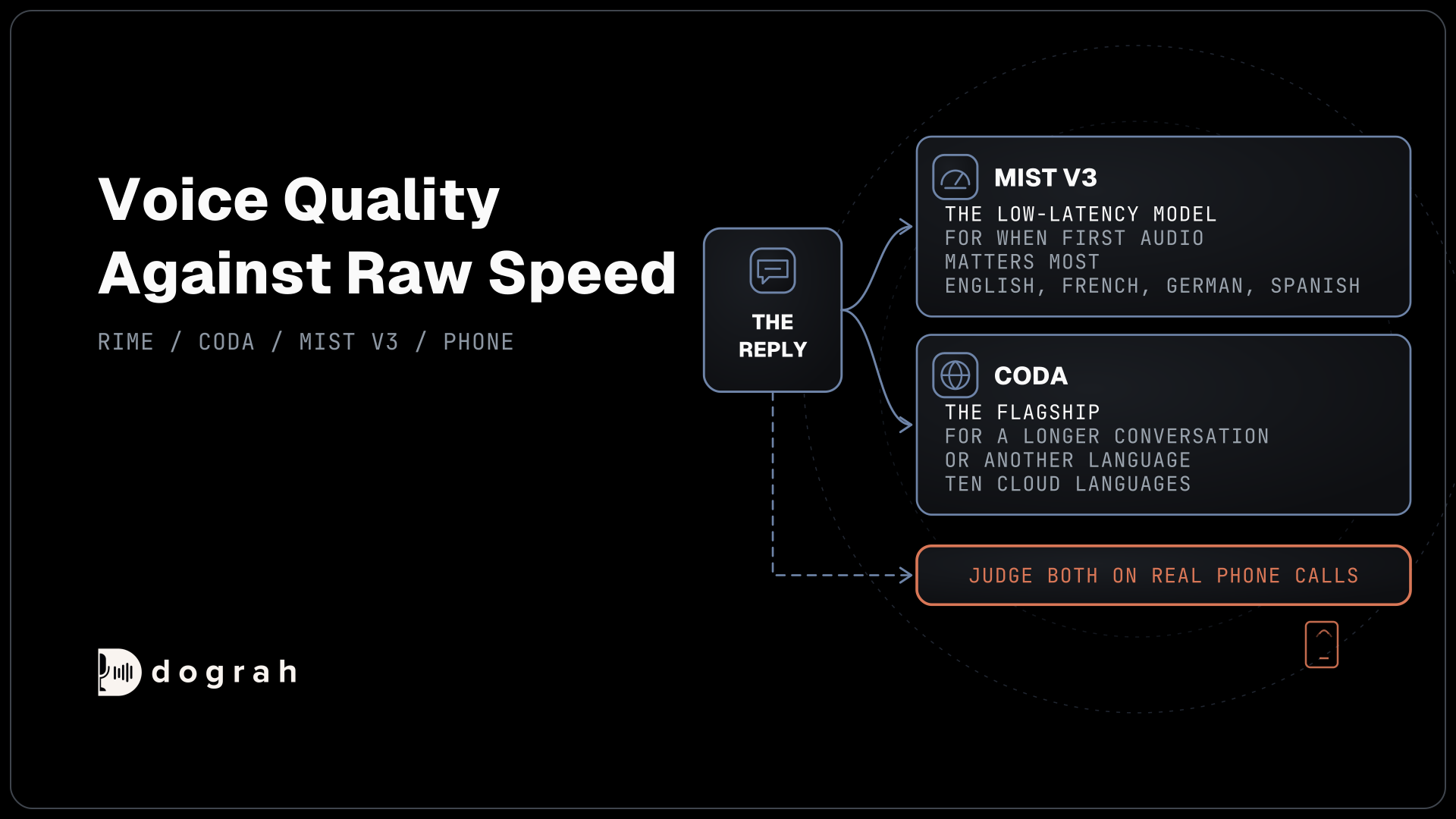
Rime sells two current models, and the choice between them is voice quality against raw speed. Rime's model guide calls Coda, released in May 2026, its flagship and the default for most new apps. It pairs a language model backbone with a speech engine trained on full-duplex conversational data, which is the kind of back-and-forth speech a phone agent produces.
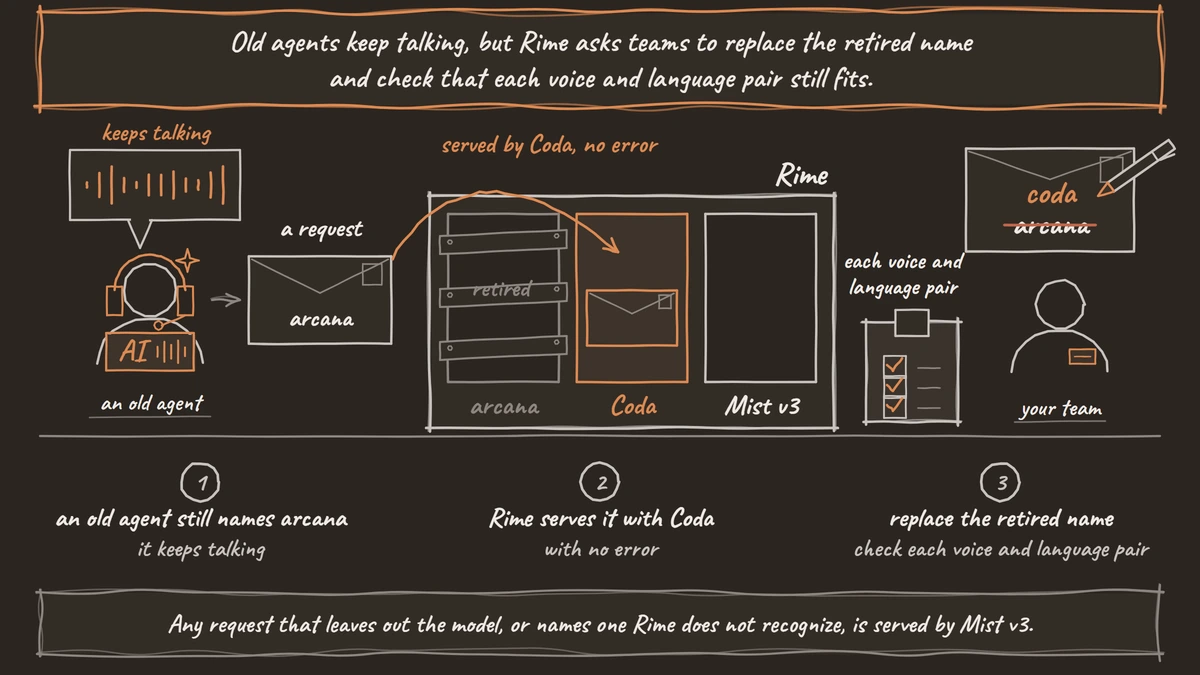
Mist v3, released in March 2026, is the low-latency model in the Mist family. Any request that leaves out the model, or names one Rime does not recognize, is served by Mist v3. The older Mist v1 and Mist v2 retire on 3 December 2026, so an agent still set to mist or mistv2 needs a new model name before then.
Arcana has left the cloud. Rime's changelog shows Arcana retired from the cloud API on 15 August 2026, and requests that still name arcana are now served by Coda with no error. Old agents keep talking, but Rime asks teams to replace the retired name and check that each voice and language pair still fits.
Coda also holds up in blind listening. On the Artificial Analysis Speech Arena, a live leaderboard built from listener votes, Coda v2 sits at rank 42 of 105 models, well above the first Coda release at 71.
Languages, voices and pronunciation
Coda covers far more languages than Mist v3. Rime lists ten cloud languages for Coda, English, Arabic, Dutch, French, German, Hindi, Italian, Japanese, Portuguese and Spanish, across 313 voices. The spread is uneven, since 185 of those voices are English and only one is Dutch. Mist v3 serves English, French, German and Spanish.
Pronunciation is where phone agents trip, on brand names, drug names and order codes. Coda accepts a custom lexicon of X-SAMPA pronunciations in English, German, Spanish, French, Italian and Portuguese, and on Mist v3 inline phoneme brackets work for English only. Rime's spell function reads codes and IDs letter by letter, which suits booking references. Dograh's Dictionary setting is for speech-to-text, so for the voice, tell the language model to write tricky names the way they should sound. Our post on reducing robotic TTS in voice agents has the rules we use for numbers and dates.
How Rime sounds on 8 kHz phone audio
Most phone calls still reach the agent as 8 kHz audio, while a browser demo runs at 16 kHz, so a voice that shines in a demo can sound flatter on the line. Rime's streaming guide says Rime synthesizes G.711 mu-law and 8 kHz audio natively, and a samplingRate of 8000 matches the telephony stream and shrinks the payload. The voice is made at the phone's own rate, with no conversion down from a studio rate on the way.
Dograh asks Rime for audio at the call's own sample rate. That is 8 kHz on Twilio, Telnyx, Plivo, Cloudonix, Asterisk ARI, Exotel and Vobiz, and 16 kHz on Vonage and WhatsApp. The connection runs over Rime's WebSocket that serves both Coda and Mist v3, so either model streams each sentence as the agent writes it.
Narrowband audio trims the high frequencies, so a breathy or whispery voice loses more on the line than one with clear consonants and a steady pace. Shortlist a few voices, read the same script with each, and listen on a mobile phone and on a landline before you choose.
Rime's speed figures and how to check them
Rime's own figures are fast, and they are Rime's measurements. Its streaming guide says the cloud API delivers sub-200 ms end-to-end latency under typical conditions. Mist v3's time to first byte is typically well below 100 ms, about 37 ms at the median in Rime's benchmark. Coda reaches sub-100 ms model latency on its GPU engine when self-hosted or on-prem, and cloud users typically add 25 to 50 ms of network round trip from most of the continental US.
Those numbers cover one stage of a turn. A natural-feeling reply keeps the full round trip under about 800 milliseconds, and the voice is rarely the slowest part, since speech-to-text usually is. Each Dograh call has a call trace with the speech-to-text, AI and voice time of every turn, so you see what Rime adds on your own network path. Our guide to the best text-to-speech APIs for voice agents sets Rime's speed figures beside other vendors'.

Open Source Alternative to Vapi / Retell
Self-hosted voice agent platform — no per-minute fees
dograh-hq/dograh
Star on GitHub
What a month of Rime speech costs
Rime bills by the minute of audio, which makes a budget easy to work out. Rime's Flex plan has no monthly fee and charges $0.030 a minute for Mist v3 and $0.050 for Coda v2. Scale costs $100 a month, takes 20% off every rate and includes a $100 monthly credit that rolls over up to $200. A free plan gives $50 of usage a month, and Rime counts about 1,000 characters as one minute on both models.
Here is an example. Take 2,000 calls a month in which the agent speaks for about 1.5 minutes each, which is 3,000 minutes of Rime audio.
| Plan | Mist v3 | Coda v2 |
|---|---|---|
| Flex | 3,000 x $0.030 = $90 | 3,000 x $0.050 = $150 |
| Scale | 3,000 x $0.024 = $72, inside the $100 credit, so $100 | 3,000 x $0.040 = $120, the $100 fee plus $20 |
At this volume Scale saves $30 on Coda and costs $10 more than Flex on Mist v3. Lines that play as pre-recorded clips use no Rime minutes, so a recorded greeting and fixed disclosures shrink the bill before any plan choice. Enterprise is priced per annual contract and adds cloud, VPC or on-prem deployment, a BAA for HIPAA, a SOC 2 Type II report and custom voice cloning.
Join the Dograh Community
Dograh is an OSS alternative to Vapi. Join our Slack community for queries, releases, best practices & community interactions.
Setting up a Rime voice in Dograh
Rime is a built-in voice provider in Dograh, so setup is one provider connection and one model configuration on your own Rime key. Open Providers in the sidebar, click Add Provider, choose Rime and paste the API key. Add API Key lets one connection store several keys, which Dograh picks between at random as calls come in.
Then open Models, click Add Configuration and choose BYOK, the mode for picking your own LLM, STT and TTS providers. On the TTS tab, pick the Rime connection, and the voice settings show Model, Voice, Speed and Language.
The Model field needs one change. Its default name, arcana, is retired at Rime, and Rime quietly serves those requests with Coda, but the Voice list for that name can come up empty. Tick Enter Custom Value and type coda, or pick mistv3 from the list, then choose a voice. The Voice list loads from Rime's public catalog, and Speed runs from 0.5 to 2.0.
Language decides what the voice speaks. A Rime voice in Dograh speaks English, German, French, Spanish or Hindi, set as en, de, fr, es or hi in the Language field. Pick a voice the catalog lists for that same language.
Each agent picks its configuration in the agent editor's Model tab, or in Settings under Model Configuration, as a Preset configuration or a Custom one. Changes save to the draft and apply to test calls straight away, and live calls change when you publish. One agent can run Coda while another stays on Mist v3, both on the same Rime account.
Then test on a real line. The Phone Call button in the editor header asks for a phone number or SIP endpoint and calls it through your telephony configuration, while Test Agent opens a browser call at 16 kHz. Place several phone calls with the same script on each voice, then compare the voice time per turn in the trace with how each one sounds on the handset.
Where the text goes and running Dograh yourself
Rime receives the text of every reply, so the agent's words leave your servers even when Dograh runs on them. Bring your own key moves the contract to your Rime account, while the text still reaches Rime. Rime's Enterprise plan sells VPC and on-prem deployment for teams that need its models inside their own network. Dograh is the orchestration layer that runs the call flow, tools and telephony, and the speech and language models are a separate layer you choose, so open voices on your own GPU are the other route. Our guide to running voice AI on local, self-hosted models covers that setup.
The Rime bill goes to your own account wherever the platform runs. Self-hosted Dograh has no per-minute platform fee, but servers, model keys and phone minutes still cost money. Dograh Cloud charges a 1¢-a-minute platform fee. Running it yourself means the server, the database and the upgrades are your team's job, with community support for the open-source edition and custom SLAs on Enterprise.
Start with Mist v3 when first audio matters most and Coda when the voice has to carry a longer conversation or another language. Set the model name by hand, then judge both on real phone calls before a single caller hears them.
Glossary
- G.711 mu-law
- The compressed 8 kHz audio format used on most phone lines in North America and Japan. Rime can produce it natively, so its voice needs no conversion from a studio sample rate.
- Time to first byte
- How long a text-to-speech service takes to return the first piece of audio after it receives text. Rime quotes well below 100 ms for Mist v3 in its own benchmark.
- Custom lexicon
- A list of words with their pronunciations written in a phonetic alphabet such as X-SAMPA. Coda accepts one in six languages, which fixes how it says brand and product names.
- BYOK
- A Dograh model configuration where you pick your own speech-to-text, LLM and voice providers on your own keys. A Rime voice runs this way and bills your Rime account.