
Soniox gives a voice agent live speech-to-text in more than 60 languages for $0.12 an hour, with endpoint detection that marks where an utterance ends. Soniox lists stt-rt-v5 for removal on 15 December 2026, so type stt-rt-v6. Dograh, the open-source AI voice agent platform, runs Soniox on your own key, self-hosted or on Dograh Cloud.
Key Takeaways
- Soniox real-time costs $0.12 an hour, plus small token charges.
- New Soniox accounts allow 10 streams at once, so raise it before launch.
- In Dograh, type stt-rt-v6 in the Model field and compare on test calls.
Soniox is a hosted speech-to-text API that streams live audio into phone agents. We cover how it handles phone audio, its models and languages, endpoint settings, price and stream limits. Then we set it up in Dograh and compare it with a second provider on the same calls.
How Soniox streams a live call
Soniox takes audio over a WebSocket and sends text back while the caller is still talking. Its real-time API accepts raw PCM such as pcm_s16le, plus mulaw and alaw, and for raw audio you must state the sample_rate. Each result arrives as tokens, and a token is marked final once Soniox will not change it.
The session config carries the choices that matter for an agent. You name the model, pass language_hints or turn on language identification, and add context, where a list of terms nudges the model toward brand names and product words. Speaker diarization and live translation are there too, though a single-caller phone agent rarely needs either.
Phone audio is the part to plan for. Most phone calls still reach the agent as 8 kHz audio, while a browser demo runs at 16 kHz, and that gap moves each speech model by a different amount. Declare the real rate of what you send, and test on recorded calls from your own line. Our post on the best speech-to-text APIs, tested on voice agent calls shows how phone codecs affect each model.
stt-rt-v6 and the v5 removal date
Soniox released stt-rt-v6 on 3 November 2026, and it is the real-time model to use now. Soniox's model list marks stt-rt-v5 as deprecated, and Soniox lists v5 for removal on 15 December 2026. After that date, requests that still name v5 route to v6 with no API change.
That routing means an old setting keeps working, but you lose the chance to test v6 before your callers hear it. Type stt-rt-v6 now, run your test calls on it, and the switch happens on your schedule. The old alias stt-rt-v4 points to v5, so it follows the same path.
Languages and language hints
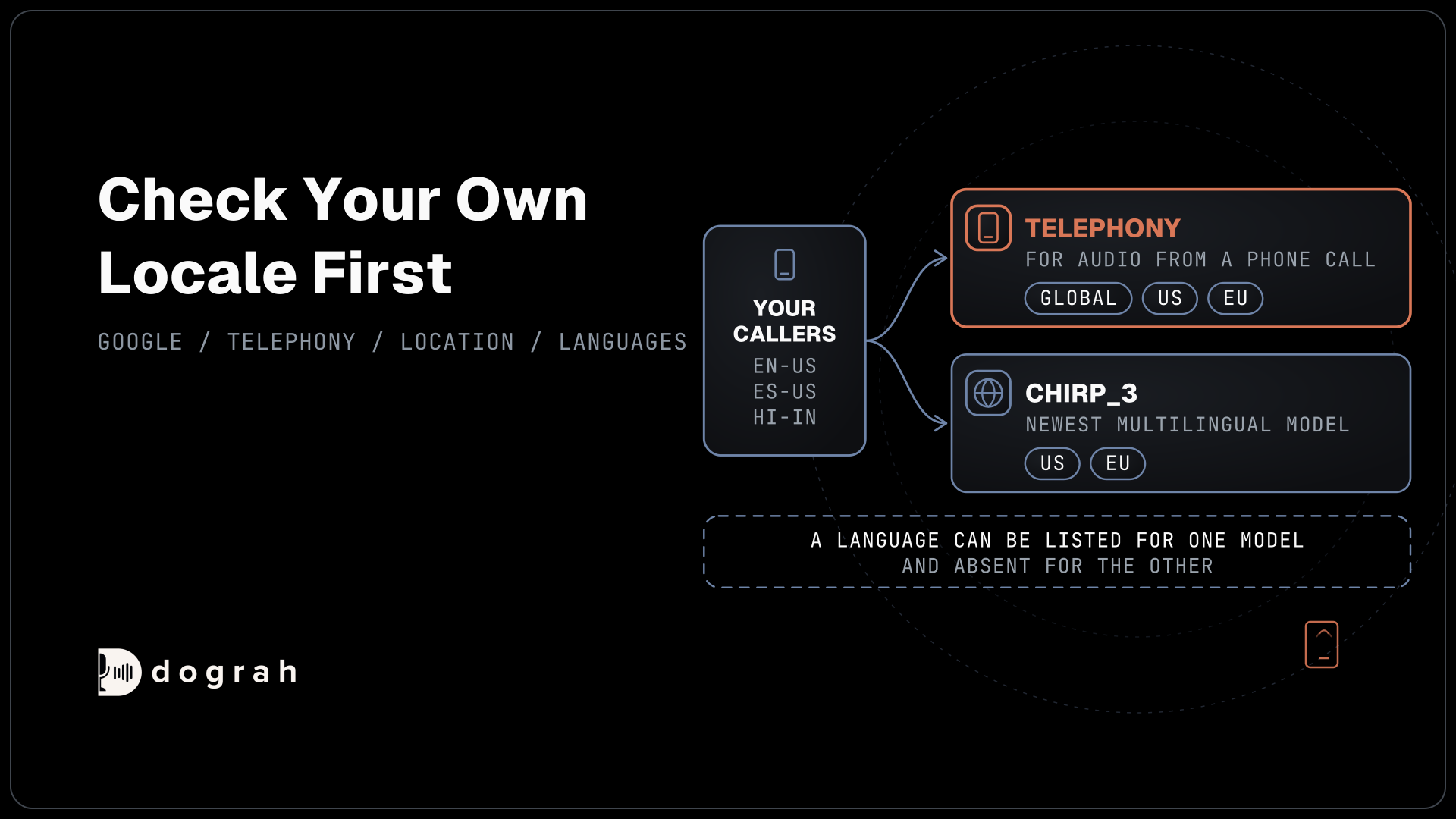
Soniox lists more than 60 languages on one model, including Hindi, Tamil, Telugu, Bengali and Spanish. You can leave detection to the model, or send one or more language hints that bias recognition toward the languages you expect. Hints help most on short phone turns, where a model has only a second or two of speech to guess from.
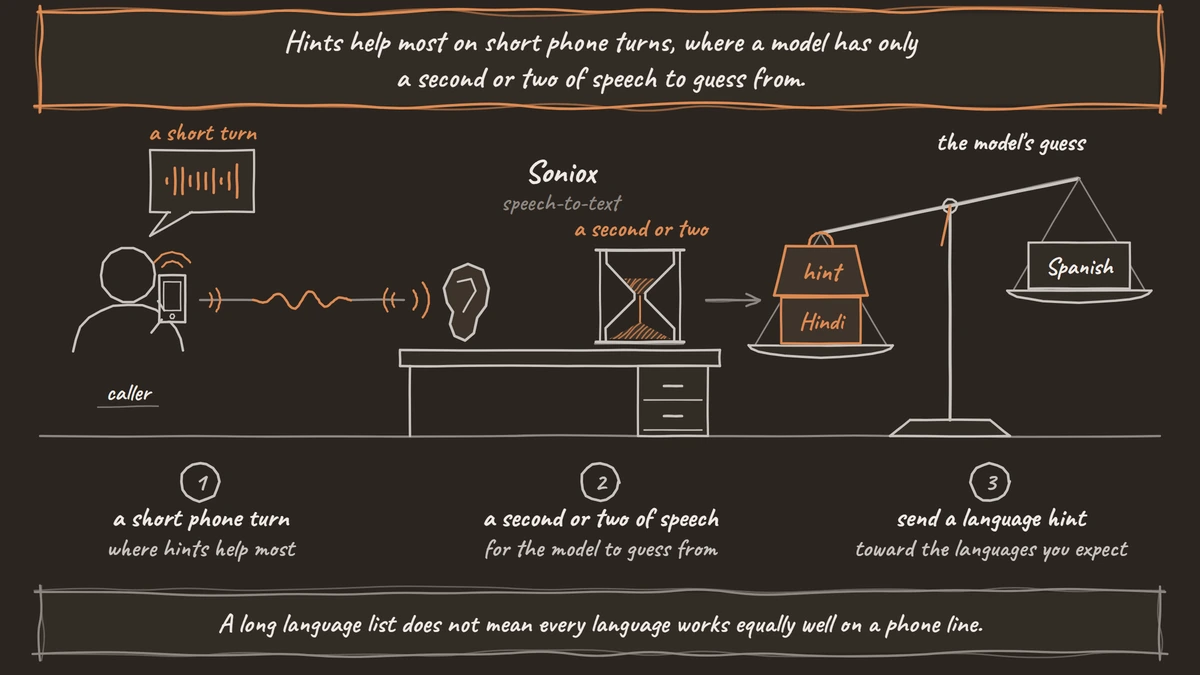
A long language list does not mean every language works equally well on a phone line. Test your top two or three languages on recorded calls before you rely on them. For Indian languages, compare Soniox with a provider built for them, which our post on Sarvam AI for Indian-language voice agents covers.

Open Source Alternative to Vapi / Retell
Self-hosted voice agent platform — no per-minute fees
dograh-hq/dograh
Star on GitHub
Endpoint detection and who ends the turn
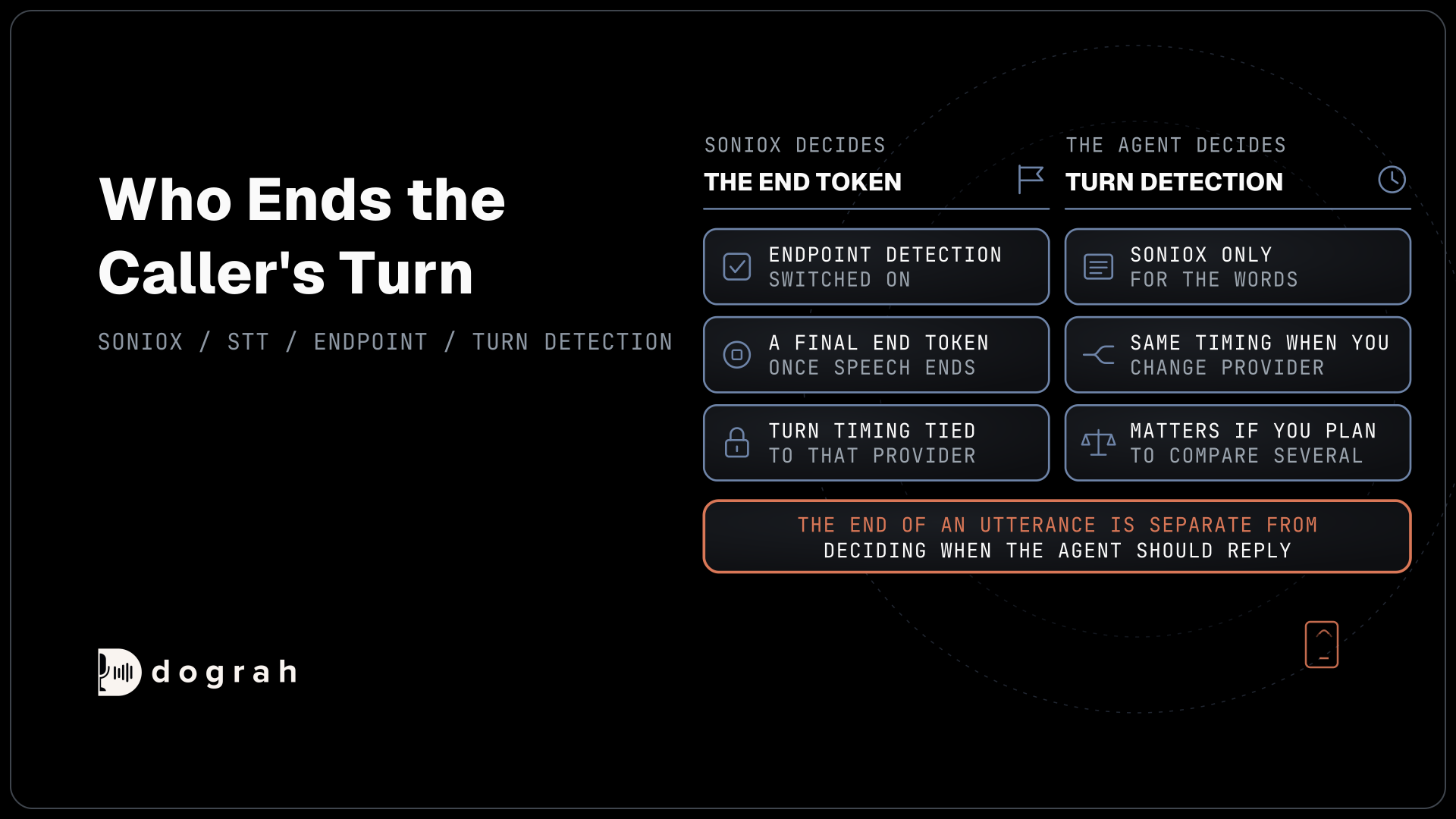
Soniox can mark the end of an utterance itself, and that is separate from deciding when the agent should reply. With enable_endpoint_detection on, Soniox returns a final <end> token once it judges the speaker has finished. Soniox's endpoint detection takes max_endpoint_delay_ms from 500 to 3000, 2000 by default, and endpoint_sensitivity from -1.0 to 1.0, 0.0 by default, where higher values end segments sooner.
A voice agent can let that signal end the caller's turn, or it can run its own turn detection and use Soniox only for the words. Letting the speech-to-text provider decide ties your turn timing to that provider. Running turn detection in the agent keeps the timing the same when you change provider, which matters if you plan to compare several. Our post on VAD vs turn detection explains what each one decides on a call.
Soniox price per hour and stream limits
Soniox bills live audio by the hour, with a small token charge on top. Soniox's pricing lists $0.12 an hour for real-time and $0.10 for async files. The real-time token rates are $2.00 per million tokens of input audio and $4.00 per million for input and output text, and the page states no free credit.
| Example volume | Sum | Speech-to-text line |
|---|---|---|
| One 4-minute call | 4 / 60 hours x $0.12 | $0.008, plus tokens |
| 10,000 calls of 4 minutes | 40,000 minutes = 666.7 hours x $0.12 | $80, plus tokens |
That example is small next to the language model, the voice and the phone minutes for the same calls. The limit to plan for is concurrency. Soniox's limits allow 10 streams at once and 100 requests a minute by default, which you can raise in the Soniox Console, and each session is capped at 300 minutes, a limit that cannot be raised. A phone call never comes near 300 minutes, but a new account carries 10 calls at once until you raise the limit.
Accuracy and speed on an open benchmark
Pipecat's open streaming benchmark is a useful first look, because it plays 1,000 conversational samples at real-time pace and scores every provider the same way. On Pipecat's STT benchmark, Soniox stt-rt-v6 has a pooled word error rate of 0.71%, with a median of 266 ms from the end of speech to the final transcript. Its predecessor v5 scored 1.09% at 260 ms, so v6 hears more for almost the same wait.
AssemblyAI's universal-3-6-pro scores 0.80% at 307 ms and Deepgram's nova-3-general 1.37% at 247 ms. The benchmark notes that gaps under about a quarter of a point fall inside its confidence interval, and the samples are not phone audio. Use it to pick a shortlist, then decide on your own calls.
Join the Dograh Community
Dograh is an OSS alternative to Vapi. Join our Slack community for queries, releases, best practices & community interactions.
Setting up Soniox in Dograh
Soniox is a built-in speech-to-text provider in Dograh, and it runs on your own Soniox key. Open Providers in the sidebar, click Add Provider, choose Soniox, paste the API key under Credentials and click Save Connection. Then open Models, click Add Configuration and name it, pick BYOK, and on the STT tab choose the Soniox connection.
The Model field defaults to stt-rt-v5 and accepts a typed name, so type stt-rt-v6. Leave Language on multi to let Soniox detect the language, or pick one of 60 codes to send it as a hint. Fill the LLM and TTS tabs, click Save Configuration, then in the agent's Model tab choose it under Preset configuration and save the agent, as the model configurations guide walks through.
On a call, Dograh sends Soniox 16-bit PCM at the call's own sample rate, which is 8 kHz on Twilio, Telnyx, Plivo, Cloudonix, Exotel, Vobiz and Asterisk ARI and 16 kHz on Vonage. Words in the agent's Dictionary, under Settings, reach Soniox as context terms. Dograh's own turn detection decides when the caller has finished and then asks Soniox to finalize the transcript, so Soniox's endpoint settings close transcripts while turn timing stays the same as on any other provider.
Comparing Soniox with another provider
A fair test runs two providers on the same calls with nothing else changed. Build a second configuration that differs only on the STT tab, for example with Deepgram or AssemblyAI. Point the agent at the Soniox configuration for one batch of test calls and at the second for the next, reading the same script with the same product names and numbers each time.
Agent Runs holds each call's transcript, so you can read the two batches side by side and mark every misheard word. Each call's trace shows the speech-to-text, AI and voice time for every turn, which tells you whether a provider is slower or only mishearing. Pick the one that hears your callers best, and use the price as the tiebreaker.
Hosting, calls at once and price
Soniox is closed code that runs in Soniox's cloud, and its pricing page offers no self-hosted version. As the orchestration layer, Dograh runs the call, and the speech and language models are a layer of their own that you choose. With your own Soniox key the contract is yours, but the call audio still goes to Soniox, and audio stays on your servers only when an open model such as Parakeet does the transcribing.
Self-hosting with Docker Compose needs a server with at least 8 GB of RAM and 4 vCPUs, the managed Dograh Cloud is the other route, and on-prem deployment comes with the Enterprise plan. Self-hosted, there is no per-minute platform fee, but servers, model keys and phone minutes still cost money. Dograh Cloud charges a 1¢-a-minute platform fee, and Soniox bills its hourly rate on your key either way. A self-hosted install runs 10 calls at once by default, the same as a new Soniox account, so raise both before a busy launch. The provider field takes more than one API key and spreads calls across them, which our post on STT and TTS concurrency limits explains. Your team takes care of the server, the database and upgrades, with community support for the open-source edition and custom SLAs on Enterprise.
Glossary
- Endpoint detection
- A speech-to-text model marking where an utterance ends. Soniox signals it with a final <end> token, tuned by max_endpoint_delay_ms and endpoint_sensitivity.
- Language hint
- A language code sent with the stream to bias recognition toward languages you expect. In Dograh, picking one Soniox language sends it as a hint, and multi sends none.
- Context terms
- A list of words sent with the session so the model favors them, such as brand names and product codes. Dograh passes the agent's Dictionary to Soniox this way.
- Concurrent stream limit
- How many live streams one account can hold open at once. Soniox allows 10 by default, and each live call holds one for its whole length.