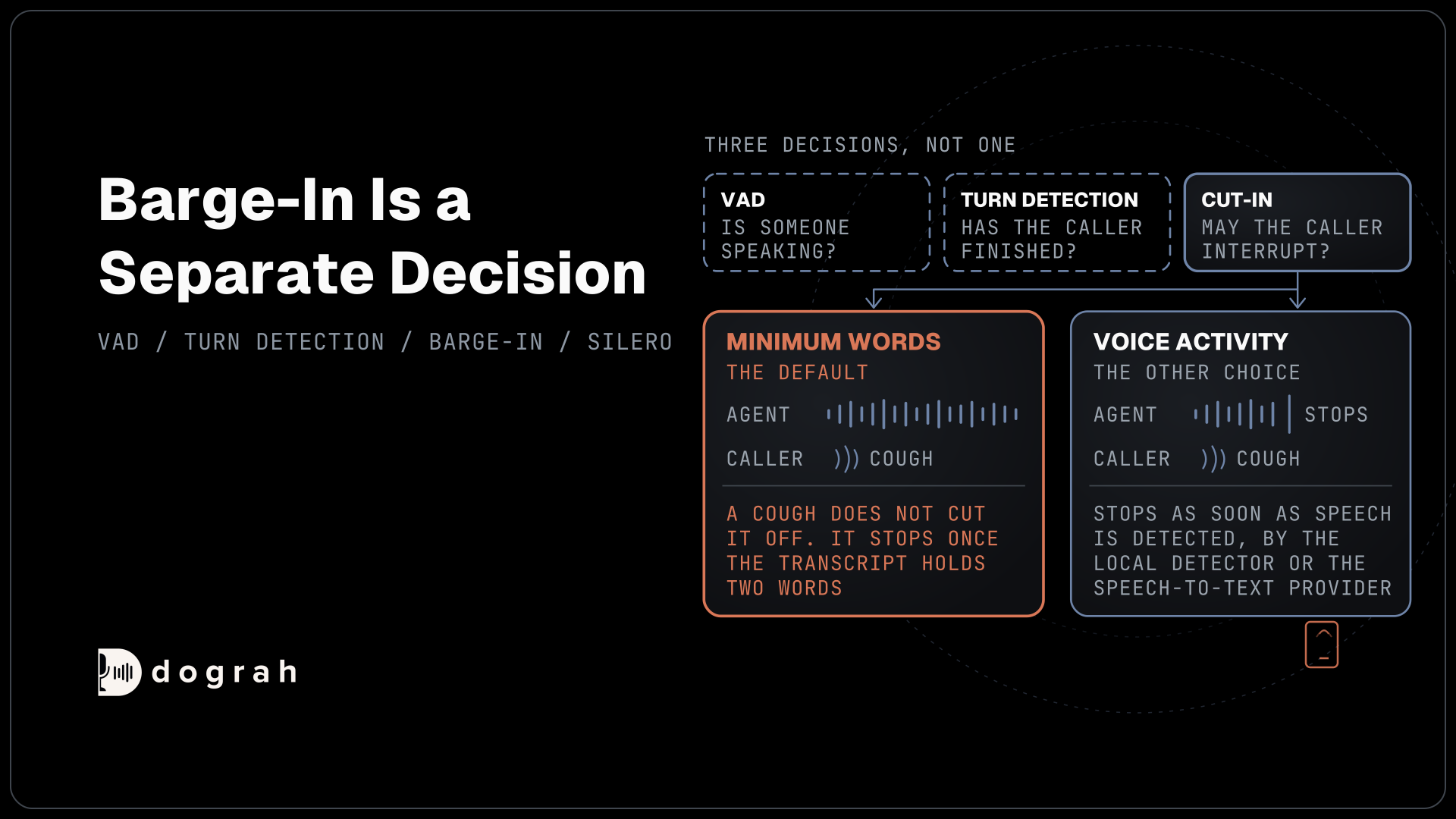

VAD decides whether a slice of call audio is speech. Turn detection decides whether the caller has finished and the agent may reply. Whether the caller may cut in while the agent talks is a third decision. In Dograh, that third decision counts transcribed words by default, so VAD alone never stops the agent.
Key Takeaways
- VAD hears sound. Turn detection judges whether the caller is done.
- Barge-in is a separate decision, with its own setting and default.
- Read the call's events to see which decision misfired before tuning anything.
This post is part of our guide to Voice Activity Detection Explained, where speech stopping is not the caller being done. We split listening into three decisions, show who makes each in Dograh, the open-source AI voice agent platform we build, and how to spot which one misfired.
Three decisions, not one
A voice agent makes three separate decisions while it listens, and each has its own input and its own setting. "VAD vs turn detection" covers the first two. The third, whether the caller may cut in, is the one most often blamed on the wrong part.
| Decision | Question | What it reads | Dograh setting | Default |
|---|---|---|---|---|
| Speech | Is someone speaking right now? | Raw audio, frame by frame | None, set in code | Silero, 0.2 s stop |
| End of turn | Has the caller finished? | VAD stops plus the transcript, or an audio model | Turn Detection, Detection Strategy | Transcription-based |
| Cut-in | May the caller interrupt the agent? | Transcribed words, or speech start | Interruption, Interruption Strategy | Minimum words, 2 |
Some vendors fold cut-in into turn detection. We keep it apart because that is how the settings are split in the agent, and because a fix for one does nothing for the other. Our post on what turn detection is covers the four ways a turn end can be decided.
Is someone speaking: the VAD decision
VAD is the fastest and dumbest of the three, and that is by design. Dograh runs one Silero VAD detector per call with a stop time of 0.2 seconds. The rest are the defaults of the Pipecat fork it runs on, a speech confidence of 0.7, a start time of 0.2 seconds and a minimum volume of 0.6.
These values live in code, not in the agent's settings, and the detector runs at 8,000 or 16,000 Hz only. VAD's output feeds the other two decisions. It marks when speech starts and stops, and it tracks whether the caller is talking at all, but on its own it decides nothing the caller hears.
That is why most tuning happens one layer up. Our post on Silero VAD for voice agents covers the versions, the settings and which providers skip the local detector.

Open Source Alternative to Vapi / Retell
Self-hosted voice agent platform — no per-minute fees
dograh-hq/dograh
Star on GitHub
Has the caller finished: turn detection
Turn detection, which many teams call endpointing, takes each VAD stop as a candidate end and decides whether to reply or wait. Under Turn Detection in the agent's Settings, the Detection Strategy has two choices. Transcription-based, the default, waits 0.6 seconds after VAD reports a stop and also waits for the transcript. With VAD's own 0.2-second stop, that is about 0.8 seconds of silence before the turn ends.
Smart Turn Analyzer runs the open Smart Turn model, which listens to the audio and judges whether the sentence sounds finished. When it does not, the agent waits up to the Incomplete Turn Timeout, 2 seconds by default and settable from 0.5 to 10. If nothing else ends the turn, a 5-second fallback does.
Some speech-to-text providers decide turn ends themselves. With Deepgram Flux, Cartesia ink-2 or Dograh's own speech-to-text in the languages Flux covers, the turn ends when the provider says so, and the fallback stretches to 30 seconds. Our comparison of Smart Turn vs silence timers puts the timer values side by side.
May the caller cut in: interruption
The cut-in decision runs only while the agent is talking, and by default it never looks at VAD. Under Interruption in the agent's Settings, the Interruption Strategy is Minimum words, with Minimum Words Before Interruption set to 2 and settable from 1 to 10. The agent stops only once the transcript holds two words from the caller, so a cough or a quick "mm-hm" does not cut it off.
The other choice, Voice activity, stops the agent as soon as speech is detected, either by the local VAD or by the speech-to-text provider. Only on this choice does VAD drive barge-in.
So if callers complain that the agent stops for background noise, check the strategy first. On the default, changing VAD values will not move barge-in at all, because the word count is doing the deciding. Our post on VAD settings for noisy phone calls covers the trades when you do switch to Voice activity.
Two more switches sit on each step. Allow Interruption is on by default for agent steps, and turning it off mutes the caller's audio until that step's reply ends, which suits lines callers must hear in full. The Start Call step has Allow Interruptions After Greeting. Most speech-to-speech models, OpenAI Realtime among them, handle cut-in themselves, so plan these settings around cascade agents.
Join the Dograh Community
Dograh is an OSS alternative to Vapi. Join our Slack community for queries, releases, best practices & community interactions.
Which decision misfired on this call
Each wrong behavior points at one decision, so name the symptom before you change a value. An agent answering half a sentence ended the turn too early. A long silence before every reply is the turn decision waiting too long, or a slow model. An agent stopping for a cough is the cut-in decision. A caller whose first word goes unheard is usually VAD or the audio itself.
Start with View Trace on the call, which opens it in Langfuse with the speech-to-text, AI and voice time for every turn. If the model times are short and the gap is still long, the wait is in the turn decision.
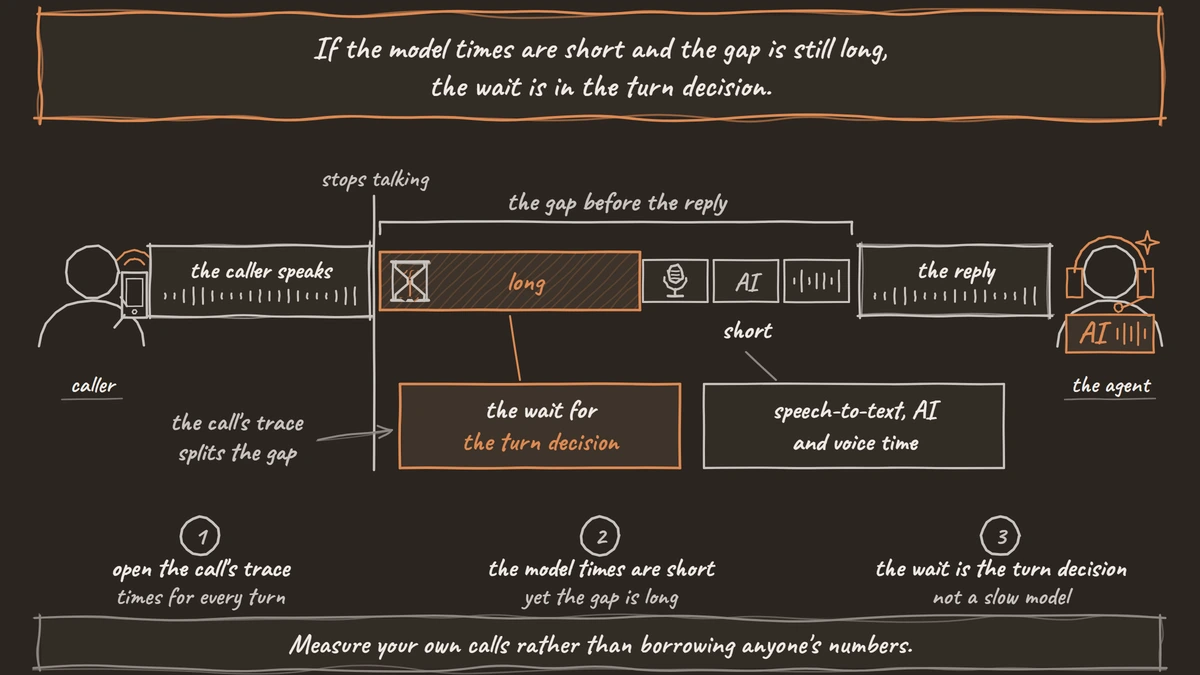
For a deeper look, Dograh can export call events to your own BigQuery table, set up under Settings, Call events. VAD and turn decisions arrive as separate rows. user_speaking_start and user_speaking_stop are VAD, while user_turn_started, user_turn_stopped and user_turn_stop_timeout are turn decisions, with interruptions logged too. The latency breakdown reports user_turn_ms, the silence window plus the end-of-turn wait, apart from the agent's response time, so a slow turn decision never hides inside a slow model.
Measure your own calls rather than borrowing anyone's numbers. Place test calls over a real phone line, since most phone calls still reach the agent as 8 kHz audio while a browser demo runs at 16 kHz.
Reading the defaults and running Dograh yourself
Because Dograh is open source, every value in this post can be read in its code, so you always know which timer you are changing. Self-hosted, you can change the values that live in code as well, while an agent on Dograh Cloud keeps to the settings in its Settings tab.
None of these settings costs extra, since every agent has them. Self-hosted Dograh has no per-minute platform fee, though servers, model keys and phone minutes still have a cost. Dograh Cloud charges a 1¢-a-minute platform fee. Self-hosting does mean your team owns the server, the database and the upgrades, with community support on the open-source version and custom SLAs on the Enterprise plan.
Start with the defaults, change one decision at a time, and check the events after every change. Most turn problems turn out to be one setting, once you know which of the three decisions made the mistake.
Glossary
- Endpointing
- Deciding that a speaker has finished, usually from silence plus other signals. In Dograh this is the Turn Detection setting, which waits on top of each VAD stop before ending the caller's turn.
- Barge-in
- A caller starting to speak while the agent is still talking. Whether it stops the agent is the cut-in decision, which Dograh makes from transcribed words by default rather than from VAD.
- Minimum words
- Dograh's default Interruption Strategy. The agent stops talking only after the caller's transcript holds a set number of words, 2 by default, so coughs and short backchannels pass.
- user_turn_ms
- A field in Dograh's call event latency breakdown. It measures the silence window plus the end-of-turn wait, separately from the agent's response time, so you can tell a slow turn decision from a slow model.