
Franchise brand consistency on every call comes from fixing the few lines that must never change and letting the agent word the rest. Record the greeting and step-change lines once, clone that speaker's voice for generated replies and run every site on one agent. Dograh, the open-source AI voice agent platform, handles this self-hosted or on Dograh Cloud.
Key Takeaways
- Exact wording holds only in the greeting, Transition Speech or a recorded clip.
- Record fixed lines once, then clone that speaker for every generated reply.
- QA tags flag the calls where generated wording strayed from brand rules.
This post is part of our guide to AI voice agents for franchises and multi-location businesses, where the brand fixes a few rules and each site sets its details. Below, we sort lines into fixed and generated, then set up recordings, one voice, shared rules and wording checks in Dograh.
Which lines the brand fixes word for word
A brand controls the exact words only where the agent plays fixed text, so the first job is deciding which lines need that. In Dograh, fixed words come from the greeting on the Start Call node, the Transition Speech on a pathway between two steps, and a pre-recorded clip. Everywhere else, the language model writes each reply from your prompt. The meaning holds, while the words shift a little from call to call.
A prompt that says "never promise same-day service" stops that phrase, yet the model can still say "we should get someone out to you today". You cannot prove a generated reply will never say something, so any line with legal or brand weight belongs in fixed text.
For most networks the fixed list is short. It covers the greeting with the brand name, any notice the brand gives every caller, the line before a transfer to staff, the goodbye and the wording of a national promotion. Hours, prices and local services stay generated from each site's own details, because sites own those and change them often. Keep the list to lines no franchisee should reword, or sites will work around an agent that cannot mention their own news.
Record the fixed lines once for the network
Recording the fixed lines gives every site the same words in the same voice. Upload each file on the Recordings page in the sidebar, where it is transcribed so you can check the text, then attach it where it should play. The pre-recorded audio setup walks through each screen.
On the Start Call node, set Greeting Type to Pre-recorded Audio and pick the Greeting Recording. The agent will not publish with that type chosen and no recording selected. On a pathway, Transition Speech takes text or audio and plays right before the next step, which suits "Let me put you through to the team at this location". The End Call tool's Goodbye Message can play a recording too.
Typing @ in a prompt inserts a recording that the agent plays when the line fits, which suits common answers such as the warranty line. The model still decides when to play it, so keep must-play lines out of the prompt.
Two settings keep a fixed line whole. Allow Greeting Interruption starts switched on, so turn it off when the greeting carries a notice callers must hear in full. On a speech-to-speech model, a typed Transition Speech line does not play at all, which is one more reason to record it.
Recordings are shared by every agent in one organization, so a network run in one organization uploads the clip set once. A franchisee with its own organization needs the same files on its own Recordings page, and each greeting and Transition Speech checked against them before that site goes live.
Clips also skip the voice provider's charge for the lines they cover. Self-hosted, Dograh carries no per-minute platform fee, though the servers, model keys and phone minutes are still paid for. Dograh Cloud bills a 1¢-a-minute platform fee for the calls it runs. Self-hosting keeps the voice actor's recordings on the franchisor's own servers, and it also makes the server, the database and each upgrade the team's job, with help from the community on Slack and GitHub and custom SLAs on an Enterprise plan.
One cloned voice for every generated reply
Fixed clips cover only part of a call, so the generated replies need the same voice or callers hear two people. Record a real voice actor for the fixed lines and use a cloned voice of that same actor for everything the model says, and the switch between clip and clone is hard to notice.
The clone is made at a speech provider that supports cloning, and its voice ID goes into the agent's voice settings with the same provider selected. Several hosted voice providers clone from a short sample. For a fully self-hosted stack, Chatterbox is an MIT-licensed open model that clones from a reference clip. NVIDIA's Magpie TTS ships five fixed speakers, and its model card rules out zero-shot cloning, so it cannot carry this pattern.
Get the voice actor's written consent before cloning, and agree what happens to the clone when the contract ends. Our post on voice cloning for pre-recorded and TTS playback covers consent and the hand-off between clip and clone, and our guide to making an AI voice sound human covers pacing and tone.
The site lookup can swap the voice for one call, for example a French voice for sites in Quebec, but each swap is a second brand voice to record and clone. Keep it for regions that truly need one.

Open Source Alternative to Vapi / Retell
Self-hosted voice agent platform — no per-minute fees
dograh-hq/dograh
Star on GitHub
Brand rules in one prompt, site details in the lookup
The rules that shape generated replies belong in one place that every step reads. The Global Node holds the persona, the tone and what the agent must never say, and its text is added to the start of every step with Add Global Prompt switched on. Each agent has one Global Node, so a shared agent gives every site the same rules, with no copies to fall out of step.
Write brand rules there as plain instructions, such as how formal to be, which offers the agent may mention and which questions go to staff. Site facts stay out of it. Hours, prices and local services arrive with each call from that site's lookup, so a franchisee corrects its own details without touching the brand's words.
Brand and product names need one more step, because speech-to-text mishears names it has never seen. Add them in the agent's Settings under Dictionary, as one comma-separated list, then click Save Dictionary.
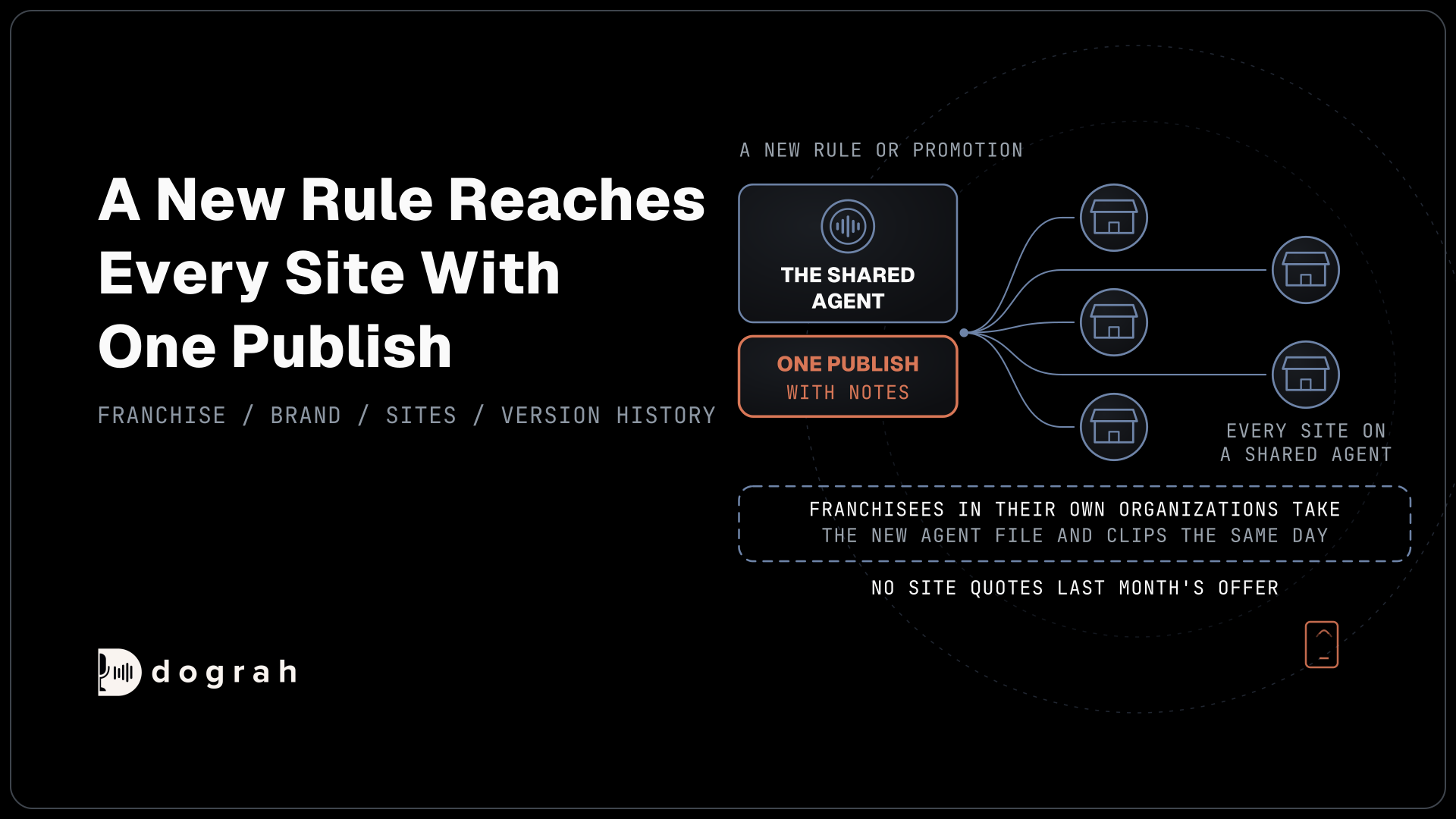
A new rule or promotion reaches every site on a shared agent with one publish. Edits save as a draft, and the published version keeps answering until you choose Publish version and add notes for Version History. Franchisees in their own organizations take the new agent file and clips the same day, so no site quotes last month's offer.
Join the Dograh Community
Dograh is an OSS alternative to Vapi. Join our Slack community for queries, releases, best practices & community interactions.
Check the wording on live calls
Recorded lines need no checking, because they cannot change, so quality checks can focus on what the model wrote. The QA node reviews finished calls and scores each step separately, with its own tags, a 1 to 10 score, sentiment and a short summary. There is no single score for the whole call, which is why brand checks work best as tags.
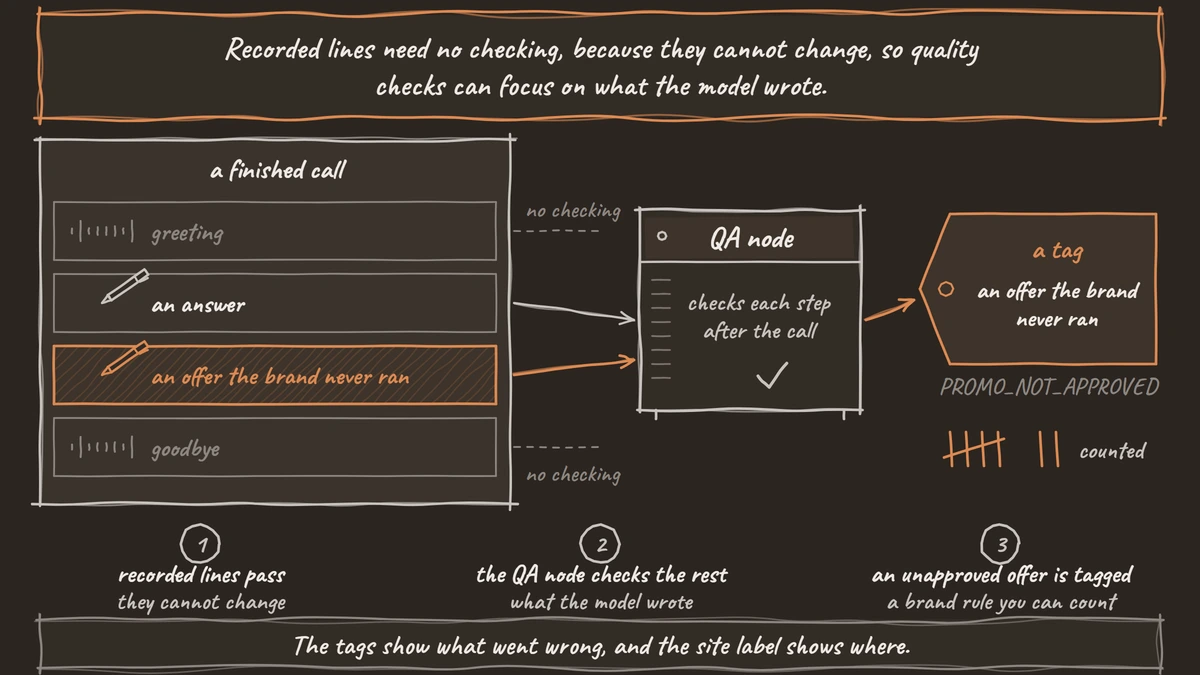
A tag such as PROMO_NOT_APPROVED for an offer the brand never ran, or STAFF_PROMISE for a callback time nobody agreed, turns a brand rule into something you can count. Write each tag into the QA System Prompt with a plain test for when it applies. Sample Rate (%) sets the share of calls reviewed, picked at random below 100. A workflow can hold more than one QA node, so a brand rule that must be checked on every call can run at 100% while general quality runs on a sample.
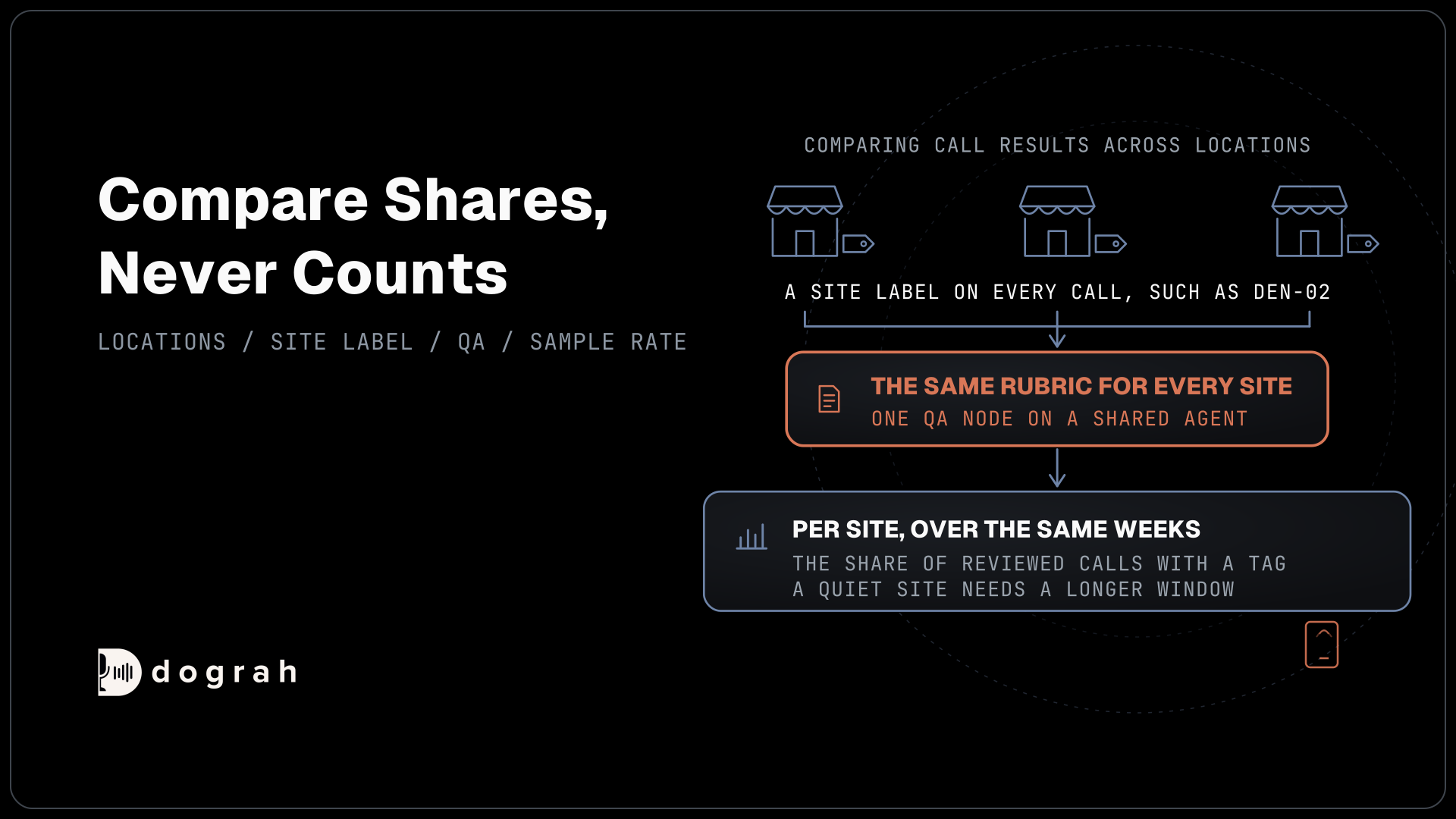
The tags show what went wrong, and the site label shows where. Our post on comparing call results across locations puts each call's site next to its QA result, so one site's unapproved offer shows up as that site's tag count.
Glossary
- Fixed line
- A line the agent plays word for word, from the Start Call greeting, a pathway's Transition Speech, the End Call goodbye or a recording. Everything else is written by the language model on each call.
- Transition Speech
- Text or a recorded clip that plays as a call moves from one step to the next. It cannot include per-caller variables, and typed text does not play on speech-to-speech models.
- Cloned voice
- A synthetic copy of a real speaker's voice, made at a speech provider that supports cloning and used for generated replies so they match that speaker's recordings.
- Global Node
- The single shared prompt in a Dograh agent, added to every step that has Add Global Prompt on. It holds the persona, the tone and what the agent must never say.