
Conversational IVR is a phone menu that understands speech. The caller says what they need and the system matches it to an intent on a fixed tree. An AI voice agent holds the whole conversation instead. Dograh, the open-source AI voice agent platform we build, can be self-hosted beside your PBX or run on Dograh Cloud.
Key Takeaways
- Conversational IVR still walks a menu tree. Callers just speak instead of pressing keys.
- Keep card numbers and two-option choices on the keypad menu.
- Self-host the agent beside your PBX with local models to keep call audio in-house.
Plenty of phone menus now take speech, and they still feel like menus. We set conversational IVR against keypad menus and AI voice agents, show how each is built and where each can run, then match call types to each one, with Dograh as the worked example.
What conversational IVR is
Conversational IVR is an interactive voice response system that listens for speech as well as key presses, then routes the caller by what they said. Under the words sits the same tree of prompts and branches a keypad menu uses. The system asks a question, listens, matches the answer to one of a set of intents, and moves to the next branch.
You can see this in the building blocks. Twilio's Gather verb collects keypad tones, speech, or both, and when both are allowed it takes whichever input it detects first. A speech prompt listens for up to 60 seconds. The menu still decides what comes next, one answer at a time.
The contact-center tools add more language understanding on top of the same pattern. Amazon Lex in Amazon Connect builds bots that take natural speech and can also capture digits from the keypad. Google's Dialogflow CX has a phone gateway that gives an agent a telephone number. Both are intent-and-flow bots. You define the intents, the details each one needs and the paths between them, and the bot fills them in.
Keypad menus, conversational IVR and AI voice agents
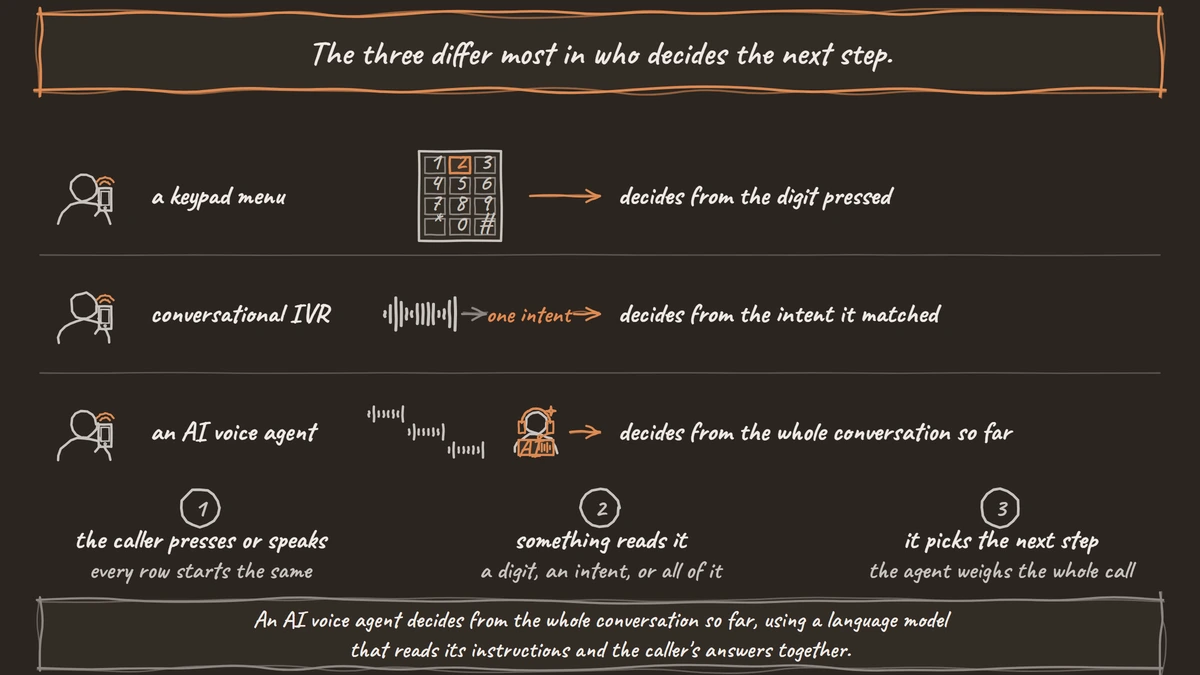
The three differ most in who decides the next step. A keypad menu decides from the digit pressed. Conversational IVR decides from the intent it matched in the caller's words. An AI voice agent decides from the whole conversation so far, using a language model that reads its instructions and the caller's answers together.
| Keypad menu | Conversational IVR | AI voice agent | |
|---|---|---|---|
| How the caller answers | Presses keys | Speaks or presses keys | Speaks freely |
| What picks the next step | The digit | The matched intent | The model, reading the whole call |
| Requests per answer | One digit, one branch | One intent per answer | Several, handled in order |
| Changing a question | Record a new prompt | Add or retrain an intent | Edit the step in plain words |
| Card numbers | Keyed, kept out of the recording | Keyed | Keyed on a menu before or after the agent |
| Where it usually runs | On your PBX | In the vendor's cloud | Hosted, or on your own servers with open source |
The last row is where open source changes the choice. A conversational IVR from a cloud contact-center suite runs wherever that vendor runs it. An open-source agent platform can run on the same network as your PBX, which matters when recordings and transcripts must stay in the building. Our post on AI voice agent vs IVR shows why conversational IVR is still a menu underneath and how to move off an IVR one call type at a time.
Running it on your own phone system
If you already run Asterisk or FreePBX, an agent can take over one menu option without replacing anything. The dialplan sends that option into a Stasis application, and Dograh answers the call through the Asterisk REST Interface (ARI) while the PBX keeps its trunks, extensions and the rest of the menu. Other PBXs, FreeSWITCH among them, reach the agent as a SIP trunk, which on Dograh Cloud lands on a Managed SIP domain set up for your organization.
Where the software runs decides where the audio goes. Dograh is the orchestration layer that runs the call flow, tools and telephony, while the speech and language models are a separate layer you choose. Self-hosted next to the PBX with open-weight models on your own GPUs, the whole call stays inside your network. With a hosted model on your own key, the contract is yours, but the audio still reaches that provider.
Our guide to open-source IVR and AI phone systems covers the ARI and SIP trunk setups in full. For the PBX you have today, how to connect an existing PBX to an AI voice agent picks the path and walks through it.

Open Source Alternative to Vapi / Retell
Self-hosted voice agent platform — no per-minute fees
dograh-hq/dograh
Star on GitHub
How each one is built
A conversational IVR is built as a list of intents. For each one you write sample phrases, the details to collect and the branch it leads to. Anything a caller says that nobody foresaw falls through to a "sorry, I didn't get that" prompt, which is why these systems need tuning once real callers arrive.
An AI voice agent is built as steps with instructions. In Dograh you describe the agent on the "Create an agent" page, and the Agent Builder may ask a few questions before it shows "Your agent requirements" for you to approve with "Approve & build". It then builds the agent for review, and "Test agent" publishes version 1.
On Dograh Cloud, building uses Dograh credits. A self-hosted install needs a Service Key to use the builder, or you build on the canvas by hand.
Steps are joined by pathways. A pathway is a condition the language model judges from the conversation, so it is never a hard rule the way a digit is. When wording must be exact, such as a legal notice, put it where the agent speaks fixed text, in the Greeting Text, a transition line or a pre-recorded clip. Lookups happen during the call too. Pre-Call Data Fetch pulls the caller's record before the greeting, and HTTP API tools read or write your systems mid-call.
Which calls fit which system
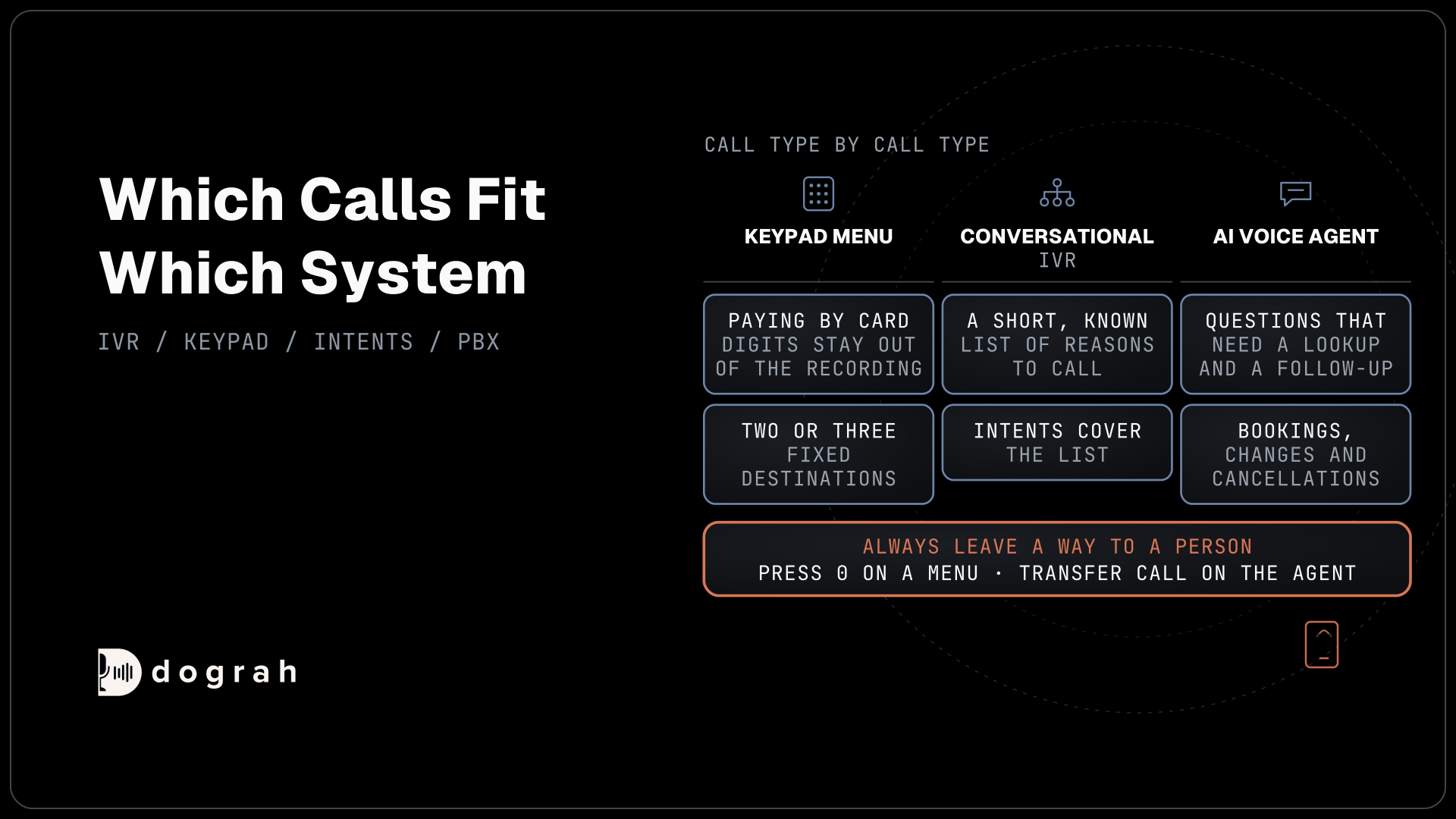
Most phone lines end up mixing the three, so decide call type by call type. The table below is where we would start.
| Call | Best fit | Why |
|---|---|---|
| Paying by card | Keypad menu | Keyed digits stay out of the recording and the transcript |
| Two or three fixed destinations | Keypad menu | One key press is quicker than a sentence |
| A short, known list of reasons to call | Conversational IVR | Intents cover the list and callers skip the menu |
| Questions that need a lookup and a follow-up | AI voice agent | It keeps the whole call in view |
| Bookings, changes and cancellations | AI voice agent | It collects details in any order |
| A caller who asks for a person | A person | Transfer the call |
Callers answer a Dograh agent by voice, so card entry stays on the PBX menu, before or after the agent's part of the call. A common shape keeps a short keypad menu for payments, sends everything else to the agent, and lets both hand the caller to a person.
Always leave a way to a person
Whatever handles the first part of the call, give callers a route to someone. In SurveyMonkey's customer service survey of 2,017 US adults, 79% said they strongly prefer dealing with a human over an AI agent, and just 8% preferred AI. A menu or agent that hides the exit only makes that worse.
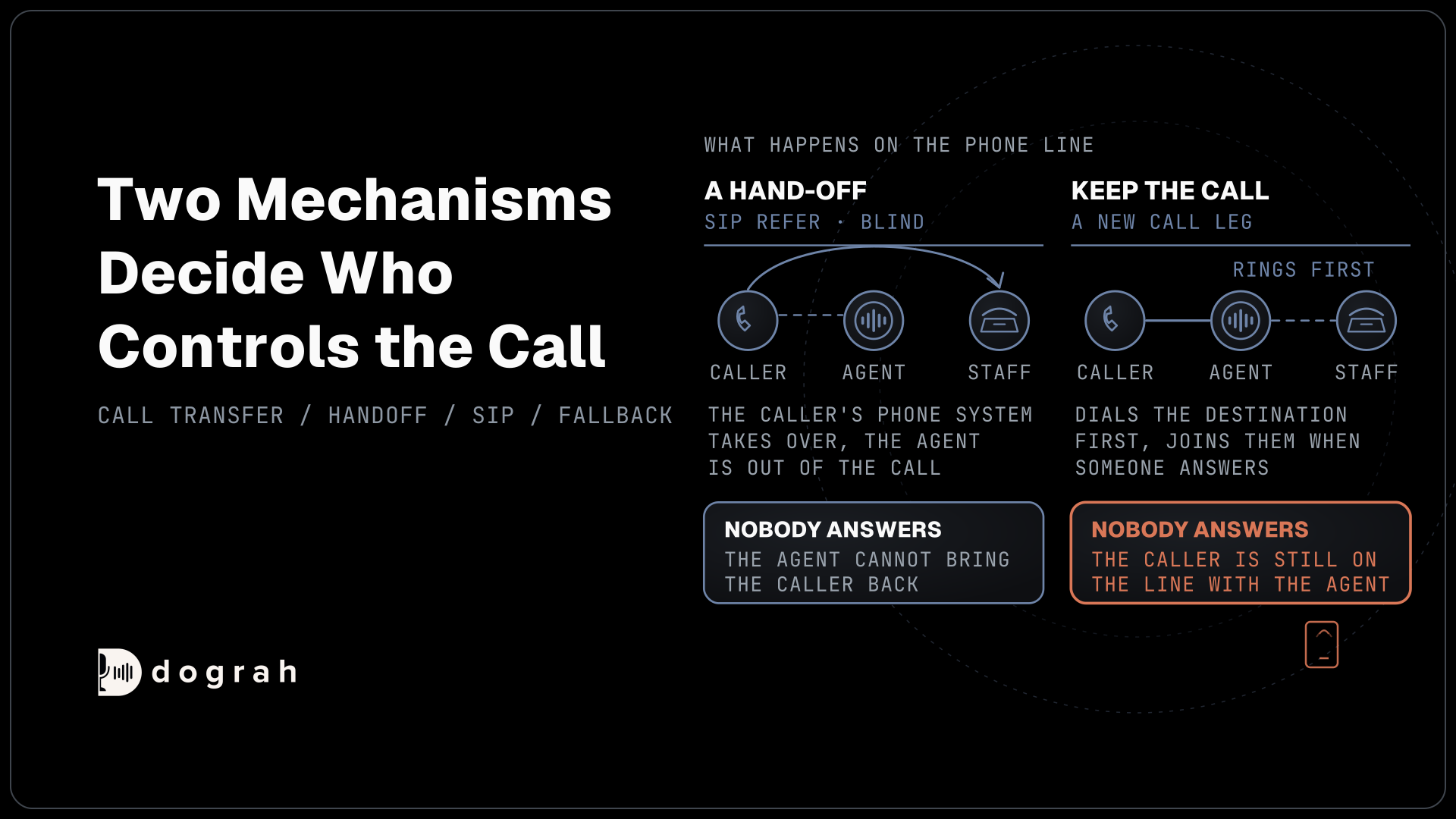
In a keypad menu the exit is "press 0". In Dograh it is the Transfer Call tool, which works on Twilio, Telnyx, Plivo, Cloudonix and Asterisk ARI. Dograh rings the destination first and connects the caller only once someone answers.
If nobody picks up, the line is busy or the call fails, the agent is told and the conversation carries on. Browser test calls cannot transfer, so test every transfer over a real phone call before callers rely on it.
Join the Dograh Community
Dograh is an OSS alternative to Vapi. Join our Slack community for queries, releases, best practices & community interactions.
What running it yourself costs and takes
A keypad menu on your own PBX costs the server and the trunk. Adding an open-source agent splits the rest into lines you can see. Self-hosted Dograh has no per-minute platform fee, though the servers, model keys and phone minutes still cost money. On Dograh Cloud the platform fee is a 1¢-a-minute charge.
Pre-recorded clips help a menu move over gracefully. The lines the agent says most can play as the same recordings your menu already uses, with text-to-speech for the rest, so callers keep hearing a familiar voice.
Running it yourself also means owning it. The server, the database and the upgrades are your team's job, and help on the open-source version comes from the community. If you need someone on the hook, the Enterprise plan adds custom SLAs and on-premise or private-cloud deployment.
Test any of them on a real phone line
Before you move a menu option over, call it from a real phone. Most phone calls still reach the agent as 8 kHz audio, while a browser demo runs at 16 kHz, so speech that is understood perfectly in a demo can be misheard on the line. Our guide to conversational AI on phone calls covers what else the phone line changes, from audio to reply timing.
Move one option at a time. Start with a call type that has a clear outcome, read the transcripts for a week, and only then hand the agent the next branch. Keep the keypad route in place until the new one has earned its spot.
Glossary
- Intent
- The reason for a call as a conversational IVR understands it, such as 'check balance' or 'move appointment'. Each intent has sample phrases and leads to one branch of the menu tree, so a request nobody wrote an intent for has nowhere to go.
- Stasis application
- The name Asterisk gives an outside program that takes control of a call. A dialplan line such as Stasis(<name>) hands the call to it, which is how a menu option on Asterisk or FreePBX reaches an AI agent through ARI.
- Pathway
- In Dograh, the link from one step of an agent to the next. The language model decides from the conversation whether its condition is met, so it is a judgment, unlike a menu branch that follows a digit.
- DTMF
- Dual-tone multi-frequency, the tones a phone sends when a caller presses a key. Keyed digits never enter the spoken conversation, which is why card numbers belong on the keypad.