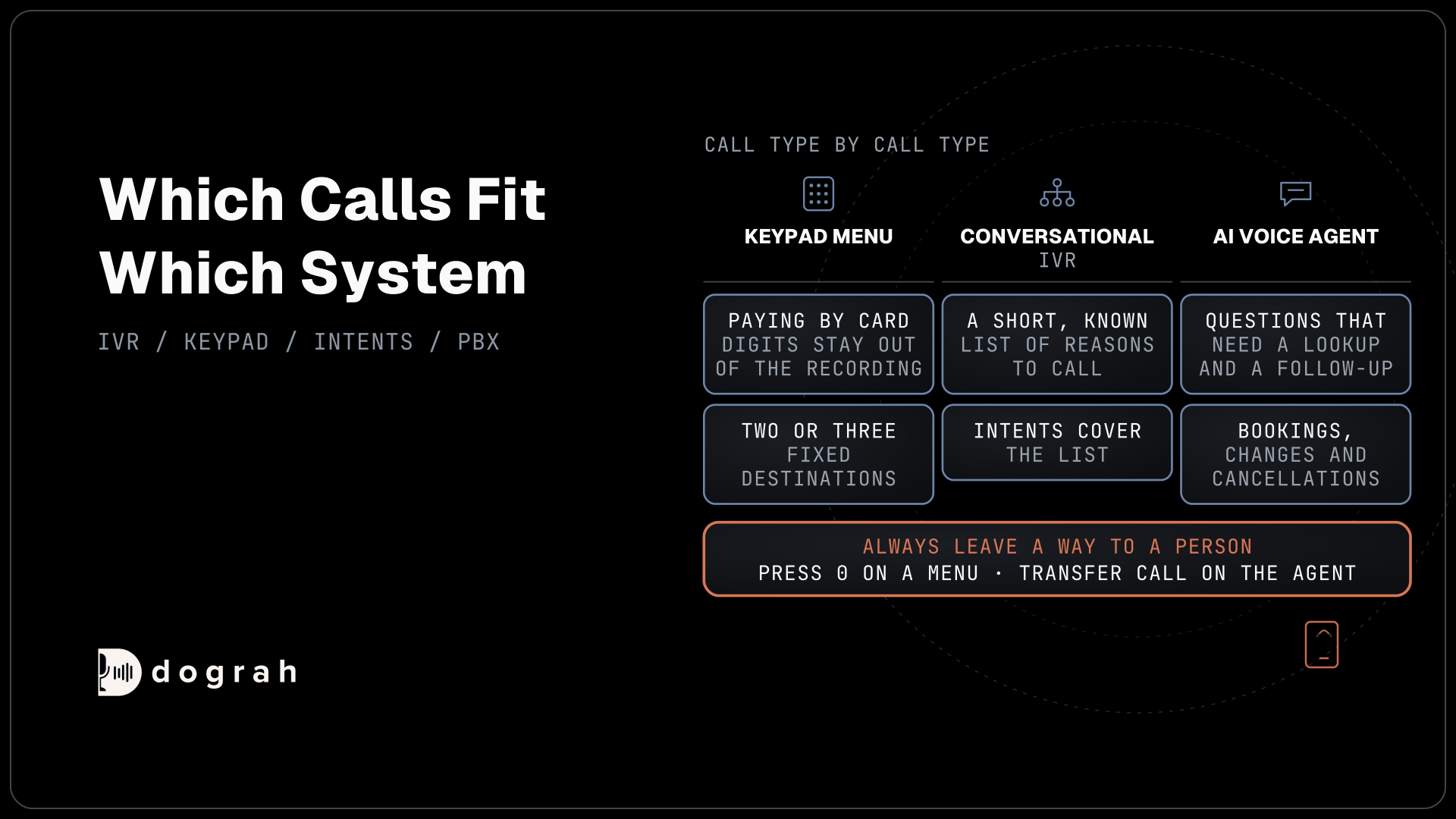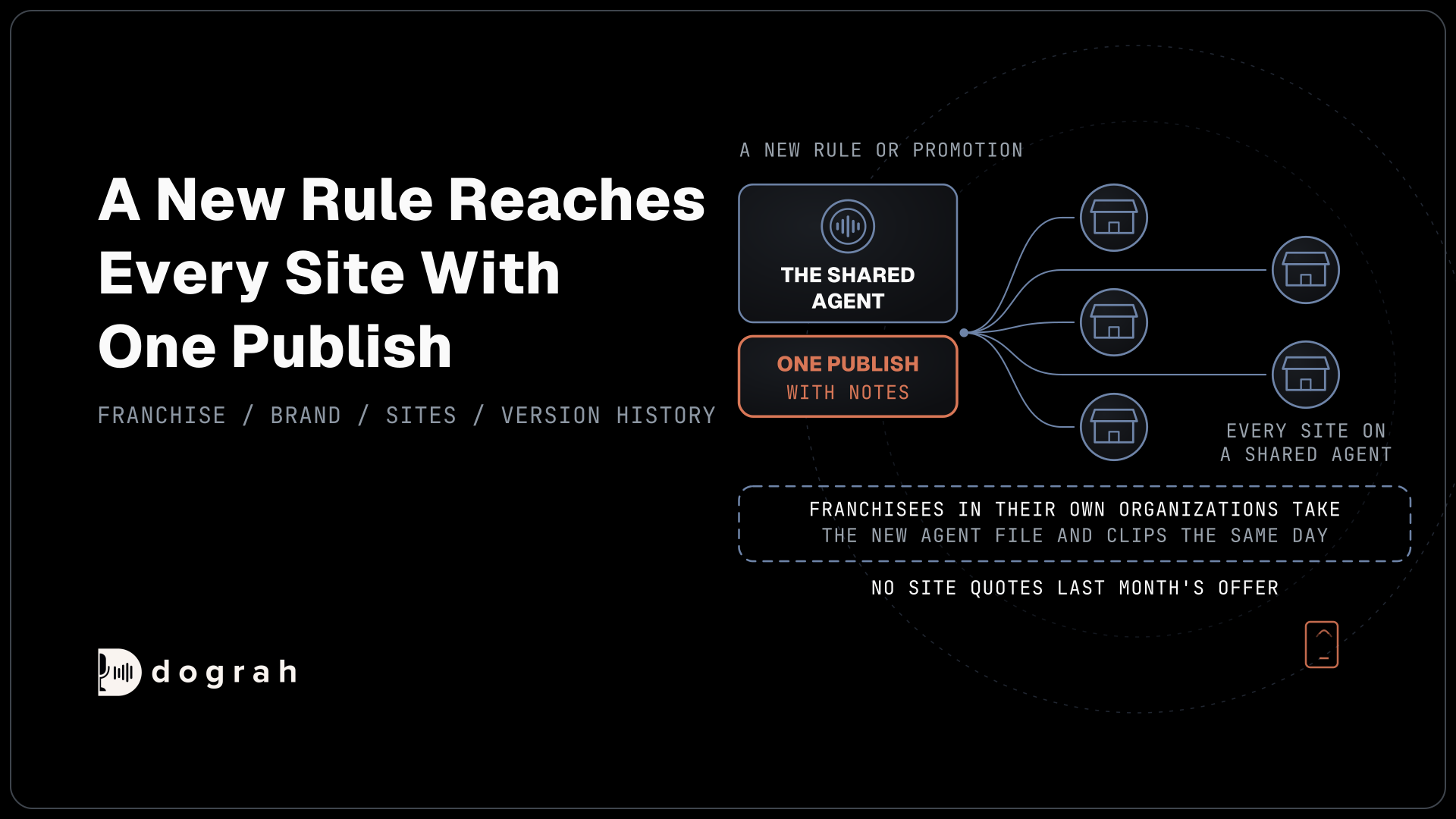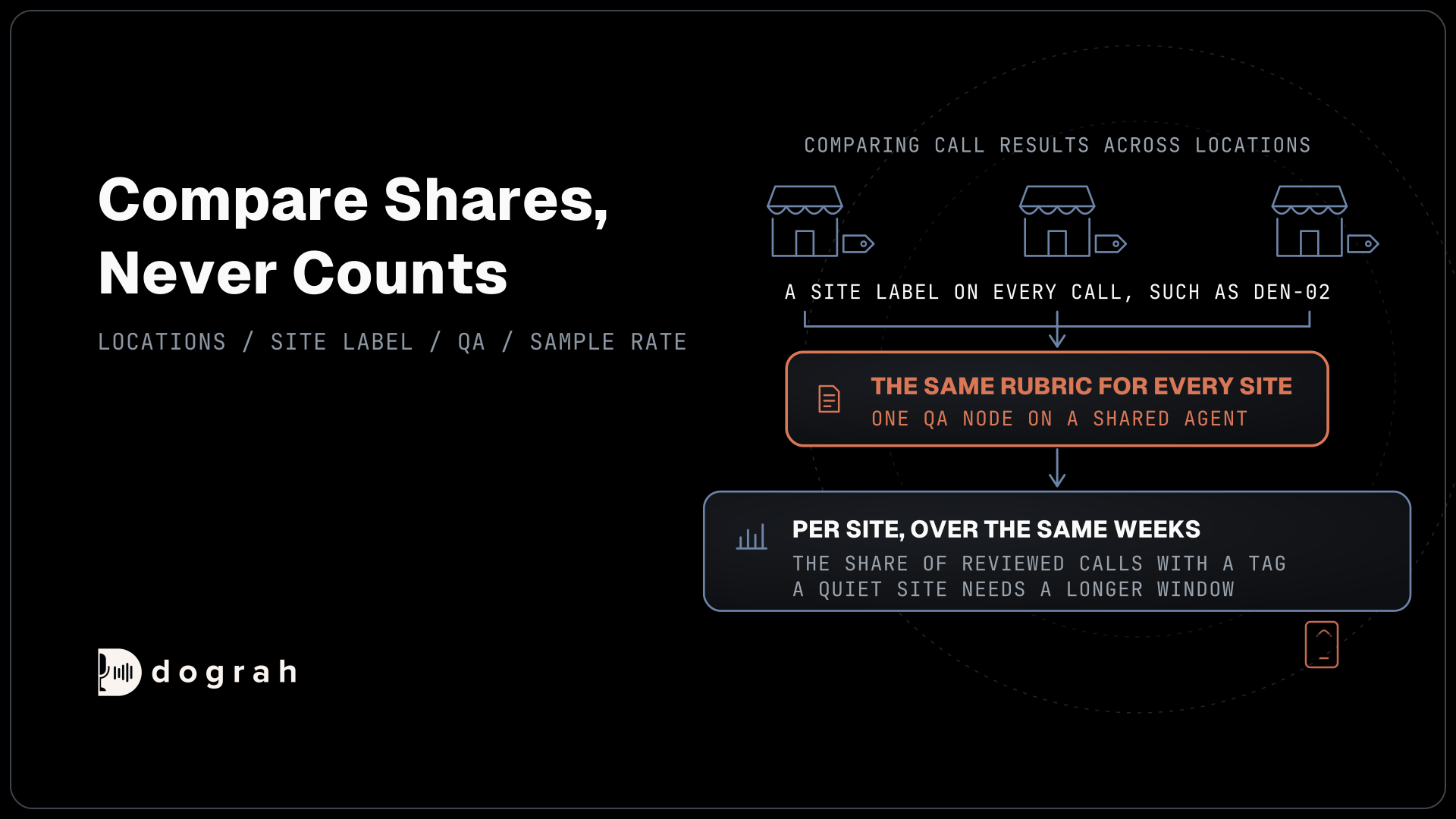

A call transfer either hands the caller's line away to someone else or keeps it and joins a second call to a person once they answer. The second way lets the agent take the caller back when nobody picks up. Dograh, the open-source AI voice agent platform we build, works that way, self-hosted or on Dograh Cloud.
Key Takeaways
- A blind transfer hands the call away. An attended transfer rings the person first.
- Set a ring timeout and decide what the agent does when nobody answers.
- Notes reach staff only if the agent writes them to their system first.
A caller only notices a transfer when it goes wrong. We define the transfer types, show what happens on the phone line, and cover no answer, busy lines, destination rules, when to hand over and what the person who answers knows, with Dograh's Transfer Call as the worked example.
Transfer types in plain words
A transfer moves a caller from whoever is talking to them now to someone else, and the types differ in how much the first party checks before letting go. Vendors use "cold" and "warm" loosely, so here are four plainer names, each with the label you will also see.
A blind transfer sends the caller to a number or extension without checking anyone is there. Vendors call this cold. An announced transfer rings the destination, plays or says a short line about who is coming, then connects the caller. An attended transfer, the one most people mean by warm, lets the first party speak to the person who picked up before the caller joins. A conference keeps all three on the line, so the first party can stay for the start of the conversation.
For an AI voice agent the same names apply, with one twist. The agent cannot judge on its own whether the person who answered is ready, so a transfer that checks first usually means "ring first and connect only when someone picks up". That single rule removes the worst outcome, a caller sent into an empty ring.
What happens on the phone line
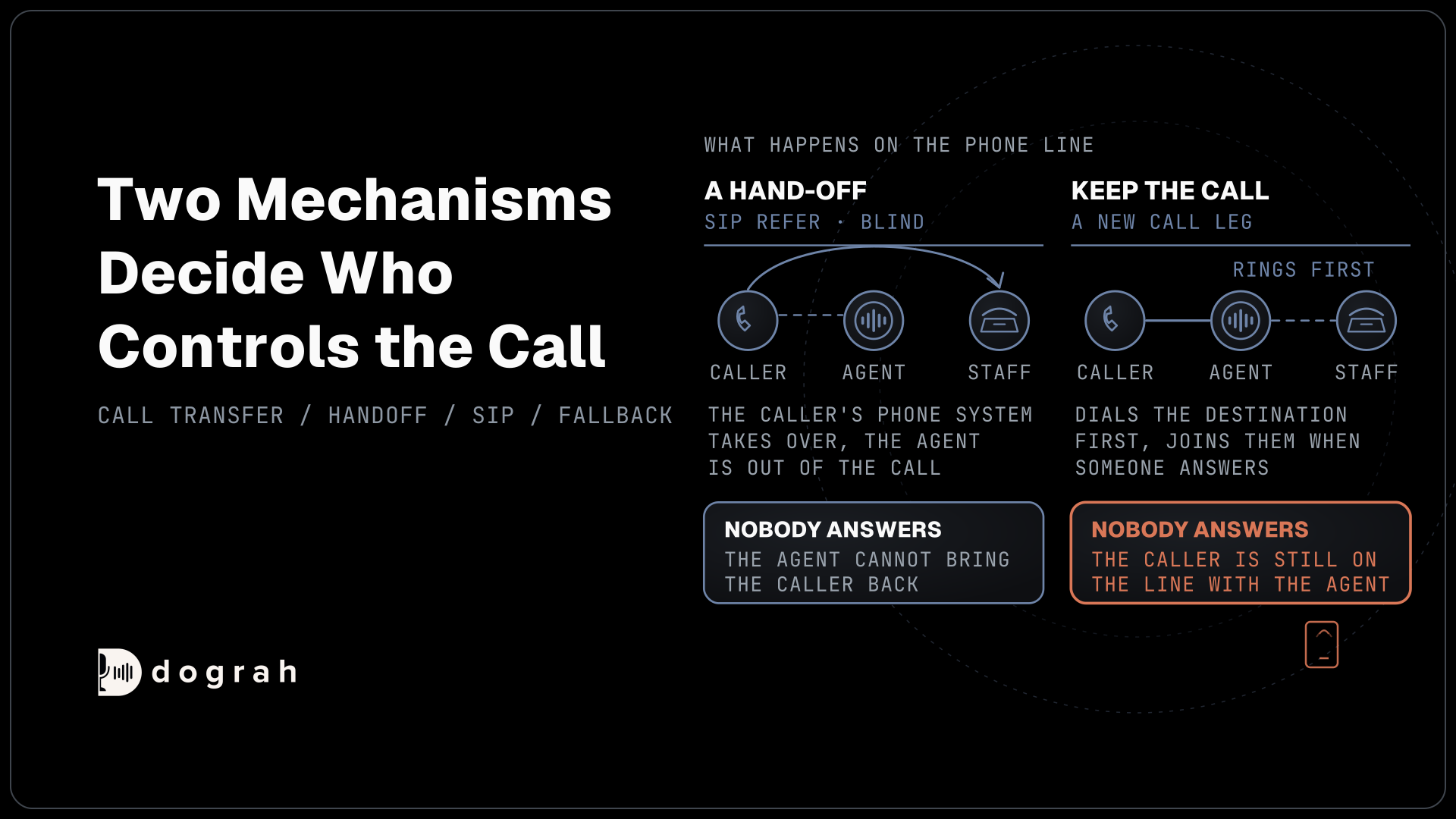
Under the names there are two mechanisms, and they decide who controls the call afterwards. The first is a hand-off. In SIP, the protocol most business calls run on, the REFER method from RFC 3515 asks the other side to call a third party, and call transfer is its best-known use. Once the caller's phone system takes over, the agent is out of the call. If the destination does not answer, the agent cannot bring the caller back.
The second mechanism keeps the call. The platform dials the destination as a new call leg, and when that leg answers it joins the two with a conference or a bridge. Twilio's own pattern for a supervised transfer works this way, with a Conference that dials in another person. Because the original leg never left, a failed transfer is just a second call that did not connect, and the caller is still on the line with the agent.
Dograh uses the second mechanism on every provider. It calls the destination first and connects the caller only when someone answers, joining them by conference on Twilio, Telnyx and Plivo and by a bridge on Asterisk.
When nobody answers the transfer
Every transfer needs a ring limit and a plan for what happens when it runs out. Carriers report the outcome in a few fixed values. Twilio's Dial verb rings for 30 seconds by default, with a minimum of five and a maximum of 600, and reports no-answer when nobody picks up in time, busy on a busy signal and failed when the number cannot be routed.
Telnyx's transfer command accepts a timeout between 5 and 600 seconds. When it runs out, the call ends and a hangup event arrives with timeout as the cause. That is the hand-off style in action, since the caller is gone along with the call.
A good fallback brings the caller back to the agent with the reason. The agent can then offer to try another team, take a message, or book a callback, and the callback request is written to your system so a person sees it. Keep the ring limit near half a minute for staff desks. Long rings feel like being dropped.

Open Source Alternative to Vapi / Retell
Self-hosted voice agent platform — no per-minute fees
dograh-hq/dograh
Star on GitHub
Choosing where the call goes
Destination rules come in three kinds, from a single fixed number to asking another system at the moment of transfer. A fixed destination suits a small office with one front desk. Rules suit a team with a handful of queues, mapping something the caller said, such as "billing", to the right extension. Asking your own system suits contact centers, where routing software knows which team is free right now.
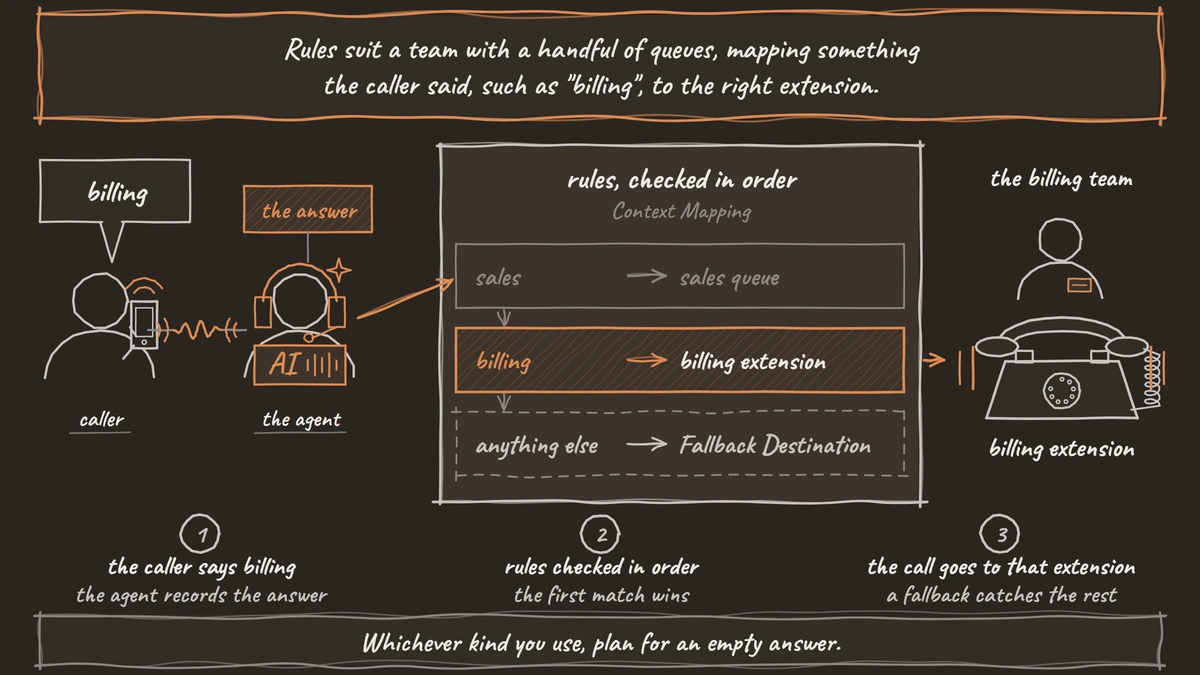
Dograh's Transfer Call offers the same three as Destination Source tabs. Static / Template takes one number or SIP endpoint, which can come from a variable. Context Mapping checks ordered rules against a value from the call, such as an answer the agent recorded, the first match wins, and a Fallback Destination catches the rest. Dynamic HTTP Resolver posts to your URL and waits up to 3 seconds by default for a destination, optionally speaking a short Resolver Wait Message meanwhile.
Whichever kind you use, plan for an empty answer. If the resolver fails or returns no destination, the transfer fails and the caller stays with the agent. Our post on human handoff routing walks through all three sources and what your system must return.
When the agent should hand over
Write the triggers into the agent's instructions, plainly and early. Common ones are a direct request for a person, a topic the agent must not decide on, such as a refund outside policy or a medical question, two failed attempts at the same task, and a caller who is clearly upset. Each trigger names where the call goes.
The request for a person deserves the most care, because callers make it often. In a Metrigy study of 503 consumers reported by No Jitter, 84.7% said they would prefer a human over an AI agent, and 80.1% would still prefer one even if the AI were sure to solve their problem. An agent that argues with that request loses the caller's trust.
Some laws require the route. Spain's customer service law, Ley 10/2025, gives customers of utilities, transport, postal, telecom and financial services, and of other consumer-facing companies with at least 250 staff or over 50 million euros in turnover or 43 million euros on the balance sheet, the right to a person on request, and expects 95% of calls answered within three minutes on average. If you take calls from Spain, confirm with counsel how it applies to your lines. For a support desk, our post on escalation rules for a helpdesk voice agent lists what should always reach a person.
Join the Dograh Community
Dograh is an OSS alternative to Vapi. Join our Slack community for queries, releases, best practices & community interactions.
What the person who answers knows
The person who picks up knows only what reaches them before or during the ring. There are two ways to give them context, a spoken line on the call or notes in a system they already have open.
In Dograh, the Pre-Transfer Message plays to the caller before the transfer, as No Message, a Custom Message or Pre-recorded Audio. On Twilio you can also play a short introduction that both people hear before they are connected, written by the agent from your instructions and limited to 25 words and 15 seconds. It is off by default and is skipped on speech-to-speech agents.
No summary travels with the call by default. If staff need the caller's name, account or reason on screen, have the agent write them to your helpdesk or CRM with an HTTP API tool just before the transfer, so the record is waiting when the phone rings.
Running transfers in Dograh
Transfer Call works on Twilio, Telnyx, Plivo, Cloudonix and Asterisk ARI. The destination is a phone number in international format or a SIP endpoint such as PJSIP/sales-queue, and on Asterisk it can be any extension or queue the PBX can reach. Dograh rings that destination first, and the caller joins only after someone picks up.
The Transfer Timeout runs from 5 to 120 seconds, 30 by default. When nobody answers, the line is busy or the call fails, the agent is told the transfer did not go through and the caller stays in the conversation. Tell the agent in its instructions what to offer next, and have it write any callback request to your system with an HTTP API tool. On a successful transfer, the Call Disposition After Successful Transfer setting records the outcome you choose.
Test transfers over a real phone call, because browser test calls cannot transfer. Our post on AI receptionist call transfer walks through the setup and the first test step by step, and our guide to open-source IVR and AI phone systems covers transfers back to staff on a PBX.
Not every handoff needs a person. Transfer to Agent passes the caller to another Dograh agent along with the conversation so far, for example from a general front desk to a billing specialist. It works between cascade agents, which run separate speech, language and voice models.
On cost, the transfer leg is a second call, so your carrier bills its minutes too. Self-hosted Dograh has no per-minute platform fee, but servers, model keys and phone minutes still cost money. Dograh Cloud adds a 1¢-a-minute platform fee. Self-hosting also puts the server, the database and the upgrades in your team's hands, with community support on the open-source version and custom SLAs on the Enterprise plan for teams that need them.
Glossary
- SIP REFER
- A SIP request that asks the other side of a call to contact a third party, defined in RFC 3515. Used for blind transfers, it hands the call away, so the sender cannot take the caller back if nobody answers.
- Call leg
- One connection between two endpoints inside a phone call. A transfer that keeps control dials the destination as a second leg and joins it to the caller's leg by conference or bridge once someone answers.
- Transfer timeout
- How long the destination rings before the transfer counts as unanswered. Twilio defaults to 30 seconds and Dograh's Transfer Timeout to 30, settable from 5 to 120.
- Context Mapping
- A Dograh Destination Source that picks the transfer number from ordered rules about a value from the call, such as an answer the agent recorded. The first matching rule wins, and an optional Fallback Destination catches anything else.