
On noisy phone calls, guard interruptions before you touch the detector. Require two or more transcribed words before the agent stops talking, then raise the speech threshold or volume floor only if bursts still trip it. Dograh, the open-source AI voice agent platform we build, has the word guard in its editor, self-hosted or on Dograh Cloud.
Key Takeaways
- A TV is real speech, so no threshold filters it. Count words instead.
- Measure false and missed barge-ins on 20 recorded calls before changing anything.
- Change one value, re-count on the same calls, then keep or revert it.
This post is part of our guide to voice activity detection, where noise is one of four ways a phone line trips the detector. Below, we match each kind of noise to the setting that handles it, then show how to measure false barge-ins on your own calls.
Match the fix to the kind of noise
Noise is four different problems on a phone line, and each one needs its own fix. Other voices, such as a TV or someone else in the room, are real speech. A good detector scores them as speech because they are, so no threshold will filter them out. The guard that works here counts words.
Short bursts are the second kind: a cough, a door, a passing truck, a dropped cup. They are loud and brief and rarely produce two clear words, so a word count ignores them, and a longer start time on the detector ignores most of them too. A steady hum, from a fan, an engine or a bad line, is the third kind. It sits under the caller's voice for the whole call, and the detector's volume floor and threshold are the settings that touch it.
The fourth kind is the agent's own voice leaking back. On speakerphone or a car's Bluetooth, the agent's words can return through the caller's microphone, get transcribed and look like an interruption. Test calls catch it best. Place calls from a speakerphone and a car, and listen for the agent stopping at its own words.
Here is an example with a TV on. On the default count of 2 words, a newsreader's "the weather tomorrow" can pass the count if the speech-to-text model picks it up, and the agent stops mid-sentence. Raising the count to 3 or 4 blocks most TV fragments, but it also means a caller's two-word "no, stop" no longer stops the agent. Test what your callers really say when they object before you settle on a number.
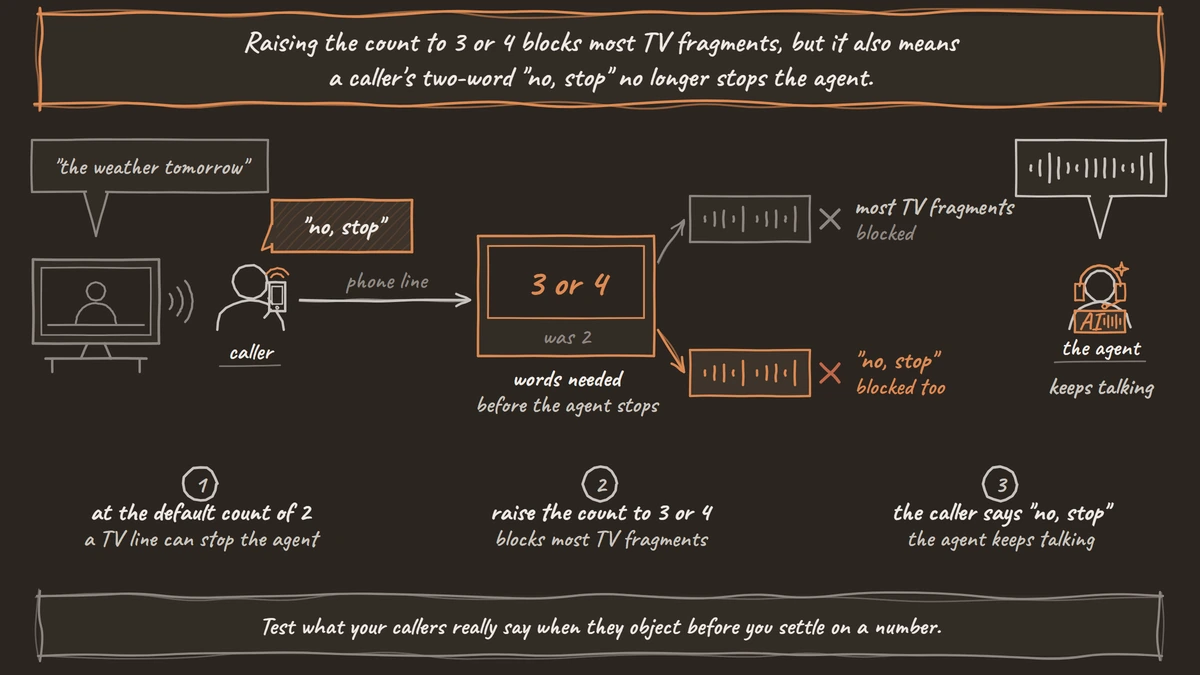
The word guard comes first
The word guard is one editor setting, so try it before any detector value. In the agent's Settings, the Interruption Strategy is Minimum words by default, and Minimum Words Before Interruption is 2, settable from 1 to 10. The count reads interim transcripts too, so a real interruption is caught as soon as the first words are transcribed.
The count only applies while the agent is speaking. When the agent is silent, a single word starts the caller's turn, so a higher count never makes the agent deaf to a caller who is answering a question. The other strategy, Voice activity, stops the agent on any detected speech and suits quiet lines only.
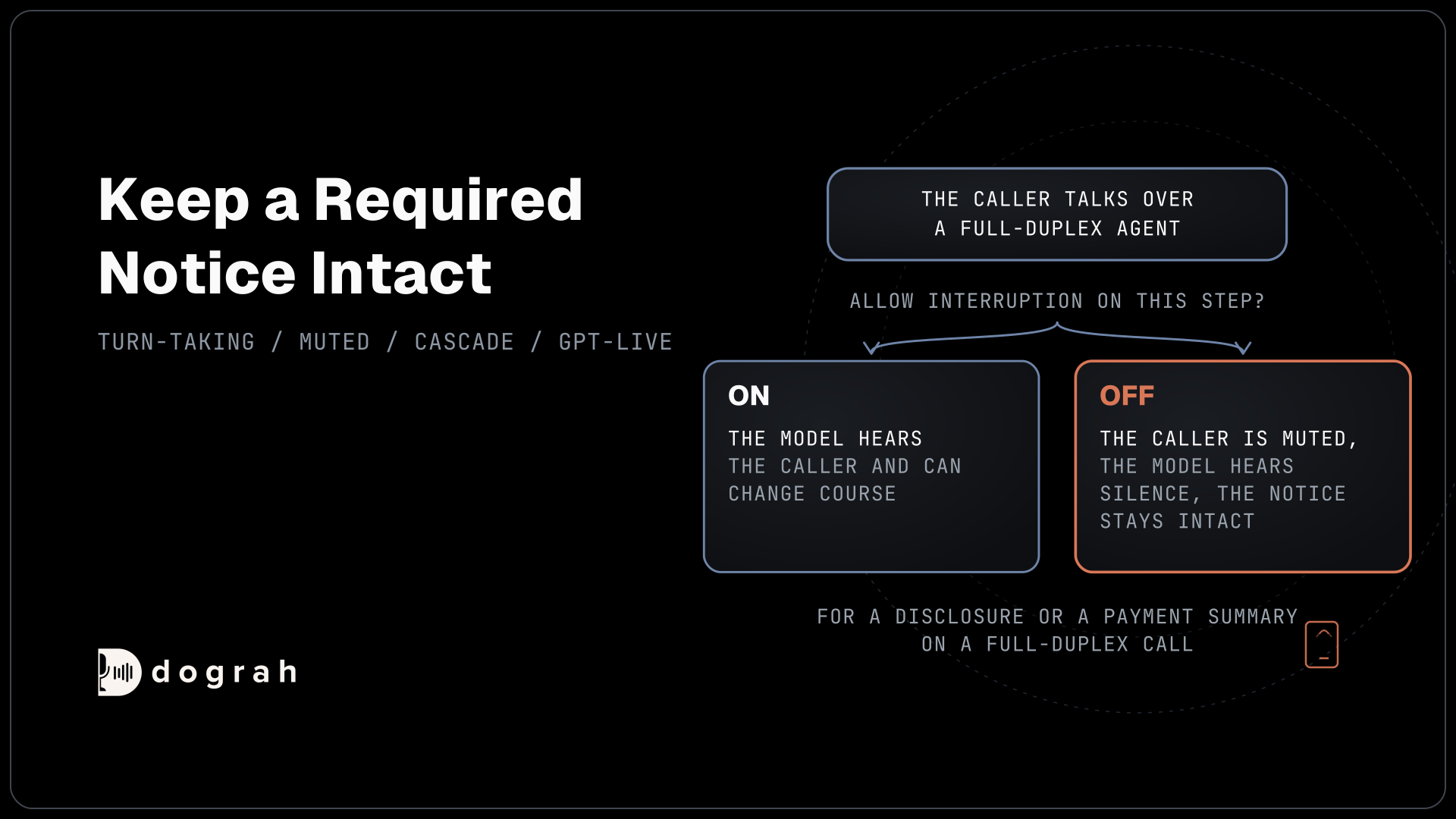
Interruption can also be switched off step by step with Allow Interruption, which is on for every new Agent step. Switch it off on short lines that must play in full, such as a read-back. The greeting has its own pair on the Start Call node: Allow Greeting Interruption, on by default, and Minimum Words to Interrupt, 2 on a cascade agent. Our post on accents and background noise shows the word guard at work on a street call.

Open Source Alternative to Vapi / Retell
Self-hosted voice agent platform — no per-minute fees
dograh-hq/dograh
Star on GitHub
What each detector value trades
Detector values in Dograh are set in code, and each one trades one problem for another. Dograh runs Silero through Pipecat's VAD settings, using Pipecat's default values. Speech starts when frames score above a confidence of 0.7, stay above a volume floor of 0.6, and keep that up for 0.2 seconds. Speech stops after 0.2 seconds below the line.
Raising the confidence makes the detector harder to fool with hum, and it also misses soft or distant voices. A longer start time, such as 0.3 seconds, ignores more short bursts, and every real interruption then registers a little later. A higher volume floor drops quiet background voices along with quiet callers, which hurts older callers and bad mobile lines first. The stop time is a turn setting more than a noise setting, so leave it alone for noise.
Two outside numbers help set expectations. Silero's release notes for v6.0 report 16% fewer errors on noisy real-life data, so the detector itself has improved on noise. Microsoft's guide for Azure Voice Live suggests a threshold of 0.3 to 0.4 for quiet rooms and 0.5 to 0.7 for noisy call centres. Those values belong to Azure's own detector, so they do not carry over to Silero's scores.
Self-hosted teams can change the Silero values in run_pipeline.py and rebuild, and our comparison of LiveKit VAD and Pipecat VAD settings lists the matching LiveKit names.
Measure false barge-ins on 20 calls
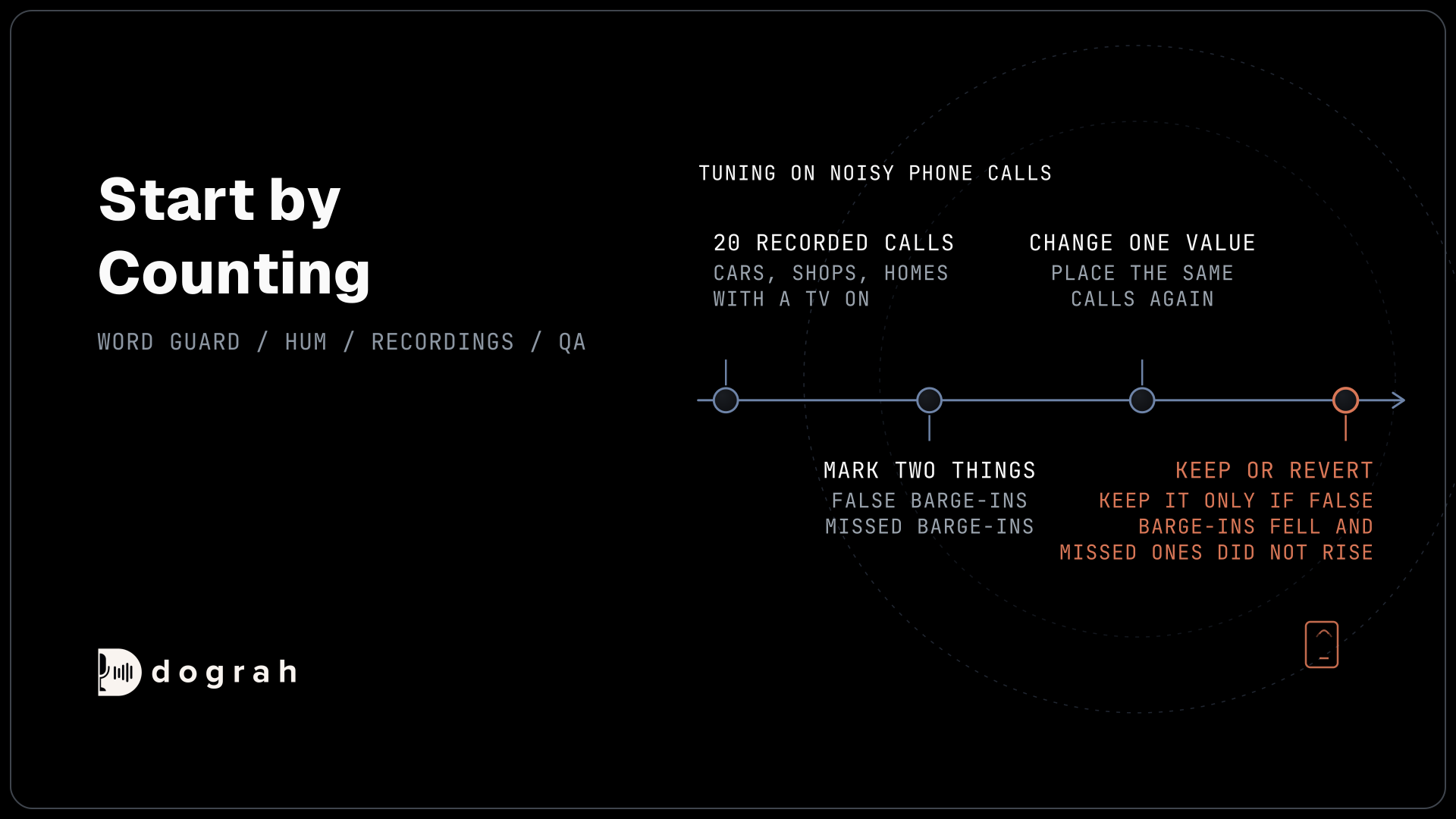
Tuning without a count turns into guessing, so start by counting. Pull 20 recorded calls from noisy places, such as callers in cars, shops or homes with a TV on. For each call, read the transcript and listen to the recording, and mark two things.
A false barge-in is the agent stopping when no real words followed, such as a stop on a cough or a TV line. A missed barge-in is the caller objecting while the agent kept talking. Each call's View Trace shows the timing of every turn, so you can see exactly where the agent stopped.
Then change one value, publish, and place the same scripted calls again from the same noisy rooms. Re-count both numbers. Keep the change only if false barge-ins fell and missed ones did not rise. Once the agent is live, sample real calls with Dograh's built-in QA to keep watching both, as our guide to automated QA explains. Self-hosted, the noisy recordings you tune on stay on your own servers.
Join the Dograh Community
Dograh is an OSS alternative to Vapi. Join our Slack community for queries, releases, best practices & community interactions.
Where these settings do not reach
In Dograh, noise on the caller's side is handled by the interruption and turn settings above. Use Ambient Noise is a separate feature: it adds background sound to the agent's own voice so it sounds like a real office, and it leaves the caller's audio as it is.
If the speech-to-text model is Deepgram Flux, Cartesia ink-2 or Dograh's own speech-to-text in Multilingual mode or one of its 10 single languages, the Voice activity strategy follows the provider's signal that the caller started speaking. A noise-triggered stop on that path comes from the provider, while Minimum words still applies. On speech-to-speech models, the provider makes the barge-in decision, and the word guard works on cascade agents only.
The line itself sets the audio rate. Twilio, Plivo, Vobiz and Asterisk send 8 kHz audio, and Vonage sends 16 kHz, so test on the carrier your callers use. Short listening sounds such as "mm-hm" are a separate question, covered in our post on barge-in, endpointing and turn-taking.
Glossary
- False barge-in
- The agent stopping mid-sentence when the caller did not really interrupt, such as for a cough, a door or a TV line. Count it on recorded calls before and after each settings change.
- Missed barge-in
- The caller trying to interrupt, such as saying no or correcting a detail, while the agent keeps talking. Raising the word count to cut false barge-ins can increase this one.
- Minimum Words Before Interruption
- The number of transcribed words a caller must say before the agent stops talking, 2 by default in Dograh and settable from 1 to 10. It applies only while the agent is speaking.
- Volume floor
- The loudness a sound must reach before the detector counts it as speech, 0.6 in Pipecat's defaults. Raising it drops quiet background voices, and quiet callers with them.