
Murf TTS runs live voice agents on Falcon 2.1, its streaming model, at 1 cent per 1,000 characters. Self-serve plans allow 5 streams at once on US-East and 2 on other endpoints. Teams that want to own the platform can run Murf on Dograh, the open-source AI voice agent platform, self-hosted or on Dograh Cloud.
Key Takeaways
- Only Falcon 2.1 streams on Murf, and the falcon-2 name now maps to it.
- Self-serve Murf allows 2 concurrent streams outside the US-East endpoint.
- In Dograh, set Murf's Base URL to a regional host for data residency.
Murf's Gen2 voices are made for studio voiceovers, and Falcon 2.1 is its model for live calls. Below we cover how it streams, the per-region limits a phone team hits first, regions and price, then we talk about setting up a Murf voice in Dograh and testing it on a real call.
Falcon 2.1, Murf's model for live calls
Falcon 2.1 is the only Murf model to use on a live call. Murf built Falcon 2.1 for real-time conversational AI, with time to first audio under 100 ms by its own measure. The earlier names falcon-2, falcon2 and FALCON are still accepted and now run on Falcon 2.1, so an integration set up last year upgraded without a code change.
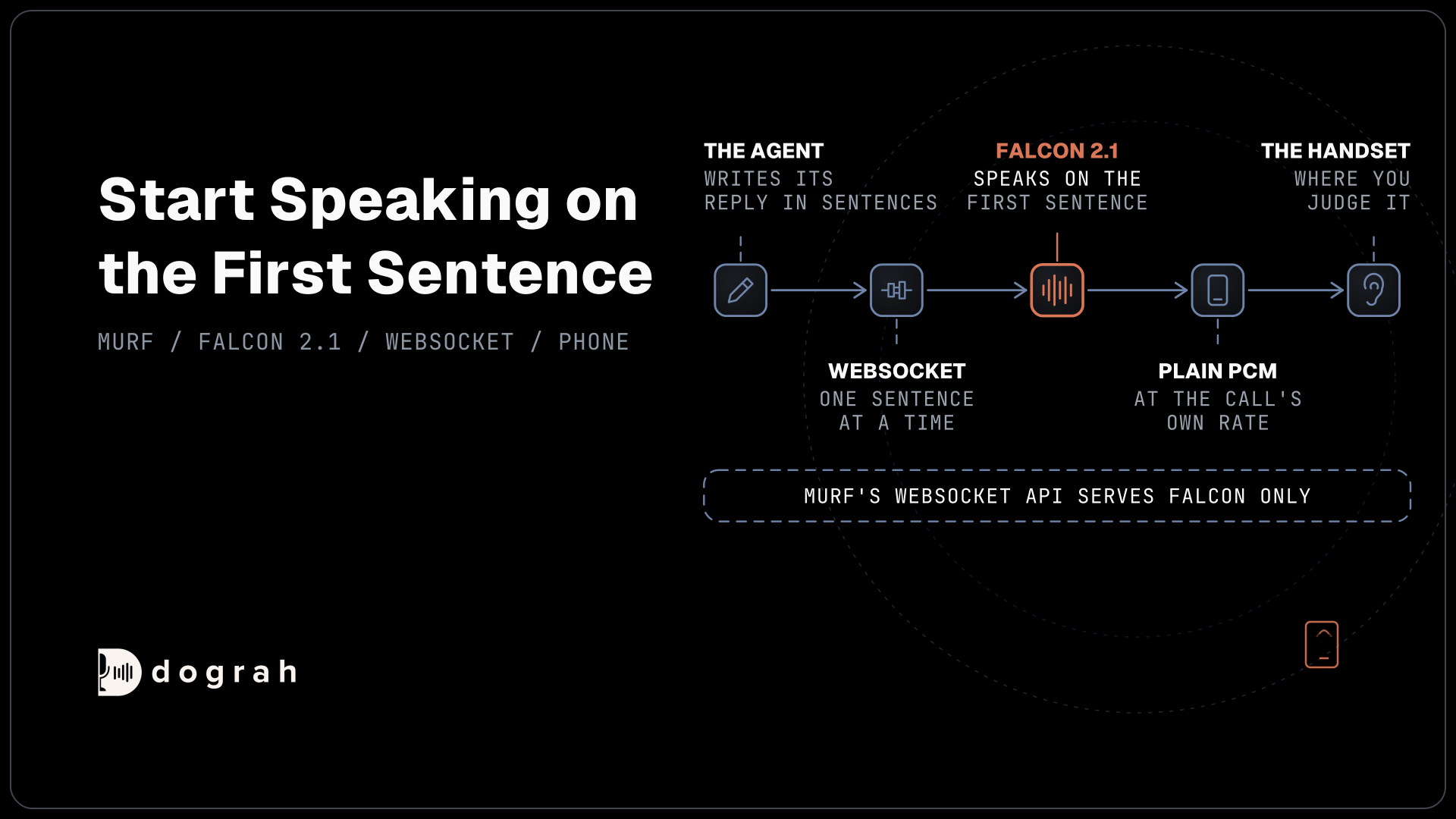
Gen2, Murf's studio model, has been decommissioned for streaming, and Murf's WebSocket API serves Falcon only. That matters on a call because the agent writes its reply sentence by sentence, and a voice has to start speaking on the first sentence rather than wait for the paragraph.
Independent listeners rate it well. On the Artificial Analysis Speech Arena, a live leaderboard built from blind votes, Falcon 2 sits at rank 31 and Falcon 2.1 at rank 32 of 105 models.
Murf's concurrency is set per region
The limit a phone team meets first with Murf is how many streams can run at once, and Murf counts it per region. Murf's rate limits give the Free and Pay as you go plans 5 concurrent Falcon 2.1 streams on the US-East endpoint and 2 on the global and regional endpoints. Enterprise supports up to 10,000 concurrent calls.
The global endpoint sends each request to the nearest region, so your limit depends on where the request came from. A request from India lands in the India region, which allows 2. For a voice agent that means the server's location sets the ceiling, and a third simultaneous caller on a self-serve plan can be refused a voice.
Open connections are counted apart from streams. Murf allows ten times your stream limit in open sockets, an idle socket uses no stream slot, and a connection closes after three minutes with no activity. Plan the peak hour against the stream number, then talk to Murf about Enterprise before a campaign needs more. Our post on STT and TTS concurrency limits explains when spreading load across keys helps and when the provider counts the whole account.
Regions and where the text is processed
Murf runs eleven regional environments, including US-East, US-West, India, Canada, the UK, EU Central, Japan, Australia, South Korea, the UAE and São Paulo. Murf offers data residency to all customers on the regional URLs, and input text, generated audio and processing data stay in the chosen region.
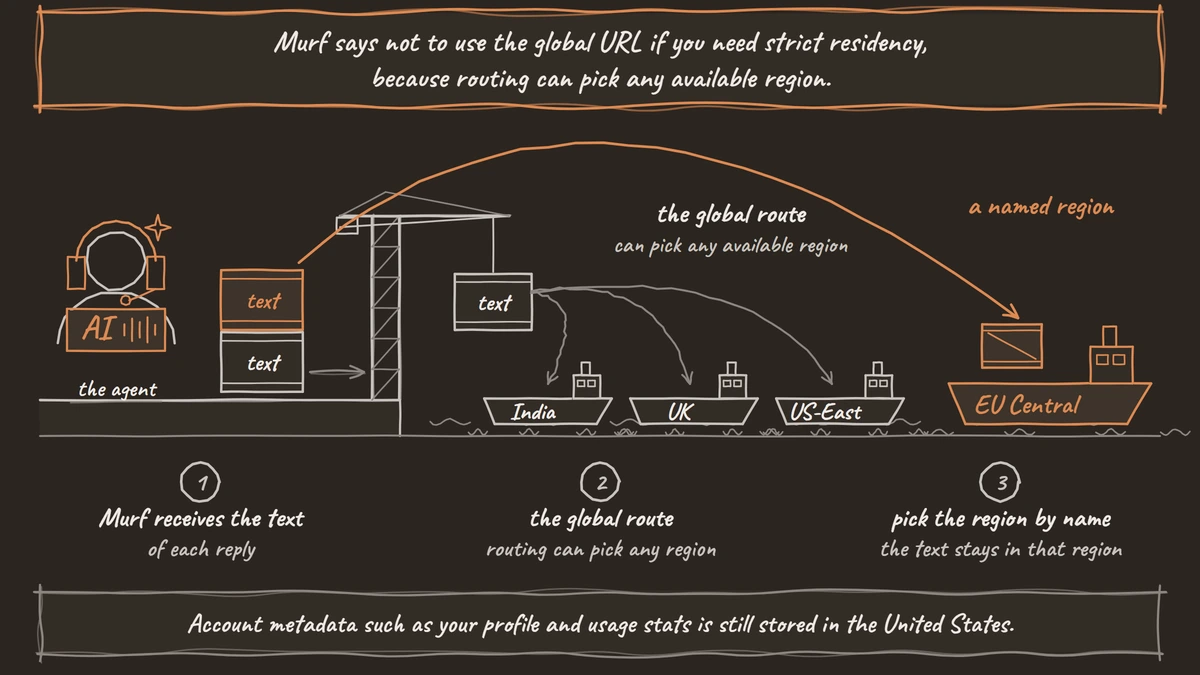
Two details change the plan. Murf says not to use the global URL if you need strict residency, because routing can pick any available region. Account metadata such as your profile and usage stats is still stored in the United States. For a European agent, our list of EU-hosted LLM, STT and TTS providers shows the EU host for Murf next to the other layers of the stack.

Open Source Alternative to Vapi / Retell
Self-hosted voice agent platform — no per-minute fees
dograh-hq/dograh
Star on GitHub
Voices, languages and 8 kHz phone audio
Murf lists more than 150 Falcon 2.1 voices in over 20 speaking styles, and its locale list is unusually deep for Indian languages. Hindi, Tamil, Telugu, Bangla, Marathi, Kannada, Malayalam, Gujarati, Punjabi, Odia and Assamese all appear, along with Hinglish as hi-LATN and one general Arabic locale, ar-XA. Our post on multilingual TTS for voice agents compares Murf's Hindi, Spanish and Arabic coverage with other providers.
Phone audio is the other half of the choice. Murf's streaming API accepts a sample rate of 8000, the rate most phone lines still carry, and offers mu-law and A-law output. Dograh asks Murf for plain PCM audio at the call's own rate, which is 8 kHz on Twilio, Telnyx, Plivo, Cloudonix, Asterisk ARI, Exotel and Vobiz, and 16 kHz on Vonage and WhatsApp. A browser demo runs at 16 kHz, so a voice that sounds rich there can sound thinner on a handset, and the phone is where you judge it.
What Falcon 2.1 costs for a month of calls
Murf prices Falcon 2.1 by the character, at 1 cent per 1,000 characters, which makes the math short. Here is an example for a reminder line.
- 3,000 short reminder calls a month, with the agent speaking about 1,500 characters on each.
- 3,000 x 1,500 = 4.5 million characters.
- 4,500,000 / 1,000 x $0.01 = $45 for the month.
Lines that play as pre-recorded clips send no characters to Murf, so a recorded greeting and fixed notices drop out of that count. Our guide to the best text-to-speech APIs for voice agents puts Murf's rate beside per-minute and per-credit pricing from other vendors.
Join the Dograh Community
Dograh is an OSS alternative to Vapi. Join our Slack community for queries, releases, best practices & community interactions.
Setting up a Murf voice in Dograh
Murf became a built-in voice provider in Dograh in release v1.51.0, so it runs on your own Murf key with no code. Open Providers in the sidebar, click Add Provider and choose Murf. The provider connection takes the API key and a Base URL, which defaults to https://global.api.murf.ai and uses the nearest server. For residency or a known limit, replace it with a regional host such as eu-central.api.murf.ai or us-east.api.murf.ai.
Next, open Models, click Add Configuration and choose BYOK, then pick the Murf connection on the TTS tab. The voice settings show three fields. Model defaults to falcon-2, which Murf now serves as Falcon 2.1. Voice takes a Murf Voice ID pasted from Murf's Voice Library, with Will as the default. Locale defaults to en-US, and you set the locale your chosen voice supports, such as hi-IN for a Hindi voice.
Dograh streams over Murf's WebSocket and sends the reply a sentence at a time, so it turns Murf's own buffering down to keep the first word early. You choose the configuration per agent in the editor's Model tab or in Settings under Model Configuration, and publishing makes it live.
Test it the way callers will hear it. The Phone Call button in the editor header calls a phone number or SIP endpoint you enter, while Test Agent opens a browser call. After a few phone calls, the call trace shows the voice time of every turn, so you can compare a regional Base URL with the global one on your own network path.
Where the text goes and running Dograh yourself
Murf receives the text of each reply and returns audio, so the agent's words reach Murf's chosen region even when Dograh runs on your own servers. Bring your own key moves the contract to your Murf account, while the text still travels to Murf. Dograh is the orchestration layer that runs the call flow, tools and telephony, and the speech and language models are a separate layer you choose, so a team that cannot send text out at all would pick an open voice on its own GPU instead.
The Murf bill reaches your own account wherever the platform runs. Self-hosted Dograh has no per-minute platform fee, but servers, model keys and phone minutes still cost money. Dograh Cloud charges a 1¢-a-minute platform fee. Running it yourself means the server, the database and the upgrades belong to your team, with community support on the open-source edition and custom SLAs on Enterprise.
Pick the regional Base URL before you pick the voice, since it sets both the stream limit and where the text is processed. Then shortlist two Falcon 2.1 voices and judge them on real phone calls.
Glossary
- Falcon 2.1
- Murf's streaming text-to-speech model for live conversations. The older falcon-2, falcon2 and FALCON names are now served by it, and it is the only Murf model on the WebSocket API.
- Concurrent streams
- How many text-to-speech streams can generate audio at the same moment. Murf sets it per plan and per region, 5 on US-East and 2 elsewhere on self-serve plans.
- Regional endpoint
- A Murf host tied to one region, such as eu-central.api.murf.ai. Using it keeps text and audio in that region, while the global URL routes to whichever region is nearest.
- Murf Voice ID
- The name of a voice in Murf's Voice Library, such as Will. In Dograh you paste it into the Voice field and set a Locale that voice supports.