
Qwen3-TTS is an open voice model family from Alibaba's Qwen team, Apache-2.0, with ten languages, nine preset voices and cloning from three seconds of audio. In our English test, as hosted on Replicate, it tied for third of seven on tricky text, at 0.49. For phone calls it needs a server you put in front of it.
Key Takeaways
- Qwen3-TTS covers ten languages under Apache-2.0 and clones from three seconds.
- In our English test it tied for third of seven, at 0.49.
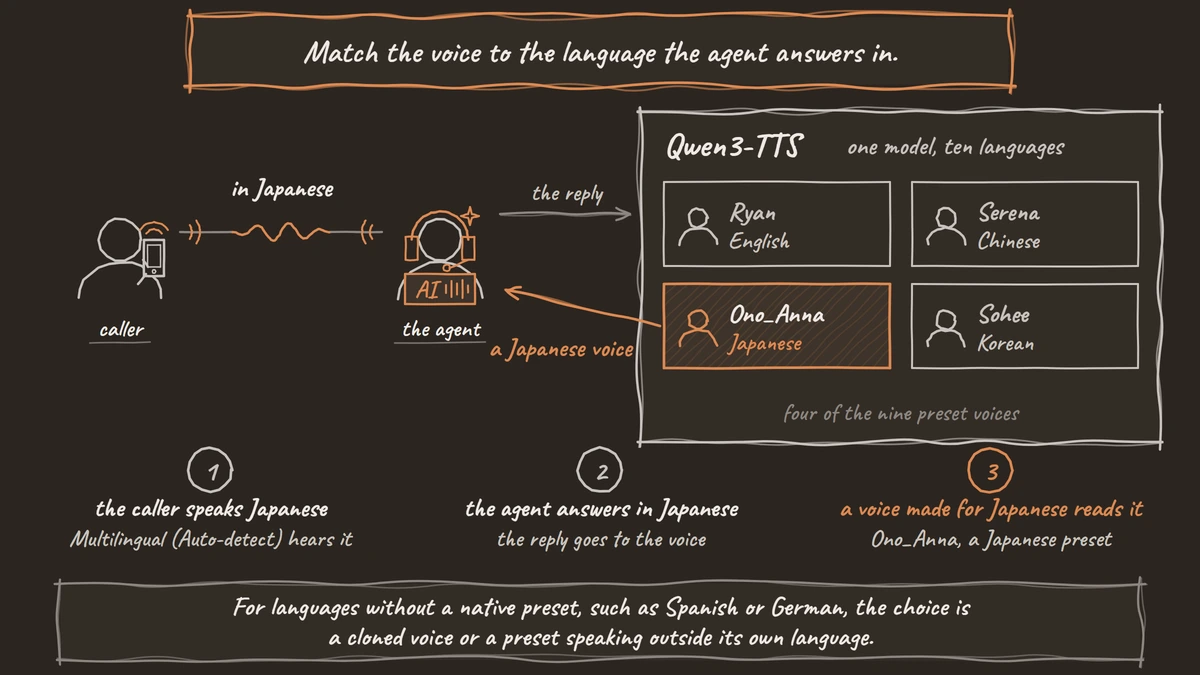
- Match the voice to the language the agent answers in.
This post is part of our guide to open-source TTS models, where Qwen3-TTS brings ten languages into one Apache-2.0 model. Below, we cover its voices and cloning, our English benchmark result, what serving it for live calls takes, and how it runs behind Dograh on a phone line.
What Qwen3-TTS offers a voice agent
Qwen3-TTS gives you many languages in one open model. Qwen3-TTS on GitHub lists ten: Chinese, English, Japanese, Korean, German, French, Russian, Portuguese, Spanish and Italian. The models are Apache-2.0, in two sizes, 0.6B and 1.7B parameters.
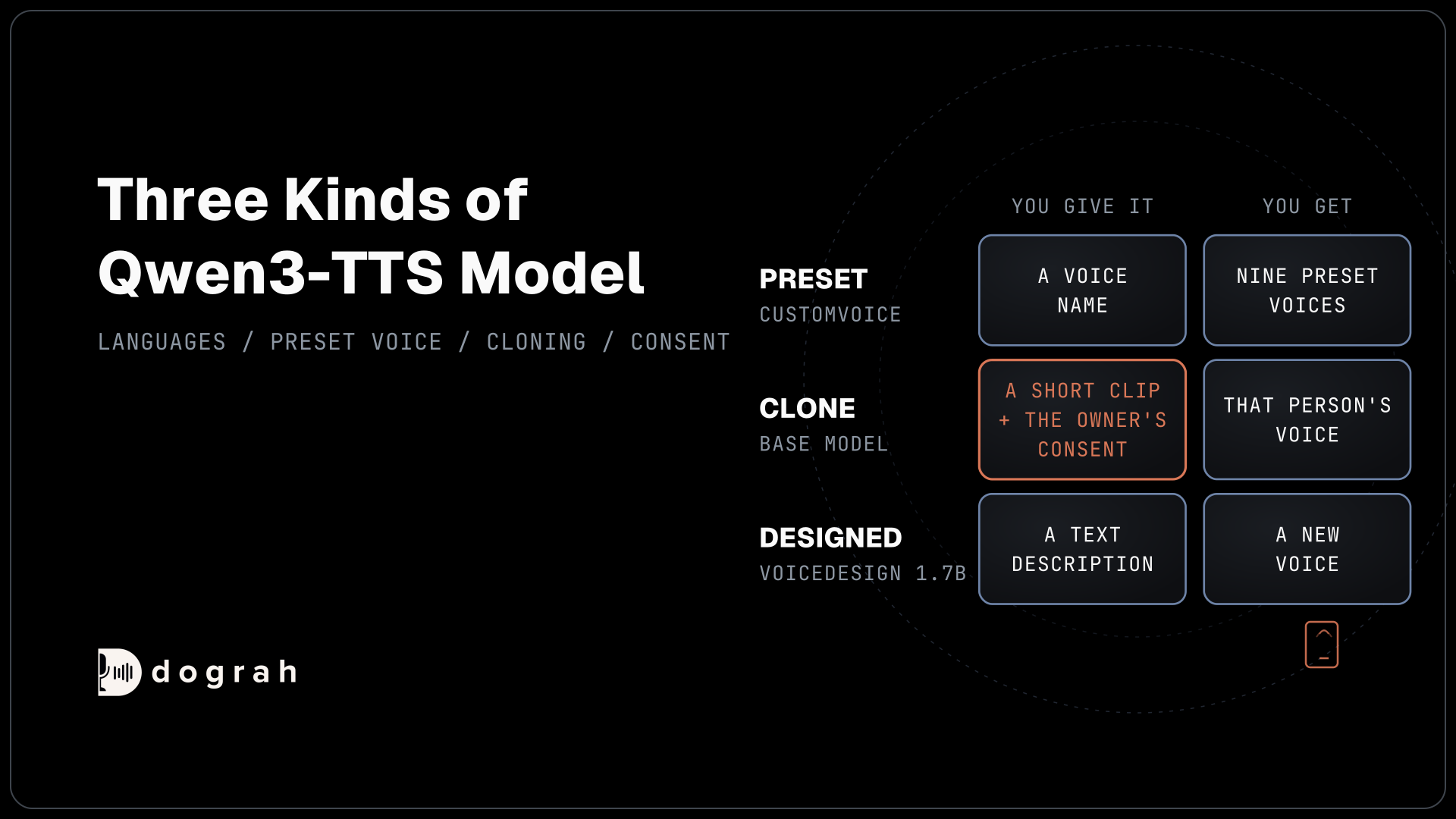
There are three kinds. CustomVoice models speak in preset voices. Base models clone a voice from a short clip. A 1.7B VoiceDesign model builds a new voice from a text description. The same model streams audio as it goes or makes a whole clip at once.
The CustomVoice model card lists nine preset voices. Five are Chinese, among them Serena, Vivian and two dialect voices. Ryan and Aiden are English, Ono_Anna is Japanese and Sohee is Korean. For languages without a native preset, such as Spanish or German, the choice is a cloned voice or a preset speaking outside its own language.
How qwen3-tts did in our English test
In our TTS verbalization benchmark, seven open models read 1,080 English sentences full of dates, prices, phone numbers and codes, and two independent speech recognizers transcribed what each said. In our English test, as hosted on Replicate, qwen3-tts scored 0.49, tied for third with chatterbox-turbo. kokoro-82m led at 0.61.
It was best of the seven on units, at 0.72, and on fractions, coordinates, math and sports scores. It read sports scores at 0.90, stock tickers at 0.92 and decimals at 0.82. Its weak spots were phone numbers at 0.41, times at 0.38, and dates and addresses at 0.17. Dates were hard for every model in the test.
It needed 4.99 seconds of compute per clip on Replicate, against 0.31 for kokoro-82m. That is a whole-clip figure, not the wait before the first word.
Two limits apply. The test used Serena, a preset Qwen lists as Chinese, and Replicate does not say which size it runs, so an English preset or another size may score differently. Our data also says nothing about its other nine languages.

Open Source Alternative to Vapi / Retell
Self-hosted voice agent platform — no per-minute fees
dograh-hq/dograh
Star on GitHub
Three-second voice cloning, with consent
The Base models clone a voice from about three seconds of reference audio, shorter than the roughly ten seconds in Chatterbox's own example. That makes a custom brand voice quick to try, and it also makes misuse easy.
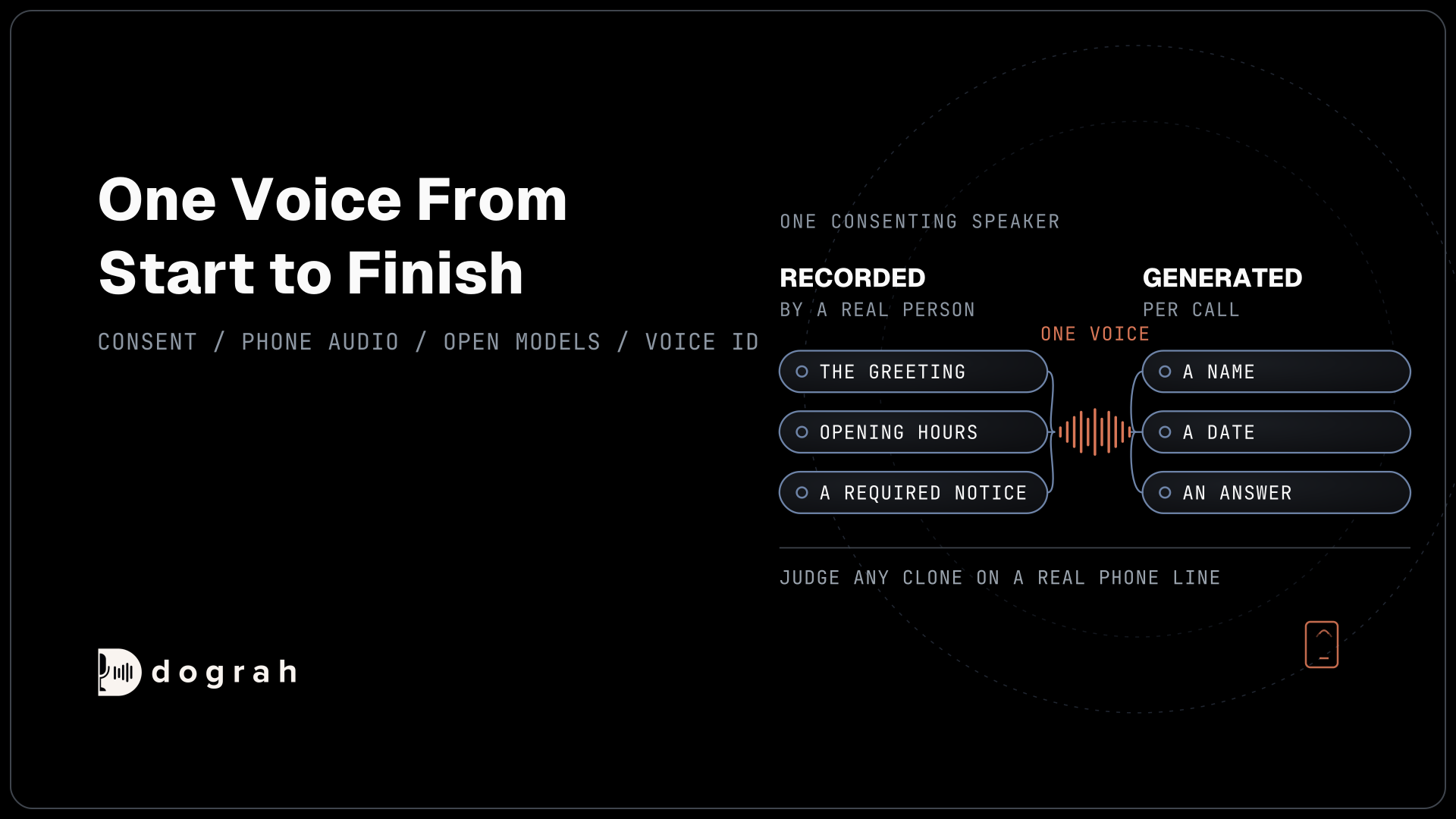
Only clone a voice when its owner has agreed, and store that consent alongside the recording. If a real person records your fixed lines, cloning the same person keeps recorded and generated speech in one voice. Our guide to voice cloning for pre-recorded audio and TTS walks through that setup and what to tell callers.
Serving Qwen3-TTS for live calls
Qwen's speed figure is real but narrow. The Qwen3-TTS technical report gives a first audio packet in 97 ms for the 0.6B model and 101 ms for the 1.7B, measured with one request at a time on Qwen's own serving engine. A phone deployment runs many calls at once, and we found no sourced figure for Qwen3-TTS under that kind of load.
The serving tools are still filling in. The repo notes that vLLM-Omni supports offline inference only, with online serving "supported later". The official repo ships no OpenAI-style speech server, and Qwen points to its hosted API for faster use. Clore.ai, a GPU host, lists about 4 GB of GPU memory for the 0.6B model and 8 GB for the 1.7B.
So a live deployment means a server you build or adopt, with streaming turned on, measured on your own GPU with several calls running before real callers hear it.
Join the Dograh Community
Dograh is an OSS alternative to Vapi. Join our Slack community for queries, releases, best practices & community interactions.
Running Qwen3-TTS with Dograh
In Dograh, orchestration is one layer covering the call flow, tools and telephony, and the speech and language models you choose make up a separate one. A self-hosted voice goes through the Local Models (Speaches) option in the voice settings, which calls an OpenAI-style /v1/audio/speech endpoint and plays raw 24 kHz PCM.
Put Qwen3-TTS behind a server that returns raw 24 kHz PCM from that endpoint, choose Local Models (Speaches), enter the server's address and model name, then run a test call with your setup.
For callers in more than one language, set speech-to-text to Multilingual (Auto-detect). Greeting Text plays before Dograh can hear the caller's language, so write it in both, for example "Hola, hello". Then pick a preset voice made for that language, or a clone, since the voice must match the language the agent answers in.
If a hosted voice suits you better, our comparison of the best TTS APIs for voice agents covers the providers you can select by key.
Glossary
- Preset voice
- A ready-made speaker that ships with a CustomVoice model. Each Qwen3-TTS preset is tied to a language, so a Chinese preset reading English may not sound like a native English voice.
- Base model
- The Qwen3-TTS model that clones a voice from a short reference clip, about three seconds. Clone only a voice whose owner has agreed to it.
- First audio packet
- The first piece of audio a model sends back. Qwen reports it in 97 ms for 0.6B at one request at a time, which is not the same as the wait with many calls running.
- Compute per clip
- The median time Replicate billed to make one whole clip in our benchmark. qwen3-tts needed 4.99 seconds and kokoro-82m 0.31, which shows how heavy each is to run, not how long a caller waits.