
Ultravox suits developers who want a speech-native model that hears callers directly, hosted at $0.05 a minute with the voice included. Pay as you go allows 5 calls at once, and the platform is closed though the weights are MIT. Dograh, the open-source AI voice agent platform we build, runs Ultravox on your key, self-hosted or on Dograh Cloud.
Key Takeaways
- Ultravox hears audio directly but replies in text, so a voice still speaks.
- Hosted minutes cost $0.05 with the voice. Pay as you go allows 5 at once.
- The MIT weights sit on GLM 4.6, a model of about 357B parameters.
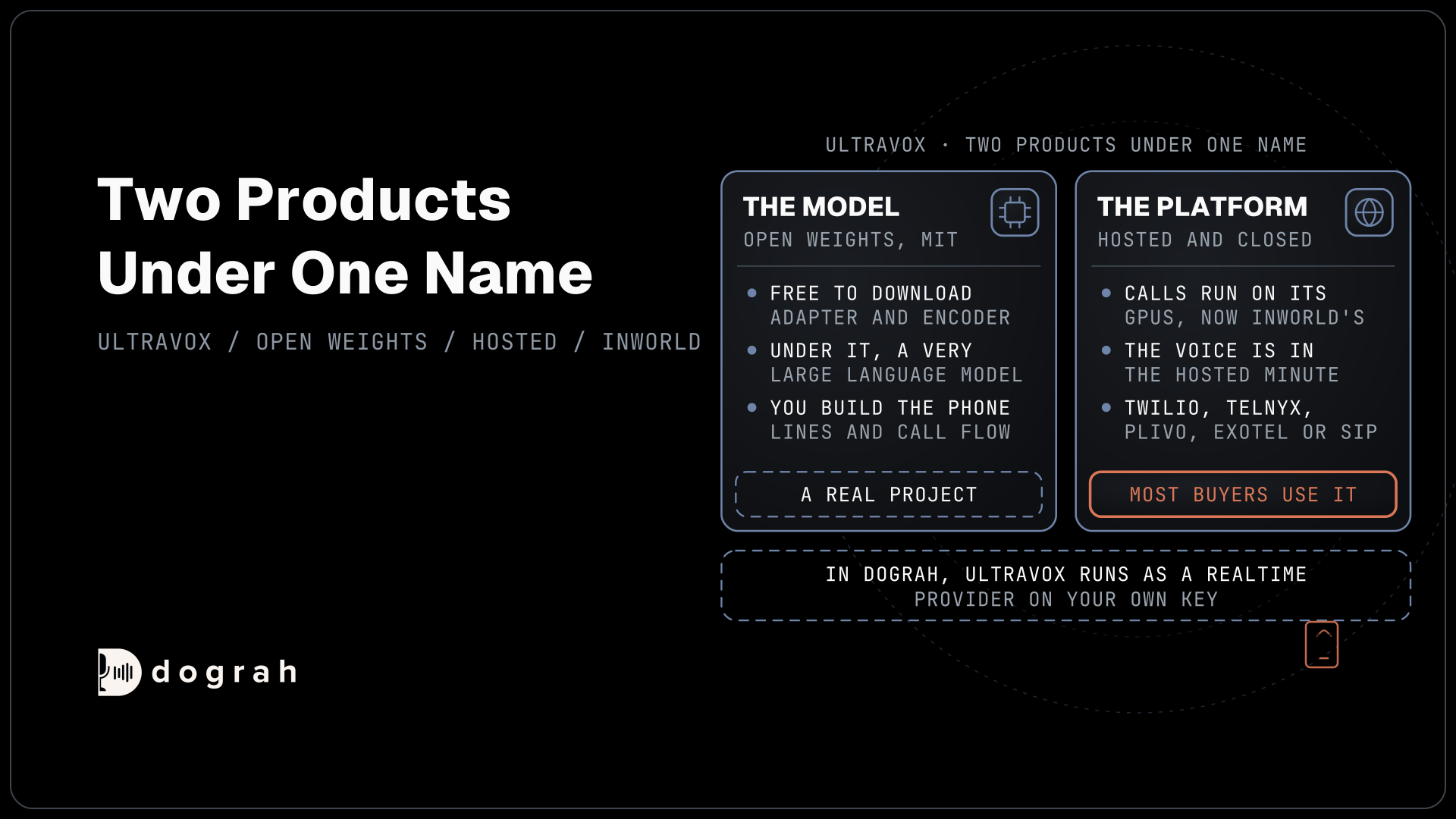
Ultravox is two products under one name, an open-weight speech model and a hosted agent platform, and this review keeps them apart. We cover the new owner, how the model hears a call, prices and phones, the open weights, then who it fits. The last section covers Dograh.
Ultravox now belongs to Inworld
Inworld now owns Ultravox, and for current customers very little moved. Inworld's announcement, dated September 30, 2026, says agents keep running and "There is no migration or code change required". Customers keep their Ultravox accounts, and the built-in Inworld voices moved to Inworld's Realtime TTS-2 at no additional cost. One plan did change. The old Scale plan is no longer offered, and Scale customers can move to Inworld's Growth tier. Everything below describes the product as it is sold now.
Ultravox pros and cons at a glance
Ultravox is strongest as a model and simplest as a price, and its limits sit in the platform around it. Each row is covered, with its source, in the sections below.
| Area | Strength | Limit |
|---|---|---|
| Model | Hears audio directly, with no separate speech-to-text step | Replies in text, so a voice model still speaks |
| License | Model code and v0.7 weights under MIT | The hosted platform is closed |
| Price | $0.05 a minute with the voice, 30 minutes free | Pro is $100 a month, billed yearly |
| Calls at once | No hard cap on Pro | 5 on Pay as you go, and busy peaks can return HTTP 429 |
| Phone | Native Twilio, Telnyx, Plivo and Exotel, plus SIP | SIP adds 0.5¢ a minute on Pay as you go |
| Voices | Bring your own ElevenLabs or Cartesia key | Five custom voices on Pro |
| Building | API and console for developers | Suits teams that work in code |
| Self-hosting | Weights are free to download | The base model is about 357B parameters |
How a speech-native model hears a call
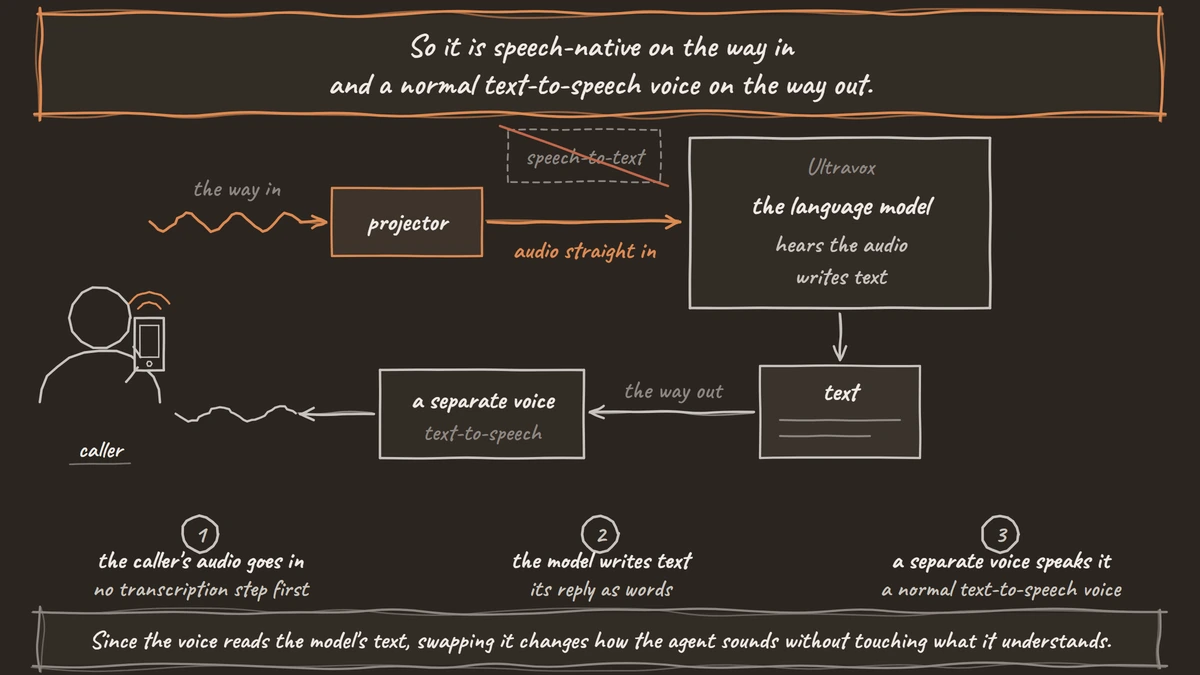
Ultravox skips the transcription step on the way in, and that is its whole design. The Ultravox repository describes a model that "takes in audio and emits streaming text". A small part called a projector maps the caller's audio straight into the language model's own input, so nothing turns speech into words first.
The reply is a different story. The model writes text, and a separate voice model reads it out, which is why Ultravox's hosted minute says "including TTS". So it is speech-native on the way in and a normal text-to-speech voice on the way out. The current release, v0.7, pairs Ultravox's adapter and an audio encoder from Whisper with GLM 4.6 as the language model.
Hearing the audio directly helps the model catch tone and hesitation that a transcript drops, and it removes one hop from every turn. The trade is the usual one for speech-to-speech systems. In our experience a cascade of separate speech-to-text, language and voice models is better at reasoning, tool calling and voice cloning, and speech-to-speech models can fail in calls that chain several tool calls. Our post on cascade vs speech-to-speech goes through each trade-off in turn.
For a conversational call with one or two lookups, that rarely matters. For an agent that books, checks and updates three systems in one call, test it hard before you commit.
Prices, plans and calls at once
Ultravox prices the hosted model simply, and the plan you pick mostly decides how many calls run at once. The first 30 minutes are free, then $0.05 a minute, with the voice included and "No surge pricing". Pay as you go allows up to 5 calls at once.
Pro costs $100 a month, billed yearly, at the same $0.05 a minute. It adds an outbound call scheduler, five custom voices and 20 knowledge corpora, and it lifts the hard cap on calls at once. Ultravox's concurrency guide adds that Pro is "Still subject to infra limits under extreme load", so new calls can get an HTTP 429 error at a busy peak. Enterprise is custom and adds a priority SLA.
SIP calls add 0.5¢ a minute on Pay as you go and 0.48¢ on Pro. Your carrier bills its own minutes on top.
As an example, take 10,000 minutes a month on Pro. The minutes come to 10,000 x $0.05 = $500, plus the $100 monthly fee, before carrier charges. The language model and the voice are already inside that $500, which makes Ultravox one of the easier hosted bills to forecast.

Open Source Alternative to Vapi / Retell
Self-hosted voice agent platform — no per-minute fees
dograh-hq/dograh
Star on GitHub
Phone lines and voices
Ultravox connects to the main phone carriers without a bridge of your own. Ultravox's telephony docs list native support for Twilio, Telnyx, Plivo and Exotel, plus a SIP integration for other carriers and PBXs. Voximplant and jambonz connect as platform integrations.
The voice is replaceable too. Ultravox includes its own voices in the minute, and you can bring your own key for providers such as ElevenLabs and Cartesia when a brand voice matters. Since the voice reads the model's text, swapping it changes how the agent sounds without touching what it understands.
Agents are set up through the console and the API, so the platform suits developers more than teams that build by drawing a call flow.
Open weights, but a hosted platform
The model is open and the platform is not, and most buyers use the platform. On the hosted service, call audio runs on Ultravox's own GPUs, now Inworld's, which Ultravox describes as dedicating GPU resources to each call for its whole length. Your security review is then a review of Ultravox and Inworld as vendors, including the privacy notice that now sits on Ultravox's site under Inworld's name.
The MIT weights look like the way out of that, and in principle they are. In practice, the v0.7 weights hold the adapter and audio encoder, and the language model underneath is GLM-4.6, also MIT, at about 357 billion parameters. Self-hosting the current Ultravox means serving a model of that size on your own GPUs, then building the phone lines, tools, call flow and monitoring yourself, because the platform does not come with the weights.
That is a real project, sized for a well-funded team. Our guide to open-source speech-to-speech models covers which open models can take phone calls today and what each needs to run.
For teams that must keep calls in-house, the more practical route today is often a cascade of smaller open-weight speech and language models, which fit on far less hardware.
Join the Dograh Community
Dograh is an OSS alternative to Vapi. Join our Slack community for queries, releases, best practices & community interactions.
Who Ultravox fits, and who it does not
Ultravox fits developers who want a natural-sounding agent on a single, predictable rate. If your calls are conversational, with light tool use, and your team is happy working in an API, $0.05 a minute with the voice included is hard to fault. It also suits teams on Twilio, Telnyx, Plivo or Exotel who want to connect without extra plumbing.
It fits less well in a few cases. Agents that chain several tool calls in one conversation may do better on a cascade. Anyone who needs more than 5 calls at once has to commit to Pro for a year. And a team whose calls must stay on its own servers faces a very large model plus a platform to build.
Whichever way you go, test on a real phone line as well as in a browser. Most phone calls still reach the agent as 8 kHz audio, while a browser demo runs at 16 kHz, so a model that understands every word on a laptop can miss more on a phone call.
Where Dograh fits
Dograh fits teams that like Ultravox's model but want an open platform around it. Ultravox is built into Dograh as a Realtime speech-to-speech provider, with ultravox-v0.7 as the default model, and it runs on your own Ultravox key. You choose Realtime mode in the inference providers settings and add a separate language model, which handles variable extraction and QA after the call.
Our platform is the orchestration layer, running the call flow, tools and telephony, while the speech and language models are a separate layer you pick. So one agent can run on Ultravox while another runs as a cascade on other providers, and you can move an agent between the two. A few features depend on that choice. On a speech-to-speech model, fixed transition lines play from a recording rather than text, and agent handoffs and the spoken transfer introduction run on a cascade agent. Our post on speech-to-speech tool calling shows where that line falls.
With Ultravox inside our platform, Ultravox still bills its own minutes and the audio still goes to its servers. Self-hosted, Dograh itself carries no per-minute platform fee, though you still pay for servers, model keys and phone minutes. Dograh Cloud adds a 1¢-a-minute platform fee on top of Ultravox's own bill. Calls that must stay on your own servers need a different route from hosted Ultravox. Self-hosted Dograh with open-weight speech-to-text, language and voice models running locally keeps the whole call inside your infrastructure, on much smaller hardware than a 357B-parameter model needs.
Running the platform yourself comes with ownership. You can self-host with Docker, and the server, the database and the upgrades are then your team's to run. Help on the open-source version comes from the community on Slack and GitHub, and Enterprise customers get custom SLAs.
Each call can then be checked the same way whichever model ran it. The QA step scores each step of test and live calls, and for latency questions the call trace shows where the time went on every turn, which is the quickest way to compare an Ultravox agent against a cascade on the same script.
Glossary
- Speech-native model
- A model that takes the caller's audio directly as input, with no separate speech-to-text step. Ultravox is speech-native on the way in and writes its reply as text, which a voice model then speaks.
- Projector
- The small network in Ultravox that maps audio into the language model's own input space. It is what lets GLM 4.6, a text model, hear the caller without a transcript.
- Open weights
- Model files published for anyone to download and run under a stated license. Ultravox's v0.7 weights are MIT, and they sit on GLM-4.6, an MIT model of about 357 billion parameters.
- Realtime provider
- A speech-to-speech model connected to a voice agent platform as one service instead of three. In Dograh, Ultravox is one, used on your own key beside a separate language model for extraction and QA.