
Synthflow suits teams that want a vendor to launch the agent and a visual builder to edit it, sold on an annual agreement. LiveKit suits engineers who want open Apache-2.0 code they write, test and maintain. Teams that want to own the platform can use Dograh, the open-source AI voice agent platform you self-host or run on Dograh Cloud.
Key Takeaways
- Synthflow sells an annual agreement with no per-minute rate and no free trial.
- LiveKit's Agent Builder is for prototypes, so production agents live in code.
- After launch, Synthflow edits stay inside its builder, and LiveKit edits go through engineers.
Synthflow and LiveKit both get a voice agent onto the phone, but the real difference shows up a year later, when someone has to change it. We compare who builds, who maintains, how each bills and where it runs, then show where open-source Dograh fits between them.
Synthflow and LiveKit in one table
The two answer the same need from opposite ends, so read each row as a question of who does the work.
| Synthflow | LiveKit | |
|---|---|---|
| What it is | Hosted voice agent platform | Open-source agent framework and media server, plus LiveKit Cloud |
| Code | Closed | Apache-2.0, turn detector under the LiveKit Model License |
| First build | Your team in the visual flow builder, or Synthflow's forward-deployed engineers when the contract includes launch support | Your engineers in Python or Node. Agent Builder for browser prototypes |
| Later changes | Edits in the builder or through Synthflow's APIs | Code changes, tests and a deploy |
| How it bills | One annual enterprise agreement, no rate by the minute | Plan fee, $0.01 per agent minute past the allowance, models extra |
| Models | Included in the agreement | Any provider on your keys, or LiveKit Inference |
| Where it runs | Synthflow's cloud, in a US or EU workspace | LiveKit Cloud, or your own servers |
| HIPAA | Self-attested on Synthflow's Trust Center | Signed BAA on Scale and Enterprise |
Who builds the first version
Synthflow offers to do much of the launch with you. Synthflow describes the product as a visual flow builder plus APIs, and where the agreement includes launch support, its forward-deployed engineers implement, test and launch the agents with your team. The contract also covers telephony through Synthflow's own network, SIP trunking or approved enterprise systems, with CRM connections, transcription, voices and SMS included.
That makes week one easy for a team without developers. Synthflow lists built-in connections to Zoom, Five9, RingCentral, 8x8, Twilio, Telnyx, Vonage and Freshcaller, with Genesys Cloud connected through an Enterprise setup, so most contact centers can plug in without custom work.
LiveKit has a browser tool too, a prototype builder, and it is honest about its limits. LiveKit's Agent Builder is meant for prototypes and proofs of concept, and it does not support workflows with handoffs or tasks, model plugins or tests. When an agent outgrows it, "Download code" turns it into a Python project, and from then on your engineers own it. The first production version on LiveKit is a software project, with someone writing the call logic, the tools and the phone wiring.
Who changes the agent in year two
The question that matters more is who does the work once the agent is live. On Synthflow, an operations lead opens the flow in the builder and edits a step, a prompt or a routing rule. Changes that the builder cannot express go through Synthflow's APIs, your own code, or a support request under the terms in your agreement.
On LiveKit, every change is a code change. The agent lives in your repository, a new transfer rule or prompt goes through review and tests, and then it ships through LiveKit Cloud or your own servers. LiveKit Agents gives engineers full control over turn-taking, tools and models, and nothing about the agent is out of reach.
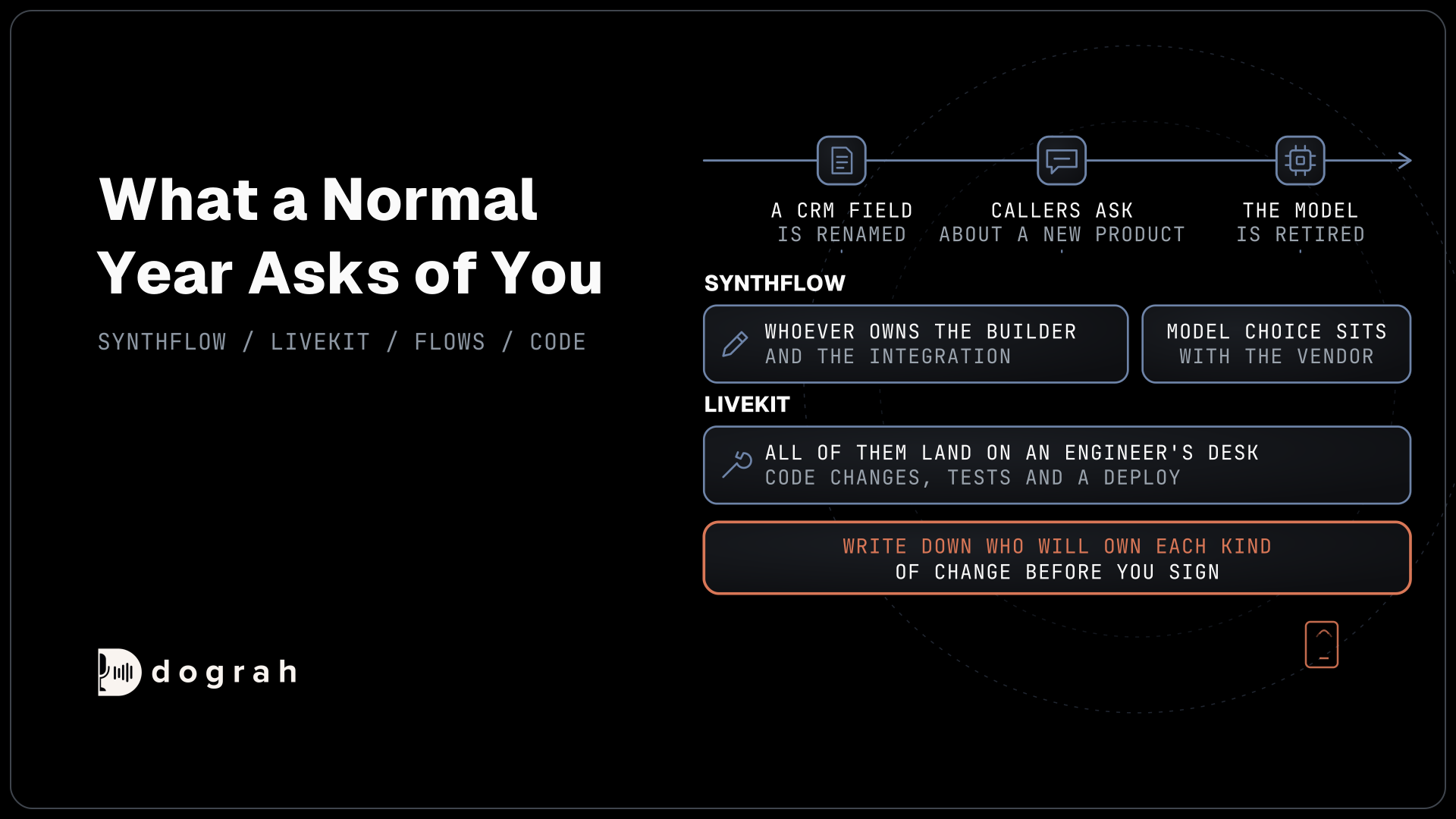
Picture a normal year. A CRM field gets renamed and a lookup breaks. Callers start asking about a new product. The language model the agent uses is retired and has to be swapped. On Synthflow, the first and second fixes sit with whoever owns the builder and the integration, and the model choice sits with Synthflow, since model usage is part of the agreement. On LiveKit, all of them land on an engineer's desk, along with the dependency upgrades a codebase needs anyway.
What each one locks in
Synthflow sets the price for the year against the call volume you expect, and the code is closed. Your flows, prompts and call settings live inside Synthflow's platform, so the main moment to change course is the renewal. If volume grows past the plan or the builder stops fitting your calls, the conversation is with Synthflow's team.
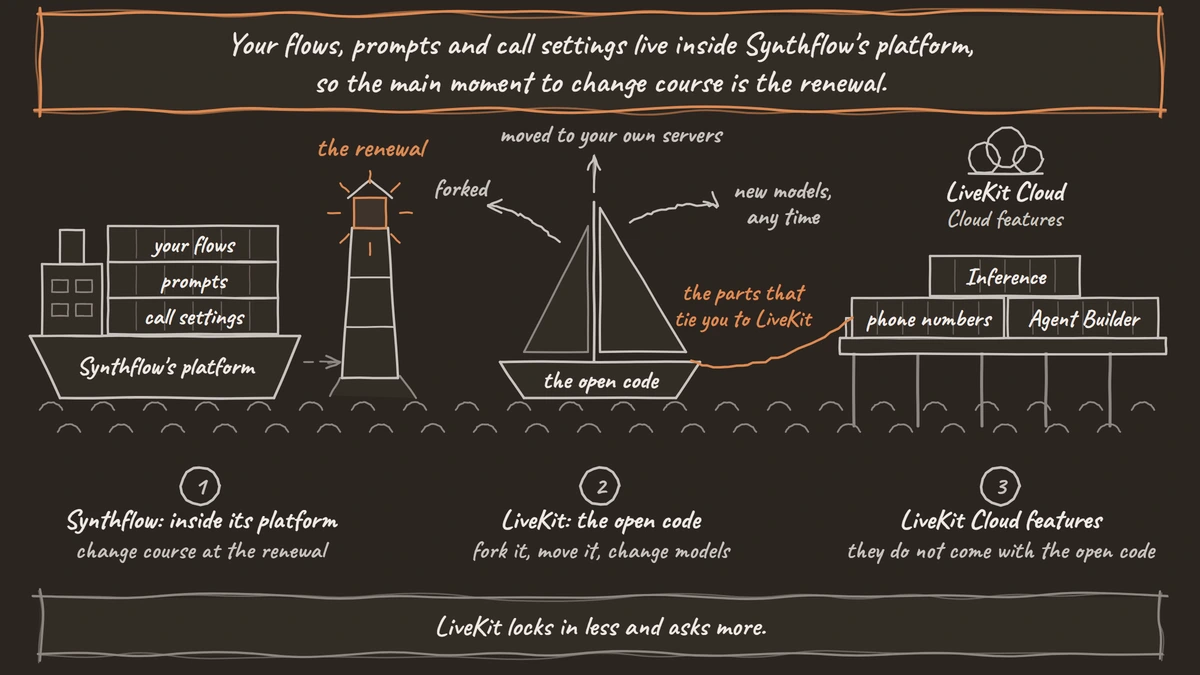
LiveKit locks in less and asks more. The open code can be forked, moved to your own servers or kept on LiveKit Cloud, and you can change models at any time. The parts that do tie you to LiveKit are its Cloud features, such as phone numbers, Inference and the Agent Builder, which do not come with the open code. The bigger cost is the product layer, from calling lists and review screens to QA on live calls, which your engineers build. Our comparison of Retell AI vs LiveKit lists that build in detail.

Open Source Alternative to Vapi / Retell
Self-hosted voice agent platform — no per-minute fees
dograh-hq/dograh
Star on GitHub
How each one bills
The two bill in shapes that are hard to compare line by line. Synthflow sells one annual agreement, with no free plan, no trial and no rate by the minute. Model usage is included, and so are transcription, voices, CRM connections and SMS, so the yearly price covers most of the running cost.
LiveKit bills a plan and a meter. LiveKit Cloud starts Build at $0 with 1,000 agent minutes, Ship at $50 a month with 5,000 and Scale at $500 with 50,000, then $0.01 per agent minute. Models come on top, on your own keys or through LiveKit Inference, and so do the phone minutes. The line no plan lists is engineering time, which on a code framework is usually the largest one.
Since Synthflow publishes no figure, any month we priced here would be a guess. Our breakdowns of Synthflow pricing and LiveKit pricing cover what each contract or plan includes.
Data, compliance and where each runs
Synthflow runs only in its own cloud. You choose a US or EU workspace at setup to keep workspace data and processing in that region, though Synthflow adds that connected providers can process some requests elsewhere. Its Trust Center lists SOC 2 Type 2, ISO/IEC 27001, GDPR, PCI DSS v4.0.1 and HIPAA marked as self-attested, which a healthcare buyer should read closely.
LiveKit gives you more places to run. A LiveKit Cloud project has a data region, with an EU option chosen when the project is created, and LiveKit lists a signed BAA from its Scale plan upward. On-prem or private deployment goes through LiveKit's sales team, and the open-source framework and media server run in any data center you choose. Running them yourself keeps the call audio inside your network only when the models run there too, because every provider on your keys still receives the audio it works on.
Join the Dograh Community
Dograh is an OSS alternative to Vapi. Join our Slack community for queries, releases, best practices & community interactions.
Which one fits your team
Synthflow fits a contact center that wants the agent launched for it, has operations staff who will own the flows, and is happy with one yearly price that covers models and telephony. Many teams never need more than that. The cost is closed code, changes bounded by the builder, and a contract that sets your terms for the year.
LiveKit fits a company with engineers who want the agent as software they test and ship like any other service. Every model, prompt and tool is in reach, and the code can run anywhere. The cost is that every later change, and the product around the agent, sits with those engineers.
A simple test helps here. List the last five changes your current phone flows needed and ask who would make each one on each option. Whichever you choose, write down who will own each kind of change before you sign, and test the first version over real phone calls rather than a browser.
Where Dograh fits for open-source and on-prem teams
Some teams want LiveKit's open code without making every change an engineering task. Dograh, the open-source AI voice agent platform under the BSD 2-Clause license, gives non-engineers a way in. New agents start in the Agent Builder, and later changes are typed in plain words in the editor's Builder tab, where edits save as a draft and the published version keeps taking calls until someone publishes the new one. The canvas stays there for hand edits, and engineers can read every line behind it.
You pick the speech-to-text, language model and voice provider for each agent, with provider accounts connected in Model Configurations. That can be Dograh's own models, your keys with a provider you already pay, or open models on your own servers. When a caller needs a person, Transfer Call works on Twilio, Telnyx, Plivo, Cloudonix and Asterisk ARI. Dograh calls the destination first and connects the caller only when someone answers, and if the line is busy, fails or rings out, the call comes back to the agent and carries on.
Where it runs sets what you pay for. Self-hosting with Docker takes at least 8 GB of RAM and 4 vCPUs, and the managed cloud and on-prem deployment on Enterprise are the other options. A self-hosted install runs 10 calls at once by default, which one setting raises, and Cloud's pay as you go plan includes 10, with more on request. Self-hosted Dograh has no per-minute platform fee, but servers, model keys and phone minutes still cost money. Dograh Cloud charges a 1¢-a-minute platform fee. Running it yourself puts the server, the database and the upgrades on your team, with community support on the open-source edition and custom SLAs on Enterprise.
For the year-two work, the QA node scores every step of test and live calls on a sample rate you set, and View Trace shows the speech-to-text, AI and voice time on each turn. Our post on the open-source alternative to Synthflow covers moving flows across in more detail.
Glossary
- Forward-deployed engineer
- A vendor engineer who works with your team to build, test and launch the agent. Synthflow provides them where the agreement includes launch support.
- Annual enterprise agreement
- A yearly contract priced against the call volume you expect, in place of a per-minute rate. Synthflow sells every new deployment this way.
- Prototype builder
- A browser tool for trying an agent before writing code. LiveKit's Agent Builder is one, and production agents move to the Agents SDK in Python or Node.
- Published version
- The copy of an agent that takes live calls while someone edits a separate draft. Edits reach callers only when the draft is published.