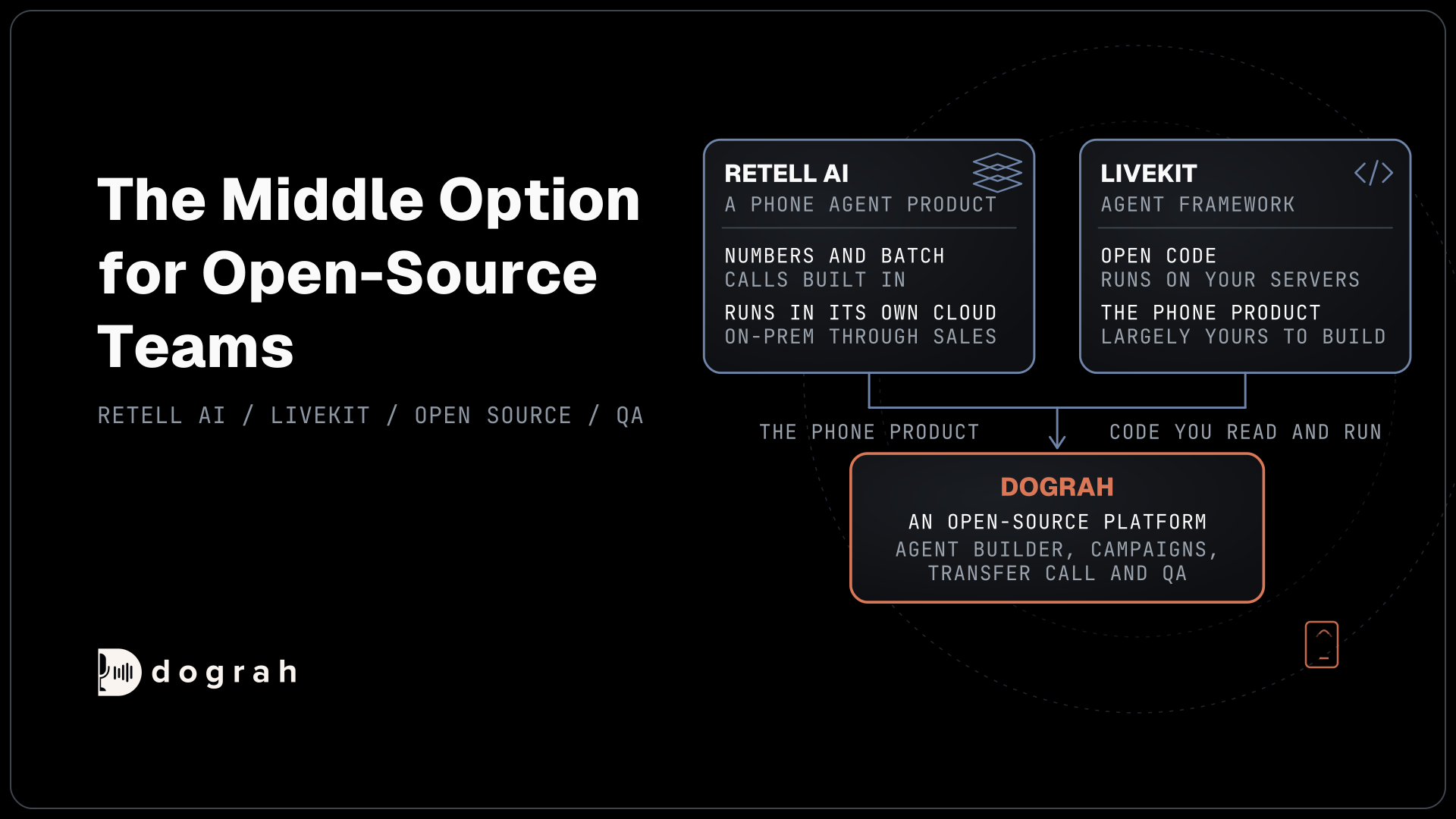

Retell AI suits teams that want a hosted phone agent product they configure, at $0.055 a minute for voice infrastructure plus models and phone minutes. LiveKit suits engineers who want open Apache-2.0 code, with LiveKit Cloud from $0 to $500 a month. Dograh is the open-source platform between the two, self-hosted or on Dograh Cloud.
Key Takeaways
- Retell is a hosted product, and LiveKit is open code with its own cloud.
- LiveKit's phone numbers are US only and inbound, so outbound needs your trunk.
- At 20,000 minutes, Retell's line items total $1,732 and LiveKit Ship's $399.
Retell AI and LiveKit both run phone agents, but one is a product you configure and the other is code you own. We compare them in one table and cover what each leaves to you, a priced month, compliance and fit, then where Dograh fits for open-source teams.
Retell AI and LiveKit in one table
The two sit at different layers, so some rows compare a feature with the code you would write to get it.
| Retell AI | LiveKit | |
|---|---|---|
| What it is | Hosted voice agent platform | Open-source agent framework and media server, plus LiveKit Cloud |
| Code | Closed | Apache-2.0, turn detector under the LiveKit Model License |
| Building agents | Conversation Flow canvas and prompts | Python or Node code. Agent Builder for simple prototypes on LiveKit Cloud |
| Phone numbers | US and Canada, inbound and outbound, $2 a month | US only, inbound only, 1 free then $1 a month. Outbound on your own SIP trunk |
| Price shape | $0.055 a minute voice infrastructure, plus voice, model and telephony | Build $0, Ship from $50, Scale from $500, then $0.01 per agent minute. Models extra |
| Calls at once | 20 included, then $8 each a month | 5 on Build, 20 on Ship, up to 600 on Scale |
| Testing | Simulated callers | Test framework in code with LLM judges |
| Self-hosting | No | Yes, framework and media server |
| HIPAA | BAA self-signed, no extra fee | Signed BAA on Scale and Enterprise |
A product you configure, or code you own
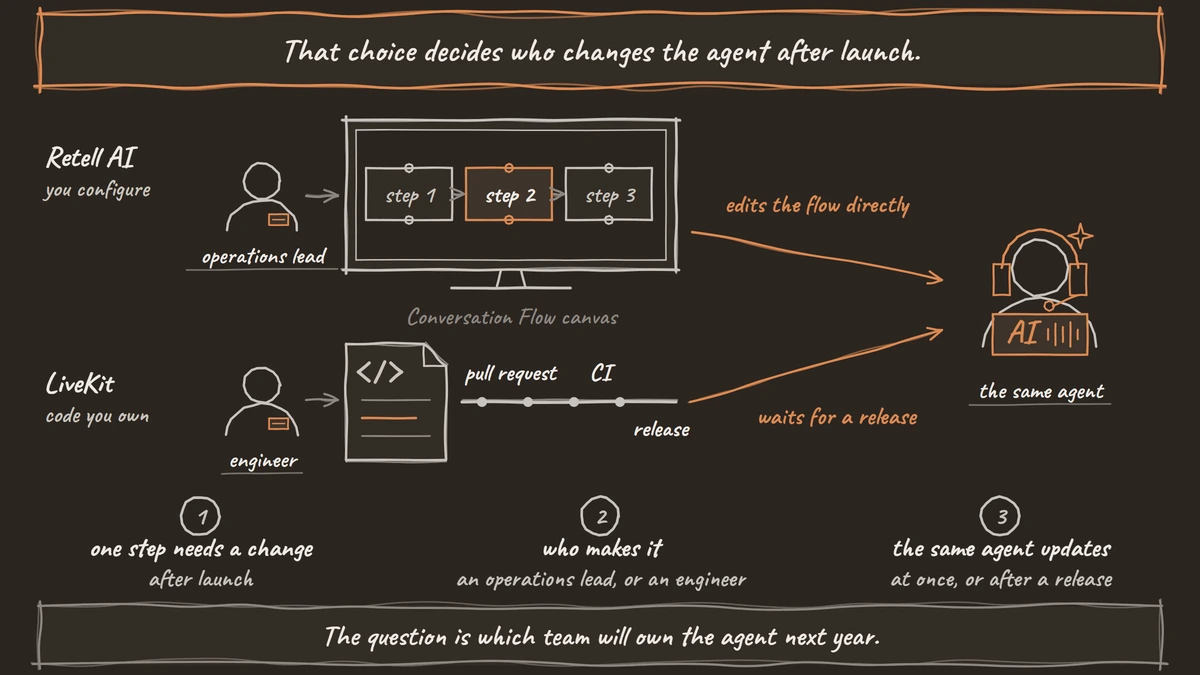
Retell gives a team a finished phone agent product. An operations lead can build the call on the Conversation Flow canvas, buy US or Canadian numbers in the dashboard, run batch outbound calls and test changes against simulated callers before release. Transfers to a person come in several types, and the language model is picked from Retell's list, from GPT 5 nano upward.
LiveKit gives engineers the code. The agent lives in your repository, every change goes through a pull request and CI, and LiveKit says its cloud deploys new versions without dropping calls in progress and can roll back a bad one. The same agent can also join video calls, run inside web and mobile apps through LiveKit's client SDKs, or take calls on your own servers.
That choice decides who changes the agent after launch. On Retell, the person closest to the calls can edit the flow directly, within what the editor allows. On LiveKit, almost anything is possible, but each change waits for an engineer and a release. Neither is wrong. The question is which team will own the agent next year.
What LiveKit leaves you to build
A phone team on LiveKit builds the product around the agent. LiveKit's Agent Builder suits simple prototypes, and workflows with several agents, handoffs and tests are written in code. A phone agent with lookups, transfers and branches ends up in code.
Phone lines need a decision early. LiveKit Phone Numbers are US only and take inbound calls, so outbound calling runs through a SIP trunk from a carrier you sign up with. Calling lists with hours and retries, a screen where the operations team reads transcripts, and QA on live calls are code your team writes against LiveKit's APIs.
Self-hosting widens the gap. The open-source framework and media server run on your servers, but LiveKit Cloud's phone numbers, Inference and Agent Builder do not come with them, so you also run a SIP service and bring every model key. Teams with a strict open-source policy should read the separate license on LiveKit's turn detection models too.
What Retell leaves you to accept
Retell's trade is the opposite one. The code is closed and the platform runs in Retell's cloud, so call audio, transcripts and recordings sit with Retell, and there is no version to run on your own servers. When Retell changes a feature or a price, you adopt the change on its schedule.
Some parts of the call carry their own charges. Retell charges $0.005 a minute for a Knowledge Base, $0.005 a dial for batch calls, and $0.10 a minute for AI QA after 100 free minutes. Calls beyond 20 at once cost $8 each a month, which matters for outbound campaigns that dial in bursts.
You also work inside the editor's limits. Logic that does not fit the canvas or the prompt usually moves to your own server, called through a custom function or a custom language model over a WebSocket. That works, but it puts part of the agent back in code that your team runs.

Open Source Alternative to Vapi / Retell
Self-hosted voice agent platform — no per-minute fees
dograh-hq/dograh
Star on GitHub
What 20,000 minutes a month costs
One month priced on both pages shows how differently they bill. Take an example of 20,000 inbound call minutes on one US number, with Retell's base voices and GPT 5 nano. Every rate comes from Retell's published per-minute rates and LiveKit's plan list.
| Line item | Retell AI | LiveKit Cloud Ship |
|---|---|---|
| Plan | No plan fee | $50, includes 5,000 agent minutes |
| Platform minutes | 20,000 x $0.055 voice infrastructure = $1,100 | 15,000 extra agent minutes x $0.01 = $150 |
| Voice | 20,000 x $0.015 base voices = $300 | Not included, your own keys or LiveKit Inference |
| Language model | 20,000 x $0.0016 GPT 5 nano = $32 | Not included |
| Phone minutes | 20,000 x $0.015 = $300 | 19,900 inbound minutes after the 100 included x $0.01 = $199 |
| Phone number | $2 a month | 1 included |
| Total | $1,732, plus the $2 number | $399 before models |
The rows are not like for like. Retell's $1,732 already covers speech-to-text, the voice, the model and the phone minutes, while LiveKit's $399 covers the agent minutes and phone minutes only, so speech-to-text, the model and the voice still have to be added. Our breakdowns of Retell AI pricing and LiveKit pricing price those extra layers in detail. For comparison, Dograh Cloud's platform fee for the same 20,000 minutes is $200, with models and phone minutes also billed separately.
Compliance and where each runs
For healthcare calls, both offer a HIPAA business associate agreement on different terms. Retell lets teams self-sign the agreement on pay as you go, and in its own words "There is no additional fee to sign these agreements". LiveKit lists a signed BAA from its Scale plan upward, which starts at $500 a month.
Where the system runs differs more. Retell runs in its own cloud, with VPC or on-prem for enterprises through its sales team. LiveKit Cloud is hosted too, on-premise or private deployments go through LiveKit's sales team, and the open-source framework and media server can run in any data center you choose. A team that has to keep call audio inside its own network can run LiveKit's open code itself, while Retell's on-prem option is a closed product under an enterprise deal. A BAA spreads duties across the vendors that touch health data, and each one still has to meet its own.
Join the Dograh Community
Dograh is an OSS alternative to Vapi. Join our Slack community for queries, releases, best practices & community interactions.
Which one fits your team
Retell fits a team that wants a phone agent live in weeks and has no engineers to spare for the product around it. Operations staff edit the flow, numbers and batch calls come built in, and the per-minute bill covers most of the stack. The cost is less control over the code, the cloud and some of the line items.
LiveKit fits engineers who expect to go past any editor's presets. Agents in code, tests in CI, video and in-app voice, and the option to self-host are its real strengths. The cost is the product layer, from outbound trunks to call review, which someone has to build and maintain.
Whichever you lean toward, run a pilot on real phone calls, not only browser tests. Most phone calls still reach the agent as 8 kHz audio, and the speech-to-text result on a phone line can differ a lot from a clean demo.
Where Dograh fits for open-source and on-prem teams
Some teams want both halves, code they can read and run like LiveKit, with the phone product Retell ships. Dograh is that middle option, an open-source AI voice agent platform under the BSD 2-Clause license, built on a fork of Pipecat.
Agents start in the Agent Builder. You describe the agent on the "Create an agent" page, approve the "Your agent requirements" card with "Approve & build", and "Test agent" publishes version 1. Self-hosted installs need a Dograh Service Key for the Agent Builder, and the visual canvas is there for edits either way. Outbound lists run as Campaigns with calling hours and automatic retries for busy and unanswered numbers.
When a caller asks for a person, Transfer Call works on Twilio, Telnyx, Plivo, Cloudonix and Asterisk ARI. Dograh dials the destination before connecting anyone, and the caller joins only when that call is answered. If nobody picks up, or the line is busy or fails, the agent takes the call back and the conversation continues.
Reviewing calls is built in. The QA node scores every step of test and live calls, with a sample rate you set.
Each call's trace shows where the time went on each turn, from speech-to-text to the voice. Models are your choice, from Dograh's own or any supported provider on your keys to a local model on your own servers.
Self-hosting Dograh carries no per-minute platform fee, while servers, model keys and phone minutes still cost money. The managed Dograh Cloud adds a 1¢-a-minute platform fee. A self-hosted install runs 10 calls at once by default and one setting raises it, and Enterprise adds on-prem deployment.
Running it yourself means the server, the database and the upgrades belong to your team. The Docker install needs at least 8 GB of RAM and 4 vCPUs, the open-source version has community support, and Enterprise adds custom SLAs. Self-hosted, there is no BAA with Dograh to sign, though model providers that handle health data may need their own.
If LiveKit is your starting point, our post on the open-source alternative to LiveKit compares the two self-hosted installs part by part. If you are leaving Retell, Dograh vs Retell AI goes feature by feature.
Glossary
- Agent minute
- LiveKit Cloud's billing unit for the time an agent spends in a session. Ship and Scale include a set number each month and charge $0.01 a minute after that.
- Outbound trunk
- A SIP connection from a phone carrier that lets an agent place calls. LiveKit's own numbers take inbound calls only, so outbound calling on LiveKit runs through one.
- Voice infrastructure
- Retell's per-minute charge for running the call itself, $0.055 a minute. Voices, language models and telephony are billed on top.
- Turn detection model
- A model that decides when a caller has finished speaking so the agent can reply. LiveKit's ship under the LiveKit Model License, separate from the framework's Apache-2.0 license.