
A small business moves to a SIP trunk by keeping the phones that work, moving its numbers to a carrier that connects over SIP, and pointing the main number at an AI agent while staff keep their extensions. Dograh, the open-source AI voice agent platform, answers on those same numbers, self-hosted or on Dograh Cloud.
Key Takeaways
- Keep phones that work. An adapter or your phone system bridges them to SIP.
- Put the main number on the agent and hand callers back to staff.
- Staff phones must dial 911 directly and send the office's address.
This post is part of our guide to SIP trunk providers, where a trunk and a staff phone plan sit side by side. Here we move a small office from analog lines, a phone system or a per-seat plan to a trunk, with a Dograh agent on the same numbers.
Three places a small business starts from
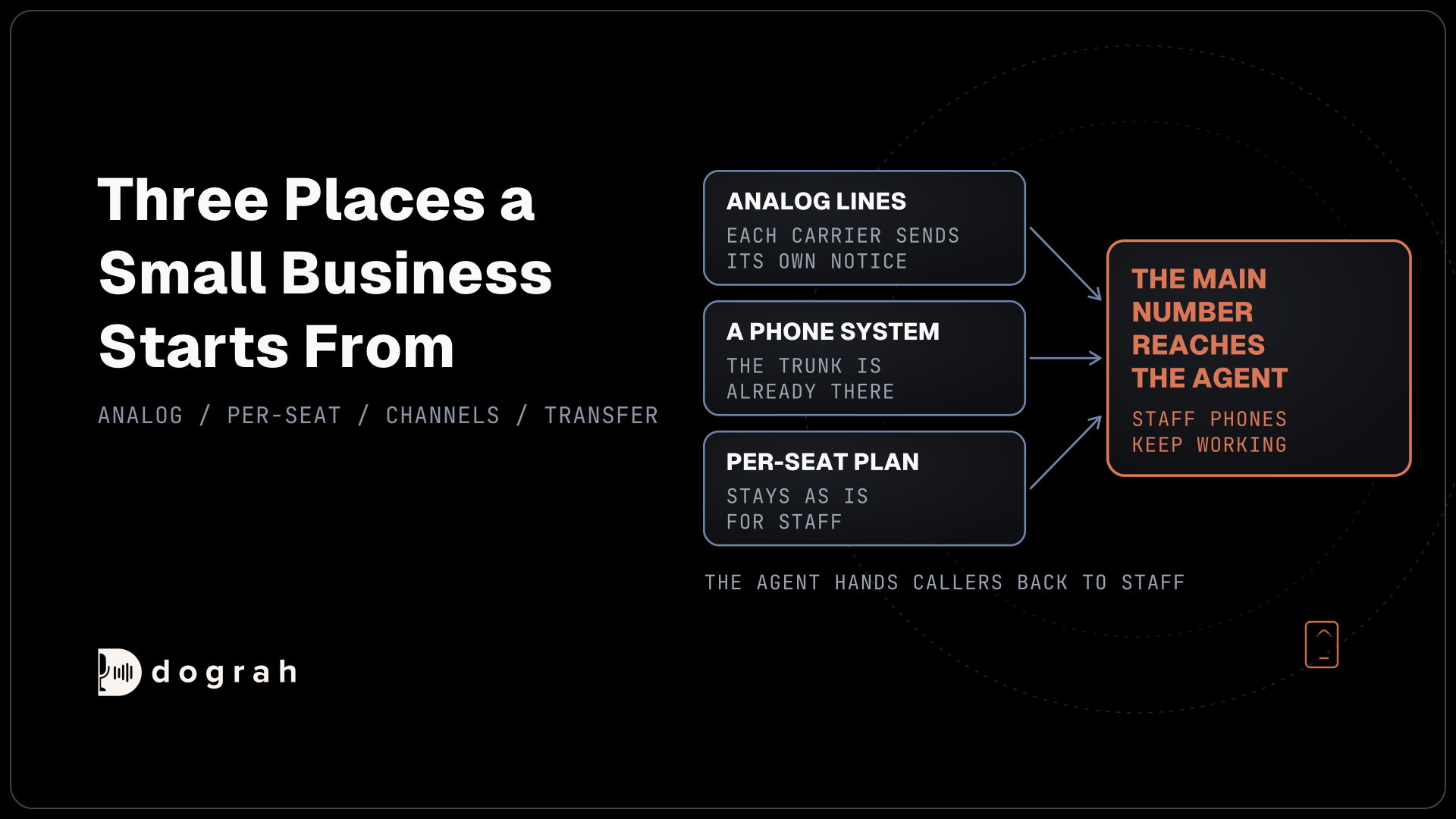
Most small businesses start from one of three setups, and each moves to a trunk differently. Some still run analog lines from the local phone company. Some have an office phone system, such as an Asterisk or 3CX system, that already sits on a SIP trunk. Others pay for a per-seat business phone plan, where every employee has a line and an app.
The analog group has a clock running. In March 2026 the FCC adopted an order easing the retirement of copper networks, giving carriers more room to stop offering legacy copper services. The order sets no deadline for customers. Each carrier sends its own notice, so check your bills and mail for one.
None of these starting points means new handsets. A phone system that works rarely needs replacing, and the move is about where the numbers live and who answers the main line. SIP trunking is the most reliable way to connect an AI agent to real phone numbers in production, so the goal in every case is the same: the main number reaches the agent, and staff phones keep working.
Analog lines: move the numbers, keep the phones
An analog office keeps its handsets and changes the line behind them. An analog telephone adapter (ATA) connects the phones you already own to the trunk over your internet connection, one port per line. The numbers move to a carrier that connects over SIP.
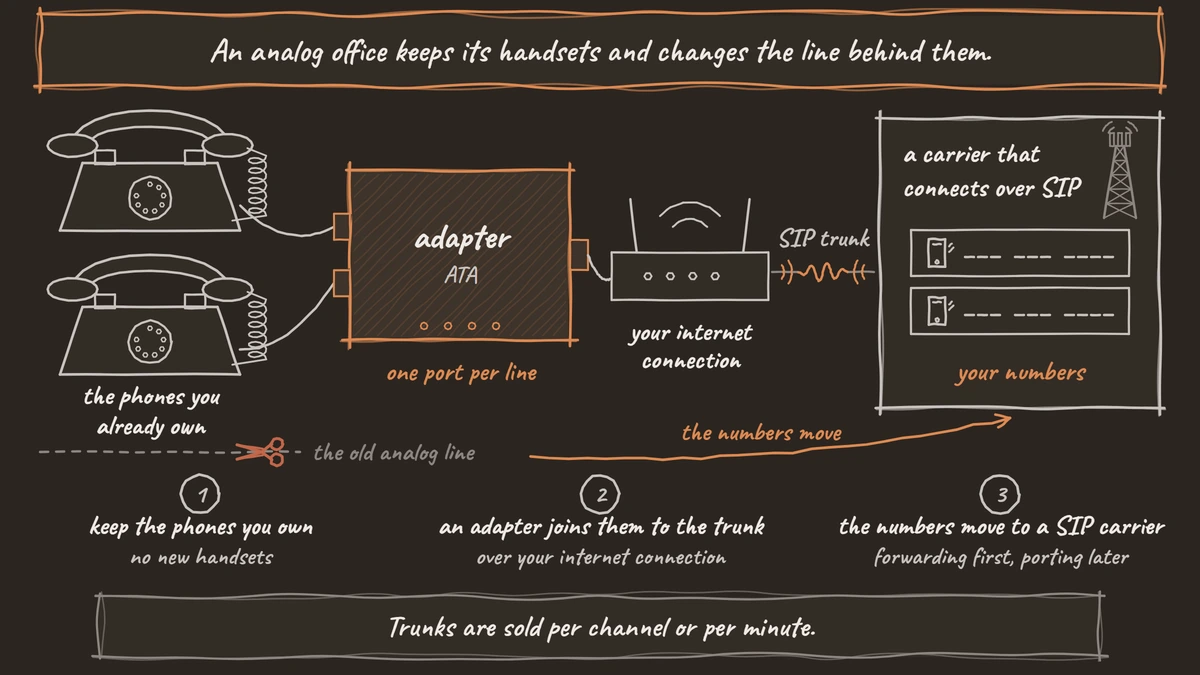
For the agent, pick a carrier that connects to Dograh directly, such as Twilio, Telnyx or Plivo, or keep any carrier's trunk and point its numbers at a Managed SIP domain. Dograh sells no numbers, so the carrier and the bill stay yours. Move the numbers in the safe order, forwarding first and porting later, as porting a business number without downtime lays out step by step.
Trunks are sold per channel or per minute. As one per-channel example, SIP.US's price list shows $24.95 a channel a month month-to-month, or $19.99 on a yearly plan, with a local number at $1.00 a month and an E911 number at $2.50. Per-minute carriers charge for each minute instead, and our breakdown of SIP trunk pricing compares the two.
Give each number one path. A Twilio number that sits on a Twilio SIP trunk to your office phone system ignores its own voice settings, so it cannot also be answered through a Twilio configuration in Dograh. Decide per number whether it rings the office system or the agent.

Open Source Alternative to Vapi / Retell
Self-hosted voice agent platform — no per-minute fees
dograh-hq/dograh
Star on GitHub
An office phone system that already has a trunk
An office phone system with a trunk is the easiest case, because the trunk is already there. Keep staff on their phones and send the main number to the agent, or send only after-hours and overflow calls if staff want to answer first during the day.
An Asterisk system connects directly through Asterisk ARI, so the PBX keeps its trunks and extensions and sends chosen calls to the agent. Other systems forward calls to a number connected to Dograh, and our guide to a SIP trunk for 3CX shows that path click by click.
Callers get back to staff through Transfer Call. Its destination can be a phone number or an Asterisk extension such as PJSIP/1001, or a rule that picks one by department, as the Transfer Call settings show. Dograh rings the number first, plays hold music to the caller, and connects the two only when a person answers. If nobody answers, the line is busy, the call fails or the wait times out, the agent is told the transfer failed and carries on with the caller.
Transfer Call works on Twilio, Telnyx, Plivo, Cloudonix and Asterisk ARI. Vonage lines suit agents that finish calls themselves, and on Exotel numbers the agent books a callback request when the caller needs a person.
A per-seat phone plan for staff
A per-seat plan can stay exactly as it is for staff. Put the main number on a trunk, then set its Inbound workflow in Dograh so the agent answers it. When a caller needs a person, the agent transfers them to that person's direct number on the plan.
This split keeps the seat bill where it is useful. The agent may take three calls at once at 9 a.m. and none at lunch, and a trunk bills those minutes without a seat behind them. Which calls to hand to the agent first, and what a small month costs, are covered in AI phone agents for small business.
The platform cost is one line beside the trunk. Self-hosted Dograh has no per-minute platform fee, but servers, model keys and phone minutes still cost money. Dograh Cloud charges a 1¢-a-minute platform fee.
Join the Dograh Community
Dograh is an OSS alternative to Vapi. Join our Slack community for queries, releases, best practices & community interactions.
How many channels staff and the agent need
On a per-channel trunk, count staff calls and agent calls together. SIP.US's guide offers a carrier's rule of thumb of one channel per three to four employees, plus 20 to 30% headroom over the busiest hour you have measured. Take it as a starting point and check it against your own call logs.
The agent adds its own calls on top. A receptionist takes one call at a time, but the agent can take several at once, so a ten-person office whose agent answers four callers at once at peak needs those four channels as well. Self-hosted Dograh runs 10 calls at once by default, a limit you can raise, and Dograh Cloud pay as you go includes 10, with more on request.
Per-minute trunks price capacity differently, with some including it and others selling channels on top. Either way, check your carrier's limit on calls at once before go-live, because that limit and the agent's limit both apply.
911 on the staff phones
The agent's number is only half of the 911 picture, because staff still dial out from their desks. Under the FCC's 911 rules for office phone systems, staff must be able to dial 911 directly, with no prefix such as 9, and the system must notify someone at the business when a 911 call is made, where it can. It must also send a dispatchable location, such as the street address and floor, with the call. In most cases, that means registering the office address on each number with the new carrier on the day the numbers move, and confirming with counsel how the rules apply to your setup.
The agent itself never connects anyone to 911. If a caller says they are in danger, the agent tells them to get to safety and call 911.
Glossary
- Channel
- One call that can run at once on a trunk. Per-channel trunks charge for each channel a month, and both staff calls and agent calls use them.
- Analog telephone adapter (ATA)
- A small box that connects ordinary analog phones to a SIP trunk over the internet, so a business keeps its handsets when copper lines go.
- Multi-line telephone system (MLTS)
- An office phone system with several lines, such as a PBX. FCC rules require direct 911 dialing, a notice to someone at the business and a dispatchable location.
- Managed SIP
- A Dograh telephony configuration that accepts calls from any carrier's SIP trunk, so a business can keep its carrier and point its numbers at the agent.