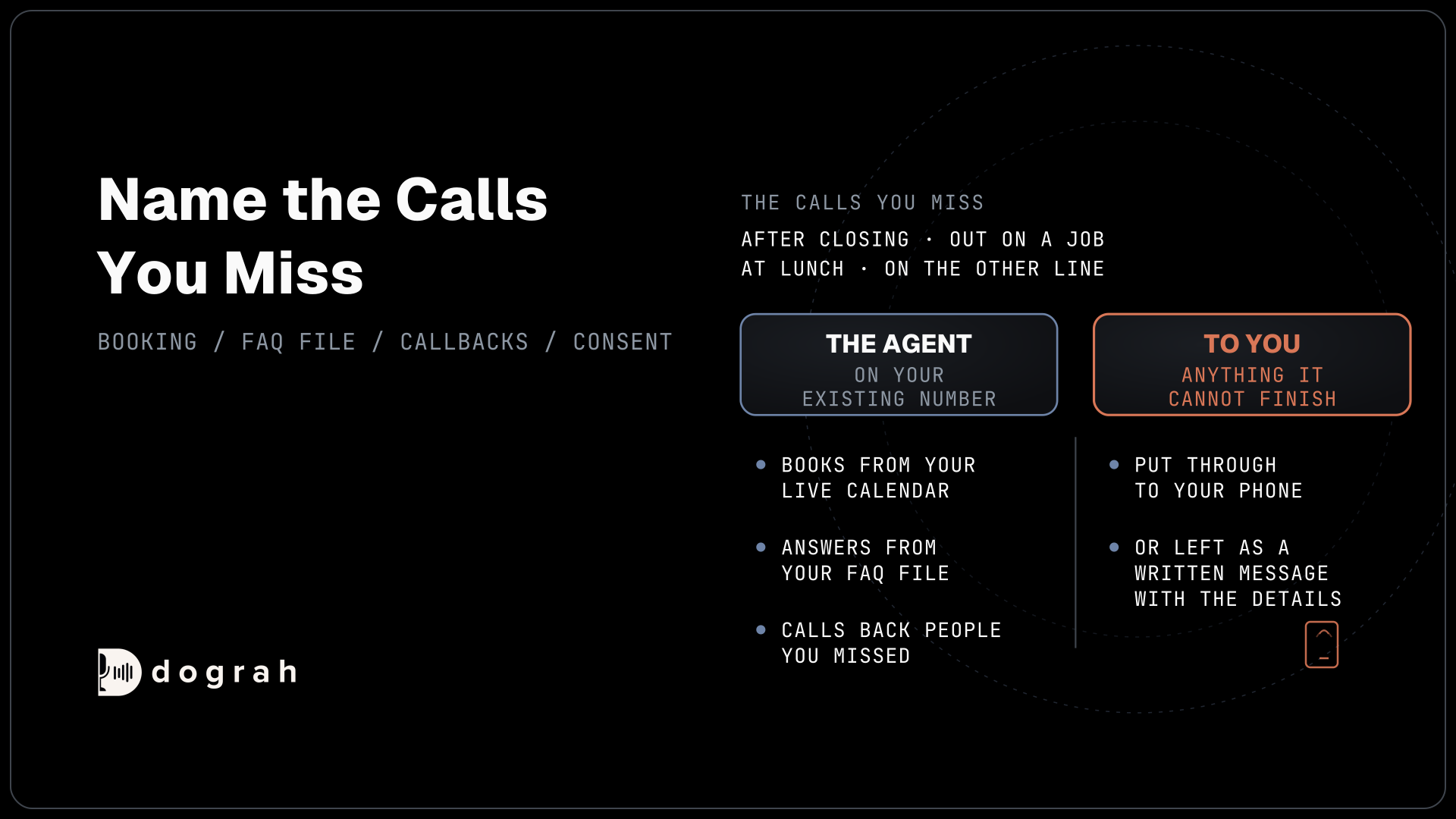

An AI phone agent for a small business answers the calls you miss while you are busy. It books from your live calendar, answers questions from your own FAQ file and calls back people you missed. Anything it cannot finish goes to you, either put through to your phone or left as a written message with the details.
Key Takeaways
- Name the calls you miss, then give the agent one job for each.
- The agent answers only from your FAQ file and hands over the rest.
- One small month is a few dollars of platform and phone, plus models.
This post is part of our guide to AI voice agents, which starts with one call the agent can finish or hand over. We cover the calls a small business misses and a job for each, then set them up in Dograh, the open-source AI voice agent platform we build.
The calls a small business misses each week
Missed calls tend to cluster at four moments: after closing, out on a job, at lunch and while you are already on the other line. Each one is a customer who wanted to book a job or ask about one.
Small firms have been slower to put AI on these calls. The Census Bureau's business survey found AI use rising among firms with 20 or more employees, with no significant change among firms with fewer than 20. Fewer than 20% of firms with four or fewer employees used AI at all.
The fix starts with a list. Write down which calls you missed last week and why. The night calls are often the first job to hand over, and our post on after-hours coverage covers the calls that still need a person tonight.
Answering and booking while you work
The agent answers on your existing number, so customers dial the same number as before. In Dograh, you point the phone number's Inbound workflow setting at the agent, as the inbound calling setup shows, and several numbers can point at the same agent.
Booking is the job most small businesses want first. The agent reads open slots from your booking system during the call, offers two or three, and writes the chosen one back through an HTTP API tool. The booking counts only when your system confirms it, and then the agent reads the day and time back to the caller.
Some callers need you. With the Transfer Call tool, Dograh calls your phone first and connects the caller only when you answer. If you do not pick up within the timeout, 30 seconds by default, the caller stays with the agent, which takes a message and writes the callback request to your system.

Open Source Alternative to Vapi / Retell
Self-hosted voice agent platform — no per-minute fees
dograh-hq/dograh
Star on GitHub
Questions answered from your own FAQ file
An agent that is never told where its answers come from can sound confident while it is wrong. So give it one source and one rule. Upload your prices, hours, service area and policies to the Knowledge Base, which takes PDF, DOCX, DOC, TXT and JSON files of up to 5 MB each.
Then write the rule into the prompt: answer only from the file, and if the answer is not there, say so and take a message. A caller who hears "I'll get the owner to call you back about that" is better served than one who hears a guess.
Your own voice can carry the fixed lines. Record the greeting and your opening hours once, and the agent plays those clips and falls back to a generated voice for everything else.
Callbacks and follow-up calls
The same agent can call people back. Put last week's missed callers, or customers due a reminder, into a campaign from a CSV file. Set the calling hours, which run in one time zone per campaign, and you set the retries (0 to 10).
Outbound calls bring consent rules. The FCC's ruling on AI-generated voices treats an AI voice as an artificial voice under the Telephone Consumer Protection Act (TCPA). A reminder about a booking generally needs the person's prior express consent, while a sales follow-up generally needs their prior express written consent. Keep offers off reminder calls, and confirm your own consent position with counsel before the first campaign.
If you want a text after the call, such as a booking confirmation, an HTTP API tool asks your own messaging provider to send it. A customer who asks not to be called again says so on the call, and the agent writes that to your list.
Your first week of setup
Day one is a description. In Dograh, you create an inbound agent by describing what it should do, and the first draft of the prompt is written from that description. Then write the greeting with your business name. If you want to tell callers they are speaking with an automated assistant, or your location requires it by law, write that in the Greeting Text too, and switch off Allow Greeting Interruption on the Start Call node so it plays in full.
Next, upload your FAQ file and add the booking tool and the transfer. Test in the browser first, then call the agent from a real phone, because transfers only work on a real call. Connect your number once both tests pass.
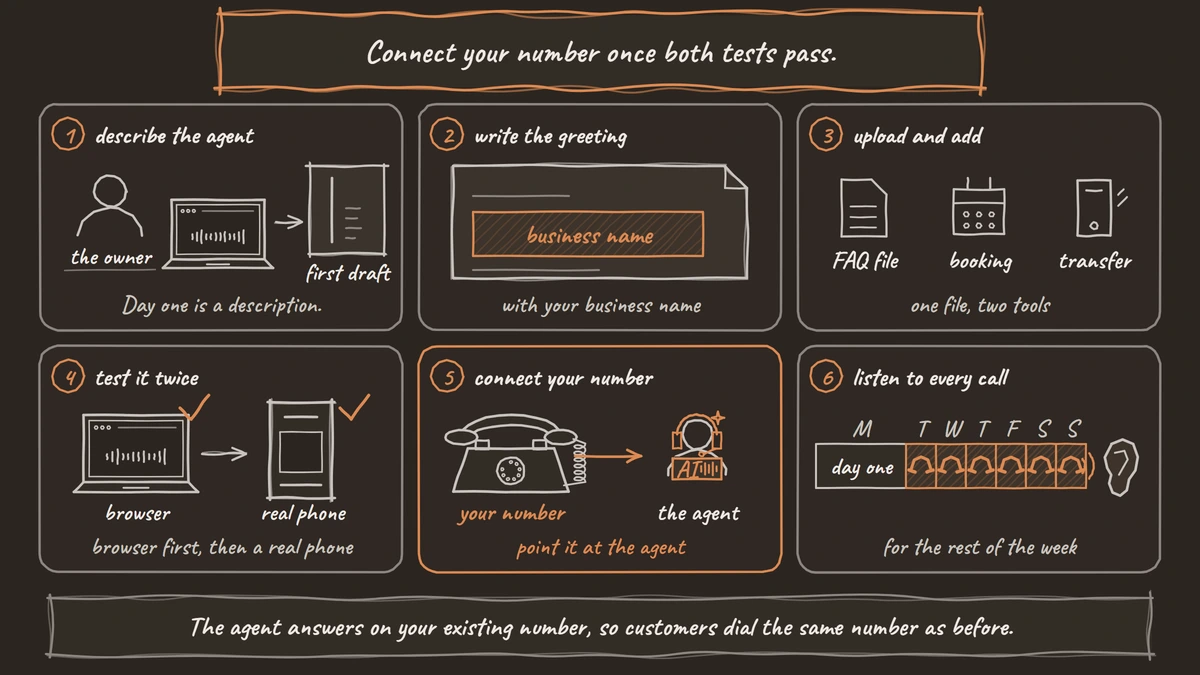
For the rest of the week, listen to every call. Our step-by-step guide on how to build an AI receptionist shows each screen, from the first prompt to the transfer test.
Join the Dograh Community
Dograh is an OSS alternative to Vapi. Join our Slack community for queries, releases, best practices & community interactions.
What one small month costs
Take 300 inbound minutes a month on one local number as a worked example. Dograh Cloud's platform fee is 300 times 1¢, or $3.00. Twilio adds $1.15 for the number and $2.55 for 300 inbound minutes at $0.0085 each. That makes $6.70 before the models.
The models are the speech-to-text, the language model and the voice, and they are billed by those providers on top. Their cost depends on which ones you pick.
Self-hosted Dograh has no per-minute platform fee, but servers, model keys and phone minutes still cost money. Dograh Cloud charges a 1¢-a-minute platform fee. It includes 10 calls at once. Most small businesses start on the cloud. If you want the agent on phone lines you already run, our page on an AI receptionist on your own phone lines shows that setup.
Glossary
- Inbound workflow
- The setting on a phone number that says which agent answers it. Point it at your agent, and calls to your existing number reach the agent. Several numbers can point at one agent.
- Knowledge Base
- The files an agent answers from, such as your prices, hours and policies. It takes PDF, DOCX, DOC, TXT and JSON files of up to 5 MB each.
- HTTP API tool
- A tool the agent runs during the call to read or write another system, such as checking open slots and booking one in your calendar.
- Transfer Call
- The tool that puts a caller through to a person. It calls your phone first and connects the caller only when you answer, 30 seconds by default before it gives up.