
PolyAI suits contact centers that want a phone agent built for them, with UK and EU hosting and contact-center connectors on Enterprise. LiveKit suits engineering teams that want open code and any model. If you want to own the platform, Dograh is an open-source AI voice agent platform you can self-host or run on Dograh Cloud.
Key Takeaways
- PolyAI Enterprise agents are built by PolyAI, Wren or a partner, with contact-center connectors.
- LiveKit's own numbers are US-only and inbound-only, so other countries need a SIP carrier.
- In a 4,000-minute example, PolyAI Plus costs $949 with models and voice included.
PolyAI and LiveKit both answer support calls with AI, but one is a service built for you and the other is open code your engineers build on. We compare who builds, lines outside the US, models, a priced month and compliance, then show where open-source Dograh fits.
PolyAI and LiveKit in one table
PolyAI is a closed, hosted platform with self-serve plans and an Enterprise service. LiveKit is an open-source framework with a hosted cloud, so the rows set a finished product against a toolkit.
| PolyAI | LiveKit | |
|---|---|---|
| Who builds the agent | You, with Wren, on self-serve plans. PolyAI, Wren or a partner on Enterprise | Your engineers, in Python or Node.js. A browser Agent Builder covers simple prototypes |
| Code | Closed. The ADK lets developers pull, edit and push agents that still run on PolyAI's cloud | Apache-2.0 framework, with the turn detector under the LiveKit Model License |
| Models | Raven 3.5 recommended, OpenAI and Amazon Bedrock options, or your own LLM endpoint | Any provider through plugins, or LiveKit Inference on Cloud |
| Lines outside the US | API hosts in the US, UK and EU, data storage in your region on Enterprise | EU project region. Numbers are US-only and inbound-only, so other countries come in over SIP |
| Contact-center connectors | NiCE CXone, Five9, Genesys Cloud, Webex Contact Center and Zoom on Enterprise | Built and maintained by your team |
| How it bills | Plans from $49 with minutes included, Platform from 9.5¢ a minute, Enterprise by contract | Build is free, Ship is $50 with 5,000 agent minutes, then $0.01 a minute |
| HIPAA | BAA on Enterprise | Signed BAA on Scale and Enterprise |
Who builds the agent on each
PolyAI sells two ways of working. On its self-serve plans, Essentials, Plus and Scale, the builder is "You, with Wren", PolyAI's assistant that you talk to in plain language inside Agent Studio. Enterprise customers have PolyAI, Wren or a partner build the agent, and get a named account manager and round-the-clock support. Developers also get the ADK, a Python command-line tool for pulling an agent down, editing it and pushing it back, though the agent still runs on PolyAI's cloud. Our PolyAI review covers each plan's day-to-day work.
LiveKit Agents is a framework. Your engineers write the agent in Python or Node.js, choose the speech, language and voice models, and deploy it to LiveKit Cloud or to servers you run. LiveKit's browser Agent Builder can stand up a simple agent quickly, but it does not support workflows, model plugins or tests, so a production support line ends up as code your team owns.
A LiveKit review from Open.cx, a competing vendor, calls PolyAI a different model entirely, and that is fair. LiveKit suits teams building voice into their own product. It is not a drop-in for a support team that wants an agent delivered and looked after.
What your engineers build on LiveKit
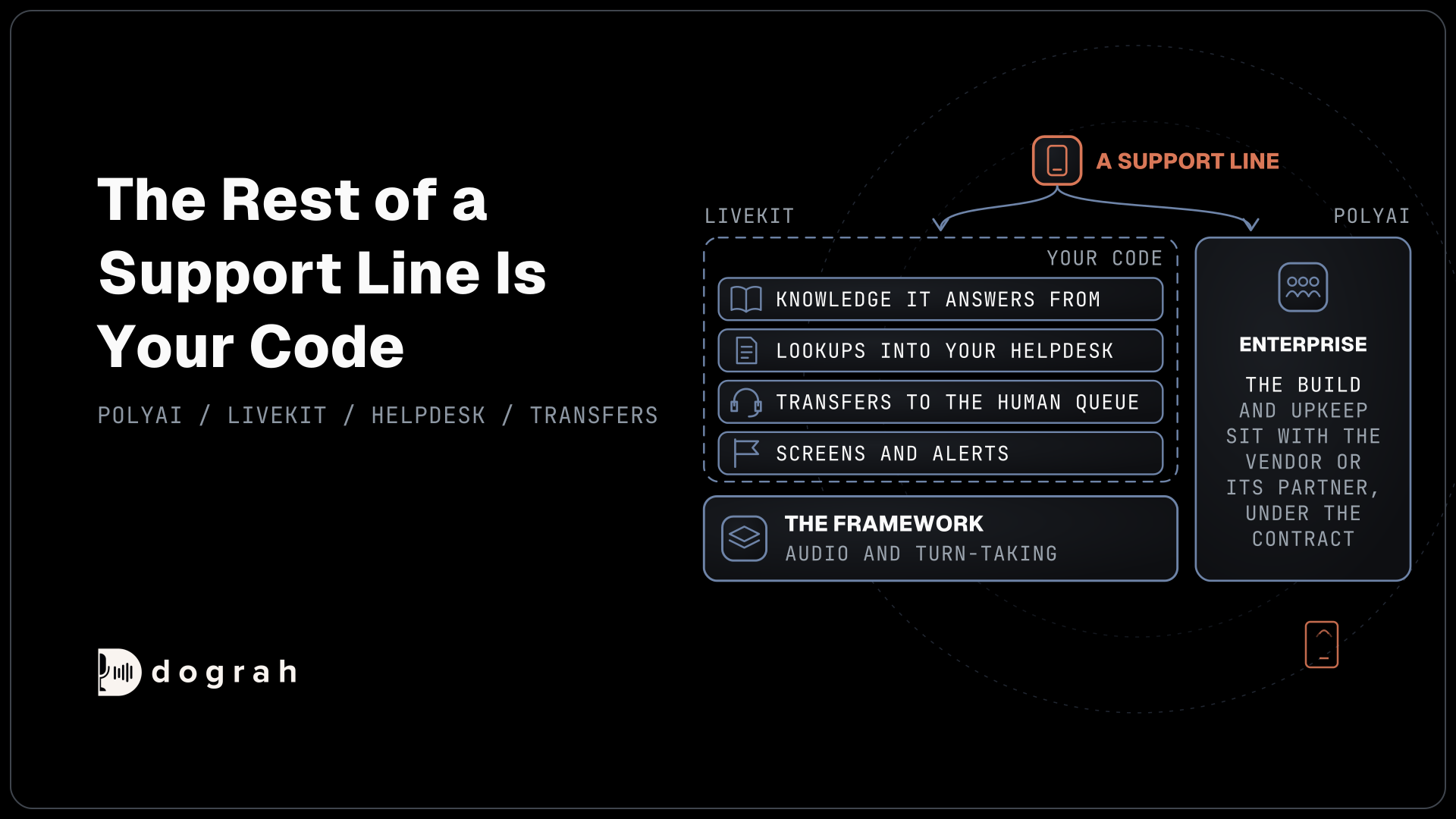
The framework handles real-time audio, turn-taking and the chain from speech to model to voice. The rest of a support line is your code. That covers the knowledge the agent answers from, lookups into your helpdesk, transfers to the human queue, screens for reviewing calls and alerts when calls fail. Our Retell AI vs LiveKit comparison walks through that build list in more detail.
The cost of that work is engineer time, which no plan price includes. WebRTC.ventures, a build agency, describes moving from a managed platform to a custom framework as something teams do once they hit the platform's ceiling. The same logic runs the other way. A team with no one to own the code after launch turns a framework into a backlog.
On PolyAI Enterprise, that build and upkeep sit with PolyAI or its partner under the contract. On the self-serve plans, your team does the building with Wren, but hosting and the model stay with PolyAI.

Open Source Alternative to Vapi / Retell
Self-hosted voice agent platform — no per-minute fees
dograh-hq/dograh
Star on GitHub
Running a support line outside the US
This is where the two differ most for a UK or European support center. PolyAI's Conversations API runs from regional hosts in the US, the UK and the EU, and the Enterprise plan adds data storage in your region. A team in London or Frankfurt can keep its build and its call data close to home without writing the telephony layer.
LiveKit lets you choose an EU data region when you create a project. Its own phone numbers are available only in the US and take inbound calls only. A UK or German support line therefore reaches LiveKit through your own carrier over a SIP trunk. Ship includes 5,000 third-party SIP minutes, then $0.004 a minute, and the carrier bills its own minutes on top.
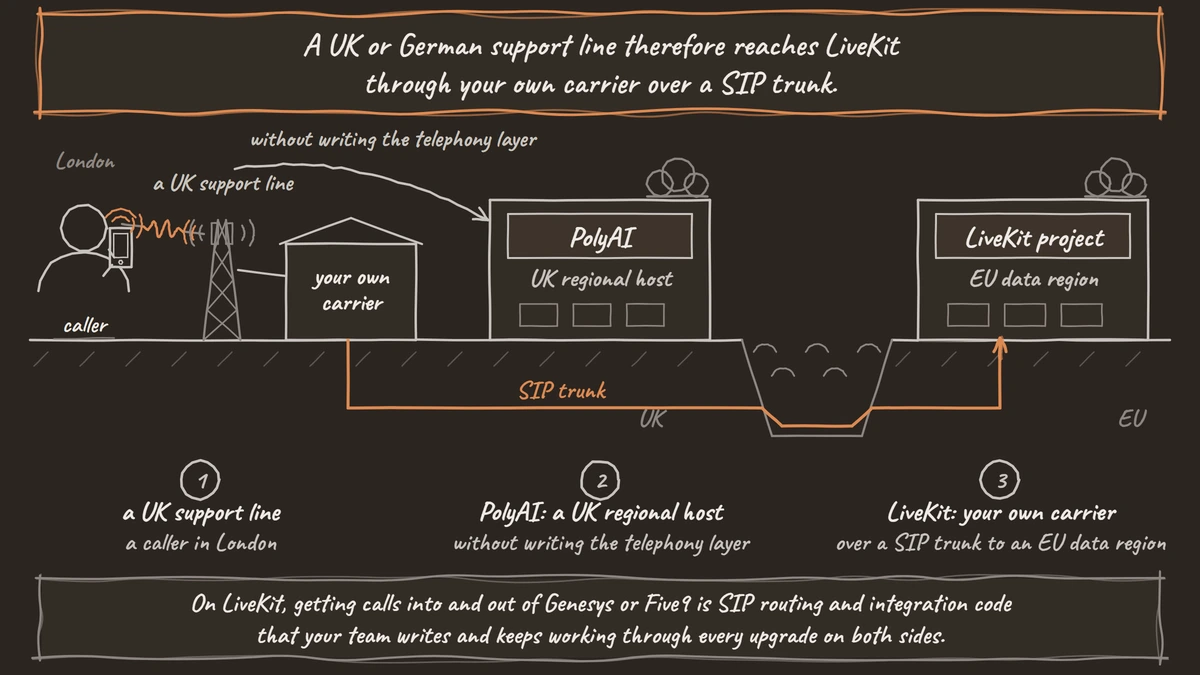
Contact-center connectors follow the same pattern. PolyAI's Enterprise plan lists NiCE CXone, Five9, Genesys Cloud, Webex Contact Center and Zoom, plus Epic and athenahealth for health systems. On LiveKit, getting calls into and out of Genesys or Five9 is SIP routing and integration code that your team writes and keeps working through every upgrade on both sides.
Raven or any model you wire in
PolyAI recommends Raven 3.5, its own model, for all deployments. Its model guide lists OpenAI and Amazon Bedrock models alongside it, plus a way to connect your own LLM endpoint. On the self-serve plans, the model and a standard voice are already inside the minute price, so there is no separate model bill to manage.
LiveKit leaves the choice open. Plugins cover the major speech-to-text, language model and voice providers, and LiveKit Inference on Cloud bills them per minute through one account. One example LiveKit Inference stack, GPT-5.4 mini with Deepgram Nova-3 and Cartesia Sonic 3, adds up to about $0.0378 a minute. Your engineers decide the trade between voice quality, speed and price on every call, and they can swap a provider without asking anyone.
What 4,000 inbound minutes cost
A priced month shows how differently the bills are built. Take an example of one support line on a US number, taking 4,000 inbound minutes a month. The PolyAI rows use PolyAI's published plans and the LiveKit row uses LiveKit Cloud's Ship plan.
| Option | 4,000 minutes | Still to add |
|---|---|---|
| PolyAI Essentials | $49 + 3,750 x $0.30 = $1,174 | Nothing for models or the standard voice, 5 calls at once |
| PolyAI Plus | $199 + 3,000 x $0.25 = $949 | Nothing for models or the standard voice |
| PolyAI Scale, one location | $299 + 2,500 x $0.20 = $799 | Nothing for models or the standard voice |
| PolyAI Platform | 4,000 x $0.095 = $380 | Your carrier's minutes |
| LiveKit Cloud Ship | $50 + 3,900 x $0.01 inbound = $89 | Models, about $151 on the example stack, and engineer time |
The rows are not like for like. PolyAI's plan rows already cover the model and a standard voice. LiveKit's $89 covers agent minutes, the number and inbound phone time, and with the example model stack it comes to about $240, before the engineers who build and run the agent. On a UK or EU line, LiveKit's phone row moves to your carrier's bill. At this volume PolyAI's Scale plan for one location comes out below Plus, and our breakdown of LiveKit pricing covers the Scale and self-hosting routes.
Join the Dograh Community
Dograh is an OSS alternative to Vapi. Join our Slack community for queries, releases, best practices & community interactions.
HIPAA, certifications and data regions
PolyAI lists ISO/IEC 27001, SOC 2 Type II, PCI-DSS, Cyber Essentials Plus and GDPR, and says its systems are designed to meet HIPAA where relevant. The self-serve plans leave out a BAA, single sign-on, PCI card capture and in-region data storage, which come only with the Enterprise tier.
LiveKit offers a signed BAA on its Scale and Enterprise plans, and Scale starts at $500 a month. Self-hosting the open code puts the media server and the agent on machines you control, but every model provider the agent calls still handles the audio or text and may need its own agreement. For a healthcare line on either platform, confirm the BAA, the region and who stores recordings before the first patient call.
Which one fits your support team
PolyAI fits a contact center with no voice engineering team, especially one outside the US or one already running Genesys, Five9 or NiCE. Small teams can start self-serve and build with Wren, multi-site teams can pool minutes on Scale, and large operations can hand the whole build to PolyAI on Enterprise.
LiveKit fits a company with engineers who want the agent as code, any model and the option to run it on their own servers. It suits a product team adding voice to what it sells more than a support team buying a finished agent, and it rewards teams that will keep a developer on the agent after launch.
Whichever you pick, run the pilot on the real number your customers dial, with your own accents, product names and account numbers, before you sign a volume commitment.
Where Dograh fits for open-source and on-prem teams
Some support teams want something between the two, a finished platform they can still run on their own servers. Dograh, the open-source AI voice agent platform under the BSD 2-Clause license, comes with the Agent Builder, a visual canvas, a Knowledge Base that takes PDF, DOCX, DOC, TXT and JSON files up to 5 MB each, and HTTP API tools that call your helpdesk or CRM during the call. Those are support pieces LiveKit leaves to code, and our guide to an open-source alternative to LiveKit compares the two in depth.
You pick the speech-to-text, LLM and voice provider for each agent, on your own keys or open models you host. Transfer Call brings in a person when the caller needs one, on Twilio, Telnyx, Plivo, Cloudonix and Asterisk ARI. Dograh calls the destination first and connects the caller only when someone answers, and a busy, failed or unanswered transfer comes back to the agent. Between agents, Transfer to Agent hands the caller over with a labeled transcript of the conversation so far.
Hosting decides where call data sits. You can self-host with Docker on at least 8 GB of RAM and 4 vCPUs in your own data center, use the managed cloud, or take on-prem deployment on Enterprise. With local models on your own servers, call audio stays inside your network, and a self-hosted install needs no BAA with Dograh, though each model provider you call may need its own. Teams that need data residency get it on Enterprise.
Self-hosted Dograh has no per-minute platform fee, but servers, model keys and phone minutes still cost money. Dograh Cloud charges a 1¢-a-minute platform fee, $40 for the 4,000-minute month above. Self-hosting puts the server, the database and the upgrades on your team, with community support on the open-source edition and custom SLAs on Enterprise.
Glossary
- ADK
- PolyAI's Agent Development Kit, a Python command-line tool for pulling an agent down, editing it locally and pushing it back. The agent still runs on PolyAI's cloud.
- SIP trunk
- A phone connection from a carrier into a voice platform over the internet. LiveKit uses one for any number outside its own US-only, inbound-only range.
- Data region
- The part of the world where a platform stores and processes a project's data. LiveKit offers an EU option at project creation, and PolyAI stores data in your region on Enterprise.
- Contact-center connector
- A built-in link to a contact-center platform such as Genesys Cloud or Five9, so calls and context pass between the AI agent and human queues.