
PolyAI suits customer-service teams that want a hosted phone agent on PolyAI's own models, now sold self-serve from $49 a month or built for you on Enterprise. The trade is closed code, PolyAI's cloud only, and a BAA, SSO and data residency held for Enterprise. Dograh, the open-source AI voice agent platform we build, runs self-hosted or on Dograh Cloud.
Key Takeaways
- Essentials costs $49 a month for 250 minutes and 5 calls at once.
- On self-serve plans you build with Wren. On Enterprise, PolyAI builds it.
- A HIPAA BAA, SSO and data residency come only with Enterprise.
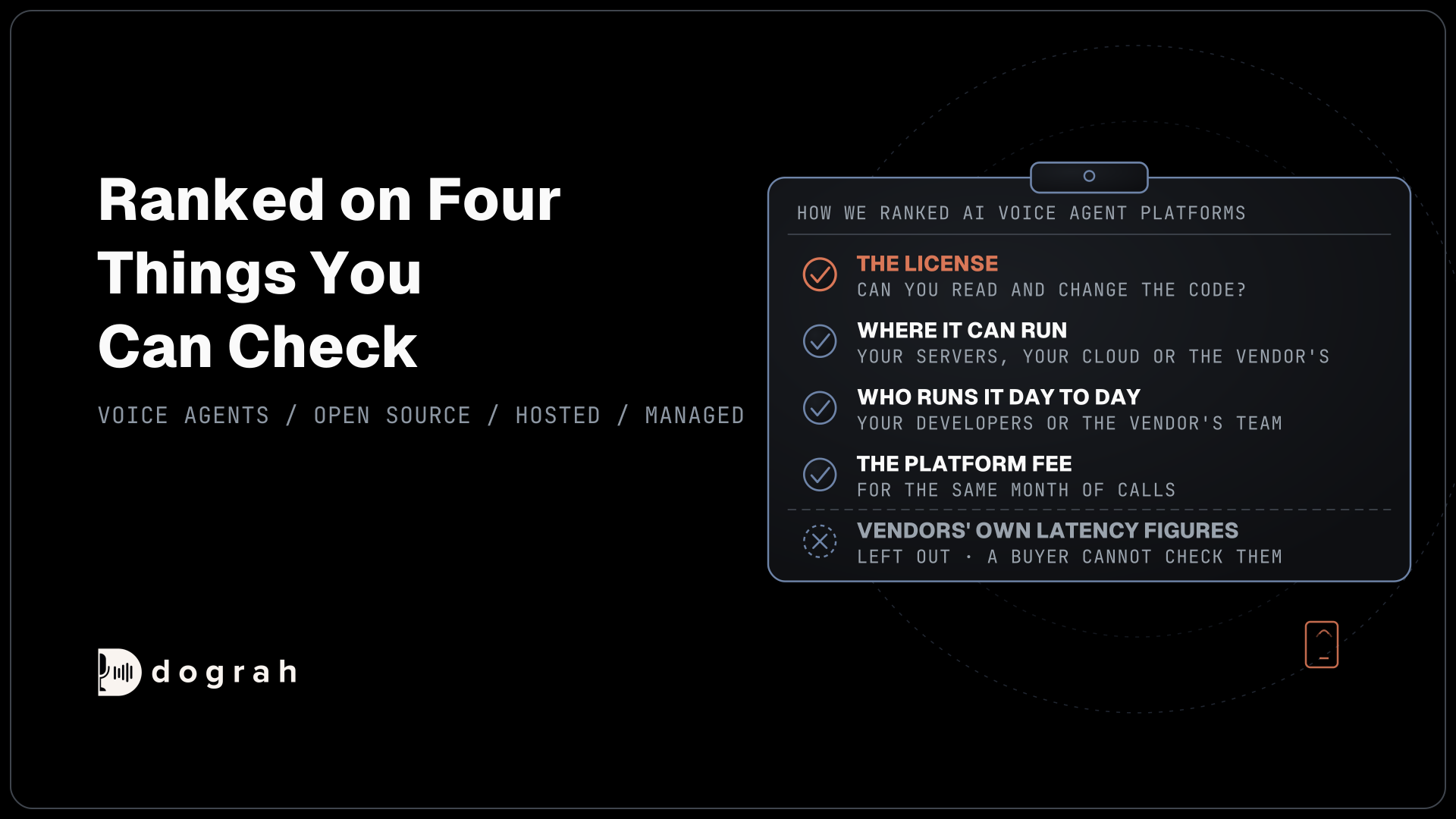
PolyAI spent years as an enterprise-only vendor, and its self-serve plans change who can buy it. We weigh the two ways to buy, what building with Wren involves, the models and compliance behind each plan, then who each plan fits. The last section covers Dograh for open-source and on-prem buyers.
PolyAI pros and cons at a glance
PolyAI's strengths are a model built for support calls and a clear path from a small plan to a managed contract, and its limits sit in what the small plans hold back and where it runs.
| Area | Strength | Limit |
|---|---|---|
| Price | Plans from $49 a month with minutes included | Enterprise pricing is custom |
| Who builds | You, with Wren, or PolyAI and partners on Enterprise | Self-serve agents are yours to build and maintain |
| Calls at once | 10 on Plus, 10 per location on Scale | 5 on Essentials |
| Models | Raven, built for customer service, plus OpenAI and Bedrock options | Every model choice runs inside PolyAI's cloud |
| Connectors | Calendars and Zapier on Essentials, CRMs from Plus | The wider set grows with the plan |
| Call review | A summary and a PolyScore on every call | The Wren AI Suite starts on Scale |
| Certificates | SOC 2 and ISO 27001 certified infrastructure on every plan | BAA, SSO and card capture on Enterprise |
| Data | Regional data storage on Enterprise | Hosted on PolyAI's cloud on every plan |
| Code | Managed for you | Closed platform |
Two ways to buy PolyAI
PolyAI now sells two quite different things, a self-serve plan you sign up for and a contract where the agent is built for you. Essentials costs $49 a month with 250 minutes, then 30¢ a minute. Plus costs $199 a month with 1,000 minutes, then 25¢. Scale costs $299 per location a month for one to nine locations, with 1,500 minutes per location pooled and 20¢ after that.
Each self-serve plan starts with a free trial, and minutes count connected time, never rounded up to the next minute. There is also a Platform route on pay as you go, from 9.5¢ a minute, and our PolyAI pricing explainer covers how that rate and the model API are built.
Enterprise is the older PolyAI. Pricing is custom and goes through sales, and PolyAI or a partner builds the agent for you. You also get a named account manager and 24/7 support.
The two routes suit different buyers more than different budgets. A single shop or clinic can try PolyAI for $49 without a sales call. A contact center with integration work and a security review still ends up in the Enterprise conversation, which is where PolyAI's earlier reputation came from.
Building it yourself with Wren
On the self-serve plans the agent is your job, and Wren is the help PolyAI gives you. PolyAI's own wording is that on Essentials, Plus and Scale "you build it yourself, with Wren to help you design, build and test". Wren is PolyAI's builder that you talk to in plain language, inside the wider Agent Studio platform.
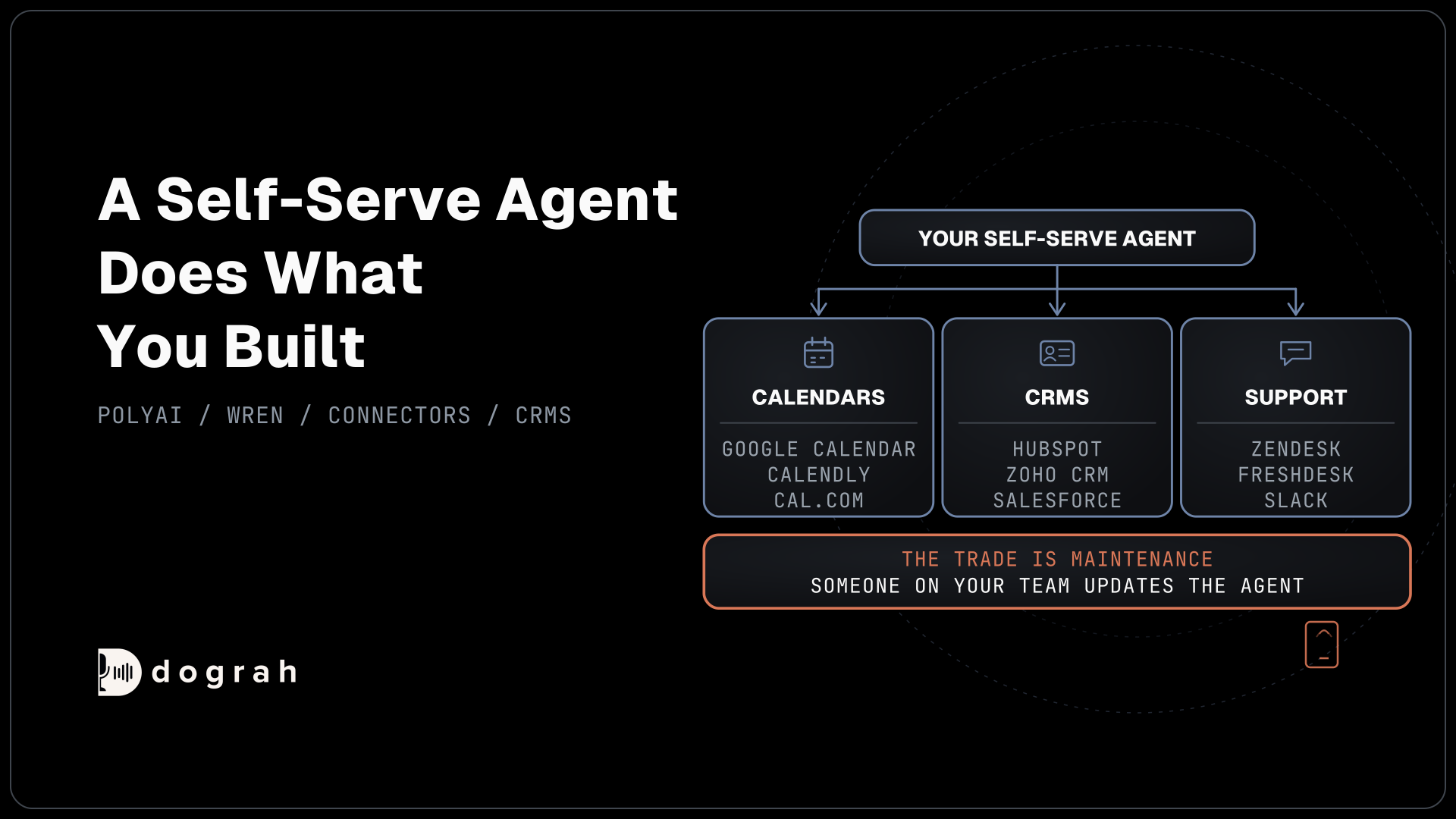
The connectors grow with the plan. Essentials connects to Google Calendar, Calendly, Cal.com and Zapier, which covers booking for a small business. Plus adds HubSpot, Zoho CRM, Dynamics 365, Microsoft 365, Google Drive and Google Sheets. Scale adds Salesforce, Zendesk, Freshdesk and Slack.
Review tools come with every plan. Each call gets a summary and a PolyScore, and Scale adds the Wren AI Suite, which reviews the agent, suggests improvements and lets you set custom AI scores.
The trade is maintenance. A self-serve agent does what you built, so when callers ask something new, someone on your team updates it. On Enterprise the opposite applies, since PolyAI or a partner owns the build, and every change you want goes through that team and its timeline.

Open Source Alternative to Vapi / Retell
Self-hosted voice agent platform — no per-minute fees
dograh-hq/dograh
Star on GitHub
The models behind a PolyAI agent
PolyAI runs its own models by default, which is a large part of what you buy. PolyAI's model guide names Raven 3.5 as the recommended model for all deployments. Raven is PolyAI's own language model, built for customer service calls.
You are not locked to it. The same guide lists OpenAI models, such as GPT-5.2 and the GPT-4.1 family, and Amazon Bedrock models, such as Claude Sonnet 4.6. You can also connect your own language model endpoint. On the Platform route, the per-minute rate includes PolyAI's Dialog-RSN-1 model.
For most support lines Raven is the point of buying PolyAI, since it is tuned for exactly those calls. A team that wants to run its own model on its own hardware will find that every model choice still runs inside PolyAI's cloud.
Compliance and where your call data sits
PolyAI's certificates are strong, but the plan you buy decides which of them reach your calls. Every plan runs on SOC 2 and ISO 27001 certified infrastructure. PolyAI's compliance page lists ISO 27001, SOC 2 Type II, Cyber Essentials Plus, GDPR and PCI DSS, and says its systems are designed to meet HIPAA where relevant.
The details that regulated buyers ask about sit on Enterprise. A business associate agreement (BAA) under the Health Insurance Portability and Accountability Act (HIPAA), single sign-on, PCI card capture, regional data storage and an uptime SLA are all listed there and not on the self-serve plans. So a clinic on Essentials cannot route patient calls under a BAA until it moves to Enterprise.
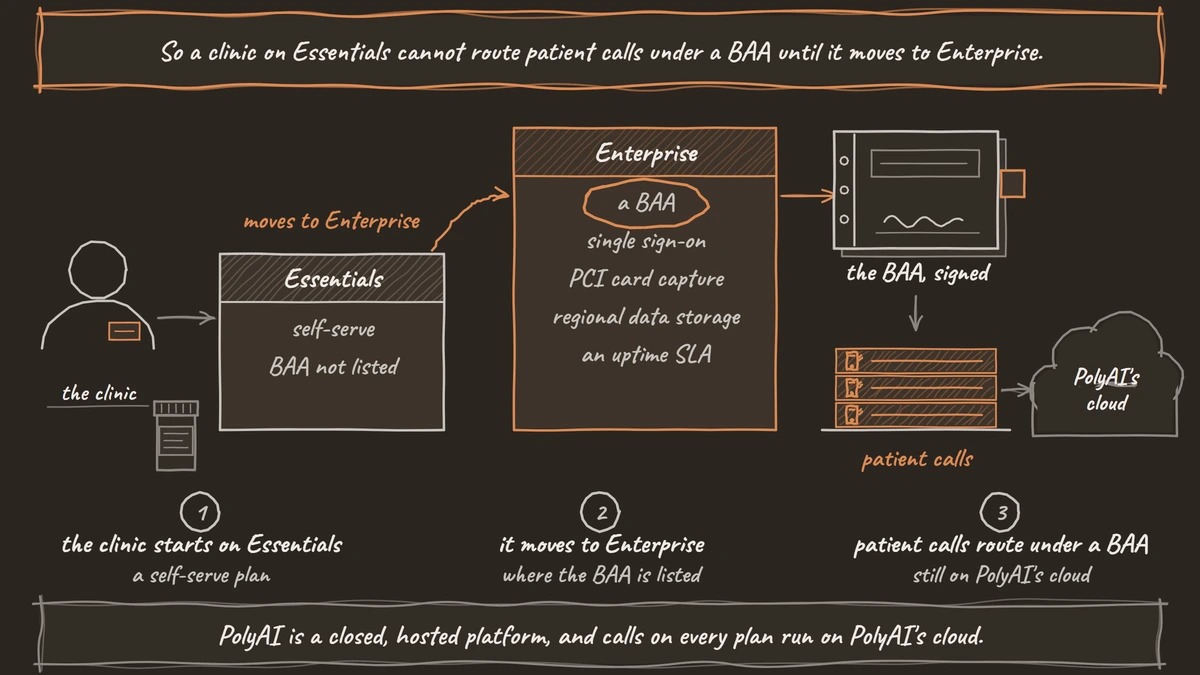
Where it runs does not change by plan. PolyAI is a closed, hosted platform, and calls on every plan run on PolyAI's cloud. Bringing your own model endpoint changes which model reasons over the call, while the audio still passes through PolyAI.
For many buyers that is fine. In healthcare and finance, though, sending call data to a third-party platform is often the thing a compliance team will not allow, and then the question becomes where the software runs, and the certificate list matters less.
Join the Dograh Community
Dograh is an OSS alternative to Vapi. Join our Slack community for queries, releases, best practices & community interactions.
Who PolyAI fits, by buyer
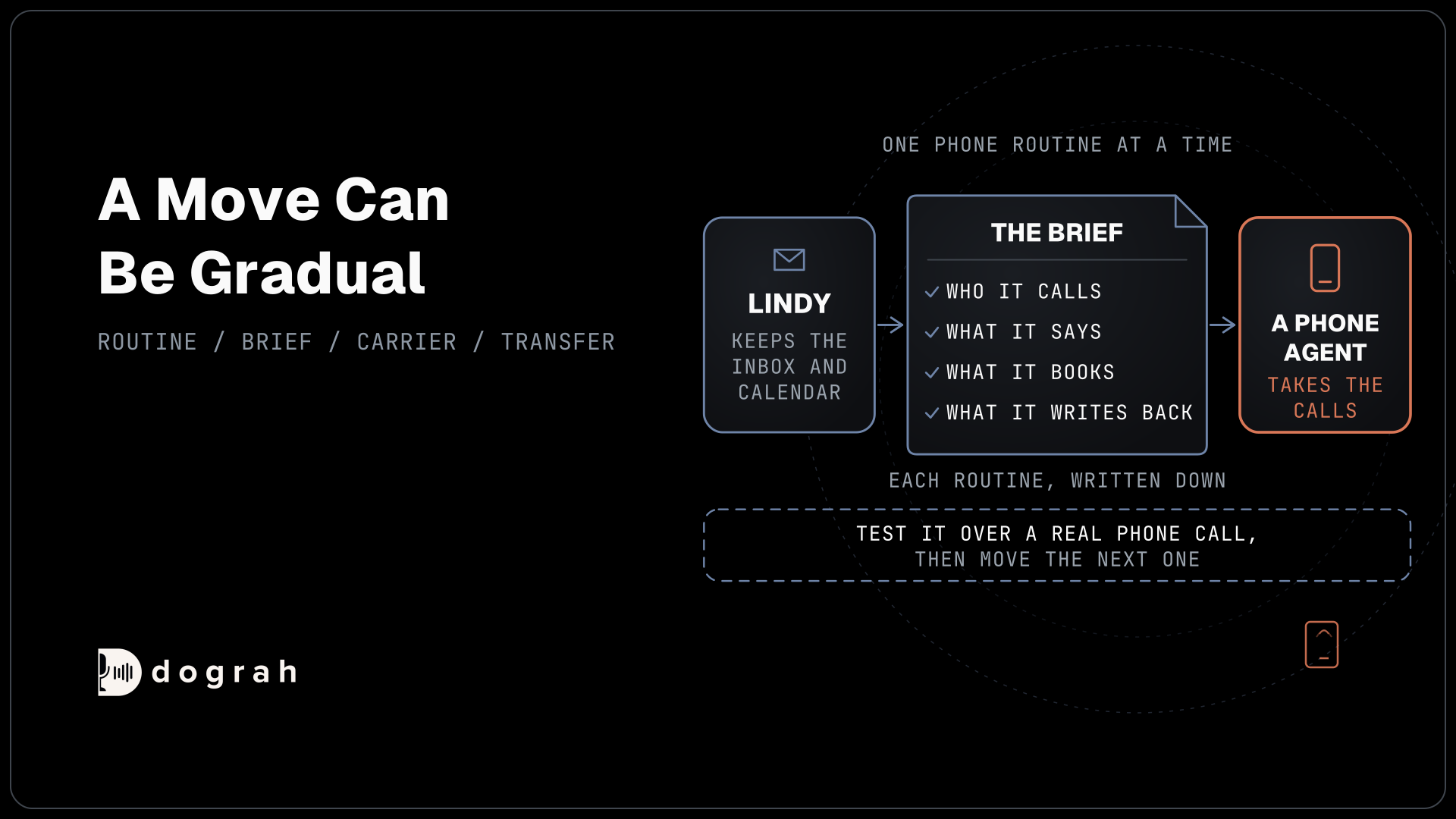
PolyAI now fits three kinds of buyer, each on a different plan. A single-site business that answers bookings and common questions fits Essentials or Plus, as long as 5 or 10 calls at once covers its busiest minute and it is happy to build the agent itself.
A business with several locations fits Scale. At $299 per location with minutes pooled across up to nine sites, a quiet branch's minutes cover a busy one, and each location adds 10 calls at once to a shared pool. Scale's extra connectors and the Wren AI Suite suit a team that reviews calls every week. A large contact center fits Enterprise, where PolyAI or a partner builds the agent and the BAA, SSO and data residency come with the contract.
PolyAI fits less well when you need patient calls covered before you are ready for Enterprise, when your security team needs the platform on your own servers, or when your engineers want to read and change the code. Whichever plan you pick, test the agent on a real phone number. Most phone calls still reach the agent as 8 kHz audio, while a browser demo runs at 16 kHz, so an agent that sounds right on a laptop can mishear callers on a real line.
Where Dograh fits
Dograh fits the buyer PolyAI does not serve, the one who needs the platform on its own servers with the code open. It is licensed under BSD 2-Clause, so you can read and change it, and you can self-host it with Docker in your own data center or cloud account. The Enterprise plan adds on-premise or private-cloud deployment with data residency and a data perimeter, and Dograh Cloud runs it for you.
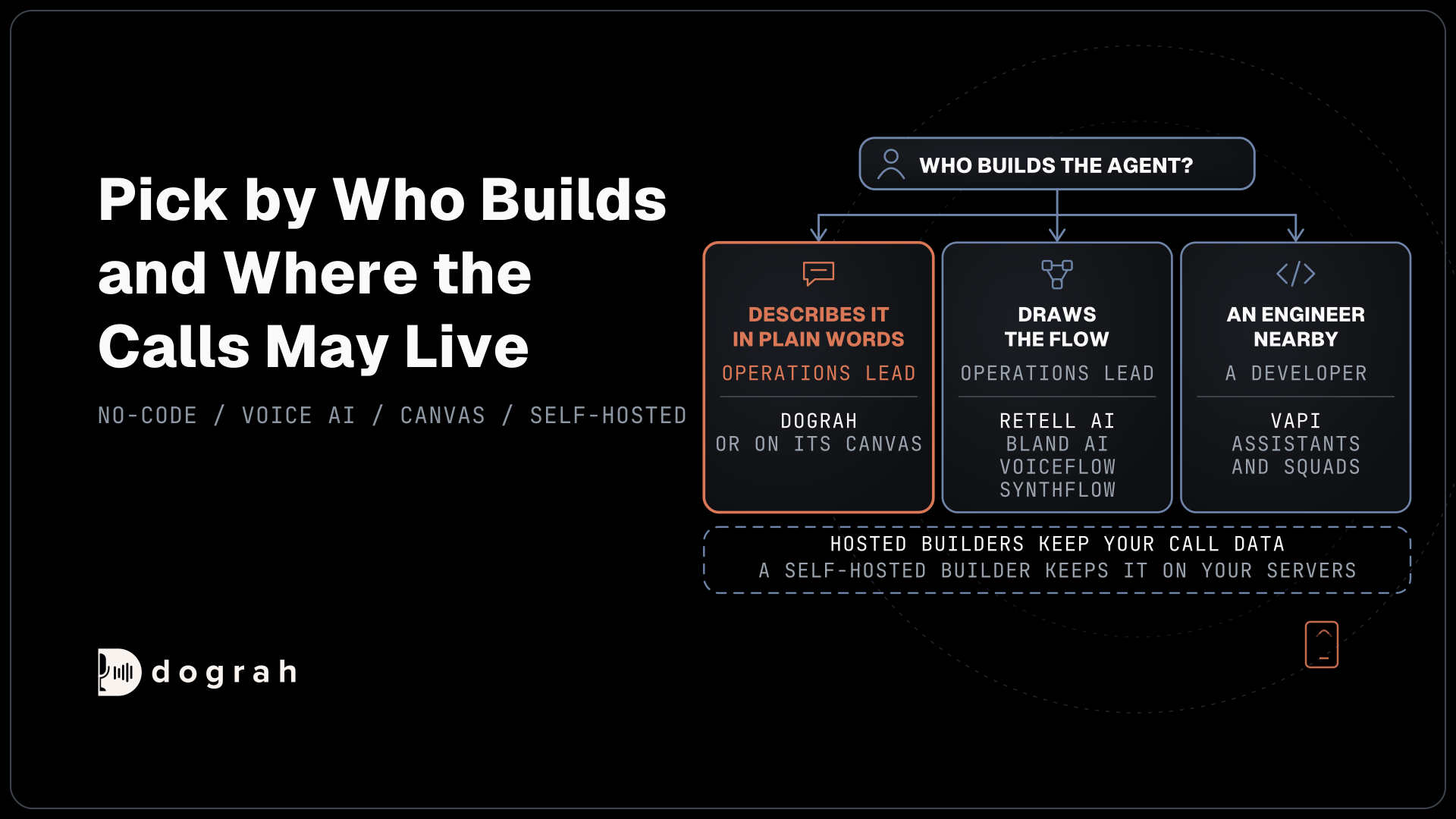
The self-build job that Wren does on PolyAI's plans is done by the Agent Builder in Dograh. On the "Create an agent" page you describe the agent, and the builder may ask a few questions before it shows a requirements card. You click "Approve & build", then "Test agent" publishes version 1, and later changes made in the Builder tab save as a draft until you publish them.
On cost, the self-hosted platform carries no per-minute fee of its own, while your servers, model keys and phone minutes still have to be paid for. Dograh Cloud bills a 1¢-a-minute platform fee instead. You pick the models, from our own to any provider on your key or open-weight models on your hardware, and our Dograh vs PolyAI comparison covers that difference from Raven in full. Owning the install means owning its upkeep. Your team runs the server and the database and applies each upgrade, with help from the community on Slack and GitHub on the open-source version and custom SLAs on Enterprise.
For patient calls, a self-hosted install needs no BAA with Dograh, because the calls never reach us. Model providers may need their own BAA, and the carrier may need one too, depending on what it stores. With open-weight models on your own servers too, no call audio leaves your infrastructure at all.
Every call can be checked the way PolyScore checks PolyAI calls. The QA step scores each step of test and live calls, and you set what share of calls it samples. When a score looks off, the call trace shows the speech-to-text, AI and voice time for every turn, so you can see which step slowed the call down. For hosted options as well as open ones, see our guide to PolyAI alternatives.
Glossary
- Wren
- PolyAI's plain-language builder inside Agent Studio. On the Essentials, Plus and Scale plans it helps your own team design, build and test the agent, and Scale adds the Wren AI Suite for review and custom scores.
- Pooled minutes
- Included minutes shared across several locations on one plan. PolyAI's Scale plan gives 1,500 minutes per location, pooled across up to nine sites, so a quiet location's minutes cover a busy one.
- PolyScore
- PolyAI's score attached to every call, alongside a call summary, on every plan, so a team can spot calls worth reviewing.
- Data residency
- A guarantee about which region a vendor stores call data in. PolyAI lists regional data storage on Enterprise only. On a self-hosted platform the answer is wherever your own servers sit.