
An outbound call center is a team that places calls to customers and prospects, for sales, collections, reminders and surveys, from contact lists and a dialer. AI agents place routine calls under the same consent rules. Dograh, the open-source AI voice agent platform, runs those calls as campaigns, with calling hours, pace and retries set for each list.
Key Takeaways
- The FCC treats an AI-generated voice as an artificial voice under robocall rules.
- Put AI on reminders and service calls before any sales calls.
- In Dograh Campaigns, you set the calling slots, pace and retries per list.
An outbound call center can be five people with headsets or a floor of hundreds, and the work is the same. We explain that work, the call types and the measures a manager reads, then we cover which calls AI should place first, the rules and how Dograh runs them.
What an outbound call center does
An outbound call center is the part of a business that starts the calls. In plain terms, it is a team working through contact lists with a dialer toward a campaign goal, such as a sale, a payment or a booked visit. The team can sit in-house, inside a sales or service department, or with an outsourcing provider.
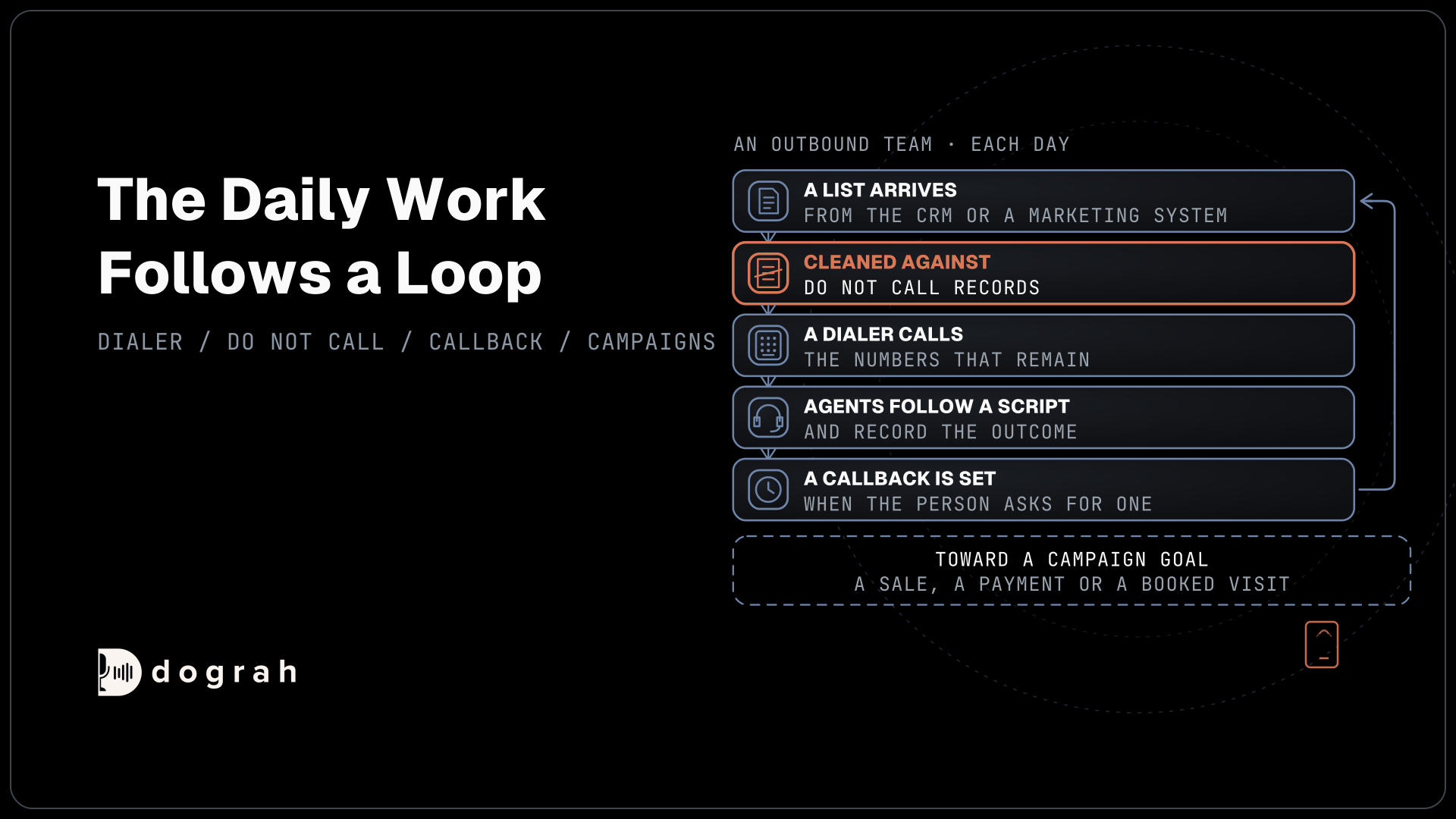
The daily work follows a loop. A list arrives from the CRM or a marketing system, it is cleaned against Do Not Call records, and a dialer calls the numbers that remain. Agents follow a script, record the outcome on each record and set a callback when the person asks for one.
The difference from an inbound team is who picks the moment. An inbound center waits for customers to call and is judged on how fast it answers, as our post on the inbound call center explains. An outbound center chooses when to call, so its results depend on the list, the hour and whether the person wanted the call at all.
The main types of outbound calls
Outbound calls fall into a few types, and whether a call sells something decides the consent you need before the first dial. Sales calls come to mind first. Telemarketing and telesales calls offer a product to a new prospect or a new plan to an existing customer, and they carry the strictest consent rules. Lead follow-up calls sit close by. They reach a person who asked for information through a form or an ad, while the interest is fresh.
Collections calls remind a customer about an overdue balance and agree a payment plan. They follow debt collection rules as well as calling rules, and good practice is to confirm you have the right person before the debt is named.
Service calls are the other large group. Appointment reminders, delivery and outage notices, renewal reminders and satisfaction surveys reach people who already do business with you. The person usually knows why you are calling, the call has one purpose, and the answer fits a short list of outcomes.
How outbound dialers work
A dialer decides how many numbers to call for each free agent, and that choice sets both speed and risk. Four modes cover most outbound teams. Preview dialing shows the agent the record first and lets them start the call, which suits complex accounts and large sales. Progressive dialing calls one number the moment an agent is free, so every answered call has a person ready. Power dialing calls a fixed number of lines per agent, such as two or three.
A predictive dialer goes further. It uses past answer rates to guess how many lines to dial so agents are rarely idle. It gets the most talk time per hour, and it is also the mode most likely to connect a person to silence, because more people answer than there are agents free.
That silence has a legal name. A call the person answers with nobody there is an abandoned call, and the rules cap how many a telemarketing campaign may have, as the rules section below explains. An AI agent does not take a campaign outside that rule. The test is a live representative, so a consented AI or recorded telemarketing call counts as not abandoned only if its message begins within two seconds of the person's completed greeting. What an agent removes is the guess about how many people will be free.

Open Source Alternative to Vapi / Retell
Self-hosted voice agent platform — no per-minute fees
dograh-hq/dograh
Star on GitHub
The measures an outbound manager reads
An outbound team is judged on reach first and results second. Connect rate is the share of dials that a person or a voicemail picks up, and contact rate is the share that reaches the right person. These two set the ceiling for everything else.
Reach has become harder. In Hiya's State of the Call 2026, a survey of more than 12,000 consumers in six countries, 86% said they do not answer calls from unknown numbers. A low connect rate on a cold list is normal, and a low rate on your own customers points at caller ID, timing or the list.
Conversion rate is the share of contacts that reach the campaign's goal, such as a booked visit, a payment or a finished survey. Average handle time is the minutes each call takes, after-call notes included, and our average handle time guide shows how to read it without rushing calls. Calls per agent per hour and occupancy show how busy the team is.
Abandon rate needs its own line, because for telemarketing it is a regulated number. Watch the share of people who ask not to be called again too. When it rises, the campaign is calling the wrong list or opening the call badly.
Which outbound calls AI should place first
AI should take the calls where the person expects to hear from you and the outcome fits one field in your system. Reminders, confirmations and service notices are the best start. The person gave you their number, the call has one purpose, and the answer is a yes, a no or a new time.
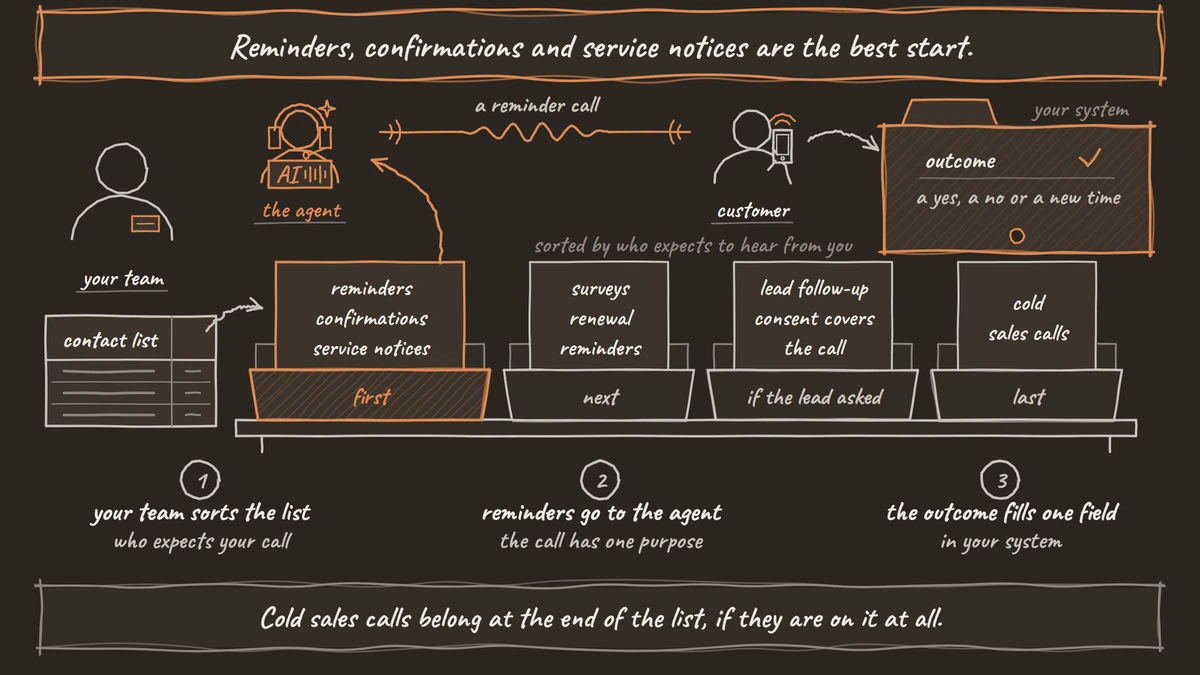
Surveys and renewal reminders come next, since they also follow a fixed set of questions. Lead follow-up works when the lead asked to be contacted and the consent covers the call. The agent asks every lead the same questions and hands the interested ones to a rep, so the rep's hour goes to people ready to talk. Collections can follow once the agent confirms it has the right person, with disputes and hardship cases going to people.
Cold sales calls belong at the end of the list, if they are on it at all. They need the strictest consent for an AI voice and the most care in the opening, and they hurt a brand most when the list is wrong. Our post on AI outbound calling covers use cases, costs and the opening line in more depth.
Contact leaders put outreach in the middle of their plans for now. In CMP Research's 2026-2027 benchmarking report, improving proactive outreach ranks 11th of 20 priorities, with customer analytics, self-service adoption and agentic AI at the top.
Consent, calling hours and Do Not Call
Four federal rules cover sales calls, and none of them relaxes for AI. Telephone solicitations to a home may not be placed before 8 a.m. or after 9 p.m. in the called person's local time. Numbers on the National Do Not Call Registry may not get telephone solicitations, and a registration does not expire. Calls with the person's signed written permission, calls within an established business relationship and calls by tax-exempt nonprofits fall outside that bar, and a person's request to stop calling ends the relationship exception for your business. Both rules sit in the FCC's telephone rules under the Telephone Consumer Protection Act (TCPA).
The same rules limit predictive dialing. A telemarketing campaign may abandon no more than 3% of the calls a person answers, measured over 30 days, and a call counts as abandoned when no live representative joins within two seconds of the person's completed greeting. An unanswered telemarketing call must ring for at least 15 seconds or four rings before the dialer disconnects it.
AI voices sit under the TCPA too. In its February 2024 ruling, the FCC said the TCPA's "artificial or prerecorded voice" covers AI technologies that generate human voices. A telemarketing call in an AI voice therefore needs the person's prior express written consent, and an informational call to a mobile needs prior express consent. The message names the business at the start and gives a number to call. On a sales call, an automated opt-out by voice or keypress must follow within two seconds of that identification, and using it adds the number to your do-not-call list and ends the call. A message left on voicemail also gives a toll-free number that reaches the same opt-out.
People notice when this goes wrong. The FTC's Do Not Call data book counted over 2.6 million Do Not Call complaints in its 2025 fiscal year. State rules on hours, call counts and opt-outs, and the FCC's newer changes to how people revoke consent, are in our post on outbound calling rules for voice agents. Calling rules differ by state and country, so confirm your own position with counsel.
Join the Dograh Community
Dograh is an OSS alternative to Vapi. Join our Slack community for queries, releases, best practices & community interactions.
Running outbound campaigns in Dograh, and where it runs
In Dograh, an outbound campaign is a contact list joined to a published agent and a telephony configuration, whose caller IDs rotate across calls. Under Campaigns, the Create New Campaign page asks for a Campaign Name, a Telephony Configuration, the agents under Agents & traffic split and a CSV File with a phone_number column. Every other column becomes context for that call, so a first name or an appointment date can fill the greeting and prompts. Our guide to outbound voice campaigns walks through list, pace, retries and voicemail in order.
The campaign settings hold the call limits and the calling hours. Max Concurrent Calls caps calls at once, up to the organization limit of 10 by default, and Calls Started per Second sets the pace. Max Retries (0 to 10, default 2), Retry Delay and Retry On set the retries, which fire only on a busy signal or no answer. A call that voicemail detection ends is not retried. Call Schedule stays off until you switch it on, and with no slots a started campaign dials continuously. Pick the Timezone and add Time Slots per weekday. One campaign runs in one time zone, so split a national list by zone, and keep limits on how often one person hears from you in your own list.
The Circuit Breaker pauses a campaign when too many calls inside a short window end in an AI pipeline error, such as a speech, model or voice failure. Busy lines, unanswered calls, carrier rejections and failed dials do not count toward it. When a person wants to talk to someone, Transfer Call works on Twilio, Telnyx, Plivo, Cloudonix and Asterisk ARI. Dograh calls the destination first and connects the caller only when someone answers, and if nobody does, the agent keeps the call. A voicemail that picks up counts as answered, so turn voicemail off on the transfer number or set it to pick up later than the Transfer Timeout. Each run keeps its transcript, recording and gathered details. Call dispositions, once you turn them on, give each call one outcome code, such as callback_requested or do_not_call. The code labels the call, so copy stop requests into your own do-not-call list and leave those numbers out of the next upload.
The code is open source under the BSD 2-Clause license, and a team that wants its campaigns on its own servers can self-host it with Docker Compose and pay no per-minute platform fee. The servers, model keys and phone minutes behind each campaign still cost money, and the database and upgrades become your team's job, with support from the open-source community and custom SLAs on Enterprise. On Dograh Cloud you pay a 1¢-a-minute platform fee, with model and phone usage on top. Start with one reminder campaign of a few hundred contacts, then read the outcome codes before you widen the list.
Glossary
- Predictive dialer
- A dialer that uses past answer rates to dial more lines than there are free agents, so agents rarely wait. It is the main source of abandoned calls.
- Abandoned call
- A telemarketing call the person answers with no live representative joining within two seconds of their completed greeting. US telemarketing campaigns may abandon no more than 3% over 30 days.
- Contact rate
- The share of dials that reach the right person, as opposed to connect rate, which also counts voicemail and wrong people picking up.
- Call disposition
- The outcome code recorded for each call once dispositions are turned on, such as callback_requested or do_not_call. It labels the call, and your team acts on it.