
Average handle time (AHT) is the average time a call takes from answer to the end of after-call work. AHT equals talk time plus hold time plus after-call work, divided by calls handled. Dograh, the open-source AI voice agent platform, can take routine calls off your team, which changes what the human team's AHT measures.
Key Takeaways
- AHT counts talk, hold and after-call work, never ring or queue time.
- A hard AHT target pushes agents to rush and cut callers off.
- Have a Dograh tool write caller details to your system before each transfer.
Average handle time is a call center number that is easy to quote and easy to misread. We start with the formula and a worked example, cover what counts and the common mistakes, explain why lower is not always better, then show how a Dograh agent cuts repeat questions.
The AHT formula and a worked example
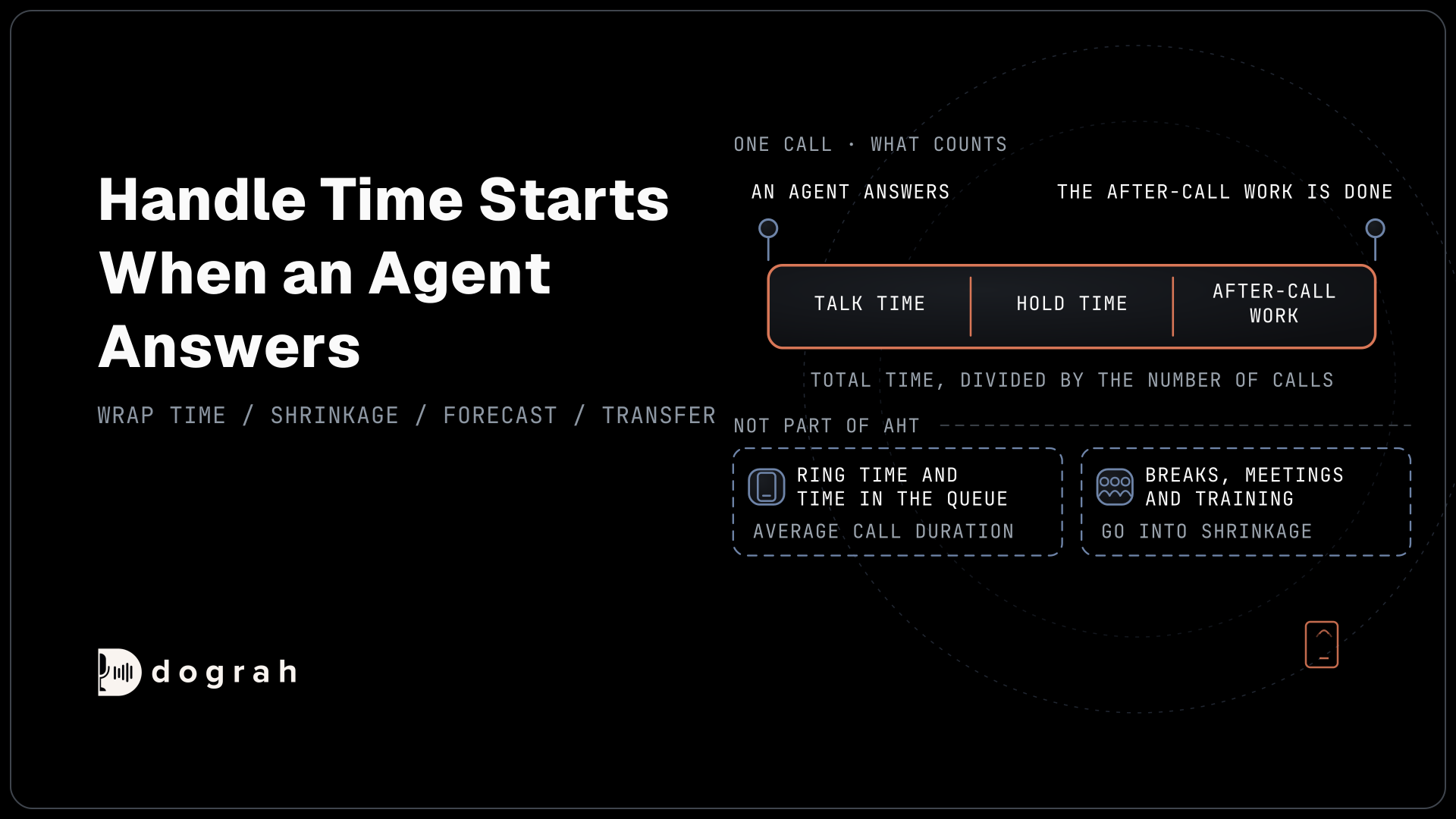
AHT is the total time agents spend handling calls, divided by the number of calls. As Call Centre Helper's guide sets it out, AHT = (total talk time + total hold time + total after-call work) ÷ calls handled. After-call work, also called wrap time, is the logging, notes and follow-up an agent does once the caller has gone.
Here is a worked example with round numbers. A support team handles 200 calls in a day. Agents spend 900 minutes talking, there are 100 minutes of hold time in total, and agents spend 200 minutes on after-call work. That is 1,200 minutes in all, and 1,200 ÷ 200 = 6 minutes AHT.
One call works the same way. A caller talks for 4 minutes, is held for 1 while the agent checks something, and the agent then spends 1 minute writing it up. That call's handle time is 6 minutes. Keep all three parts in the same unit, minutes or seconds, before you add them, since a mix of the two is a common way to get a silly result.
What counts in handle time and what does not
Handle time starts when an agent answers and ends when the after-call work is done. Ring time and time waiting in the queue are not part of AHT. They belong to average call duration, which measures the whole call from the caller's side, and to queue measures such as speed of answer, which our post on the inbound call center explains.
Breaks, team meetings, training and side projects are not part of AHT either. They go into shrinkage, the share of paid time when agents are not available for calls. Mixing them into AHT makes calls look longer than they are and hides where the time really went.
A transferred call has a handle time on each side. The first agent's time ends when the call leaves them, and the second agent's begins when they answer. Count both if you want the cost of the whole call, and each one separately if you want to see where it got stuck.
AHT is mostly a planning number. TechTarget's definition describes how workload equals call volume times AHT, which is how a team works out how many people it needs each half hour.
Common AHT mistakes
Most AHT mistakes come from counting the wrong time or reading the average as if every call were typical. Leaving hold time out is the first. If only talk and wrap count, holding callers becomes a quiet way to lower the number, and callers wait longer for it.
Wrap time can hide breaks. When after-call work has no limit, a few minutes between calls can become a pause that nobody records as a break. Look at wrap time per agent, and talk about the long ones before you set rules.
Comparing teams that take different calls is another trap. A billing line and a technical support line will never share an AHT, and neither will a team of new starters and a team of experienced agents. New agents usually take weeks or months to reach full speed, so judge them against their own progress.
Averages also hide the long tail. Most calls cluster below the average and a few run very long, so a small number of hard calls can move AHT on their own. Read the spread of call lengths, or at least the longest 10% of calls, beside the average.

Open Source Alternative to Vapi / Retell
Self-hosted voice agent platform — no per-minute fees
dograh-hq/dograh
Star on GitHub
Why lower AHT is not always better
A lower AHT is good only when the caller's issue is still solved. Call Centre Helper says using AHT as a personal target for agents is "normally deemed a 'bad thing'", because "It also tells you nothing about the outcome of a call". Agents under an AHT target rush callers, skip notes or transfer hard calls to get them off their own clock.
The cost shows up later. A call cut short often comes back as a second call, so the business pays for two calls instead of one and the customer is less happy. Call Centre Helper adds that companies that dropped AHT as an agent target often saw handle time rise at first, then first contact resolution improve. Our guide to first call resolution explains how to measure the second number.
Contact leaders already rank it lower. In CMP Research's 2026-2027 report, 56% of customer contact leaders rated AHT important or highly important, against 71% for first contact resolution and 80% for customer satisfaction.
For a reference point, MaxContact's 2025-26 UK survey of 300 contact center leaders, reported by IT Brief, put average handle time at 7.8 minutes, unchanged from the year before. MaxContact sells contact center software, and the figure covers UK centers of many kinds, so it says little about what your own calls should take.
What happens to AHT when AI takes the easy calls
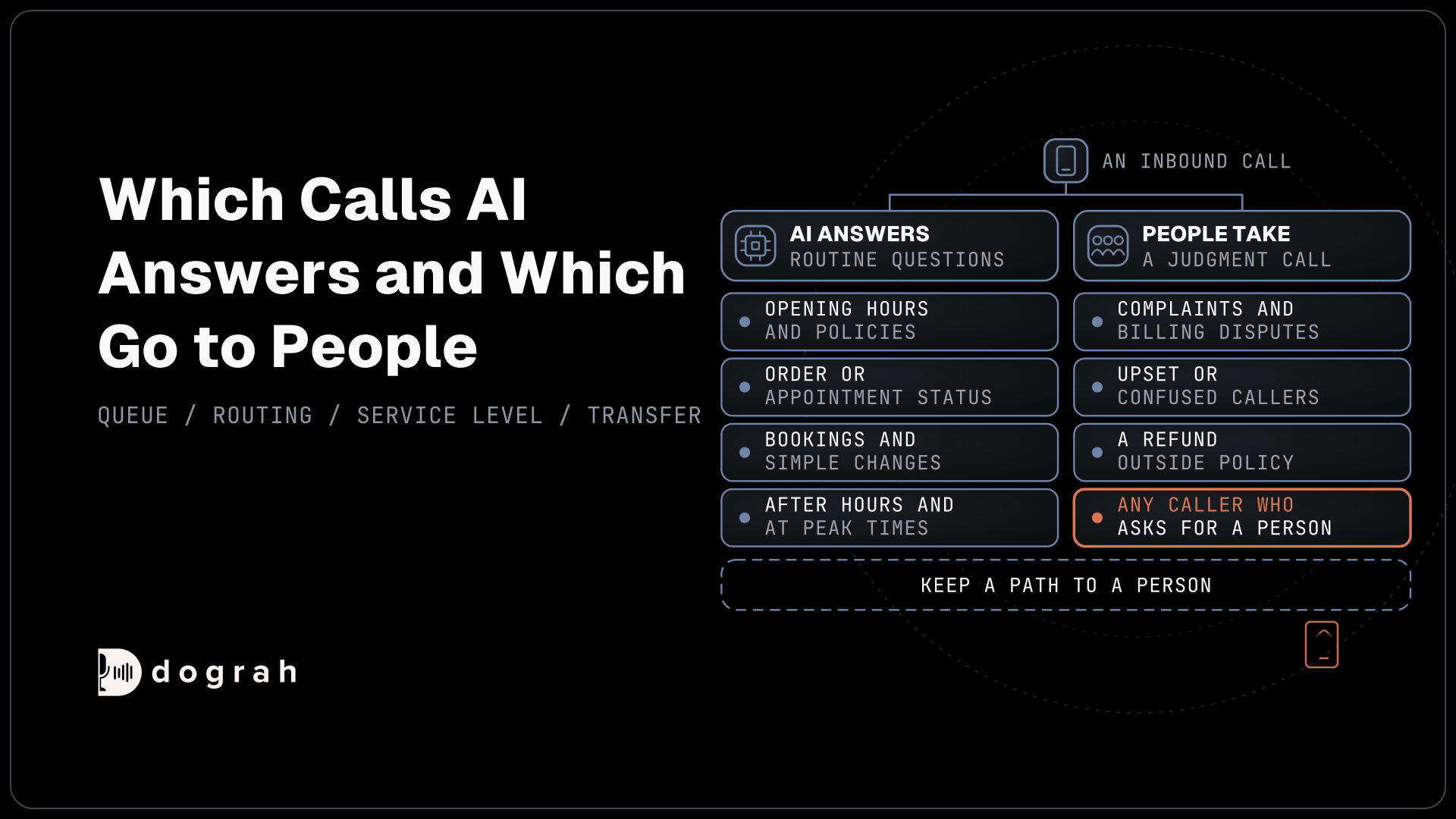
When an AI agent or a self-service option takes the short routine calls, the calls left for people are the longer ones. This mix effect can push the human team's AHT up even while customers wait less and more issues get solved. TechTarget notes the same pattern for self-service, which often raises AHT because it removes simple, short calls. CMP Research links rising front-line complexity to the automation of simpler contacts in the same way.
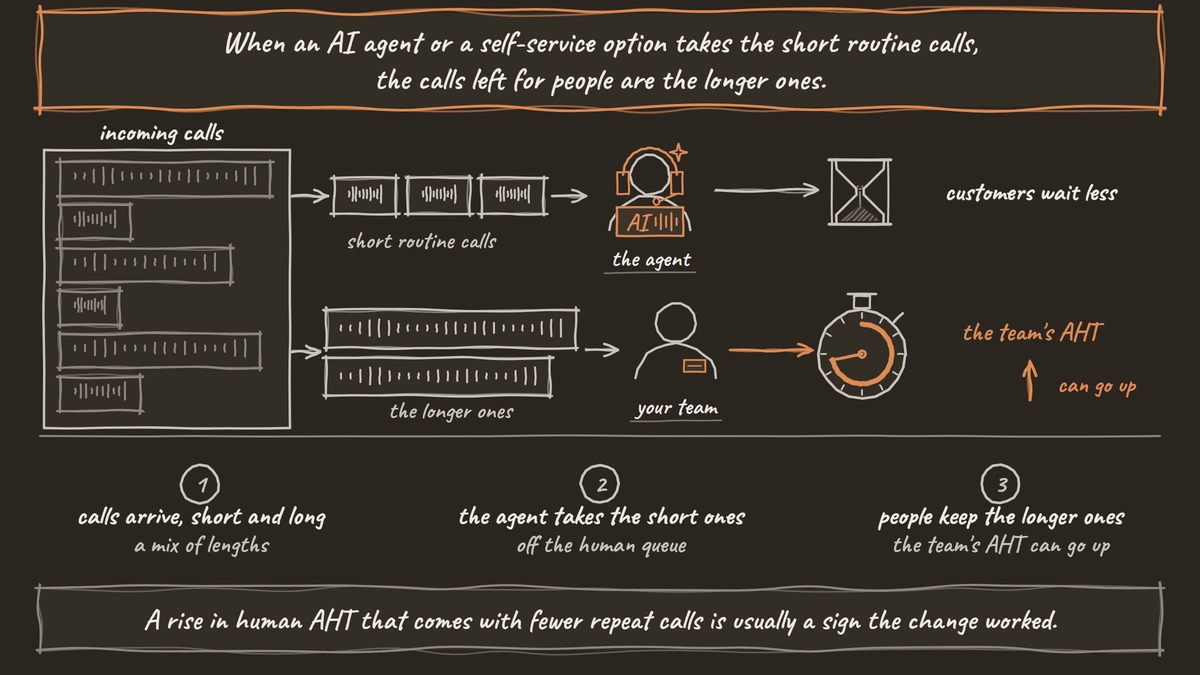
That is why AHT should never be read alone after a change like this. Read it beside resolution and the share of calls that came back. A rise in human AHT that comes with fewer repeat calls is usually a sign the change worked.
Staffing plans need the new number too. If the plan still assumes the old, shorter AHT, it will ask for too few people for the longer calls that remain, and the team will be short at the busy hours. Rebuild the forecast from a few weeks of calls after the change, with the AI agent's share taken out of the volume and the longer human calls left in.
The AI agent's own call length is a different measure. An agent has no hold time in the usual sense and no after-call work that takes a person's time, since its notes are written automatically during or right after the call. Compare its calls by duration and outcome, and keep AHT for the human team.
Join the Dograh Community
Dograh is an OSS alternative to Vapi. Join our Slack community for queries, releases, best practices & community interactions.
Cutting repeat questions with Dograh, and hosting
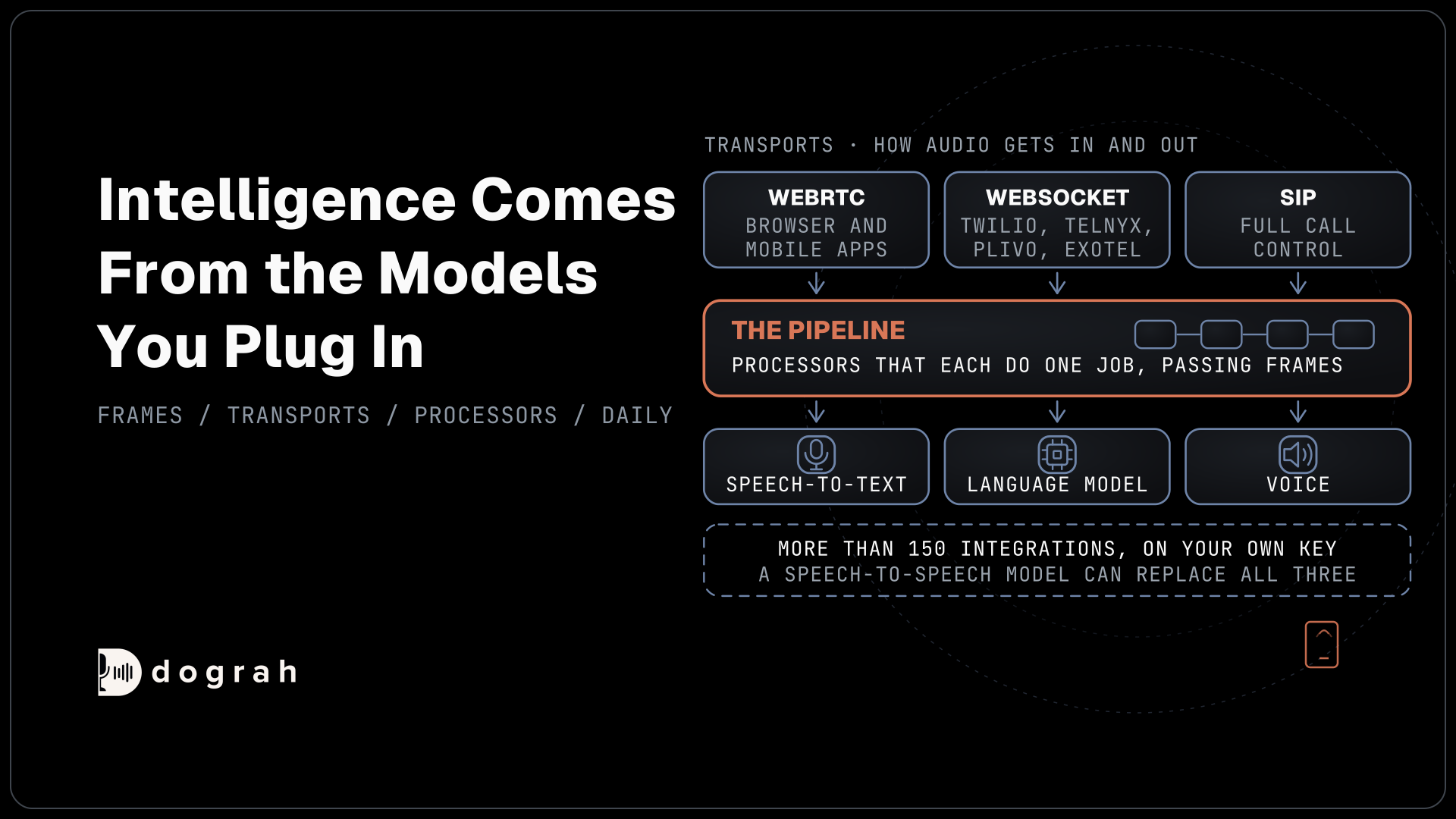
A Dograh agent takes routine calls off the human queue, and the details it gathers can be waiting for the person who takes a transfer. It answers from Knowledge Base files, such as policies and price lists, and from your own systems through HTTP API tools, such as an order lookup. While a lookup runs, the tool's Messages can play a short line as it starts and a further update if it runs long, so the caller is not left in silence.
Repeat questions start before the greeting. Pre-Call Data Fetch, at the bottom of the Start Call node, sends the caller's number to your endpoint and waits for the answer before the agent speaks, so the agent can greet a known customer by name and skip questions your system already answers. Our Pre-Call Data Fetch guide walks through the setup, and MCP tools can fetch data from other systems during the call.
When the call needs a person, the agent gathers the details first. An HTTP API tool can write the account number and the reason to your system, sent as the tool's own parameters, before Transfer Call runs. Variable extraction also records them, in the background as the agent moves between steps and again at call end. Dograh calls the destination first and connects the caller only when someone answers, with no summary passed by default, so the record on screen is what saves the second "can I take your account number". Our post on human handoff routing covers how to write those notes.
Each run records its duration, and once Langfuse tracing is set up, View Trace shows the speech-to-text, AI and voice time for every turn, which tells you where a long agent call spent its time. Those traces, with the transcript, prompts and tool data, are held in that Langfuse project, so they stay on your servers only when Langfuse is self-hosted too. The platform itself can be self-hosted with Docker Compose with no per-minute platform fee, while the servers, model keys and phone minutes still cost money and your team keeps the database and upgrades running. Dograh Cloud runs it for you at a 1¢-a-minute platform fee, with model and phone usage on top.
Glossary
- After-call work
- The notes, logging and follow-up an agent does after the caller has gone. It counts in AHT, and is also called wrap time.
- Average call duration
- The length of the whole call from the caller's side, ring and queue time included. It is a different number from AHT.
- Shrinkage
- The share of paid time when agents are not available for calls, such as breaks, meetings and training. It stays out of AHT.
- Mix effect
- The rise in a team's average handle time when automation takes the short calls, leaving people with a harder set of calls.