
First call resolution (FCR) is the share of issues solved on first contact, with no repeat call inside a set window. FCR equals issues resolved on first contact divided by all first contacts, times 100. Dograh, the open-source AI voice agent platform, can record each call's outcome so AI and human resolutions are counted apart.
Key Takeaways
- The repeat window and which calls count move your FCR more than effort does.
- Count calls the AI agent finished apart from calls people finished.
- Turn on Dograh dispositions and add a resolved code to count each call's outcome.
First call resolution sounds simple until two teams measure it and get very different numbers. We define it, work through the formula and its choices, compare three ways to measure it and what changes when an AI agent takes calls, then show how Dograh records and routes each outcome.
What first call resolution means
First call resolution means the customer's issue was solved on the first contact, and they did not need to call back about it. The customer's view is what counts. A call the agent closed as done, followed by the same customer calling two days later about the same problem, is not a first call resolution.
First contact resolution is the same idea across every channel. If a customer emails first and then calls, the call is the second contact. Teams that only count phone calls will report a higher number than teams that count every channel, so decide which one you mean before you compare.
A quiet ending is not proof either. A customer who says "no, that's all" may be satisfied, or may have given up. Salesforce makes the same point in its FCR guide, warning that silence or a short "no, thanks" does not show the issue was resolved. A firm definition says what resolved means for each call type, such as a booking confirmed, a refund issued or a question answered with nothing left to do.
The FCR formula, with an example
The formula is simple. FCR = issues resolved on the first contact ÷ all first contacts × 100. The choices behind the two numbers are where teams differ.
Here is a worked example, with round numbers for illustration. A support line takes 1,000 first calls in a month. Over the next 7 days, 280 of those customers call back about the same issue. That leaves 720 issues resolved on the first contact, so FCR is 720 ÷ 1,000 × 100 = 72%.
Now stretch the window to 30 days. Seventy more customers call back in the extra weeks, so 650 issues count as resolved and the same month reads 65%. Nothing about the work changed, only the counting. Pick one window per call type and keep it.
Other choices move the number too. Exclude calls that were never an issue to solve, such as wrong numbers and spam, or they inflate FCR. Decide how to count transfers, since a call that a second person solved is resolved for the team but not by the first person who took it. And decide what to do with a call that raised two issues and solved one, which most teams count as unresolved.
Three ways to measure it
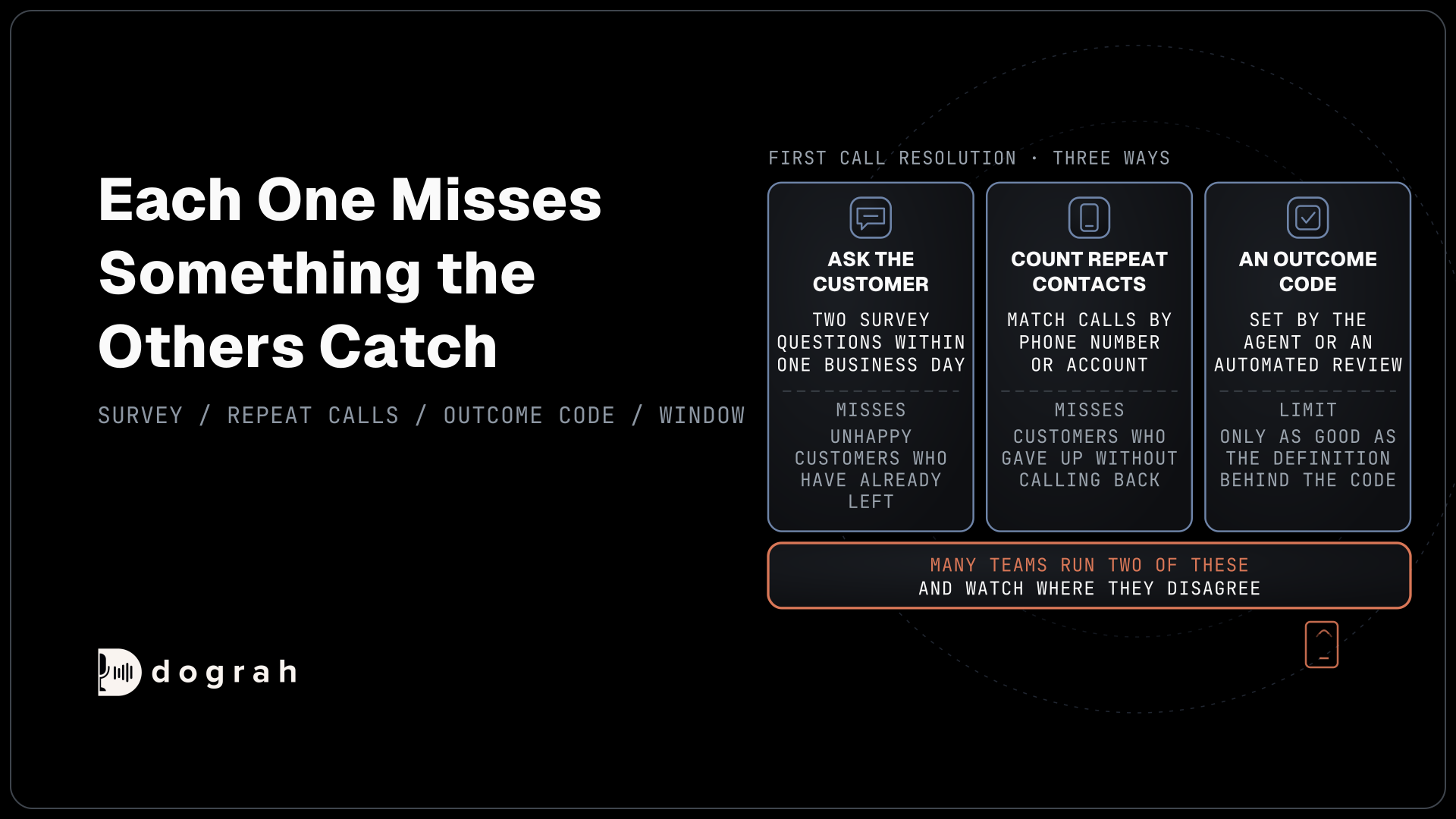
There are three common ways to measure FCR, and each misses something the others catch. The first is to ask the customer. SQM Group measures FCR with two survey questions asked within one business day of the call. A survey hears the customer's own view, which is the point. It also depends on who answers surveys, and unhappy customers who have already left rarely do.
The second is to count repeat contacts. Match calls by phone number or account, and count a first call as resolved when no repeat about the same issue arrives inside the repeat-contact window. It covers every call, needs no survey, and runs on data you already have. It misses customers who gave up without calling back, and it can count an unrelated later call as a repeat unless the reason is recorded.
The third is an outcome code on each call, set by the agent or by an automated review of the transcript, often checked by quality assurance. It gives a result for every call on the day, and it is only as good as the definition behind the code. Many teams run two of these and watch where they disagree.

Open Source Alternative to Vapi / Retell
Self-hosted voice agent platform — no per-minute fees
dograh-hq/dograh
Star on GitHub
Why FCR benchmarks disagree
Published FCR figures vary widely, and the way each one is measured explains much of the gap. In MaxContact's 2025-26 UK survey of 300 contact center leaders, reported by IT Brief, average first call resolution was 40.9%, close to 41% the year before. MaxContact sells contact center software, and the report does not say how each center defined FCR.
Survey-based benchmarks of inbound service lines, such as SQM Group's, run much higher. Neither kind of figure is wrong. A survey-based number, a repeat-call number with a 7-day window and an agent's own closing code will give three different results for the same calls. Compare your FCR with your own past months, using one fixed definition, before you compare it with anyone else's.
Leaders still rank it near the top. In CMP Research's 2026-2027 report, 71% of customer contact leaders rated first contact resolution important or highly important, second only to customer satisfaction at 80%.
How to improve first call resolution
Improving FCR starts with the calls that came back. Read a sample of repeat calls each week and write down why the first call failed. The reasons usually cluster around a handful of causes, such as an answer the agent did not have or a callback that was promised and never came.
Fix the causes in that order. Give agents, human or AI, the account data and the written answers they need during the call, so they are not guessing. Give them the authority to finish common jobs, such as a small refund or a rebooking, without passing the call on. Route calls to the team that can finish them, which is often the same fix as cutting transfers.
When a call cannot be finished, own the next step. Record who will call back, by when, and what they will do, and measure whether it happened. Do not push for FCR by shortening calls or hurrying customers off the line. FCR and average handle time pull against each other when either becomes a target, and the customer feels it first.
What changes when an AI agent takes calls
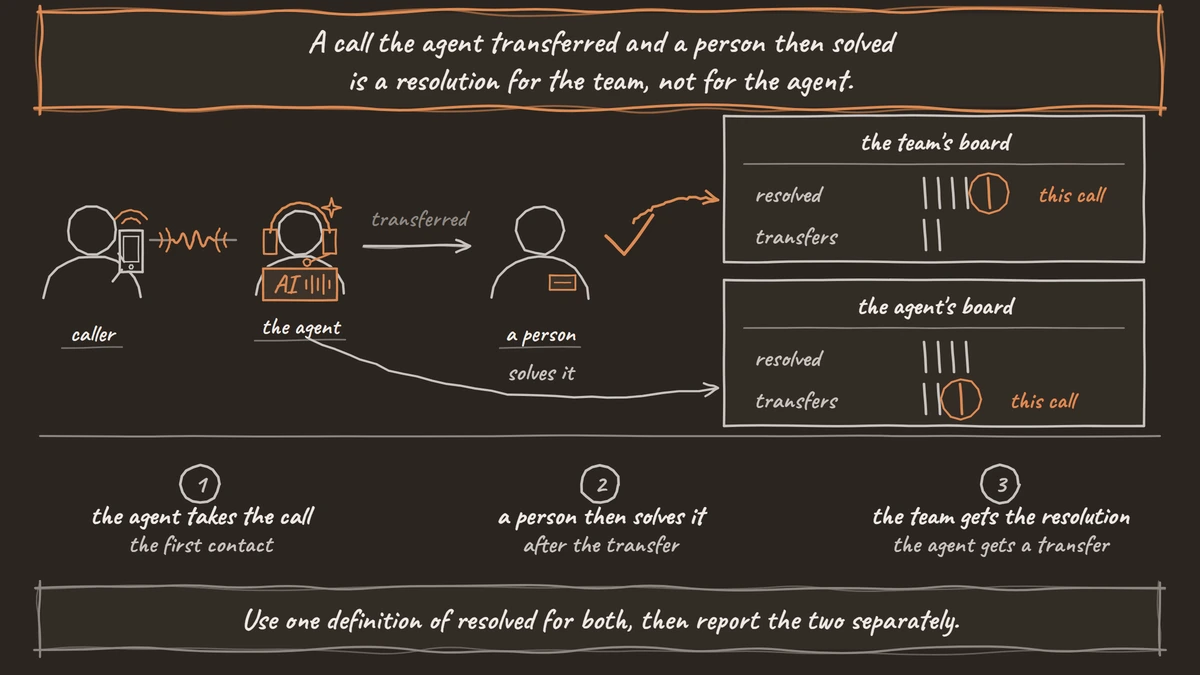
An AI agent adds a second kind of first contact, so the counting has to cover both. The COPC CX Standard asks operations to "apply the same performance standards to every interaction, whether handled by a person or a bot". Use one definition of resolved for both, then report the two separately.
That split used to be hard. CMP Research notes that "historically, few organizations were able to successfully parse resolution rate by live-service versus self-service contacts". When each AI call carries its own outcome code, the split is simple to read.
A call the agent transferred and a person then solved is a resolution for the team, not for the agent. Count it as a transfer on the agent's side. Expect the human team's FCR to move as well. When the agent takes the simple calls, people get a harder mix, and their rate can fall even while customers are better served. Our post on tier-1 call deflection covers how to count the calls an agent finished on its own, often called containment.
Join the Dograh Community
Dograh is an OSS alternative to Vapi. Join our Slack community for queries, releases, best practices & community interactions.
Recording resolution in Dograh, and where it runs
Dograh can record whether each call was resolved in three ways. Call dispositions, turned on in the agent's Settings, General with "Extract call disposition at the end of the call", let you add custom codes such as resolved and follow_up_required with a plain description of each, and the model picks exactly one per call. A boolean variable such as issue_resolved in an agent step's variable extraction does the same job inside the flow. A resolved field added to the QA step's prompt gives a second AI reading, returned once for each step of the call, which our guide to AI call center QA software covers.
Each of these is an AI judgment from the transcript, so the transcript and recording stay the exact record. When the agent cannot finish, Transfer Call on Twilio, Telnyx, Plivo, Cloudonix or Asterisk ARI hands the call to people. Dograh calls the destination first and connects the caller only when someone answers. A code set by the transfer tool is kept, and transfers mapped to XFER show on the Transfer Dispositions card in Reports.
Repeat calls are counted by phone number. Each inbound run stores the caller's number, and the call list can be filtered by Caller Number, while the report CSV's Phone Number column is filled for outbound calls. Pre-Call Data Fetch sends the caller's number to your endpoint before the greeting, so your own system can match repeats inside your window and flag a recent earlier call. A Webhook node sends the outcome code to your CRM after each call. Our post on how to measure voice-agent quality walks through the reports.
Where the records live depends on where Dograh runs. On your own install, transcripts, codes and reports stay on your servers. You can self-host it with Docker Compose with no per-minute platform fee, though servers, model keys and phone minutes still cost money and your team looks after the database and upgrades. Dograh Cloud takes the hosting off your hands for a 1¢-a-minute platform fee, and models and phone minutes come on top.
Glossary
- Repeat-contact window
- The number of days after a first call during which a call about the same issue counts as a repeat. A longer window gives a lower FCR.
- First contact resolution
- FCR counted across every channel, so an email followed by a call makes the call a second contact.
- Call disposition
- The outcome code recorded for each call, such as resolved or follow_up_required, which turns FCR into a number you can count per call.
- Containment
- The share of calls an AI agent finished without a transfer to a person. It is not the same as resolution, because a contained call can still come back.